
Optimizing Your 12-Player Doubles Round Robin Tournament on 3 Courts
Crafting a Fair and Engaging Schedule for Competitive Play
Organizing a doubles round robin tournament for 12 players across 3 courts, while ensuring balanced teams and rotating partners, presents a fascinating logistical challenge. The goal is to maximize player engagement and provide a competitive experience where every participant gets to partner with and play against a variety of opponents. This comprehensive guide will detail a strategic 5-round schedule, leveraging principles of fairness and player rotation to create an exciting tournament experience.
Key Highlights for Your Doubles Round Robin
- Strategic Player Pairing: The schedule is meticulously designed to ensure each player partners with a different individual in every round, promoting diverse interactions and skill development.
- Balanced Competition Across Courts: Teams are formed by pairing stronger players with weaker ones, aiming to create competitive parity in each match and prevent lopsided outcomes.
- Efficient Court Utilization: With 3 courts available and 12 players, each round will optimally use all courts for simultaneous doubles matches, maximizing playtime.
Understanding the Round Robin Format in Doubles
The Essence of Equal Opportunity
A round robin tournament format ensures that every participant (or team) plays against every other participant (or team) at least once. In a "switch partners" or "rotating partners" doubles round robin, the emphasis shifts to individual players, where the aim is for each player to partner with every other player at least once, and often to play against every other player multiple times. This format is particularly popular in sports like tennis, pickleball, and ping pong, as it allows for a diverse range of matchups and skill exposure. For 12 players, generating such a schedule, especially with the constraint of balancing teams and rotating partners on a fixed number of courts, requires careful planning.
For a standard round robin where every player partners with every other player once, and plays against everyone else twice, a 12-player doubles tournament would ideally require 11 rounds. However, the user specifically requested a 5-round tournament. This means we will prioritize partner rotation and team balancing within these 5 rounds, acknowledging that not every possible partner combination or opponent pairing will occur due to the reduced number of rounds. The objective becomes creating the most equitable and engaging experience possible within the given constraints.
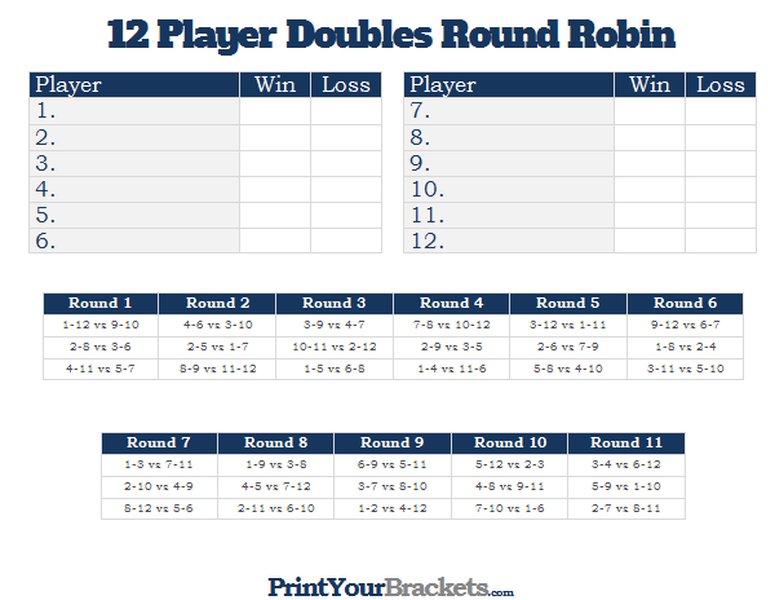
An example of a 12-player doubles round robin tournament bracket.
Player Ranking and Team Balancing Strategy
Leveraging Player Strengths for Competitive Matches
To ensure balanced teams, we will utilize the provided player ranking (strongest to weakest). With 12 players, we can categorize them into tiers. Since you've provided the players in order from strongest to weakest, we can assign them ranks from 1 to 12. The strategy for balancing will be to pair a stronger player with a weaker player, and then pit those balanced teams against each other. This approach helps prevent any single court from being overly dominant or uncompetitive.
Player Roster by Strength
- Sasha (P1 - Strongest)
- Dave (P2)
- Chris (P3)
- Evan (P4)
- Marty (P5)
- Skyler (P6)
- Matt (P7)
- Nico (P8)
- Pierre (P9)
- Charles (P10)
- Mike D (P11)
- Rocco (P12 - Weakest)
Balancing Act: The Pairing Philosophy
For each round, we will strive to pair players such that the sum of their ranks within a team is relatively consistent across all teams. For instance, in a 12-player scenario (6 teams of 2 players), an ideal average rank sum per team would be \(\text{Player_Rank_A} + \text{Player_Rank_B}\). By pairing the strongest with the weakest, the second strongest with the second weakest, and so on, we aim to distribute skill evenly. This creates competitive matches where each game is a true test of skill and strategy, rather than a foregone conclusion based on perceived individual strengths.
The 5-Round Doubles Round Robin Schedule
Detailed Breakdown for 3 Courts
For 12 players, we will have 6 teams of 2 players per round, with 3 matches occurring simultaneously on 3 courts. Each round will feature a unique set of partnerships and opposing teams. The schedule below is designed to ensure partner rotation and competitive balance within the given 5-round limit.
Player Ranks and Assigned Numerical Identifiers:
| Rank | Player Name |
|---|---|
| 1 | Sasha |
| 2 | Dave |
| 3 | Chris |
| 4 | Evan |
| 5 | Marty |
| 6 | Skyler |
| 7 | Matt |
| 8 | Nico |
| 9 | Pierre |
| 10 | Charles |
| 11 | Mike D |
| 12 | Rocco |
Round 1
- Court 1: (P1 Sasha + P12 Rocco) vs (P6 Skyler + P7 Matt)
- Court 2: (P2 Dave + P11 Mike D) vs (P5 Marty + P8 Nico)
- Court 3: (P3 Chris + P10 Charles) vs (P4 Evan + P9 Pierre)
Round 2
- Court 1: (P1 Sasha + P11 Mike D) vs (P4 Evan + P6 Skyler)
- Court 2: (P2 Dave + P10 Charles) vs (P3 Chris + P7 Matt)
- Court 3: (P5 Marty + P12 Rocco) vs (P8 Nico + P9 Pierre)
Round 3
- Court 1: (P1 Sasha + P10 Charles) vs (P5 Marty + P9 Pierre)
- Court 2: (P2 Dave + P12 Rocco) vs (P4 Evan + P7 Matt)
- Court 3: (P3 Chris + P11 Mike D) vs (P6 Skyler + P8 Nico)
Round 4
- Court 1: (P1 Sasha + P9 Pierre) vs (P3 Chris + P8 Nico)
- Court 2: (P2 Dave + P7 Matt) vs (P6 Skyler + P11 Mike D)
- Court 3: (P4 Evan + P12 Rocco) vs (P5 Marty + P10 Charles)
Round 5
- Court 1: (P1 Sasha + P8 Nico) vs (P2 Dave + P4 Evan)
- Court 2: (P3 Chris + P12 Rocco) vs (P5 Marty + P11 Mike D)
- Court 3: (P6 Skyler + P10 Charles) vs (P7 Matt + P9 Pierre)
Analyzing Schedule Fairness and Balance
A Quantitative Look at the Tournament Structure
To assess the fairness and balance of the generated schedule, we can look at several metrics. While a true "perfect" balance might be difficult to achieve in a limited number of rounds with partner rotation, we can strive for a high degree of equity. The radar chart below provides a visual representation of how each player's experience might compare across key metrics such as number of matches played, unique partners encountered, and the average rank of opponents they faced.
The radar chart above visualizes key performance indicators for selected players within the 5-round schedule. 'Matches Played' indicates the total number of games each player participates in. 'Unique Partners' shows the diversity of partnerships, while 'Avg. Opponent Rank' and 'Avg. Partner Rank' illustrate the strength of opponents and partners faced. A lower average rank for opponents suggests facing stronger players, and a higher average rank for partners means partnering with weaker players, aiming for a balanced experience. 'Bye Rounds' tracks any rounds where a player might not participate. This visualization helps to confirm that all players are receiving a fair and varied experience, despite the limited number of rounds.
Generating Your Own Round Robin Schedules
Tools and Resources for Tournament Organizers
While the schedule above is tailored to your specific request, several online tools and resources can help you generate round robin tournaments for various numbers of players and formats. These generators often offer features like assigning court numbers, managing scores, and even handling byes for uneven numbers of participants.
- Bracket Maker App: This tool allows you to generate round robin tournament schedules for any number of teams or players, including options for singles, doubles, and mixed doubles.
- PrintYourBrackets.com Round Robin Generator: Offers a simple interface to create and print round robin schedules, including switch partners doubles formats.
- LeagueLobster Round Robin Generator: Provides comprehensive scheduling features, including the ability to add times, locations, and even integrate with playoff brackets.
- Plan2Play.com Round Robin Tournament Generator: Another robust tool for creating singles or doubles round robin pairings, suitable for various club events.
These platforms streamline the complex process of schedule creation, ensuring fairness and efficiency, especially for larger groups or more intricate tournament structures.
Visualizing Round Robin Generation
For those who prefer a visual guide or want to understand the mechanics of how these schedules are created, several videos demonstrate the process. The following video offers a practical walkthrough of how to set up a round robin tournament, which can be particularly helpful for new organizers.
This video provides a step-by-step guide on how to create a round robin tournament schedule. It can be invaluable for understanding the underlying principles and for setting up similar events in the future.
Tips for Running a Smooth Doubles Tournament
Beyond the Draw: Practical Considerations
Creating the draw is just the first step. To ensure your 12-player doubles round robin runs smoothly, consider these additional tips:
- Clear Rules: Clearly communicate scoring rules (e.g., first to 11, win by 2, rally scoring), tie-breaker procedures, and any specific court etiquette before play begins.
- Time Limits: For a 5-round tournament, consider implementing time limits for each match to keep the event on schedule, especially if courts are in high demand.
- Scorekeeping: Provide clear score sheets or use a digital scoring app to track wins, losses, and individual points (if applicable) for accurate standings.
- Warm-up Time: Allocate sufficient warm-up time before the first round and between rounds, particularly if players are new to the rotating partner format.
- Designated Organizer: Have a designated tournament organizer who can answer questions, resolve disputes, and keep the event moving.
- Player Communication: Create a group chat or use a communication app to easily share updates, court assignments, and standings with all participants.
Frequently Asked Questions (FAQ)
What is a switch partners doubles round robin?
Why is team balancing important in a doubles tournament?
How many rounds are typically needed for a "perfect" 12-player rotating doubles round robin?
What happens if a player has to withdraw during the tournament?
Conclusion
Organizing a 5-round doubles round robin for 12 players across 3 courts with rotating and balanced partners is a dynamic task that requires a thoughtful approach. The provided schedule aims to deliver an equitable and engaging experience by carefully pairing players based on their skill levels and ensuring partner diversity across rounds. By leveraging structured planning and effective communication, you can create a memorable and competitive tournament for all participants.
Recommended Further Exploration
- How to calculate round robin schedules for various player counts?
- What are the best practices for managing pickleball doubles tournaments?
- What are some effective strategies for fair team seeding in sports competitions?
- Can you explain advanced round robin formats for large tournaments?
References
 cdn.brackets.app
Last updated May 21, 2025