
Unleashing Top Band Performance: Navigating 160-Meter Antennas for Compact Spaces
Optimizing Your Ham Radio Experience on the 160-Meter Band in Limited-Space Environments
Key Insights for 160-Meter Antennas in Small Lots
- Compromise is Key: Almost any 160-meter antenna in a small lot will involve compromises, primarily due to the significant wavelength of the 160-meter band (approximately 160 meters or 525 feet).
- Vertical and Inverted-L Designs Reign Supreme: For limited spaces, vertical antennas, particularly inverted-L configurations, often offer the best performance for DX (long-distance) communication due to their lower take-off angles.
- Radial Systems are Crucial: Regardless of the antenna type, a robust radial system is vital for efficient operation on 160 meters, especially for vertical and inverted-L antennas, to ensure proper ground conductivity and maximize signal radiation.
Operating on the 160-meter band, often dubbed "Top Band," presents unique challenges for amateur radio enthusiasts, particularly when dealing with small property sizes. The sheer physical length required for a full-sized 160-meter antenna—a half-wave dipole needing around 260 feet of horizontal space—makes it impractical for many suburban or urban lots. However, this doesn't mean getting on 160 meters is impossible. It necessitates a strategic approach, often involving compromise antennas that prioritize efficiency within spatial constraints.
Understanding the 160-Meter Challenge
The Physics of a Long Wavelength
The 160-meter band operates in the 1.8 to 2.0 MHz frequency range. A quarter-wavelength vertical antenna for this band would ideally be around 130 feet tall, and a half-wave dipole would stretch approximately 260 feet. These dimensions are often unattainable for operators with limited backyard space, making full-sized antennas a luxury. When an antenna is significantly shorter than a quarter-wavelength, its radiation resistance becomes very low, and its reactance becomes highly capacitive. This necessitates the use of loading coils or other methods to electrically lengthen the antenna, which can introduce losses and reduce efficiency.
The goal is to find an antenna design that can effectively radiate signals at these low frequencies while fitting within a confined area. This often involves sacrificing some ideal performance characteristics, but with careful design and optimization, excellent results can still be achieved.
Top Antenna Options for Small Lots
For ham radio operators with limited space, several antenna types have proven effective on the 160-meter band. Each has its own set of advantages and disadvantages, and the "best" option often depends on the specific dimensions of your lot, available support structures (like tall trees), and your primary operating goals (e.g., local contacts vs. DX).
Vertical Antennas: Reaching Out on Top Band
Vertical antennas are frequently recommended for small lots, especially for long-distance (DX) communication. This is because they typically exhibit a lower take-off angle for radiated signals, which is desirable for bouncing signals off the ionosphere over long distances. While a full quarter-wave vertical (around 130 feet) is often impractical, shortened or loaded vertical designs can still be highly effective.
Inverted-L Antennas: A Popular Hybrid
The inverted-L is a widely adopted solution for 160 meters in limited spaces. It combines a vertical section with a horizontal top-hat portion, effectively "bending" a significant portion of the antenna's length to fit. The vertical section provides the desired low-angle radiation, while the horizontal section helps to achieve electrical resonance and reduces the overall vertical height requirement.
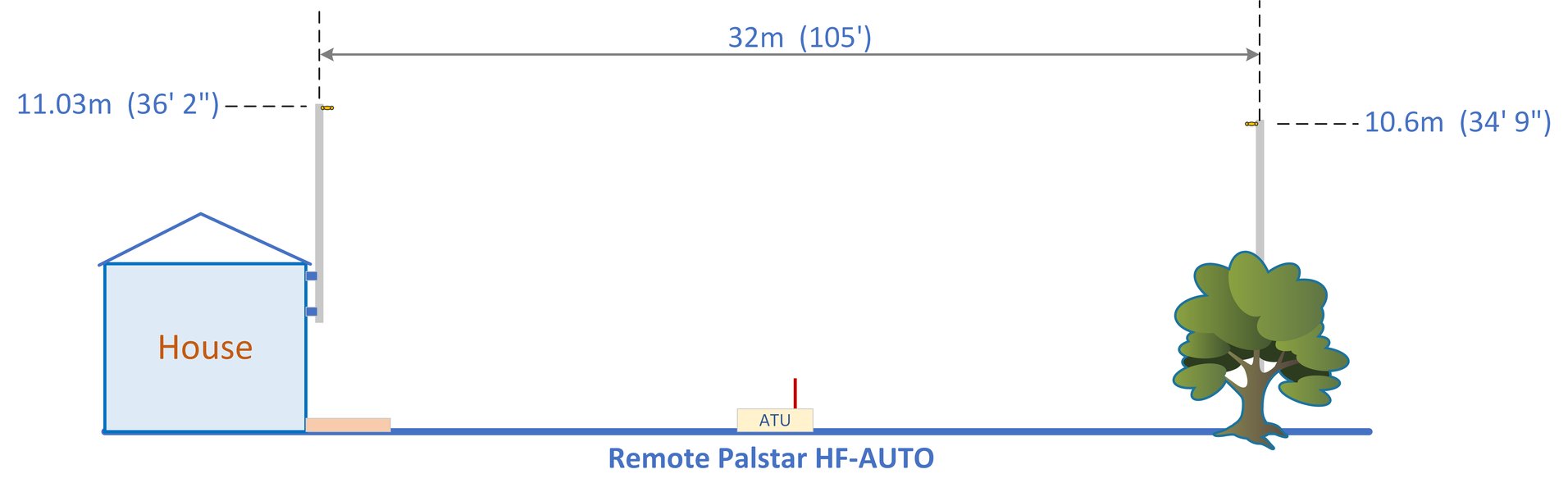
An inverted-L antenna design, illustrating the vertical and horizontal segments suitable for limited space.
A crucial component for any vertical antenna, including the inverted-L, is a good radial system. These are wires laid out on or buried just below the ground, acting as the other half of the antenna. The more radials, and the longer they are (ideally a quarter-wavelength or more), the more efficient the antenna will be. A simple hairpin match at the feed point can be used for impedance matching.
Helically Wound Verticals: Compacting the Length
Helically wound verticals offer another way to reduce the physical height of a 160-meter antenna. In this design, the antenna wire is wound around a non-conductive form (like PVC pipe) in a helical pattern, effectively packing a long length of wire into a much shorter physical space. While they are more compact, they can also be less efficient than a full-sized or even a well-designed inverted-L due to increased losses from the coil.
Short Vertical with Loading Coil
A shortened vertical antenna can be made resonant on 160 meters by adding a loading coil at its base or somewhere along its length. This coil adds the necessary inductance to tune out the capacitive reactance of the short antenna, making it appear electrically longer. While simple to implement, loading coils can introduce losses if not designed correctly, reducing the overall efficiency.
Wire Antennas: Maximizing Available Space
Even with limited space, various wire antenna configurations can be adapted for 160 meters. These often involve bending or folding the wire to fit within the confines of the property.
Loaded Dipoles: Bending the Rules
A standard 160-meter half-wave dipole is incredibly long. However, loaded dipoles use coils or traps to electrically shorten the physical length of the antenna. This allows a 160-meter dipole to fit into a significantly smaller footprint, though often with a trade-off in bandwidth and efficiency compared to a full-sized counterpart. They might be installed much closer to the ground than ideal, which can impact performance by directing more power overhead rather than at lower angles for DX.
Loops: Versatile and Noise-Reducing
Loop antennas, such as delta loops or full-wave loops, can be an excellent option for 160 meters, particularly if you have an "L-shaped" or irregular lot. A full-wave loop for 160 meters is quite large (around 525 feet in circumference), but its shape can be adapted to fit around property boundaries. Loops can also offer a lower noise floor on receive compared to some vertical designs, which is a significant advantage on the often noisy 160-meter band. Ladder line fed loops can be surprisingly good performers and can often be used as all-band antennas with an appropriate tuner.
Compact Solutions: When Space is Extremely Limited
For those with very small backyards (e.g., 40ft x 17ft), even the "compromise" antennas listed above might be too large. In such extreme cases, highly compact solutions become necessary.
Magnetic Loop Antennas
Magnetic loops are a popular choice for extremely limited spaces due to their small physical footprint. They are optimized for small space and low cost, making them accessible. However, they are typically narrowband, meaning they require retuning for significant frequency changes, and their efficiency can be lower than larger antennas. Despite this, they can still provide usable signals for local and even some DX contacts.
Isotron Antennas
Isotron antennas are marketed as an ideal solution for limited space and HOA-restricted environments, claiming full half-wave dipole performance in a very compact size. These are often commercially available and designed to offer a balance between size and performance.
Key Considerations for Any Small-Lot 160-Meter Antenna
Regardless of the specific antenna type chosen, several factors are critical to maximizing performance on the 160-meter band when space is limited.
The Importance of Height and Grounding
For any antenna, height is desirable. A dipole for 160 meters at only 25 feet above ground is just a fraction of a wavelength and will perform sub-par, directing most of its power directly overhead. Higher is almost always better, even for shortened antennas. For vertical antennas, a robust ground system with numerous, long radials is paramount for efficient operation. Without it, a significant portion of your transmitted power will be lost in heating the ground.
Matching and Tuning
Since most small-lot 160-meter antennas are compromises, they will likely not present a perfect 50-ohm match to your transceiver. An antenna tuner (ATU) is almost always essential to "fool" the transmitter into seeing a 50-ohm load and prevent excessive power reflection back into the radio. For wire antennas, using open-wire (ladder) line to feed the antenna to a balanced tuner can significantly reduce feedline losses and allow for broader band operation.
Efficiency vs. Compromise
It's important to understand that any antenna significantly shortened from its full size will inherently be a compromise. This means a reduction in efficiency, which translates to less radiated power for a given input power. While a full-sized antenna might achieve 80-90% efficiency, a very short, heavily loaded antenna might only be 20% efficient or less. The goal is to achieve the maximum possible efficiency given your constraints.
Comparative Analysis of 160-Meter Antenna Characteristics
To provide a clearer perspective on the trade-offs involved, here's a radar chart illustrating the subjective performance characteristics of various 160-meter antenna types suitable for small lots. This chart represents a general qualitative comparison, as actual performance will vary based on specific implementation, surrounding environment, and antenna height.
This chart illustrates that while a full-size dipole offers high efficiency and performance, it demands significant space. Compact solutions like magnetic loops excel in space saving but compromise on efficiency and bandwidth. Inverted-L antennas often strike a good balance, offering decent performance for DX in a manageable footprint.
Video Resource: Exploring Compact 160m Antenna Ideas
To further visualize and understand various antenna concepts for the 160-meter band in confined spaces, the following video offers valuable insights into different designs, including inverted-L, sloper, loaded vertical, compact dipole, and loop antennas. It provides practical considerations for how these antennas might be deployed and their general performance characteristics.
"Cheap Compact 160m Antenna Ideas" from DXCommander provides an overview of various antenna types suitable for small lots.
Summary of Antenna Types for Small Lots
Here's a concise overview of the most viable 160-meter antenna options for small lots, highlighting their characteristics:
| Antenna Type | Description | Pros for Small Lots | Cons for Small Lots | Typical Space Requirement |
|---|---|---|---|---|
| Inverted-L | Vertical radiator with a horizontal top-hat wire. | Good DX performance (low angle), relatively compact, uses existing structures (trees). | Requires good ground system (radials), some height still beneficial. | Moderate (e.g., 40-60 ft vertical, 60-80 ft horizontal). |
| Shortened/Loaded Vertical | Vertical wire with loading coils or capacity hats to achieve resonance. | Excellent DX performance, compact vertical footprint. | Requires extensive radial system, efficiency can be reduced by loading. | Small (e.g., 20-50 ft height). |
| Helical Vertical | Wire wound spirally around a non-conductive form. | Very compact physical size. | Lower efficiency due to coil losses, narrow bandwidth. | Very Small (e.g., 6-20 ft height). |
| Magnetic Loop | Small, often circular or square loop antenna. | Extremely small footprint, low noise on receive. | Narrow bandwidth (requires frequent retuning), lower efficiency, high Q. | Minimal (e.g., 3-6 ft diameter). |
| Loaded Dipole | Dipole with coils or traps to shorten its physical length. | No radials needed (balanced), can be strung creatively. | Efficiency reduced by loading, still needs some horizontal space. | Moderate (e.g., 100-150 ft length). |
| Full-Wave Loop (Folded/Bent) | A closed loop of wire, often adapted to property shape. | Good all-around performance, lower noise floor. | Large total wire length (525 ft), can be challenging to fit. | Large (e.g., perimeter of property, >500 ft). |
Making Your Choice: A Practical Approach
The "best" 160-meter antenna for a small lot is subjective and depends on your specific circumstances. Begin by assessing your available space accurately. Measure the length and width of your usable area, note the height of any potential support structures like trees or poles, and consider any homeowner association (HOA) restrictions. If you have tall trees (60-80 feet), an inverted-L or even a shortened vertical becomes much more feasible. If your space is truly tiny (e.g., 40x17 feet), then a magnetic loop or a helical vertical might be your only realistic options.
Consider your primary operating goals. If you aim for DX, a vertical or inverted-L with a good ground system will likely serve you best due to their low take-off angles. For local communication or net participation, a shortened dipole or even a compromise vertical can be effective. Experimentation is a hallmark of amateur radio, and many operators find success by adapting designs and fine-tuning them for their unique environments.
Frequently Asked Questions
What is the biggest challenge for a 160-meter antenna in a small lot?
Do I really need a radial system for a 160-meter vertical antenna?
Can a 160-meter antenna work well if it's very close to the ground?
Are magnetic loop antennas a good choice for extreme space limitations on 160 meters?
Conclusion
While the 160-meter band presents considerable challenges for small lots, a variety of effective antenna solutions exist. The inverted-L and shortened vertical designs are often the top contenders for their balance of performance and space efficiency, especially for DX. For extremely confined spaces, magnetic loops and helical verticals offer viable, albeit more compromised, pathways onto Top Band. Ultimately, success lies in a thorough assessment of your property, careful antenna selection, meticulous construction (especially the radial system), and a willingness to experiment. With perseverance, you can enjoy the unique characteristics of the 160-meter band, even from a modest backyard.
Recommended Further Exploration
- How can I optimize my radial system for maximum 160-meter antenna efficiency?
- What are the step-by-step instructions for building a DIY inverted-L antenna for 160 meters?
- What are the design considerations and performance characteristics of magnetic loop antennas for the 160-meter band?
- What are the best feedline and antenna tuner options for compromise HF antennas on small lots?
References
 amazon.com
Last updated May 21, 2025