
Unraveling Fuel Efficiency: A Deep Dive into 6-Cylinder Engine Consumption
Calculating the Fuel Consumption Rate Per Cylinder for Optimal Performance
- Brake Specific Fuel Consumption (BSFC) is Key: The BSFC value (220 g/kWh) is the fundamental metric that directly links an engine's power output to its fuel consumption efficiency. A lower BSFC indicates better fuel efficiency.
- Total Engine Fuel Consumption is the Starting Point: Before delving into individual cylinders, the overall fuel consumption of the entire engine must be calculated using its total power output and BSFC. This provides the aggregate fuel usage.
- Distribution Across Cylinders: For multi-cylinder engines, the total fuel consumption is typically distributed equally among all cylinders, assuming a balanced engine operation. This allows for the calculation of fuel consumption per cylinder.
Understanding the fuel consumption of an internal combustion engine, especially a multi-cylinder one like a 6-cylinder 4-stroke engine, involves several interconnected parameters. This detailed analysis will guide you through the calculations, starting from the given brake specific fuel consumption (BSFC) and leading to the fuel consumption rate per cylinder in kg/hr.
Understanding Brake Specific Fuel Consumption (BSFC)
The Core Metric of Engine Efficiency
Brake Specific Fuel Consumption (BSFC) is a crucial measure of an engine's fuel efficiency. It quantifies how much fuel an engine consumes per unit of brake horsepower or kilowatt-hour of work produced. In simpler terms, it tells you how efficient an engine is at converting fuel into useful power. A lower BSFC value indicates that an engine is more efficient, using less fuel to generate a given amount of power.
BSFC is expressed in units such as grams per kilowatt-hour (g/kWh) or pounds per horsepower-hour (lb/hp·h). It's a dynamic value that changes with engine load and RPM, typically measured on a dynamometer under various operating conditions. This makes it a more reliable indicator of efficiency than simple fuel economy figures, as it accounts for the actual power output.
The formula for BSFC is generally given by:
In our scenario, the BSFC is given as 220 g/kWh, meaning the engine consumes 220 grams of fuel for every kilowatt-hour of energy it produces at its shaft.
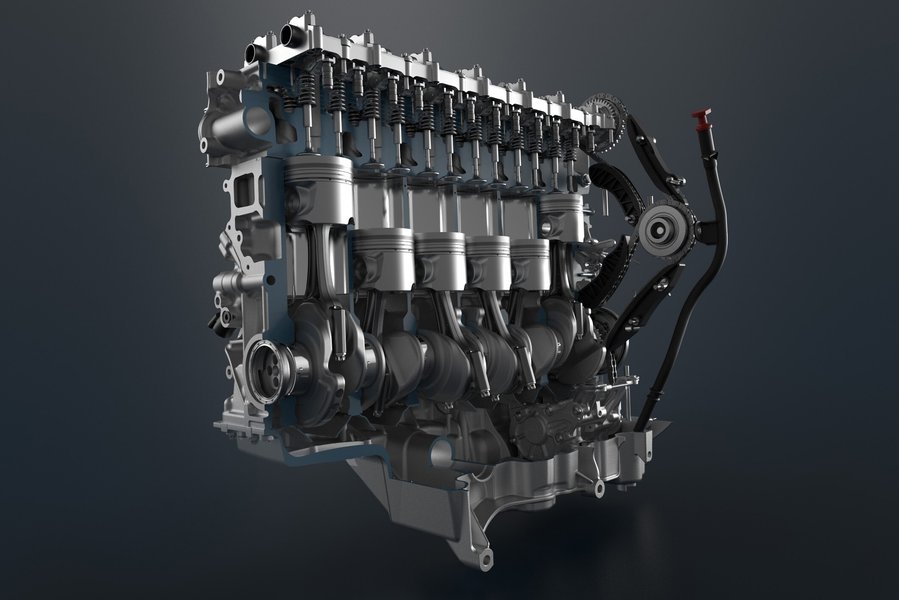
Visualizing the core difference between 4-cylinder and 6-cylinder engines.
Calculating Total Fuel Consumption Rate
From Power to Total Fuel Burn
To determine the total fuel consumption rate of the engine, we can rearrange the BSFC formula. Since BSFC is the ratio of fuel mass flow rate to brake power, we can calculate the fuel mass flow rate by multiplying the BSFC by the brake power. The given parameters are:
- Engine Power (P): 120 kW
- Brake Specific Fuel Consumption (BSFC): 220 g/kWh
First, let's calculate the total fuel consumption rate for the entire engine. The formula is:
Plugging in the values:
This result gives us the total amount of fuel consumed by the entire 6-cylinder engine in one hour, expressed in grams.
Converting Units and Distributing Consumption
From Grams to Kilograms and Total to Per Cylinder
The problem asks for the fuel consumption rate per cylinder in kilograms per hour (kg/hr). We currently have the total fuel consumption rate in grams per hour (g/hr). To convert grams to kilograms, we divide by 1000:
Now, we have the total fuel consumption rate for the entire 6-cylinder engine. To find the fuel consumption rate per cylinder, we simply divide the total by the number of cylinders. The engine has 6 cylinders.
Therefore, the fuel consumption rate per cylinder is 4.40 kg/hr.
Factors Influencing Fuel Consumption
Beyond the Numbers: Real-World Considerations
While the calculation provides a precise theoretical value, several real-world factors can influence an engine's actual fuel consumption. These include:
Engine Design and Configuration
- Number of Cylinders: Generally, engines with more cylinders tend to be less fuel-efficient due to increased friction from more moving parts. However, they can also offer smoother operation and higher power output.
- Engine Displacement: Larger engine displacement (total volume swept by the pistons) typically correlates with higher fuel consumption as more air-fuel mixture is processed per cycle.
- Aspiration (Naturally Aspirated vs. Turbocharged/Supercharged): Forced induction systems (turbochargers, superchargers) can significantly boost power but may also increase fuel consumption at peak performance due to increased air intake and corresponding fuel requirements.
- Engine Type (Diesel vs. Gasoline): Diesel engines generally have better fuel efficiency (lower BSFC) than gasoline engines due to their higher compression ratios and lean-burn characteristics.
Operating Conditions
- Engine Load and RPM: As seen in BSFC maps, fuel efficiency varies significantly with engine speed and load. An engine typically has an "sweet spot" where its BSFC is lowest.
- Temperature: Both ambient and engine operating temperatures affect fuel density, air density, and engine friction, all of which influence fuel consumption.
- Driving Style: Aggressive acceleration, rapid braking, and excessive idling significantly increase fuel consumption. Smooth driving, maintaining consistent speeds, and anticipating traffic can lead to considerable fuel savings.
- Vehicle Weight and Aerodynamics: Heavier vehicles require more energy to move, leading to higher fuel consumption. Poor aerodynamics also increase drag, necessitating more power and thus more fuel.
Fuel Characteristics and Quality
- Fuel Type and Energy Density: Different fuels (gasoline, diesel, E85, methanol) have varying energy densities (heating values). An engine designed for E85, for instance, will consume more volume of fuel than one running on gasoline to produce the same power due to E85's lower energy density per unit volume.
- Fuel Quality: Contaminated or poor-quality fuel can lead to incomplete combustion and reduced efficiency.
Maintenance and Tuning
- Tire Pressure: Underinflated tires increase rolling resistance, leading to higher fuel consumption.
- Engine Tune-up: A well-maintained and properly tuned engine, with clean air filters, spark plugs, and correctly functioning fuel injectors, operates more efficiently.
- Gear Ratios: The vehicle's gear ratios affect the engine's RPM at a given road speed, influencing its operating efficiency.
Visualizing Engine Performance Metrics
A Radar Chart Analysis
To further illustrate the multifaceted nature of engine performance and fuel consumption, let's consider a radar chart. This chart will visually represent how various parameters contribute to an engine's overall efficiency and operational characteristics. Our radar chart will compare a hypothetical well-tuned 6-cylinder engine with an average one, based on their relative strengths in different areas impacting fuel consumption.
This radar chart illustrates that a well-tuned engine generally excels in areas like fuel efficiency, power delivery, and lower emissions, while potentially requiring more specialized maintenance compared to an average engine. The values are illustrative and represent relative strengths, not absolute metrics. For instance, a higher score in 'Fuel Efficiency (BSFC)' signifies a lower BSFC value and thus better efficiency.
Key Engine Parameters and Their Role
Interconnected Elements of Engine Performance
Understanding fuel consumption also requires an appreciation for how various engine parameters interact. These include:
| Parameter | Description | Impact on Fuel Consumption |
|---|---|---|
| Brake Power (kW or HP) | The useful power produced by the engine at the crankshaft. | Directly proportional to fuel consumption rate when BSFC is constant. Higher power demand means more fuel burned. |
| Engine RPM (Revolutions Per Minute) | The rotational speed of the crankshaft. | Influences cycle time and the rate at which fuel is injected and combusted. BSFC varies with RPM, often having an optimal range. |
| Engine Displacement (cc or L) | The total swept volume of all pistons in the cylinders. | Larger displacement generally means more air-fuel mixture per cycle, leading to higher fuel consumption if not managed efficiently. |
| Compression Ratio | The ratio of the volume of the cylinder and combustion chamber when the piston is at its lowest point to its volume when the piston is at its highest point. | Higher compression ratios generally lead to better thermal efficiency and lower BSFC, especially in diesel engines. |
| Air-Fuel Ratio (A/F) | The ratio of air mass to fuel mass in the combustion mixture. | Crucial for complete combustion. Stoichiometric ratios (e.g., 14.7:1 for gasoline) are ideal for emissions control, while leaner mixtures can improve fuel economy. |
| Volumetric Efficiency | The ratio of the actual volume of air drawn into a cylinder to its theoretical maximum volume. | Higher volumetric efficiency means more air enters the cylinder, allowing for more complete combustion and potentially more power, but also requiring more fuel to maintain optimal A/F ratio. |
Examining Engine Idling and Fuel Consumption
The Hidden Cost of Stationary Operation
While our calculation focused on power production, it's also worth noting fuel consumption during idling. Idling refers to an engine running when the vehicle is stationary, not producing useful work. Even at idle, an engine consumes fuel to maintain its operation, power accessories, and overcome internal friction. This consumption, although lower than under load, adds up over time. Factors like engine displacement directly influence idling fuel consumption; a larger engine will generally consume more fuel at idle.
For more insights into how much fuel engine idling uses and whether start-stop systems are effective, this video provides a comprehensive explanation:
A deep dive into the theory and practical implications of engine fuel consumption at idle.
The video delves into the physics behind engine idling and offers practical insights into reducing fuel wastage. It highlights that while starting a car typically consumes a very small amount of fuel, prolonged idling, especially for more than 10 seconds, usually wastes more fuel than restarting the engine. This makes features like automatic start-stop systems beneficial for urban driving where frequent stops occur.
Frequently Asked Questions
How does the number of cylinders affect fuel consumption?
What is Brake Specific Fuel Consumption (BSFC) and why is it important?
Can I estimate fuel consumption without a BSFC value?
Does engine RPM impact fuel consumption significantly?
How does engine displacement relate to fuel consumption?
Conclusion
Calculating the fuel consumption rate per cylinder for a 6-cylinder 4-stroke engine, given its power output and Brake Specific Fuel Consumption (BSFC), involves a straightforward application of the BSFC definition. Starting with a total power output of 120 kW and a BSFC of 220 g/kWh, the total fuel consumption rate for the engine is found to be 26.40 kg/hr. Dividing this total by the 6 cylinders, we arrive at a fuel consumption rate of 4.40 kg/hr per cylinder. This calculation highlights the direct relationship between an engine's efficiency (as measured by BSFC) and its fuel consumption. Understanding these metrics is vital for optimizing engine performance, fuel economy, and operational costs in various applications, from automotive to marine and industrial machinery.
Recommended Further Exploration
- How to optimize engine fuel efficiency for daily driving?
- Understanding Brake Specific Fuel Consumption maps and charts.
- Impact of forced induction on engine fuel consumption.
- Comparison of fuel efficiency between gasoline and diesel engines.