

Understanding the behavior of a function is a cornerstone of calculus, offering profound insights into its graph and real-world applications. Two crucial aspects of function behavior are its absolute maxima and minima, representing the highest and lowest values a function attains, and its inflection points, which mark where the function's concavity shifts. This comprehensive guide will walk you through a step-by-step process to determine these critical features, ensuring a thorough grasp of these fundamental concepts.
Key Insights into Function Analysis
- Absolute Extrema are the global highest and lowest points of a function within a specified domain or interval, guaranteed to exist on a closed, continuous interval by the Extreme Value Theorem.
- Inflection Points indicate a change in a function's concavity—where it switches from curving upwards to curving downwards, or vice versa—and are identified by analyzing the second derivative.
- The process for finding these points involves a systematic application of derivatives, evaluating the function at critical points and endpoints, and testing for sign changes in the derivatives.
To fully appreciate the intricacies of function analysis, let's break down the methodologies for identifying absolute maxima, minima, and inflection points.
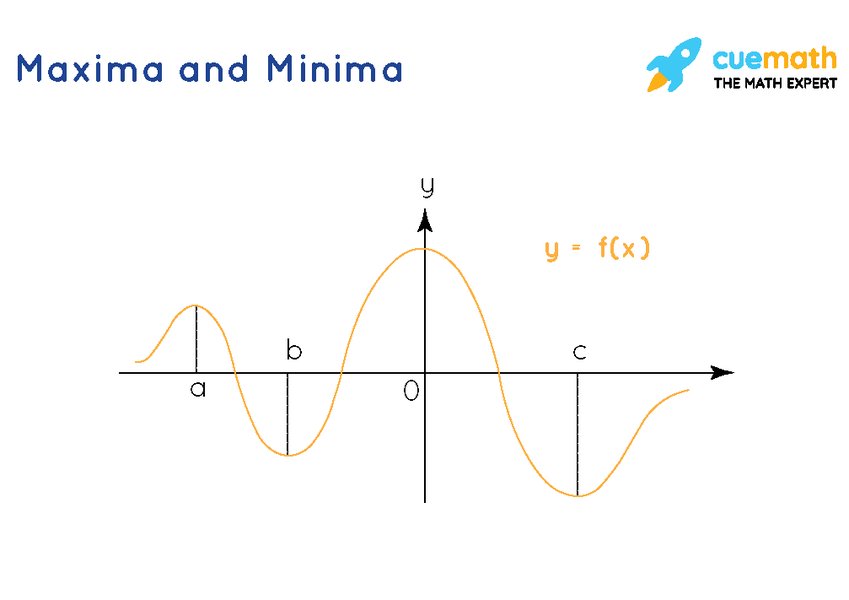
Visual representation of maxima and minima on a function's graph.
The systematic approach to identifying a function's highest and lowest values.
Absolute maxima and minima, often referred to as absolute extrema, are the highest and lowest values a function reaches over its entire domain or a specific interval. Finding these points is crucial for optimization problems in various fields, from engineering to economics.
Step 1: Define the Domain and Ensure Continuity
First, identify the domain of the function and, if applicable, the specific closed interval \([a, b]\) on which you are seeking the extrema. The Extreme Value Theorem guarantees that if a function \(f(x)\) is continuous on a closed interval \([a, b]\), then both an absolute maximum and an absolute minimum must exist within that interval. If the function is not continuous or the interval is open, absolute extrema may not be guaranteed, or their existence might require further analysis of limits and asymptotic behavior.
Step 2: Calculate the First Derivative
Compute the first derivative of the function, denoted as \(f'(x)\). The first derivative provides information about the function's slope and rate of change. It's the primary tool for locating critical points.
Step 3: Identify Critical Points
Critical points are the interior points in the function's domain where the first derivative is either zero or undefined. These points are candidates for local maxima or minima, and subsequently, for absolute extrema. To find them:
- Set \(f'(x) = 0\) and solve for \(x\). These are points where the tangent line is horizontal.
- Identify any \(x\)-values where \(f'(x)\) is undefined, but \(f(x)\) itself is defined. These could indicate sharp turns or vertical tangent lines.
It's important to only consider critical points that fall within the specified domain or interval.
Step 4: Evaluate the Function at Critical Points and Endpoints
Once you have identified all relevant critical points within your domain (and the endpoints if working on a closed interval), substitute each of these \(x\)-values back into the original function \(f(x)\). This will give you the corresponding \(y\)-values of these points. Make a list of all these functional values.
Step 5: Determine the Absolute Extrema
Compare all the \(y\)-values obtained in Step 4. The largest of these values is the absolute maximum of the function on the given interval, and the smallest value is the absolute minimum. If the function is defined on an open interval or an unbounded domain, you might also need to consider the behavior of the function as \(x\) approaches the boundaries or infinity, as absolute extrema might not always exist in such cases.
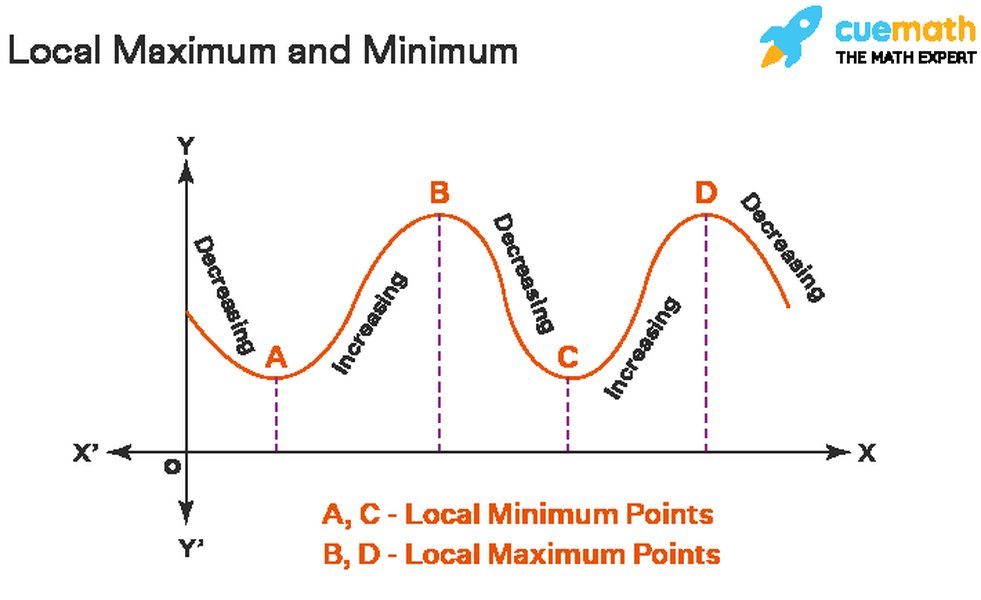
Local maxima and minima shown on a function's curve.
Uncovering where a function's concavity shifts.
Inflection points are fascinating features of a function's graph, marking where the curve changes its concavity—from bending upwards (concave up) to bending downwards (concave down), or vice versa. These points are essential for understanding the overall shape and behavior of a function.
Step 1: Compute the Second Derivative
Begin by calculating the second derivative of the function, denoted as \(f''(x)\). The second derivative provides information about the concavity of the function.
Step 2: Find Candidate Inflection Points
Candidate inflection points are \(x\)-values where the second derivative is either zero or undefined. These are the potential locations where the concavity might change. To find them:
- Set \(f''(x) = 0\) and solve for \(x\).
- Identify any \(x\)-values where \(f''(x)\) is undefined, but \(f(x)\) is defined.
Step 3: Test for Changes in Concavity
This is the most critical step. For each candidate inflection point found in Step 2, you must verify if a change in concavity actually occurs. This is done by testing the sign of \(f''(x)\) in intervals to the left and right of each candidate point:
- Choose test values of \(x\) slightly less than and slightly greater than each candidate point.
- Substitute these test values into \(f''(x)\).
- If the sign of \(f''(x)\) changes across the candidate point (e.g., from positive to negative, or negative to positive), then that \(x\)-value corresponds to an inflection point. If there is no sign change, it is not an inflection point, even if \(f''(x) = 0\) at that point.
A positive \(f''(x)\) indicates concave up, while a negative \(f''(x)\) indicates concave down.
Step 4: Determine the Coordinates of the Inflection Point
Once an \(x\)-value is confirmed as an inflection point, substitute this \(x\)-value back into the original function \(f(x)\) to find the corresponding \(y\)-coordinate. The point \((x, f(x))\) is the inflection point.
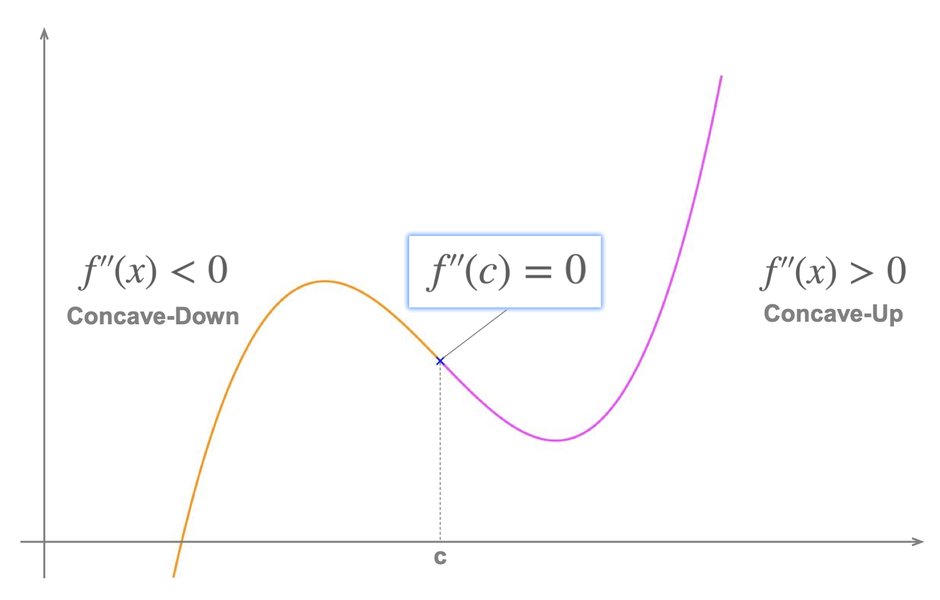
An illustration highlighting an inflection point where concavity changes.
Understanding the scope of maximum and minimum values.
While the focus here is on absolute extrema, it's important to understand the distinction between local (or relative) and absolute (or global) extrema. Local extrema are the highest or lowest points within a specific neighborhood of the function, while absolute extrema are the highest or lowest points across the entire domain or specified interval.
The First Derivative Test and Second Derivative Test are often used to classify critical points as local maxima or minima:
- First Derivative Test: If \(f'(x)\) changes from positive to negative at a critical point \(c\), then \(f(c)\) is a local maximum. If \(f'(x)\) changes from negative to positive, \(f(c)\) is a local minimum.
- Second Derivative Test: If \(f'(c) = 0\) and \(f''(c) > 0\), then \(f(c)\) is a local minimum. If \(f'(c) = 0\) and \(f''(c) < 0\), then \(f(c)\) is a local maximum. If \(f''(c) = 0\), the test is inconclusive, and the First Derivative Test should be used.
A graphical representation of the analytical process.
To better grasp the interplay between derivatives and the characteristics of a function, let's visualize the steps and relationships in a mindmap. This mindmap illustrates the hierarchical structure of analyzing function behavior.
Mindmap illustrating the systematic process for finding absolute extrema and inflection points.
Understanding what each derivative reveals about a function.
The first and second derivatives play distinct yet interconnected roles in understanding a function's behavior. The table below summarizes their primary functions and how they contribute to identifying extrema and inflection points.
| Feature | Role of First Derivative (\(f'(x)\)) | Role of Second Derivative (\(f''(x)\)) | What it Reveals |
|---|---|---|---|
| Absolute Maxima/Minima | Identifies critical points where slope is zero or undefined. | (Indirectly) Helps classify local extrema, which can be absolute extrema. | Highest/lowest functional values on an interval/domain. |
| Local Maxima/Minima | Identifies critical points and determines intervals of increasing/decreasing. | Determines concavity at critical points to classify them (if \(f''(x) \ne 0\)). | Peaks and valleys within specific regions of the function. |
| Inflection Points | Slope of the tangent line at the inflection point. | Identifies points where concavity changes sign (from positive to negative or vice versa). | Points where the curve changes its bending direction. |
| Function Behavior | Indicates whether the function is increasing or decreasing. | Indicates whether the function is concave up or concave down. | Overall shape and trend of the function. |
A detailed comparison of the roles of first and second derivatives in analyzing function behavior.
Watch this video to solidify your understanding of critical points.
Critical numbers are the cornerstone of finding extrema. They are the potential locations where a function can change its direction (from increasing to decreasing or vice versa), leading to a local maximum or minimum. The following video provides an excellent introduction to identifying critical numbers, which is the first crucial step in determining absolute extrema.
This video explains how to find the critical numbers of a function, a fundamental concept for locating extrema.
This video titled "Finding Critical Numbers" explains how to identify critical points, which are values of x where the derivative of a function is zero or undefined. These points are crucial because they represent locations where the function's slope might change, leading to a potential maximum, minimum, or an inflection point. Grasping this concept is foundational for the subsequent steps in finding absolute extrema and inflection points, as critical points are the primary candidates for these significant features of a function.
Frequently Asked Questions
What is the Extreme Value Theorem and why is it important?
Can a function have multiple absolute maxima or minima?
What is the difference between a local extremum and an absolute extremum?
Is it possible for a function to have no absolute maxima or minima?
What if the second derivative is zero at a candidate inflection point?
Conclusion
Mastering the techniques for finding absolute maxima, minima, and inflection points is fundamental to understanding the detailed behavior of functions. By systematically applying derivatives and analyzing critical points, you can uncover the most important characteristics of a function's graph. These skills are not merely academic; they are directly applicable to solving real-world optimization problems and modeling complex phenomena across diverse scientific and engineering disciplines. A clear understanding of these concepts empowers you to predict, analyze, and interpret functional relationships with confidence and precision.
Recommended Further Exploration
- How to apply the Extreme Value Theorem effectively?
- Understanding higher-order derivatives in function analysis
- Practical applications of extrema and inflection points in engineering
- Visualizing concavity and inflection points using graphing tools