

Key Insights into Absolute and Non-Euclidean Geometries
- Absolute Geometry serves as the neutral foundation, encompassing principles common to both Euclidean and non-Euclidean systems by excluding the parallel postulate.
- The Lambert-Saccheri Quadrangles were pivotal historical tools, used by mathematicians to test the parallel postulate and subsequently unveil the distinct properties of non-Euclidean spaces.
- Non-Euclidean Geometries, such as hyperbolic and elliptic, emerged from challenging Euclid's fifth postulate, introducing concepts like "quasi-parallel" lines and diverse angle sums in geometric figures.
The study of geometry, often associated with Euclid's foundational work, takes a fascinating turn when we consider the implications of his fifth postulate concerning parallel lines. This literature review delves into the concepts that arise when this postulate is relaxed or altered, leading to the rich fields of Absolute Geometry and Non-Euclidean Geometries. We will explore key definitions, historical backgrounds, and previous research surrounding General Absolute Geometry, Quasi-Parallel Lines, the enigmatic Zigzag Operation, Non-Euclidean Geometry, and the instrumental Lambert-Saccheri Quadrangles.
At its core, geometry provides a framework for understanding space and form. While Euclidean geometry has long been the standard, the questioning of its axioms, particularly the parallel postulate, has opened doors to alternative, equally valid geometric systems. These investigations have not only deepened our understanding of mathematical structures but have also provided powerful tools for various scientific and engineering applications.
1.2 Essential Concepts Shaping Modern Geometry
This section outlines the fundamental concepts crucial for understanding the intricate relationship between Euclidean and non-Euclidean geometries, all stemming from the foundational principles of absolute geometry.
Absolute Geometry: The Neutral Ground
Absolute Geometry, often referred to as neutral geometry, represents a geometric framework built upon Euclid's first four postulates but explicitly excluding the fifth, the parallel postulate. This means that any theorem proven within absolute geometry holds true in Euclidean, hyperbolic, and elliptic geometries alike. It provides a common ground for studying geometric properties without committing to a specific type of parallelism. Historically, the development of absolute geometry was crucial for understanding what properties of space are independent of the parallel postulate, thus paving the way for the discovery of non-Euclidean geometries.
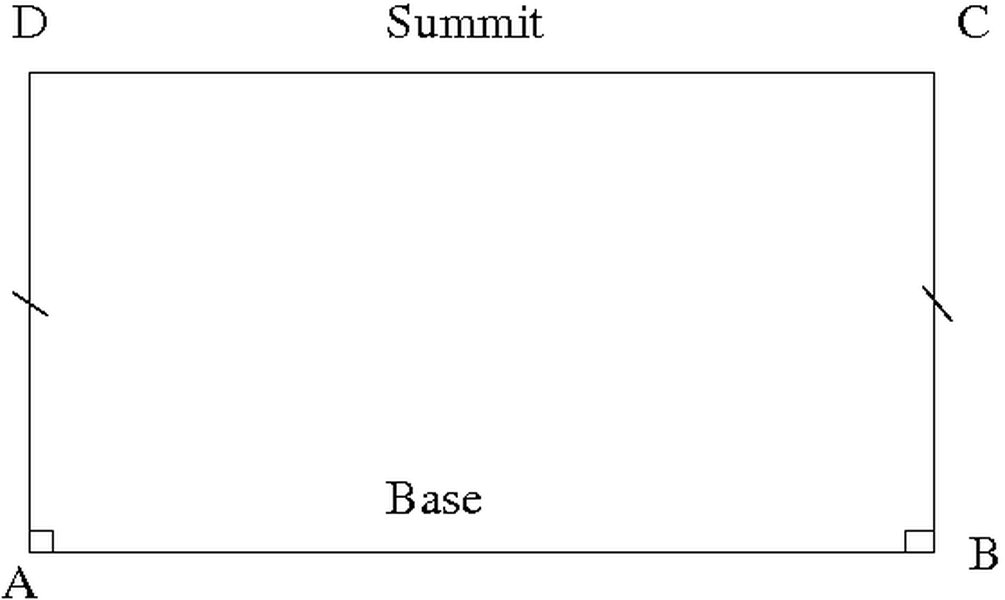
A visual representation of a Saccheri quadrilateral, a fundamental construct in absolute geometry.
Lambert-Saccheri Quadrangles: Pivotal Explorations
The Lambert-Saccheri Quadrangles are specialized quadrilaterals that played a critical role in the historical attempts to prove Euclid's parallel postulate, ultimately leading to the birth of non-Euclidean geometries. These quadrilaterals were instrumental tools for mathematicians like Gerolamo Saccheri and Johann Heinrich Lambert.
The Saccheri Quadrilateral
A Saccheri quadrilateral is defined by two equal sides perpendicular to a base segment, with the side opposite the base referred to as the "summit." The two angles at the base are right angles (90 degrees). In absolute geometry, the two summit angles are always equal, but their measure dictates the underlying geometry:
- If the summit angles are 90 degrees, the geometry is Euclidean (a rectangle).
- If the summit angles are less than 90 degrees (acute), the geometry is hyperbolic.
- If the summit angles are greater than 90 degrees (obtuse), the geometry is elliptic.

An illustrative comparison of Saccheri and Lambert quadrilaterals, highlighting their structural differences.
The Lambert Quadrilateral
A Lambert quadrilateral is a related figure possessing three right angles. The nature of its fourth angle is what distinguishes different geometries:
- If the fourth angle is 90 degrees, the geometry is Euclidean.
- If the fourth angle is less than 90 degrees (acute), the geometry is hyperbolic.
- If the fourth angle is greater than 90 degrees (obtuse), the geometry is elliptic.

A graphical representation of a Lambert quadrilateral, emphasizing its defining characteristics.
These quadrilaterals are fundamental in demonstrating how angle sums in triangles and quadrilaterals can vary dramatically across different geometries, directly impacting the concept of parallelism.
Non-Euclidean Geometry: Beyond the Parallel Postulate
Non-Euclidean Geometry refers to any geometric system that modifies or rejects Euclid's parallel postulate. The two primary branches are:
- Hyperbolic Geometry: In this geometry, through a point not on a given line, there exist at least two distinct lines parallel to the given line. This leads to interesting properties, such as the sum of angles in a triangle being less than 180 degrees.
- Elliptic Geometry: In contrast, elliptic geometry posits that any two lines will intersect. Consequently, there are no parallel lines, and the sum of angles in a triangle is greater than 180 degrees.
The emergence of these geometries was a revolutionary development in mathematics, challenging centuries of assumptions about the nature of space.
Quasi-Parallel Lines: A Nuance of Parallelism
The concept of Quasi-Parallel Lines arises primarily in non-Euclidean settings, particularly hyperbolic geometry. Unlike Euclidean parallel lines, which maintain a constant distance and never intersect, quasi-parallel lines do not strictly adhere to this definition. In hyperbolic geometry, through a point not on a given line, there can be infinitely many lines that do not intersect the given line. Among these, some are called "limiting parallels" or "asymptotic parallels," which approach the given line indefinitely but never meet it. These lines can be considered quasi-parallel as they exhibit properties of non-intersection while diverging from the Euclidean understanding of parallelism.
The Zigzag Operation: An Analytical Tool
While not as widely known as the quadrilaterals, the Zigzag Operation refers to specific geometric constructions or iterative processes, often involving alternating perpendiculars or segments. For instance, the "orthogonal zigzag operation" in an absolute plane maps points via successive perpendicular projections between two lines. This operation can be used to study properties of parallelism and distance in various geometries, particularly when exploring intrinsic properties of lines and quadrilaterals under relaxed axioms. It can reveal subtle relationships and behaviors of geometric figures that might not be immediately apparent through static analysis.
2.2 Historical Background and Evolution
The journey from Euclid's postulates to the complexities of non-Euclidean geometries is a rich narrative of intellectual curiosity and mathematical rigor. Understanding this historical arc is crucial for appreciating the significance of current research.
Euclid's Legacy and the Parallel Postulate
The story begins with Euclid's Elements, a monumental work that laid the foundation for geometry. Among its five postulates, the fifth—the parallel postulate—stood out as particularly complex and less self-evident than the others. It states that through a point not on a given line, there is exactly one line parallel to the given line. For centuries, mathematicians attempted to prove this postulate from the other four, believing it to be a theorem rather than an independent axiom.
The Birth of Absolute Geometry and the Quadrilateral Investigations
The persistent failure to prove the parallel postulate led to a crucial shift: mathematicians began to investigate what geometry would look like if the fifth postulate were simply removed or altered. This marked the birth of Absolute Geometry. Figures like Gerolamo Saccheri (1667–1733) and Johann Heinrich Lambert (1728–1777) were central to this endeavor. Saccheri, in his 1733 work Euclides ab omni naevo vindicatus ("Euclid Freed of Every Flaw"), meticulously explored the consequences of denying the parallel postulate using his eponymous quadrilaterals. Though he aimed to prove its necessity by deriving contradictions, he inadvertently laid the groundwork for hyperbolic geometry.
This video provides an excellent historical overview of Gerolamo Saccheri's pioneering work in challenging Euclidean axioms, directly relating to the development of absolute geometry and the Lambert-Saccheri quadrangles.
Lambert, building on Saccheri's work, further investigated quadrilaterals with three right angles (Lambert quadrilaterals) and considered the implications of the fourth angle being acute or obtuse. Unlike Saccheri, Lambert recognized the internal consistency of the acute hypothesis, even noting its connection to hyperbolic functions, though he did not fully embrace the idea of a non-Euclidean space.
The Rise of Non-Euclidean Geometries
The work of Saccheri and Lambert, despite their initial intentions, profoundly influenced later mathematicians. In the 19th century, mathematicians like Carl Friedrich Gauss, Nikolai Lobachevsky, and János Bolyai independently recognized the possibility of consistent geometries where the parallel postulate did not hold. Their work formally established hyperbolic geometry. Later, Bernhard Riemann introduced elliptic geometry, completing the trilogy of fundamental geometries. This historical progression highlights how the systematic investigation of the parallel postulate, often using the Lambert-Saccheri framework, transformed our understanding of geometric possibility.
2.3 Previous Research and Contemporary Relevance
Previous research has not only solidified the theoretical foundations of absolute and non-Euclidean geometries but also continues to explore their nuances and applications. The legacy of Saccheri and Lambert permeates modern studies.
Formalizing Absolute Geometry and Quadrilateral Analysis
Early research extensively focused on documenting and analyzing the properties of Saccheri and Lambert quadrilaterals within the framework of absolute geometry. These studies clarified how the sum of angles and the behavior of parallel lines differ from Euclidean expectations. Modern treatments of absolute geometry, including formalizations by Hilbert and Tarski, provide rigorous axiomatic systems that underpin these explorations. This work has also included examining how propositions and theorems valid without the parallel postulate inform our understanding of lines and geometric properties.
Deepening Understanding of Parallelism and Quasi-Parallel Concepts
Research on non-Euclidean properties of these quadrilaterals clarified the behavior of angles and side lengths, particularly in hyperbolic geometry. The concept of "quasi-parallel" or "limiting parallels" has been thoroughly analyzed, showing how these lines approach each other asymptotically in hyperbolic space, forming congruent angles with perpendiculars—a key distinction from Euclidean parallels. These analyses have contributed to a deeper understanding of how "parallelism" can manifest in diverse geometric contexts, extending beyond the simple Euclidean definition.
The Zigzag Operation in Modern Contexts
While the "zigzag operation" might seem a more recent or specialized topic, its theoretical underpinnings can be traced back to fundamental geometric constructions. Modern research, such as studies on the "orthogonal zigzag operation in an absolute plane," formalizes these iterative processes. These investigations often involve dynamic constructions and geometric software to illustrate the properties of lines and distances, particularly in settings where the parallel postulate is absent. Such operations offer a powerful analytical lens for exploring transformations and sequences of angle/line relations in abstract geometric spaces.
The table below summarizes the key attributes and historical significance of the primary concepts discussed:
| Concept | Core Definition | Key Historical Figures | Relationship to Parallel Postulate | Characteristic Property |
|---|---|---|---|---|
| Absolute Geometry | Geometry derived from Euclid's first four postulates, excluding the parallel postulate. | Euclid, Saccheri, Lambert | Neutral; forms a common basis for all geometries irrespective of the parallel postulate. | Theorems hold true in Euclidean, Hyperbolic, and Elliptic geometries. |
| Saccheri Quadrilateral | A quadrilateral with two equal sides perpendicular to a base, two right base angles. | Gerolamo Saccheri | Used to test the parallel postulate; summit angles reveal underlying geometry. | Summit angles are equal; measure determines Euclidean, Hyperbolic, or Elliptic nature. |
| Lambert Quadrilateral | A quadrilateral with three right angles. | Johann Heinrich Lambert | Used to test the parallel postulate; fourth angle reveals underlying geometry. | Fourth angle determines Euclidean, Hyperbolic, or Elliptic nature. |
| Non-Euclidean Geometry | Geometries that modify or reject Euclid's parallel postulate (e.g., Hyperbolic, Elliptic). | Gauss, Lobachevsky, Bolyai, Riemann | Directly contradicts or alters the parallel postulate. | Angle sums of triangles vary from 180 degrees. |
| Quasi-Parallel Lines | Lines that do not intersect but do not maintain a constant distance, often asymptotic in hyperbolic geometry. | Lobachevsky, Bolyai | Arise in geometries where the Euclidean parallel postulate is false. | Approach each other indefinitely without intersecting. |
| Zigzag Operation | Iterative geometric constructions, such as alternating perpendicular projections between lines. | (Modern formalizations) | Explores geometric properties in various axiomatic systems, including absolute planes. | Reveals relationships between lines and distances through iterative mapping. |
The evolution of these concepts highlights a continuous effort to understand the fundamental properties of space and geometry, moving from attempts to prove Euclid's fifth postulate to the acceptance and exploration of alternative geometric systems.
To further organize the interconnectedness of these ideas, here is a mindmap summarizing the central themes discussed:
This mindmap visually structures the relationships between General Absolute Geometry, Non-Euclidean Geometries, the influential Lambert-Saccheri Quadrangles, the concept of Quasi-Parallel Lines, and the analytical approach of the Zigzag Operation, demonstrating their interconnected roles in the broader field of geometry.
Frequently Asked Questions (FAQ)
What is the main difference between Absolute Geometry and Euclidean Geometry?
Why are Saccheri and Lambert Quadrilaterals important?
What does "quasi-parallel" mean in geometry?
What is the significance of the Zigzag Operation?
How did the attempts to prove the parallel postulate lead to non-Euclidean geometry?
Conclusion
The exploration of General Absolute Geometry, Non-Euclidean Geometries, and the specific constructs like Lambert-Saccheri Quadrangles and the Zigzag Operation reveals a profound intellectual journey in mathematics. From Euclid's foundational postulates to the revolutionary insights of Saccheri, Lambert, Lobachevsky, and Bolyai, the understanding of space and parallelism has evolved dramatically. Absolute geometry serves as the unifying framework, allowing for theorems common to all geometries, while non-Euclidean systems challenge our intuitive understanding of space. The historical efforts to prove the parallel postulate ultimately led to its disproof as a theorem and its acceptance as an independent axiom, thereby opening up entirely new realms of mathematical possibility. These concepts continue to be fertile ground for research, offering deep insights into the structure of mathematical thought and the nature of reality itself.
Recommended Further Reading
- The historical development of non-Euclidean geometry
- Properties of Saccheri and Lambert quadrilaterals in hyperbolic geometry
- Modern axiomatic systems for absolute geometry
- Applications of non-Euclidean geometry in physics and cosmology