
Unlocking ACME: Resource Lifecycles, URL Persistence, and Implementation Secrets Revealed
Understanding how the ACME protocol manages dynamic resources, nonces, and common pitfalls for seamless certificate automation.
Key Insights into ACME Resource Management
- Resource URLs Are Not Permanent: ACME servers can (and often do) delete resources like orders and authorizations after they expire or become invalid, following RFC 8555 guidelines.
- URL Reuse is Highly Discouraged: While not explicitly forbidden by RFC 8555, reusing URLs from deleted resources for new, unrelated objects breaks tracking and auditability, and is generally avoided in practice.
- Anti-Replay Nonces Are Strictly Single-Use: To prevent replay attacks, each nonce provided by the ACME server must be used exactly once; servers reject reused nonces.
The Dynamic Nature of ACME Resources
Understanding Resource Validity and Deletion
The Automatic Certificate Management Environment (ACME) protocol, defined in RFC 8555, relies heavily on dynamically created resources managed by the ACME server (typically a Certificate Authority like Let's Encrypt). These resources include:
- Order Objects: Represent a client's request for a certificate.
- Authorization Objects: Represent the server's authorization for an identifier (e.g., domain name) to be included in a certificate.
- Challenge Objects: Represent the tasks a client must perform to prove control over an identifier.
- Certificate Resources: The final issued certificate.
These resources are accessed via unique URLs provided by the server upon creation. A key question arises: are these URLs and the resources they point to permanent?
Resource Lifespan and Validity
No, ACME resource URLs are not expected to remain valid forever. RFC 8555 explicitly allows ACME servers to manage the lifecycle of these resources, including their deletion. Section 5.1 notes that servers are free to "garbage-collect" old objects that are no longer useful.
For example:
- Expired Authorizations: Authorizations typically have a limited validity period (e.g., 30 days for Let's Encrypt). Once expired, the server may delete the corresponding authorization object.
- Finalized or Invalid Orders: Once an order is fulfilled (certificate issued) or becomes invalid (e.g., challenges not completed before expiration), the server may delete the order resource after a certain retention period.
- Completed Challenges: Similarly, challenge objects associated with successful or failed validation attempts may be removed.
Servers might delete resources immediately upon expiration or invalidation, or after a defined retention period for logging or auditing purposes. Clients must therefore treat resource URLs as potentially ephemeral and should always fetch the current status or required resource URL from the server rather than relying on cached or previously obtained URLs indefinitely.
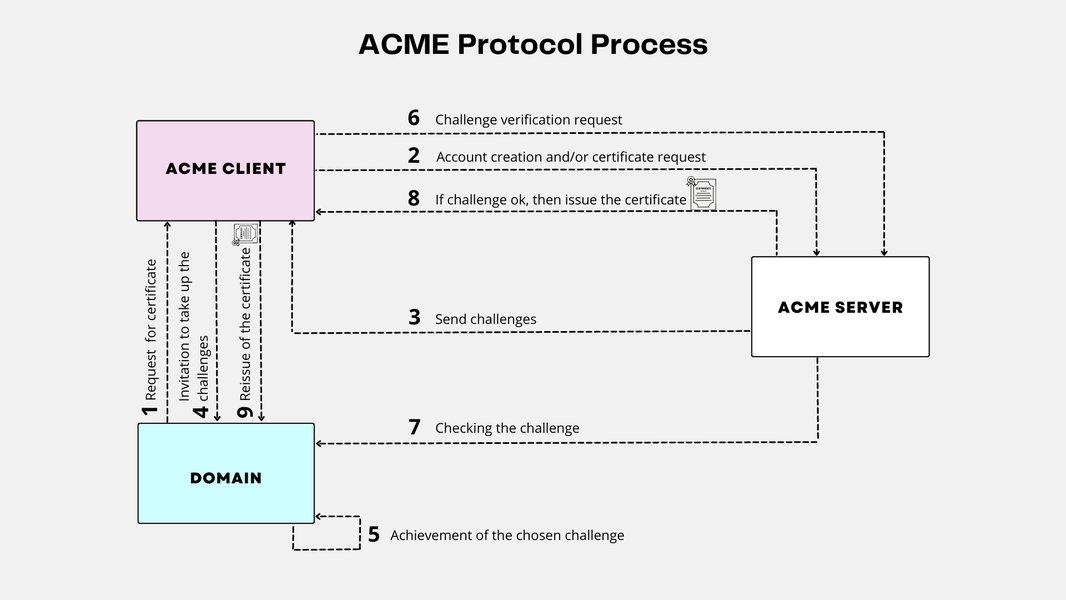
Visual representation of the typical ACME workflow, involving account creation, orders, challenges, and certificate issuance.
The Question of URL Reuse
Can Old URLs Be Repurposed?
If an ACME server deletes a resource, can the URL that previously identified it be reused for a completely new, unrelated resource? For instance, if https://acme.example.com/authz/123 pointed to an expired authorization for example.com, could the server later assign this same URL to a *new* authorization for example.com (or even another domain) under the same account?
RFC 8555 does not explicitly forbid the reuse of URLs previously associated with deleted resources. However, the protocol's design strongly implies that URLs should act as stable, unique identifiers for the lifetime of the resource and potentially beyond for auditing purposes.
Why Reuse is Problematic and Discouraged:
- Auditability and Tracking: Reusing URLs would severely compromise logging, auditing, and debugging. Systems tracking certificate issuance based on URLs would become confused if a URL suddenly pointed to a different resource context.
- Client Confusion: Clients polling an old URL might receive data for a new, unrelated resource, leading to incorrect state management and potential errors.
- Integrity: Unique URLs ensure the integrity of references within the ACME ecosystem.
While technically possible if a server implementation chose to do so (perhaps for resource optimization, though unlikely), it is considered bad practice. Most robust ACME server implementations avoid URL reuse to maintain clarity and reliability. Therefore, clients should operate under the assumption that once a resource URL becomes invalid (returns an error like 404 Not Found), it should not be expected to become valid again pointing to a different resource.
Anti-Replay Nonces: A Security Cornerstone
Ensuring Request Freshness
ACME uses anti-replay nonces to protect against replay attacks, where an attacker intercepts a signed request and resends it later. The mechanism works as follows:
- Before sending a protected POST request (e.g., creating an order, responding to a challenge), the client requests a fresh nonce from the server's
newNonceendpoint. - The client includes this nonce in the protected header of its signed request.
- The server receives the request, verifies the signature, and checks the nonce.
Can Nonces Be Reused?
Absolutely not. RFC 8555 Section 6.4 is clear: each nonce must be used exactly once. If a client attempts to reuse a nonce, the server MUST reject the request with an error (typically badNonce).
This non-reuse requirement is fundamental to preventing replay attacks.
Server-Side Nonce Management
Does this mean the server must store every nonce ever generated indefinitely? No. While the server must ensure a nonce isn't reused, it doesn't need to keep a perpetual, ever-growing list.
Servers typically implement nonce validation strategies that achieve security without infinite storage:
- Time-Limited Validity: Nonces often have a short lifespan (e.g., minutes or hours). The server only needs to track nonces issued within this recent window.
- Nonce Pools: Servers might maintain a pool of recently issued, unused nonces. Once used or expired, they are removed from the valid pool.
- Cryptographic Nonces: Some schemes might use techniques like signed timestamps, allowing the server to validate nonce freshness without storing the nonce itself.
If a client receives a badNonce error, it should simply request a new nonce from the newNonce endpoint and retry the request. Proper client implementation involves fetching a new nonce before each protected request or retrying with a fresh nonce upon receiving a badNonce error.
Visualizing ACME Relationships
A Mindmap of Key ACME Components
This mindmap illustrates the core components of the ACME protocol and their relationships, starting from the client's interaction with the server to obtain a certificate.
Common Mistakes in ACME Implementation
Implementing the ACME protocol, whether as a client or integrating with a server, requires careful attention to detail. Misunderstandings or oversights can lead to failures in obtaining or renewing certificates. Here are some common mistakes:
Categorizing Implementation Pitfalls
Nonce and Request Handling
- Improper Nonce Management: Failing to request a fresh nonce before each protected POST request, or failing to retry with a new nonce after a
badNonceerror. - Reusing Nonces: Attempting to use the same nonce for multiple requests.
- Using Deprecated GET Requests: Relying on unauthenticated GET requests for accessing resources where POST-as-GET is now required by ACME v2 and many servers.
Resource Lifecycle Mismanagement
- Assuming URL Permanence: Caching resource URLs indefinitely and failing to handle cases where servers delete expired or invalid resources.
- Ignoring Order/Authorization Expiry: Not monitoring the
expiresfields in order and authorization objects, leading to missed deadlines for completing challenges. - Improper Cleanup: Servers failing to garbage-collect old resources efficiently, or clients not handling the potential disappearance of resources gracefully.
- URL Reuse Assumptions: Incorrectly assuming a deleted resource's URL might be reused, leading to client-side state confusion.
Challenge Validation Errors
- Incorrect Challenge Configuration:
- For
http-01: Failing to place the validation file correctly under/.well-known/acme-challenge/or configuring the web server to serve it properly (e.g., correct MIME type, accessible from the internet). - For
dns-01: Incorrectly formatting the DNS TXT record (_acme-challenge.<domain>) or not accounting for DNS propagation delays (TTL).
- For
- Ignoring Self-Checks: Clients not verifying that the challenge setup (HTTP file or DNS record) is correct and accessible *before* notifying the ACME server to proceed with validation.
- DNSSEC Issues: Not correctly implementing DNSSEC if required by the CA for
dns-01validation. - Wildcard Flag Errors: For wildcard domain authorizations, failing to check or handle the
wildcardfield in the authorization object correctly.
CSR and Key Management Issues
- Reusing CSRs Inappropriately: Resubmitting the exact same CSR repeatedly, especially when encountering failures, which can hit rate limits for pending authorizations.
- CSR Signature Mismatches: Using a different private key to sign the JWS request than the one associated with the ACME account.
- Unvalidated CSR Content: Servers failing to properly validate the identifiers requested in the CSR against the authorized identifiers.
- Ignoring Key Rollover: Not implementing or using the account key rollover feature (RFC 8555 §7.3.5) when account keys need changing.
- Poor Key Security: Insecure storage of ACME account private keys.
Error Handling and Rate Limiting
- Inadequate Error Parsing: Not properly parsing the ACME Problem Document (RFC 7807) returned by the server on errors, making debugging difficult.
- Ignoring Rate Limits: Repeatedly hitting server rate limits (e.g., certificates per domain, pending authorizations, new orders) without implementing backoff or retry logic.
Operational Oversights
- Forgetting Revocation: Failing to revoke certificates for decommissioned services or compromised keys.
- Incomplete Server Setup: Initiating ACME requests before the target server (e.g., web server for http-01) is fully configured and accessible.
This table summarizes the key areas where mistakes often occur:
| Category | Common Mistakes | Impact |
|---|---|---|
| Nonce Handling | Not fetching fresh nonces, reusing nonces, mishandling badNonce errors. |
Request failures, replay vulnerabilities (if server check fails). |
| Resource Lifecycle | Assuming URLs are permanent, ignoring expiry dates, improper cleanup. | Client errors (404s), failed renewals, server resource bloat. |
| Challenge Validation | Incorrect HTTP/DNS setup, DNS propagation issues, ignoring self-checks, wildcard flag errors. | Failed domain validation, inability to issue certificates. |
| CSR & Key Management | Reusing CSRs excessively, key mismatches, poor key security, not using key rollover. | Rate limiting, request failures, security risks. |
| Error & Rate Limit Handling | Ignoring ACME error details, not implementing backoff for rate limits. | Debugging difficulties, repeated failures, temporary blocks. |
| Protocol Adherence | Using deprecated methods (e.g., unauthenticated GET), assuming element order in JSON. | Compatibility issues, unexpected behavior. |
Assessing ACME Implementation Focus Areas
Relative Importance and Difficulty
Successfully implementing or utilizing ACME requires balancing several technical aspects. This radar chart provides a qualitative assessment of the relative importance and potential difficulty of key areas based on common challenges faced by implementers. Higher scores indicate greater importance or complexity.
This chart highlights that areas like Challenge Validation, Error Handling, and Nonce Handling are both critical for reliability and can present significant implementation challenges. Careful attention to these aspects is crucial for robust ACME clients and integrations.
Visual Guide: ACME Certificate Revocation
Understanding the Revocation Process
While obtaining certificates is the primary goal of ACME, understanding how to revoke them is also crucial for security (e.g., if a private key is compromised). The ACME protocol provides a mechanism for automated revocation. This video explains the process of revoking certificates using ACME, which is another important aspect of the certificate lifecycle managed via the protocol.
ACME: Revoking a Certificate - A walkthrough of the certificate revocation process using the ACME protocol.
Frequently Asked Questions (FAQ)
Can ACME servers delete my active certificate resource URL?
If a URL is deleted, will requests to it return a 404 error?
404 Not Found. Clients should be prepared to handle such errors gracefully, understanding that the resource no longer exists.
Is URL reuse explicitly forbidden in RFC 8555?
How long do ACME servers typically keep anti-replay nonces valid?
badNonce error occurs.
Recommended Further Exploration
- What are the detailed steps for implementing ACME DNS-01 challenge validation, including handling propagation delays?
- How does the ACME account key rollover process work according to RFC 8555?
- Can you explain the ACME POST-as-GET request mechanism and why it replaced unauthenticated GETs?
- What are the best practices for ACME clients to handle server rate limits effectively?
References
Last updated May 5, 2025