
Crafting Engaging Lessons on Active Voice
Strategies and Activities to Empower Your Students' Writing
Key Takeaways for Teaching Active Voice
- Focus on the Subject: A core concept is that in active voice, the subject performs the action.
- Hands-on Practice is Crucial: Students learn best by actively identifying and converting sentences.
- Variety is Key: Employing diverse activities keeps students engaged and reinforces learning.
Teaching active and passive voice is a fundamental aspect of English language instruction. Mastering the active voice is particularly important as it generally leads to clearer, more direct, and more engaging writing. This lesson plan focuses on providing educators with a comprehensive guide and a variety of activities to effectively teach students how to understand, identify, and utilize active voice in their writing.
Understanding Active vs. Passive Voice
Before diving into activities, it's essential to establish a clear understanding of the difference between active and passive voice. The core distinction lies in the relationship between the subject and the verb in a sentence.
Defining Active Voice
In active voice, the subject of the sentence performs the action of the verb. This structure emphasizes the doer of the action, making the sentence more direct and often more concise.
The Structure of Active Voice
The basic structure of an active voice sentence is:
\[ \text{Subject} + \text{Verb} + \text{Object (optional)} \]For example, in the sentence "The dog chased the ball," the subject "dog" is performing the action "chased" on the object "ball."
Defining Passive Voice
In passive voice, the subject of the sentence receives the action of the verb. The doer of the action is often less prominent or may be omitted entirely. Passive voice sentences typically use a form of the verb "to be" followed by the past participle of the main verb, often with the preposition "by" to introduce the doer if it is included.
The Structure of Passive Voice
The basic structure of a passive voice sentence is:
\[ \text{Subject} + \text{Form of "to be"} + \text{Past Participle} + \text{("by" + Doer, optional)} \]Using the previous example, the passive voice equivalent would be "The ball was chased by the dog." Here, the subject "ball" is receiving the action "chased."
Why Emphasize Active Voice?
While passive voice has its uses, particularly in scientific or technical writing where the action is more important than the doer, active voice is generally preferred in most forms of writing because it:
- Is clearer and more direct.
- Is often more concise.
- Makes the writing more engaging and dynamic.
- Avoids ambiguity about who is performing the action.
Engaging Activities for Teaching Active Voice
Effective teaching of active voice involves more than just definitions; it requires hands-on practice and engaging activities that allow students to apply their understanding. Here are several activity ideas that can be incorporated into a lesson plan.
Activity 1: Identifying Subject and Verb
A foundational step is ensuring students can correctly identify the subject and verb in a sentence. This is crucial for understanding who or what is performing the action.
Practice Sentences
Provide students with a list of sentences and have them underline the subject and circle the verb. Start with simple sentences and gradually introduce more complex ones.
Example:
The cat sat on the mat. (Subject: cat, Verb: sat)
Birds fly in the sky. (Subject: Birds, Verb: fly)
My sister reads a book. (Subject: sister, Verb: reads)
Activity 2: Sorting Active and Passive Sentences
Once students can identify subjects and verbs, have them practice differentiating between active and passive voice. This can be done through sorting activities.
Sentence Card Sort
Prepare cards with various sentences, some in active voice and some in passive voice. Have students work individually or in groups to sort the cards into two piles: "Active Voice" and "Passive Voice." Encourage them to explain their reasoning based on the relationship between the subject and the verb.
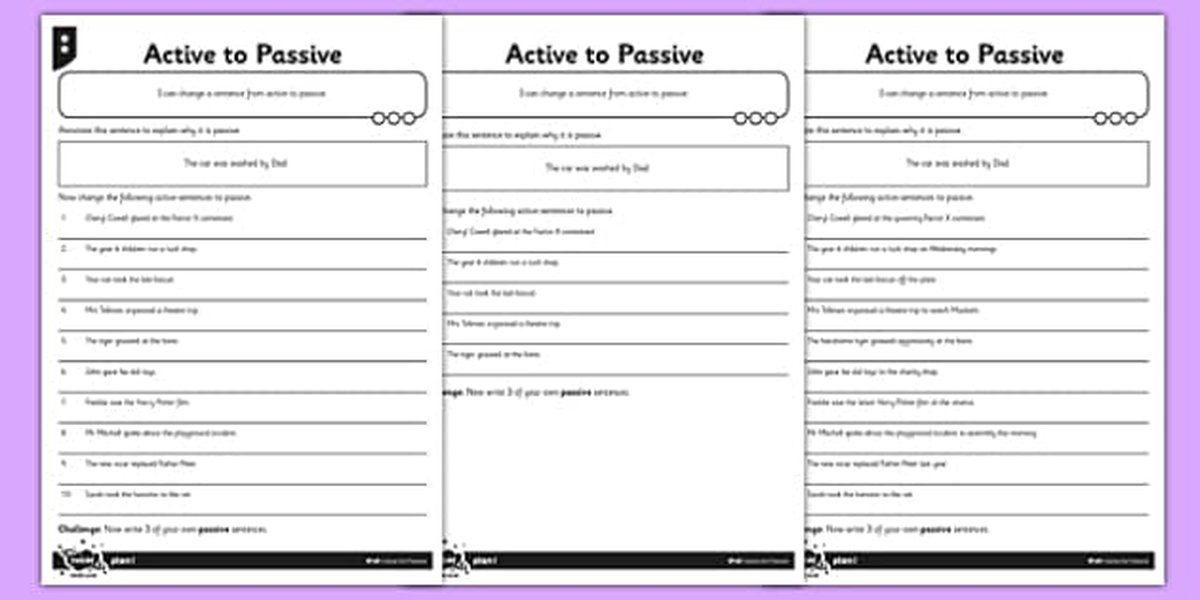
Sorting sentences into active and passive voice categories.
Activity 3: Converting Passive to Active Voice
A key skill is converting sentences from passive to active voice. This helps students see how changing the voice can impact clarity and conciseness.
Rewrite Challenge
Provide students with sentences in passive voice and challenge them to rewrite them in active voice. Discuss the changes they made and how the active version is different.
Example:
Passive: The cake was eaten by John.
Active: John ate the cake.

Passive: The letter was written by Sarah.
Active: Sarah wrote the letter.
Activity 4: Active Voice in Writing
Integrate the concept of active voice into actual writing tasks. Encourage students to revise their own writing to use active voice more frequently.
Paragraph Revision
Have students take a paragraph they have written and identify any sentences in passive voice. Then, have them rewrite those sentences in active voice and discuss how the revised paragraph reads differently.
Activity 5: Visualizing Voice with Cartoons or Scenes
Connecting grammar concepts to visual elements can make learning more engaging, especially for younger learners.
Cartoon Creation
Students can create simple cartoons where the action is clearly depicted. Below each panel, they write a sentence describing the action, first in active voice and then, for comparison, in passive voice. This visually reinforces the difference in emphasis.
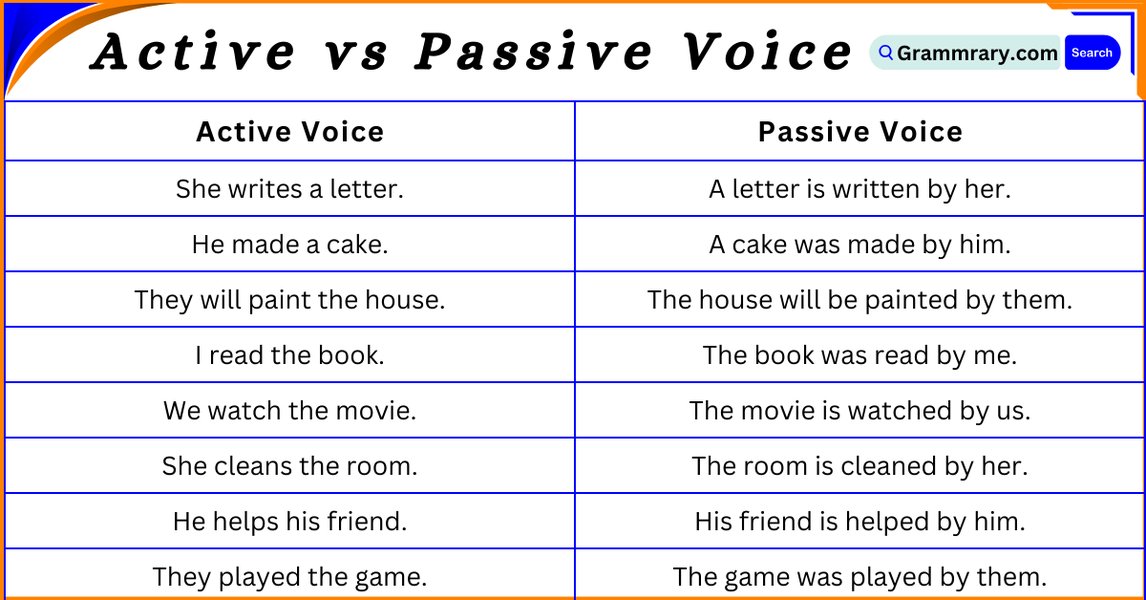
Comparing active and passive voice through examples.
Activity 6: Using Mentor Sentences
Analyzing how skilled writers use active voice can provide valuable insights for students.
Mentor Sentence Analysis
Provide students with excerpts from literature or other well-written texts that effectively use active voice. Have them identify the active voice sentences and discuss the impact of using this voice in those specific contexts.
Structuring Your Lesson Plan
A typical lesson plan for active voice might include the following components:
Introduction (10-15 minutes)
Begin by introducing the concept of voice in grammar. Explain that voice tells us whether the subject of the sentence is performing or receiving the action. Introduce active voice with a clear definition and simple examples.
Guided Practice (20-25 minutes)
Work through examples as a class, guiding students in identifying the subject and verb and determining if the sentence is in active or passive voice. Use activities like the sentence card sort or quick whiteboard exercises.
Independent Practice (15-20 minutes)
Provide students with worksheets or exercises where they can practice identifying and converting sentences on their own. This allows you to assess individual understanding.
Application/Extension (15-20 minutes)
Engage students in activities that require them to use active voice in a more creative or applied way, such as the cartoon creation or paragraph revision activities.
Conclusion/Review (5-10 minutes)
Summarize the key concepts of active voice and answer any remaining questions. Briefly review why active voice is important in writing.
Tips for Effective Teaching
Here are some additional tips to enhance your active voice lessons:
- Use Visual Aids: Diagrams, charts, or even acting out sentences can help students visualize the concepts.
- Provide Immediate Feedback: Correcting misunderstandings early is crucial.
- Connect to Real-World Writing: Show students examples of active voice in news articles, stories, or other texts they encounter daily.
- Encourage Collaboration: Pair students for activities to allow for peer learning and discussion.
- Be Patient: Mastering grammar takes time and practice. Celebrate small victories and provide ongoing support.
Visualizing the Transformation
Understanding the shift from passive to active voice can be made clearer by visually representing the movement of the subject and object. Consider the following table that illustrates this transformation:
| Passive Voice Structure | Transformation Steps | Active Voice Structure |
|---|---|---|
| Subject (receiver) + form of "to be" + Past Participle + ("by" + Doer) | 1. Identify the doer (if present in the "by" phrase). 2. Make the doer the new subject. 3. Move the original subject (receiver) to become the object. 4. Change the verb from passive to active form. |
Subject (doer) + Active Verb + Object (receiver) |
| Example: The letter was written by Sarah. | Doer: Sarah New Subject: Sarah New Object: The letter Active Verb: wrote |
Example: Sarah wrote the letter. |
This table provides a structured way for students to see the mechanics of converting a sentence from passive to active voice.
Leveraging Digital Resources
Many online resources offer interactive exercises and explanations that can supplement your lesson plan. Websites like BrainPOP and Flocabulary provide videos and activities tailored for different grade levels. Additionally, platforms like Teachers Pay Teachers offer a variety of ready-made worksheets and games.
This video provides a lesson and activity on active vs. passive voice, which can be a useful resource.
This embedded video offers a direct visual and auditory explanation of active and passive voice, followed by an activity. Incorporating such videos can break up traditional lecture formats and cater to different learning styles. It provides clear examples and reinforces the concepts discussed in the lesson.
Addressing Common Challenges
Students may face challenges in consistently identifying and using active voice. Some common difficulties include:
-
Confusing the passive voice structure with perfect tenses.
-
Overlooking the "by" phrase in passive sentences.
-
Difficulty in identifying the true doer of the action.
To address these challenges, provide ample practice with varied sentence structures and offer targeted feedback. Encourage students to explain why a sentence is in active or passive voice, rather than just identifying it.
Frequently Asked Questions About Teaching Active Voice
What age group is this lesson plan suitable for?
The activities and explanations can be adapted for various age groups, from elementary to high school. The complexity of the sentences and the depth of analysis can be adjusted according to the students' proficiency levels.
How can I make learning active voice fun?
Incorporate games, competitive activities (like team challenges to convert sentences), visual aids, and connect the concept to topics that interest your students. Allowing them to be creative in applying active voice, such as writing short stories or dialogues, can also enhance engagement.
Should I teach active and passive voice together?
It is often helpful to introduce both concepts together to highlight the differences. However, focusing more heavily on active voice and providing ample practice in using it is generally recommended for clearer writing.
How can I assess student understanding?
Assessment can include worksheets with identification and conversion exercises, analyzing student writing samples for the use of active voice, or short quizzes. Observing student participation and explanations during activities also provides valuable assessment information.
Why is it important for students to learn active voice?
Learning active voice is crucial for developing strong writing skills. It helps students write more clearly, directly, and concisely, making their ideas easier for readers to understand. It is a fundamental skill for effective communication in various contexts.
References
Last updated May 3, 2025