
Beyond the Spark: How Can Compressing Gas Ignite a Fire?
Exploring the surprising power of adiabatic compression to cause ignition in engines and industrial systems.
When we think of ignition, sparks or flames usually come to mind. However, there's a less intuitive but equally powerful mechanism: adiabatic compression. Simply squeezing a gas rapidly, without letting heat escape, can raise its temperature dramatically – sometimes enough to cause spontaneous combustion. This principle is intentionally harnessed in some technologies but also poses significant risks if not properly managed.
Highlights: Understanding Adiabatic Ignition
- Mechanism: Rapid gas compression converts work into internal energy, significantly increasing temperature without external heat addition.
- Engine Relevance: This is the core principle of diesel engines but causes harmful preignition knock in gasoline engines under specific conditions (e.g., running hot or lean).
- Industrial Hazards: Flammable vapors entering air compressors or improper handling of high-pressure gases (especially oxygen) can lead to autoignition and potentially catastrophic fires or explosions.
What is Adiabatic Compression?
Definition and Core Principle
Adiabatic compression is a thermodynamic process where a gas is compressed very quickly, typically in less than a second. The key characteristic is that the compression happens so rapidly that there is negligible time for heat to be exchanged between the gas and its surroundings. In essence, it's a perfectly insulated compression process.
Because heat cannot escape, the mechanical work done on the gas to reduce its volume is entirely converted into an increase in the gas's internal energy. This manifests primarily as a significant rise in temperature and pressure.
The Thermodynamic Foundation
The behavior of an ideal gas undergoing adiabatic compression can be described by specific thermodynamic relationships. Unlike processes governed solely by the Ideal Gas Law (\(PV = nRT\)), adiabatic processes follow these key equations:
\[ PV^\gamma = \text{constant} \]Where:
- \(P\) is the pressure of the gas.
- \(V\) is the volume of the gas.
- \(\gamma\) (gamma) is the adiabatic index, also known as the heat capacity ratio (\(C_p/C_v\)). This ratio depends on the type of gas (e.g., approximately 1.4 for diatomic gases like air at room temperature, 1.67 for monatomic gases).
From this relationship, we can derive how temperature changes with volume or pressure during adiabatic compression:
\[ T_2 = T_1 \left( \frac{V_1}{V_2} \right)^{\gamma-1} \]or equivalently,
\[ T_2 = T_1 \left( \frac{P_2}{P_1} \right)^{\frac{\gamma-1}{\gamma}} \]Where:
- \(T_1, V_1, P_1\) are the initial absolute temperature, volume, and pressure.
- \(T_2, V_2, P_2\) are the final absolute temperature, volume, and pressure.
These equations quantify how dramatically the temperature (\(T\)) increases as the volume (\(V\)) decreases or the pressure (\(P\)) increases during rapid, insulated compression.
Visual representation of adiabatic temperature changes due to pressure variations.
The Ignition Threshold: Autoignition
Understanding Autoignition Temperature
Every flammable substance (fuel, vapor, certain oils) has an autoignition temperature (AIT). This is the minimum temperature at which the substance will spontaneously ignite in a normal atmosphere without an external ignition source like a spark or flame. If the temperature reached during adiabatic compression (\(T_2\)) exceeds the AIT of a flammable gas or vapor mixture present, ignition will occur.
This phenomenon, often called compression ignition or autoignition, is the core reason why adiabatic compression can be both a useful tool and a significant hazard.
Adiabatic Compression in Action: Engines
The Power Behind Diesel Engines
Diesel engines are perhaps the most well-known application of intentional adiabatic compression for ignition. They lack spark plugs. Instead, they rely on extremely high compression ratios (typically 16:1 or higher). During the compression stroke, air alone is drawn into the cylinder and compressed adiabatically to a very high pressure and temperature – easily exceeding the autoignition temperature of diesel fuel. When diesel fuel is then injected into this superheated air, it ignites spontaneously, driving the piston down.
Diesel engines utilize adiabatic compression to achieve ignition temperatures.
The Peril of Preignition Knock in Gasoline Engines
In contrast, gasoline engines use spark plugs to initiate combustion at a precise moment. However, under certain conditions, adiabatic compression can cause problems. If the engine runs too hot (due to cooling system issues), uses a fuel with too low an octane rating, or operates with a very lean air-fuel mixture, the temperature of the fuel-air mix during the compression stroke can reach its autoignition point *before* the spark plug fires. This premature, uncontrolled ignition is known as **preignition** or **engine knock**.
Knocking creates sharp pressure waves inside the cylinder, leading to a characteristic pinging or knocking sound, reduced performance, and potentially severe engine damage. It also explains why some significantly overheated engines might continue to sputter or "run on" briefly even after the ignition key is turned off – the residual heat combined with the compression cycle is enough to keep igniting the fuel.
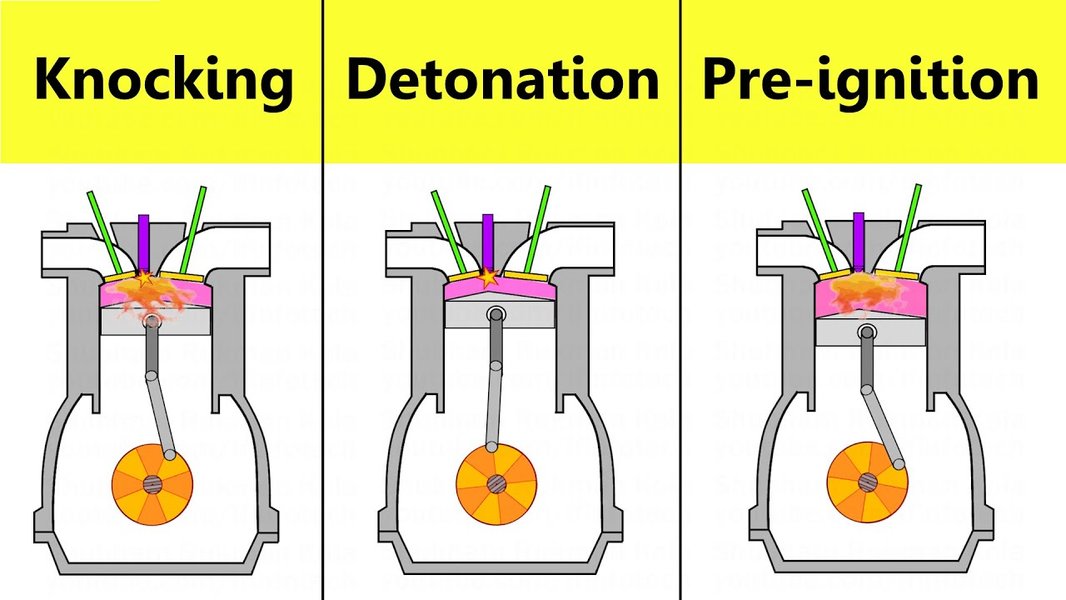
Preignition knock is an undesirable consequence of premature autoignition in gasoline engines.
Hidden Dangers: Risks in Compressors and Industrial Systems
Air Compressors: A Susceptible Environment
Adiabatic compression poses significant safety risks in industrial settings, particularly involving air compressors. If flammable vapors – such as hydrocarbons from lubricating oils, process leaks, or contaminated intake air – are drawn into a compressor, the rapid compression cycle can heat these vapors above their autoignition temperature.
This can lead to internal fires or explosions within the compressor or associated piping, sometimes referred to as the "Diesel Effect" occurring where it's not intended. Several major industrial accidents have been attributed to this mechanism.
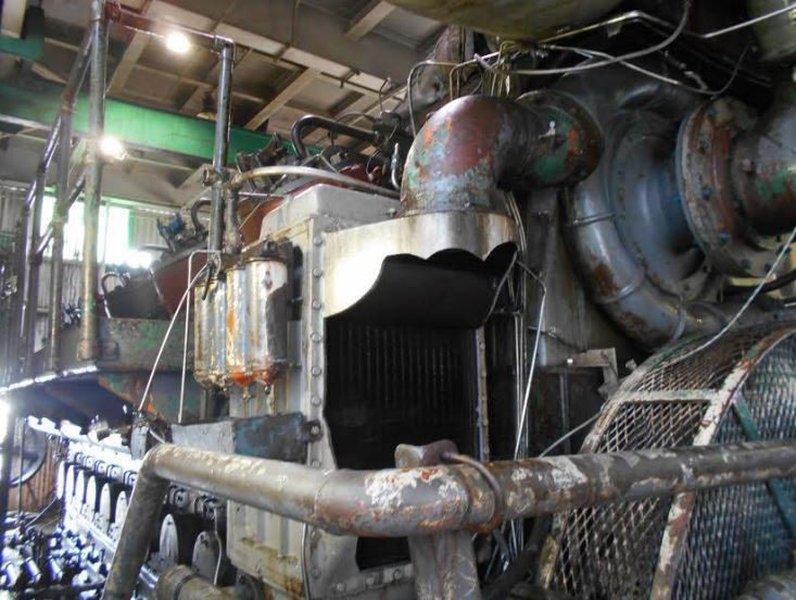
Compressor systems require safeguards against autoignition caused by adiabatic compression of contaminants.
The Critical Role of After-Coolers
Most compressors incorporate after-coolers designed to remove the heat of compression from the discharged air. However, if these after-coolers become fouled (e.g., clogged with dirt, oil residue, or scale), their efficiency drops significantly. This means the compressed gas remains much hotter than intended, substantially increasing the risk of any entrained flammable vapors reaching their autoignition temperature.
Oxygen Systems: A Special Case
Adiabatic compression is a particular concern in systems handling pure or enriched oxygen. Oxygen itself doesn't burn, but it vigorously supports combustion. Rapidly compressing oxygen, such as by opening a high-pressure valve too quickly into a downstream section, can generate significant heat. If even tiny amounts of contaminants like oils, greases, metal particles, or other organic materials are present in the system (e.g., on valve seats or pipe walls), this heat can easily raise them above their ignition temperature in the oxygen-rich environment, leading to violent ignition or explosions.
This phenomenon is sometimes called the "gas hammer effect" or "heat of compression ignition." Ensuring extreme cleanliness ("oxygen clean") and operating valves slowly are critical safety measures in oxygen service.
Calculating the Temperature Rise: A Practical Example
Applying the Thermodynamic Equation
We can use the thermodynamic equations to estimate the potential temperature rise. Let's consider an example of compressing air in a compressor:
Example Calculation
Suppose air enters a compressor stage at atmospheric pressure (\(P_1 = 1 \, \text{atm}\)) and room temperature (\(T_1 = 27^\circ\text{C} = 300 \, \text{K}\)). It is compressed adiabatically to a final pressure of \(P_2 = 10 \, \text{atm}\). We assume air behaves as an ideal diatomic gas with \(\gamma = 1.4\).
Using the pressure-temperature relationship:
\[ T_2 = T_1 \left( \frac{P_2}{P_1} \right)^{\frac{\gamma-1}{\gamma}} \] \[ T_2 = 300 \, \text{K} \times \left( \frac{10 \, \text{atm}}{1 \, \text{atm}} \right)^{\frac{1.4-1}{1.4}} \] \[ T_2 = 300 \, \text{K} \times (10)^{\frac{0.4}{1.4}} \approx 300 \, \text{K} \times (10)^{0.2857} \] \[ T_2 \approx 300 \, \text{K} \times 1.9307 \approx 579 \, \text{K} \]Converting back to Celsius:
\[ T_2 \approx 579 - 273 = 306^\circ\text{C} \]This calculated temperature (\(306^\circ\text{C}\) or \(583^\circ\text{F}\)) might already exceed the autoignition temperature of some lubricating oils or volatile vapors, illustrating the potential hazard even under moderate compression ratios if contaminants are present.
Visualizing Factors Influencing Adiabatic Ignition Risk
The risk of ignition due to adiabatic compression isn't uniform; it depends on several interacting factors. The radar chart below provides a conceptual comparison of the relative importance of key factors across different scenarios. Higher values indicate a greater contribution to ignition risk in that specific context.
This chart highlights how factors like contamination and poor cooling can dramatically elevate risk in compressor systems, while high initial temperature is a key concern for preignition in gasoline engines. In oxygen systems, rapid pressure changes and absolute cleanliness are paramount.
Mapping the Concepts: Adiabatic Compression and Ignition
The mindmap below visually organizes the core concepts surrounding adiabatic compression, linking its definition and underlying thermodynamics to its applications, associated risks, and essential mitigation strategies.
Rapid compression
No heat exchange
Temperature increases"] id2["Thermodynamics"] id2a["PV^gamma = constant"] id2b["T2 = T1 * (V1/V2)^(gamma-1)"] id2c["T2 = T1 * (P2/P1)^((gamma-1)/gamma)"] id2d["Role of gamma (Cp/Cv)"] id3["Applications & Examples"] id3a["Diesel Engines
(Intentional Ignition)"] id3b["Gasoline Engines
(Preignition Knock Risk)"] id3c["Air Compressors"] id3d["Oxygen Systems"] id3e["Fire Syringe
(Demonstration)"] id4["Ignition Mechanism"] id4a["Temperature Rise > Autoignition Temp (AIT)"] id4b["Spontaneous Ignition
(No External Spark)"] id4c["Compression Ignition"] id5["Risks & Hazards"] id5a["Engine Knock / Damage"] id5b["Compressor Fires / Explosions"] id5c["Oxygen System Fires"] id5d["Process Safety Incidents"] id5e["Role of Contaminants (Oil, Vapors)"] id5f["Effect of Fouled Coolers"] id6["Mitigation & Safeguards"] id6a["System Design
(Cooling, Materials)"] id6b["Operational Procedures
(Slow Valve Opening)"] id6c["Maintenance
(Cleaning, Cooler Upkeep)"] id6d["Intake Air Quality Control"] id6e["Material Compatibility Testing (e.g., for O2)"] id6f["Pressure/Temperature Monitoring"]
This map illustrates how the fundamental principles of thermodynamics translate into practical applications and potential dangers, emphasizing the need for robust safety measures in relevant systems.
Demonstrating the Principle: The Fire Syringe
A classic physics demonstration vividly illustrates adiabatic compression ignition: the fire syringe. This simple device consists of a plunger fitting tightly into a clear cylinder, with a small piece of flammable material (like cotton or char cloth) placed at the bottom. When the plunger is pushed down very rapidly, the air inside is compressed adiabatically.
The resulting temperature increase is dramatic enough to exceed the autoignition temperature of the cotton, causing it to flash ignite briefly – all without any external heat source. This directly showcases the power of rapid compression to generate ignition temperatures.
Video demonstrating the fire syringe, where rapid air compression ignites cotton wool.
Safeguarding Against Adiabatic Ignition
Given the potential hazards, preventing unintended ignition from adiabatic compression requires careful consideration in design, operation, and maintenance.
Design and Engineering Controls
- Implementing effective after-coolers in compressor systems to remove heat.
- Selecting materials compatible with the process fluids and temperatures, especially in oxygen service (e.g., using materials resistant to adiabatic compression ignition).
- Designing systems to avoid rapid, uncontrolled pressure changes (e.g., specifying slow-opening valves).
- Incorporating temperature and pressure monitoring with alarms or automated shutdowns.
- Considering flame arrestors or explosion venting where appropriate.
Operational Procedures and Maintenance
- Strict adherence to procedures for opening high-pressure valves slowly, especially in oxygen systems.
- Regular inspection and cleaning schedules to prevent fouling of coolers and accumulation of contaminants.
- Controlling the quality of intake air for compressors to minimize ingestion of flammable vapors.
- Ensuring system cleanliness, particularly in oxygen service, prohibiting oil and grease contamination.
- Proper lubrication practices, using lubricants with appropriate autoignition characteristics for the operating conditions.
The table below summarizes key risks and corresponding safeguards for different systems:
| System Type | Primary Adiabatic Ignition Risk | Key Safeguards |
|---|---|---|
| Gasoline Engine | Preignition knock due to high temperature/lean mixture/hot spots | Proper engine tuning, correct fuel octane, effective cooling system, avoid overheating |
| Air Compressor | Autoignition of ingested vapors (lubricants, process contaminants) | Effective after-cooling, regular cooler maintenance, intake air filtering/monitoring, proper lubricant selection |
| High-Pressure Oxygen System | Ignition of contaminants (oil, particles) due to rapid compression (gas hammer) | Strict cleanliness standards ("Oxygen Clean"), slow valve operation procedures, material compatibility testing (e.g., ISO 21969), particle filters |
| General High-Pressure Gas Systems | Ignition of flammable components if present during rapid pressurization | Slow pressurization protocols, system cleanliness, material compatibility checks, pressure/temperature monitoring |
Frequently Asked Questions (FAQ)
What's the difference between adiabatic and isothermal compression?
Adiabatic compression occurs rapidly with no heat exchange, causing temperature to rise significantly. Isothermal compression occurs very slowly, allowing heat to transfer out so that the temperature remains constant, while pressure increases.
Why is the adiabatic index (gamma, γ) important?
Gamma (\(\gamma\)) reflects how much the temperature rises for a given compression. Gases with higher gamma values (like monatomic gases, γ ≈ 1.67) experience a larger temperature increase for the same compression ratio compared to gases with lower gamma values (like diatomic gases/air, γ ≈ 1.4). This affects the final temperature achieved and thus the ignition risk.
How fast does compression need to be for it to be considered adiabatic?
There's no strict cutoff, but generally, the compression needs to happen faster than the rate at which heat can dissipate into the surroundings. In practical terms, processes occurring in fractions of a second to about one second (like an engine stroke or rapid valve opening) are often treated as approximately adiabatic.
What are typical autoignition temperatures (AITs)?
AITs vary widely. For example, gasoline vapor is around 280°C (536°F), diesel fuel is around 210°C (410°F), many mineral lubricating oils are between 250-370°C (482-698°F), but some volatile hydrocarbons can have lower AITs, especially under pressure. Contaminants can also lower the effective AIT of a mixture.
Recommended Further Exploration
- How do different gas properties affect adiabatic temperature rise?
- What are the specific safety standards for oxygen system design regarding adiabatic compression?
- Compare preignition knock and detonation in gasoline engines.
- Case studies of industrial accidents caused by adiabatic compression in compressors.
References
Last updated April 27, 2025