
Crafting Your Expert Resume: Aerospace Structural Engineer Specializing in Satellite Systems
Showcasing your expertise in designing and analyzing resilient satellite structures for the final frontier.
As an Aerospace Structural Engineer with a specialization in satellite structures, your resume needs to meticulously detail your technical proficiency, project experience, and analytical capabilities. This document serves as your primary tool to demonstrate how your skills align with the demanding requirements of the aerospace industry, particularly in the design, analysis, and testing of spacecraft. Below is a comprehensive template designed to help you construct a compelling resume that highlights your unique qualifications and experience with satellite structures.
Key Highlights of Your Profile
- Practical Experience: Demonstrated involvement in satellite structural design, encompassing rigorous analysis and thorough testing phases to ensure mission success.
- Technical Proficiency: Expertise in industry-standard software for Finite Element Analysis (FEA) and Computer-Aided Design (CAD), coupled with a strong understanding of advanced materials like composites.
- Project Acumen: Proven ability to significantly contribute to complex aerospace projects, from initial conceptualization and design through to validation and deployment.
Please replace the placeholder information below with your personal details.
[Your Full Name]
[Your Address]
[City, State, ZIP Code]
Phone: [Your Phone Number]
Email: [Your Email Address]
LinkedIn: [Your LinkedIn Profile URL (e.g., linkedin.com/in/yourprofile)]
Professional Profile: Charting Your Course in Aerospace
Summary of Qualifications
A highly motivated and detail-oriented Aerospace Structural Engineer with a strong academic foundation in Aerospace Engineering and specialized hands-on experience in the design, analysis, and testing of satellite structures. Proficient in leveraging advanced software tools such as STAAD.Pro, ANSYS, and NASTRAN for complex structural simulations, including static, dynamic, thermal, and vibration analyses. Proven ability to work with lightweight composite materials (e.g., CFRP) and metallic alloys, optimizing structural performance and minimizing mass for space applications. Adept at collaborating within cross-functional teams to deliver high-quality, reliable aerospace projects that meet stringent industry standards and mission objectives. Eager to apply expertise in structural integrity, load path determination, and innovative design solutions to challenging satellite projects.
Core Competencies & Technical Arsenal
Key Engineering Proficiencies
- Satellite Structural Design & Analysis
- Finite Element Analysis (FEA): Static, Dynamic, Modal, Thermal, Buckling
- Advanced Composite Materials (CFRP, GFRP, Metal Matrix Composites)
- Lightweight Metallic Structures (Aluminum, Titanium Alloys) * Structural Dynamics & Vibration Analysis (Sine, Random, Acoustic) * Thermal Load Assessment & Thermo-elastic Analysis * Structural Testing, Validation & Qualification (Static, Dynamic, Modal) * Launch Load Analysis & Environment Definition * On-Orbit Structural Behavior Prediction * Fracture Mechanics & Fatigue Life Assessment * Material Characterization & Selection for Space Environments * Aerospace Project Management Principles * Technical Documentation, Reporting & Compliance (e.g., NASA, ECSS standards) * Cross-Disciplinary Team Collaboration
Software and Tools Mastery
- FEA Software: ANSYS, NASTRAN, Abaqus, STAAD.Pro
- CAD Software: SolidWorks, CATIA, AutoCAD
- Programming & Analysis: MATLAB, Python (for scripting, data analysis, and automation)
- Operating Systems: Windows, Linux * Version Control: Git
Visualizing Your Skill Spectrum
The following chart provides a visual representation of key skill areas pertinent to an Aerospace Structural Engineer specializing in satellite systems. It illustrates a balanced proficiency across core analytical capabilities, advanced application development, and overarching project and system-level competencies, showcasing a well-rounded expertise crucial for tackling the multifaceted challenges in satellite structural engineering.
Professional Experience: Engineering the Future of Satellites
Satellite Structural Engineer
[Company Name], [City, State] — [Month Year] to Present (or relevant dates)
- Led the structural design, analysis, and verification of satellite primary and secondary structures, including bus platforms, payload interfaces, and deployable mechanisms (e.g., solar arrays, antennas) using STAAD.Pro, ANSYS, and NASTRAN.
- Conducted comprehensive Finite Element Analyses (FEA) encompassing static (gravity, inertial loads), dynamic (modal, shock, random vibration, acoustic), and thermal-structural simulations to ensure structural integrity across all mission phases (launch, deployment, on-orbit operations).
- Developed and validated advanced composite material applications, particularly Carbon Fiber Reinforced Polymers (CFRP), for critical satellite components, achieving significant mass reductions (e.g., 15-20%) while maintaining or enhancing stiffness, strength, and dimensional stability.
- Performed detailed stress, strain, deformation, buckling, and fatigue life assessments to predict structural behavior under extreme environmental conditions, including launch stresses, thermal cycling, and space radiation effects.
- Collaborated extensively with multidisciplinary teams including thermal engineers, propulsion specialists, systems engineers, and manufacturing teams to optimize designs, resolve complex interface challenges, and ensure seamless integration of structural components.
- Authored and maintained detailed technical documentation, including structural analysis reports, design specifications, test plans, validation procedures, and compliance matrices for internal reviews and external regulatory bodies (e.g., NASA, ESA, FCC).
- Managed and executed structural test campaigns, including modal surveys, static load tests, and vibration qualification tests (sine and random) on prototype and flight hardware to validate analytical models and verify compliance with mission requirements.
- Participated actively in Materials Review Board (MRB) activities, evaluating material and manufacturing non-conformances, and proposing technically sound dispositions or corrective actions for satellite hardware.
- Contributed to the development of innovative structural health monitoring (SHM) strategies for assessing long-term performance and predicting potential failures in on-orbit satellite structures.
- Supported trade studies for material selection, structural concepts, and manufacturing processes to achieve optimal balance between performance, cost, schedule, and risk.
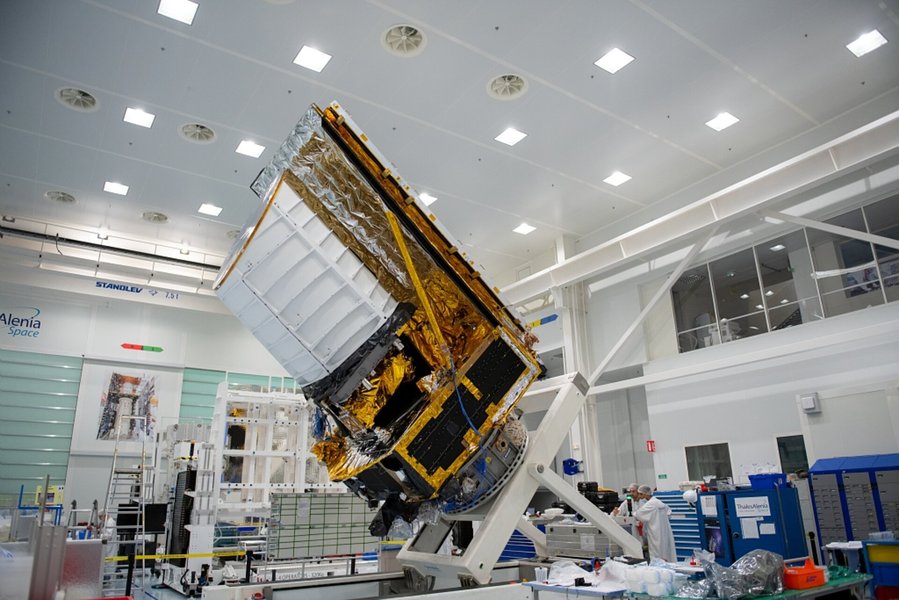
Structural and thermal model of the Euclid satellite, illustrating the complexity involved in designing spacecraft structures.
(Optional: Previous Role or Internship, e.g., Junior Structural Engineer)
[Previous Company Name], [City, State] — [Month Year] to [Month Year]
- (Detail responsibilities and achievements relevant to structural engineering and aerospace)
Foundations in Aerospace Engineering
Educational Background
Bachelor of Science (or Master of Science) in Aerospace Engineering
[University Name], [City, State]
Graduated: [Month, Year]
Specialization/Focus (if applicable): Aerospace Structures, Spacecraft Design, Satellite Systems Engineering
Relevant Coursework:
- Aerospace Structures & Mechanics of Materials
- Finite Element Analysis & Computational Methods
- Spacecraft Design & Satellite Systems
- Structural Dynamics & Vibrations
- Composite Materials & Lightweight Structures
- Aerodynamics & Astrodynamics
- Thermal Analysis in Aerospace Applications
- Materials Science for Aerospace Engineers
Capstone Project (Example):
Design and Analysis of a Small Satellite (CubeSat) Deployable Solar Array Mechanism: Led structural modeling and simulation efforts, optimizing for launch survivability and on-orbit deployment reliability. Utilized ANSYS for FEA and SolidWorks for CAD, culminating in a successful design review and prototype testing.
Certifications & Specialized Training
- [Relevant Certification Name, Issuing Body, Year (e.g., Professional Engineer (PE) License)]
- [Training Program in Advanced FEA, Composite Material Design, etc.]
- (Or: "Certifications available upon request" or "Actively pursuing [Certification Name]")
Showcase: Satellite Structure Projects
Project Highlights & Contributions
My project experience demonstrates a practical application of aerospace structural engineering principles to real-world satellite challenges, focusing on innovation, reliability, and performance.
Satellite Component Mass Optimization Initiative
Successfully re-engineered a critical satellite antenna support structure, employing topology optimization techniques and advanced carbon-fiber reinforced polymer (CFRP) layups. Achieved a 22% reduction in component mass while increasing natural frequency by 15%, thereby enhancing pointing accuracy and reducing launch costs. Validated design through rigorous FEA and qualification testing.
CubeSat Deployable Mechanism Structural Integrity Project
Led the structural design and analysis for a novel deployable high-gain antenna system for a 6U CubeSat mission. Performed detailed modal, static, and transient dynamic analyses to ensure survivability during launch G-loads and successful deployment in orbit. Implemented a unique kinematic solution that minimized stowed volume and deployment shock.
Thermal-Structural Coupled Analysis for Earth Observation Satellite Payload
Conducted comprehensive coupled thermal-structural analyses for a high-precision optical instrument mounted on an Earth observation satellite. Modeled on-orbit thermal variations and their impact on structural stability and optical alignment. Developed passive thermal control solutions and structural interface designs to mitigate thermal distortion, ensuring instrument performance exceeded mission requirements.
Advanced Composite Material Characterization for Deep Space Mission
Spearheaded a research project to characterize the performance of novel radiation-hardened composite materials for a long-duration deep space satellite. This involved defining test protocols, overseeing material coupon fabrication and testing (tensile, compressive, shear, fatigue under simulated space environmental conditions), and correlating experimental data with analytical models to inform material selection for primary structural elements.
Mapping Expertise in Satellite Structural Engineering
Interconnected Domains of Knowledge
The field of satellite structural engineering is multifaceted, requiring a deep understanding of various interconnected disciplines. The mindmap below illustrates the core areas of expertise, responsibilities, and key considerations that define the role of a Satellite Structural Engineer. It highlights how structural design and analysis, materials science, software proficiency, and project management converge to ensure the integrity and success of satellite missions.
Dynamic
Thermal
Modal)"] id1b["Component & System Level Design"] id1c["Launch Load Analysis (LLA)"] id1d["On-Orbit Environment Analysis"] id1e["Buckling & Stability Assessment"] id1f["Fatigue & Fracture Mechanics"] id2["Materials Science & Application"] id2a["Composite Materials (CFRP
GFRP
Sandwich Panels)"] id2b["Lightweight Alloys (Aluminum
Titanium
Magnesium)"] id2c["Material Characterization & Testing"] id2d["Space Environmental Effects (Radiation
Outgassing
Thermal Cycling)"] id3["Software & Tools Proficiency"] id3a["FEA Software (ANSYS
NASTRAN
STAAD.Pro
Abaqus)"] id3b["CAD Software (SolidWorks
CATIA
NX)"] id3c["Programming (MATLAB
Python for analysis automation)"] id4["Project Experience & Key Responsibilities"] id4a["Satellite Bus Structures Design"] id4b["Payload Integration & Interface Design"] id4c["Deployable Structures (Antennas
Solar Arrays
Booms)"] id4d["Structural Testing & Validation (Modal
Static
Vibration)"] id4e["Technical Documentation & Reporting"] id4f["Regulatory Compliance & Standards (NASA
ECSS
MIL-STD)"] id5["Critical Engineering Considerations"] id5a["Mass Optimization & Weight Reduction"] id5b["Structural Integrity & Reliability"] id5c["Mission Specific Requirements & Constraints"] id5d["Manufacturability, Assembly & Integration (MAI)"] id5e["Cost & Schedule Management"]
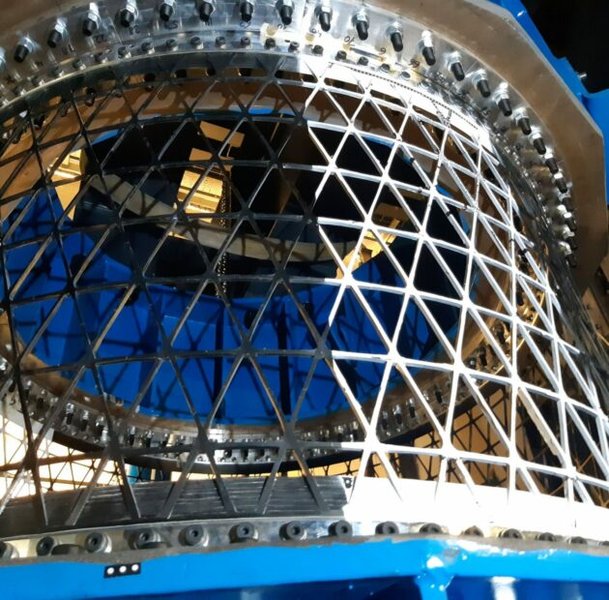
Example of a cylindrical lattice structure, an innovative lightweight solution often considered for satellite applications to optimize strength-to-weight ratios.
Analytical Toolkit for Satellite Structures
Key Software and Techniques Employed
A robust toolkit of analytical software and engineering techniques is essential for the rigorous demands of designing and verifying satellite structures. The table below summarizes some of_the primary tools and methodologies used to ensure structural performance, safety, and reliability throughout a satellite's lifecycle, from initial concept to on-orbit operation.
| Technique/Software | Description | Application in Satellite Structures |
|---|---|---|
| Finite Element Analysis (FEA) | A numerical method for solving complex engineering problems by discretizing a structure into smaller elements. | Performs stress, strain, deformation, vibration, thermal, and buckling analyses of satellite components and entire assemblies under various load conditions. |
| STAAD.Pro | Comprehensive structural analysis and design software widely used for beam, plate, and shell structures. | Primarily used for the design and analysis of primary and secondary satellite structures, truss frameworks, and support elements. |
| ANSYS / NASTRAN / Abaqus | Advanced, general-purpose FEA software suites offering extensive multi-physics simulation capabilities. | Conduct detailed and complex simulations, including non-linear analysis, contact problems, explicit dynamics (e.g., deployment events, impact), and coupled-field analyses (thermo-structural) for intricate satellite systems. |
| Composite Material Analysis | Specialized analytical techniques and software modules for modeling anisotropic and layered composite materials. | Enables design optimization of composite layups, prediction of failure modes (e.g., delamination, fiber failure), and assessment of long-term durability for composite parts such as reflectors, solar panels, and bus structures. |
| Modal Analysis | Determines the natural frequencies (resonant frequencies) and corresponding mode shapes of a structure. | Crucial for avoiding resonance with launch vehicle induced vibrations, predicting dynamic response, and validating finite element models against experimental modal test data (GVT - Ground Vibration Test). |
| Thermal Analysis | Simulates temperature distributions, heat transfer paths (conduction, convection, radiation), and thermal gradients within a structure. | Assesses thermal stresses and distortions, ensures components operate within acceptable temperature ranges, and informs the design of thermal control systems. Essential for thermo-elastic stability of precision instruments. |
| CAD (SolidWorks/CATIA/NX) | Computer-Aided Design software for creating 2D and 3D geometric models of parts and assemblies. | Used for generating detailed geometric models that serve as the input for FEA, as well as for creating manufacturing drawings, assembly instructions, and interface control documents. |
| MATLAB / Python Scripting | High-level programming languages often used for pre/post-processing FEA data, automating analysis workflows, and custom tool development. | Automates repetitive analysis tasks, develops custom material models, performs parametric studies, optimizes designs through algorithms, and visualizes complex simulation results. |
Understanding Spacecraft Structures: Parts and Failure Modes
Insights from Aerospace Engineering Education
A fundamental aspect of designing robust satellite structures involves a thorough understanding of the various spacecraft components and their potential failure modes. The following video, "Aerospace Structures I - 7. Spacecraft Parts and Failure Modes," offers valuable educational insights into these critical areas. It discusses the diverse elements that constitute a spacecraft, from the primary bus structure to deployable appendages like antennas and solar arrays, and explores how different types of loads (mechanical, thermal, dynamic) can lead to structural failures. For a structural engineer, grasping these concepts is paramount for anticipating challenges, implementing preventative design measures, selecting appropriate materials, and ensuring the overall integrity and longevity of a satellite mission.
Frequently Asked Questions (FAQ)
What are your key strengths in satellite structural engineering? ▼
My key strengths lie in the comprehensive structural analysis of satellite components and systems, particularly using advanced FEA tools like ANSYS and NASTRAN. I have significant experience in designing with lightweight composite materials to optimize for mass and stiffness, crucial for launch and on-orbit performance. Furthermore, I excel in analyzing structures under dynamic and thermal loads, ensuring their integrity in the harsh space environment. My project experience includes managing the structural aspects from conceptual design through to testing and validation.
Can you describe your experience with Finite Element Analysis (FEA) tools? ▼
I am proficient in using a range of FEA software, including ANSYS, NASTRAN, and STAAD.Pro. My experience covers static analysis (for launch loads, steady-state accelerations), dynamic analysis (modal, frequency response, random vibration, shock), thermal stress analysis, and buckling analysis. I have applied these to various satellite structures, from individual components like brackets and panels to complex assemblies like payload support structures and deployable solar arrays. I'm adept at mesh generation, boundary condition application, results interpretation, and model validation against test data.
How do you approach material selection for space applications? ▼
My approach to material selection for space applications is multi-faceted. Key considerations include:
- Specific Strength and Stiffness: To minimize mass while meeting structural requirements. Composites like CFRP are often favored.
- Thermal Properties: Coefficient of Thermal Expansion (CTE) for dimensional stability, and thermal conductivity.
- Outgassing: Low outgassing materials are critical to prevent contamination of sensitive optical surfaces or electronics.
- Radiation Resistance: For long-duration missions or those in high-radiation environments.
- Fatigue and Fracture Toughness: To withstand cyclic loading during launch and operations.
- Manufacturability and Cost: Practical considerations for fabrication and assembly.
What is your experience with structural testing and validation for satellites? ▼
I have hands-on experience in defining, overseeing, and analyzing results from various structural tests for satellite hardware. This includes:
- Modal Testing (Ground Vibration Testing - GVT): To identify natural frequencies and mode shapes, and to correlate/update FEA models.
- Static Load Testing: To verify strength and stiffness under design limit loads and ultimate loads.
- Vibration Testing: Sine sweep, random vibration, and acoustic testing to qualify structures for launch environments.
- Shock Testing: To simulate pyrotechnic separation events.
Recommended Further Exploration
Deepen Your Understanding
- How are advanced composite materials utilized in modern satellite structures to enhance performance and reduce weight?
- What are the key challenges in structural analysis for deployable satellite mechanisms like antennas and solar arrays?
- Describe the process of qualifying satellite structures for the extreme vibration and acoustic environments during launch.
- What are the latest trends in structural health monitoring for on-orbit satellites and their implications for future designs?
References
Sources & Further Reading
Last updated May 16, 2025