
Unpacking Agilent TapeStation Sales: An Inside Look Beyond the Numbers
Delving into market dynamics and expert estimations for Agilent's popular electrophoresis units, where concrete sales figures remain elusive.
Key Insights: Estimating TapeStation Sales
- Elusive Official Figures: Exact monthly sales numbers for Agilent TapeStation units are not publicly disclosed by Agilent, making precise quantification challenging. This information is typically proprietary.
- A Reasoned, Unconfirmed Estimate: While not official, some market analyses, considering factors like market size, demand in genomics, and Agilent's overall performance, suggest a potential global sales volume of approximately 800–900 units per month across all TapeStation versions. This remains an educated guess.
- Sustained Market Demand: TapeStation systems are integral to modern life science research, particularly in next-generation sequencing (NGS) workflows, biobanking, and pharmaceutical development, indicating strong and consistent demand from academic, clinical, and industrial laboratories worldwide.
Understanding Agilent TapeStation Systems
The Agilent TapeStation family of instruments provides automated electrophoresis solutions crucial for the quality control (QC) of nucleic acid (DNA and RNA) samples. These systems are vital in modern molecular biology labs, offering analysis of sample size, quantity, and integrity with speed and precision.
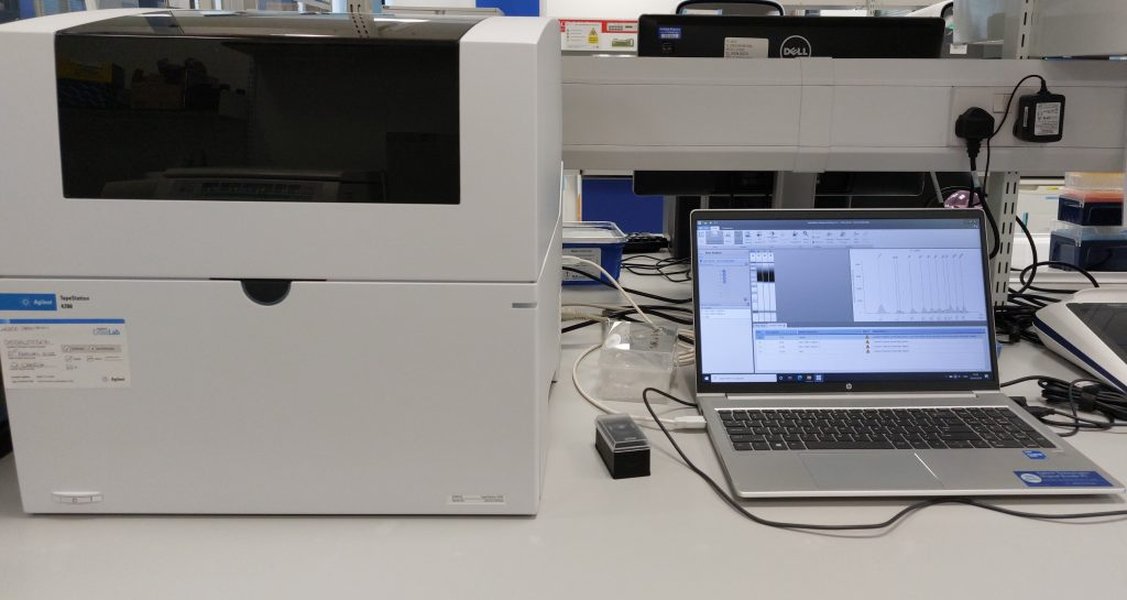
An Agilent TapeStation system being utilized in a typical laboratory environment for sample analysis.
Core Functionality and Importance
TapeStation systems automate traditional gel electrophoresis, minimizing hands-on time and improving reproducibility. They use pre-packaged ScreenTape consumables, which are credit card-sized devices containing individual lanes for sample separation. This technology allows for rapid analysis, typically within 1-2 minutes per sample after initial setup. The ability to quickly assess sample quality is paramount before downstream applications like NGS, PCR, or microarray analysis, as poor sample quality can lead to failed experiments and wasted resources.
Key System Versions and Their Roles
Agilent offers several TapeStation models to cater to diverse laboratory needs, primarily differing in throughput and specific application focuses:
- Agilent 2200 TapeStation: Often considered a versatile, mid-level system, it offers a balance of automation and throughput suitable for labs with moderate sample numbers. It automates sample loading, separation, and imaging.
- Agilent 4150 TapeStation: Positioned as a lower-throughput, more economical option. It can process up to 16 samples per run and is ideal for labs with smaller workflows or those transitioning to automated QC.
- Agilent 4200 TapeStation: This is the flagship high-throughput system, capable of analyzing up to 96 samples per run (compatible with 96-well plates). It is widely adopted in genomics core facilities, NGS service providers, biobanks, and large research institutions requiring robust and scalable QC.
The choice of system often depends on the lab's sample volume, budget, and the specific demands of their research or diagnostic applications.

The Agilent 4150 TapeStation system, designed for lower-throughput applications.
Market Dynamics and Demand Drivers
The demand for Agilent TapeStation systems is influenced by several interconnected factors within the life sciences and diagnostics markets.
Global Reach and User Base
TapeStation systems are sold globally, catering to a broad spectrum of users including academic research laboratories, clinical diagnostic labs, pharmaceutical and biotechnology companies, and biobanks. Agilent leverages a direct sales force and a network of distributors to reach these customers.
Integral Role in Key Scientific Workflows
The most significant driver for TapeStation sales is its critical role in next-generation sequencing (NGS) workflows. NGS requires high-quality DNA and RNA input, and TapeStation provides an efficient means to verify this. As NGS applications expand in research (e.g., genomics, transcriptomics, epigenomics) and clinical settings (e.g., cancer diagnostics, genetic testing), the demand for reliable QC instruments like the TapeStation grows in tandem.
Other applications contributing to demand include:
- Biobanking: Ensuring the integrity of stored samples.
- Vaccine development and production: QC of nucleic acid-based vaccines.
- General molecular biology: Routine checks for PCR products, DNA fragments, and RNA integrity.
Agilent's Market Position and Financials
Agilent Technologies is a major player in the analytical and life sciences instrument market. While the company does not typically break out unit sales for specific instruments like the TapeStation, its overall financial performance in relevant segments offers some context. For example, Agilent's Life Sciences and Applied Markets Group (LSAG), which includes such instrumentation, reported revenues of $1.70 billion for the fourth quarter of fiscal year 2024 (ending October 31, 2024). The company's total revenue for the fiscal year 2024 was reported at $6.51 billion, underscoring its significant market presence. This strong overall performance suggests a healthy demand for its portfolio, including specialized systems like the TapeStation.
Furthermore, the availability of TapeStation systems on the used equipment market, through vendors like The Lab World Group, Machinio, and eBay, indicates a mature product line with ongoing turnover and residual value.
Challenges in Estimating Monthly Sales
Pinpointing an exact number of Agilent TapeStation units sold per month is fraught with challenges, primarily due to the proprietary nature of such data.
Lack of Publicly Disclosed Unit Sales Data
Agilent, like most instrument manufacturers, does not publicly release detailed unit sales figures for specific product lines. Financial reports provide aggregated revenue data by segment, but not the granularity needed to determine monthly unit sales for TapeStation systems. Such information is considered commercially sensitive.
Factors Influencing Sales Variability
Even if average figures were available, monthly sales can fluctuate significantly due to various factors:
- Budget Cycles: Academic and governmental institutions often make large purchases based on fiscal year funding.
- Large Institutional Orders: A single large order from a major research consortium or pharmaceutical company can skew monthly figures.
- Product Launch Cycles: The introduction of new models or significant upgrades can lead to initial sales spikes.
- Competitive Landscape: The presence and marketing efforts of competing automated electrophoresis systems can influence market share.
- Regional Demand: Economic conditions, research funding priorities, and healthcare investments vary by region, impacting sales.
- Consumable Sales: While not unit sales of instruments, the ongoing purchase of ScreenTapes and reagents is a significant and recurring revenue stream for Agilent, indicating the active use of the installed base.
A Reasoned (but Unconfirmed) Sales Estimate
Despite the lack of official data, some market observers and analyses attempt to derive estimates based on indirect factors. One such reasoned, albeit unconfirmed, estimate suggests that Agilent might sell approximately 800 to 900 TapeStation units per month globally, across all versions (2200, 4150, 4200, and any other variants).
It is crucial to reiterate that this is an estimation and not an official figure released by Agilent. It is based on a synthesis of market understanding rather than direct sales data.
Basis for Such an Estimate
An estimate like this would typically be formulated by considering several factors:
- Installed Base and Market Demand: The TapeStation systems, particularly the 4200 model, are well-established and popular. Given the global expansion of NGS and large-scale genomic studies, there's a continuous demand for new units and replacements.
- Price Points and Revenue Benchmarks: New TapeStation systems can range from approximately $20,000 (for lower-end models) to over $100,000 (for high-end configurations with software and service packages). Correlating these with Agilent's segment revenues can provide a rough sense of potential unit volumes.
- Market Penetration and Sales Dynamics: Agilent's global sales infrastructure and strong presence in academic, clinical, pharmaceutical, and biobanking sectors support consistent sales. Instrument replacement cycles (typically 5-7 years) and lab expansions also contribute.
- Analogous Market Data: While not specific to TapeStation, broader industry reports on genomics instrument sales and related QC tools can offer context on market size and growth trends. Automated electrophoresis is a key segment within this.
Important Caveats to the Estimate
Any such estimate comes with significant caveats:
- Indirect Data: The estimation relies on indirect indicators and market assumptions, not on direct, verified sales numbers from Agilent.
- Potential for Fluctuation: Actual monthly sales could be higher or lower depending on the numerous variables mentioned earlier (e.g., large tenders, economic shifts).
- Model Mix: The estimate combines all versions; the 4200 TapeStation likely constitutes a significant portion of these sales due to its high-throughput capabilities aligning with current research trends.
- Excludes Consumables: This estimate refers to instrument unit sales. The sale of proprietary ScreenTape consumables and reagents represents a substantial and separate recurring revenue stream, reflecting the active use of the installed base.
Agilent TapeStation Systems: Key Strengths and Market Drivers
The Agilent TapeStation's success and presumed sales volume are underpinned by several key strengths and market drivers. The following chart provides a visual representation of these factors, rated on a subjective scale reflecting their perceived impact and Agilent's performance in these areas (where a higher score indicates greater strength or impact). This is an opinionated analysis based on available information.
This radar chart illustrates various attributes contributing to the TapeStation's market position. For example, 'Technological Advancement' and 'Brand Reputation (Agilent)' are rated highly, reflecting the system's sophisticated automation and Agilent's strong standing in the scientific community. 'Market Penetration (NGS)' scores high due to the system's critical role in next-generation sequencing workflows. 'Recurring Consumable Revenue' is also a significant factor, highlighting the business model's strength. 'Ease of Use & Automation' and 'Versatility (Across Models)' point to user-centric design and a broad product portfolio catering to different lab needs.
Interconnected Factors Influencing TapeStation Sales
The sales performance of Agilent TapeStation systems is not isolated but rather influenced by a complex web of interconnected factors. The mindmap below visualizes some of these key elements, ranging from broad market trends to specific product attributes and company strategies. Understanding these relationships provides a clearer picture of the dynamics shaping demand for these instruments.
Monthly Sales Estimate"] id1["Factors Driving Sales"] id1_1["Growth in Genomics & NGS"] id1_1_1["Increased Research Funding"] id1_1_2["Clinical Diagnostics Adoption"] id1_1_3["Personalized Medicine Trends"] id1_2["Technological Advantages"] id1_2_1["Automation & Speed"] id1_2_2["Reliable QC Data"] id1_2_3["Reduced Sample/Reagent Volume"] id1_3["Agilent's Market Strategy"] id1_3_1["Global Sales & Support Network"] id1_3_2["Product Line Diversification
(2200, 4150, 4200)"] id1_3_3["Strong Consumables Ecosystem
(ScreenTapes, Reagents)"] id1_3_4["Brand Reputation & Trust"] id2["Factors Influencing Variability/Challenges"] id2_1["Laboratory Budget Cycles"] id2_1_1["Academic Grant Availability"] id2_1_2["Pharma R&D Spending"] id2_2["Competitive Landscape"] id2_2_1["Alternative QC Technologies"] id2_2_2["Pricing Pressure"] id2_3["Global & Regional Economic Conditions"] id2_4["Pace of New Technology Adoption"] id2_5["Instrument Replacement Cycles"] id3["Data Unavailability"] id3_1["Proprietary Sales Figures"] id3_2["Lack of Public Disclosure"]
This mindmap illustrates how factors like the 'Growth in Genomics & NGS' directly fuel demand, supported by 'Technological Advantages' of the TapeStation systems and 'Agilent's Market Strategy'. Conversely, 'Laboratory Budget Cycles', the 'Competitive Landscape', and overarching 'Economic Conditions' can introduce variability. The central challenge, 'Data Unavailability', underscores why precise sales figures are difficult to obtain.
Comparative Overview of Agilent TapeStation Models
To better understand the product line, the table below summarizes key characteristics of the main Agilent TapeStation system versions discussed. This helps illustrate how Agilent caters to different laboratory needs, which in turn influences the sales mix.
| Model | Typical Throughput | Primary User Profile / Lab Type | Key Application Areas |
|---|---|---|---|
| 2200 TapeStation | Mid-level (automated analysis of 1-15 samples previously described, more flexible than 4150 but less than 4200) | Labs requiring automation, versatility, and consistent results for moderate sample numbers. | General DNA/RNA quality control, PCR fragment analysis, smaller NGS library QC. |
| 4150 TapeStation | Low-throughput (up to 16 samples per run) | Smaller labs, budget-conscious users, or those with lower sample volumes needing reliable automated QC. | Entry-level DNA/RNA QC, basic integrity checks, smaller research workflows. |
| 4200 TapeStation | High-throughput (up to 96 samples per run) | Core facilities, high-volume genomics centers, pharmaceutical R&D, biobanks. | Comprehensive DNA/RNA QC for NGS, high-throughput screening, large-scale genomic studies, clinical research. |
This comparison highlights the strategic segmentation of the TapeStation portfolio, allowing Agilent to address a wide range of market demands, from basic QC in smaller labs to high-throughput needs in large-scale operations.
Frequently Asked Questions (FAQ)
Why is it hard to find exact sales numbers for Agilent TapeStation units?
Agilent Technologies, like most manufacturers of specialized scientific instruments, does not publicly disclose specific unit sales figures for individual product lines such as the TapeStation. This information is considered confidential and commercially sensitive. Companies typically report revenue at a broader segment level (e.g., Life Sciences and Applied Markets Group) rather than detailing sales for each instrument.
What are the main applications of Agilent TapeStation systems?
Agilent TapeStation systems are primarily used for automated quality control of DNA and RNA samples. Key applications include:
- Next-Generation Sequencing (NGS) library preparation and QC.
- Integrity assessment of RNA (e.g., calculating RINe values).
- Sizing and quantification of DNA fragments and PCR products.
- Quality control in biobanking and sample archiving.
- Analysis in pharmaceutical research and vaccine development.
Are there different models of TapeStation systems?
Yes, Agilent offers several TapeStation models to suit different laboratory needs and throughput requirements. The main versions include:
- 2200 TapeStation: A versatile mid-throughput system.
- 4150 TapeStation: A lower-throughput, economical option for up to 16 samples.
- 4200 TapeStation: A high-throughput system capable of analyzing up to 96 samples, widely used for NGS workflows.
Does Agilent's financial reporting give clues about TapeStation sales?
Agilent's financial reports provide revenue data for its major business segments, such as the Life Sciences and Applied Markets Group (LSAG), which includes automated electrophoresis instruments like the TapeStation. For instance, LSAG reported $1.70 billion in revenue for Q4 fiscal year 2024. While this indicates the overall health and scale of the segment, it doesn't break down sales by individual product lines. Therefore, it offers a general market context rather than specific TapeStation unit sales numbers.
Recommended Further Exploration
To delve deeper into related topics, consider exploring these queries:
- What are the key differences between Agilent TapeStation models and competing automated electrophoresis systems?
- How is the growth of the Next-Generation Sequencing market influencing demand for nucleic acid quality control instruments like the TapeStation?
- What is Agilent's strategy regarding consumables (ScreenTapes, reagents) for its TapeStation ecosystem?
- What are the current trends in laboratory automation for DNA and RNA analysis beyond electrophoresis?
References
The information synthesized in this response draws from general market understanding and details found on the following and similar pages:
Last updated May 8, 2025