
Creating an AI-Powered Audio Mock Interview App
Leveraging AI for Personalized Interview Preparation
Key Insights
- AI-powered platforms can create realistic, job-specific audio mock interviews by analyzing job descriptions and user input.
- These tools offer personalized feedback on aspects like content, delivery, and even non-verbal cues (through voice analysis).
- Developing such an app involves integrating Natural Language Processing (NLP) for question generation and response analysis, and Speech-to-Text (STT) and Text-to-Speech (TTS) for the audio interface.
In today's competitive job market, effective interview preparation is crucial. Traditional methods often involve practicing with friends or mentors, but these can be limited in availability and objectivity. The rise of Artificial Intelligence offers a powerful solution: AI-powered mock interview applications. Specifically, an AI app designed for audio mock interviews based on a specific job offer can provide highly relevant and flexible practice, helping candidates build confidence and refine their responses. This approach allows users to practice anytime, anywhere, receiving instant and personalized feedback tailored to the requirements of the target job.
The core concept of such an application is to simulate a real interview scenario using audio. The user would input a job description, and the AI would generate relevant questions based on the skills, qualifications, and responsibilities outlined in the description. The user would then respond verbally, and the AI would analyze their answers, providing feedback on content, clarity, conciseness, and potentially even vocal delivery and pace.
The Power of AI in Interview Preparation
How AI Enhances Mock Interviews
AI brings several significant advantages to the mock interview process. Unlike static lists of common interview questions, an AI can dynamically generate questions that are specifically relevant to the job the user is applying for. By analyzing the job description, the AI can identify key requirements and tailor its questions accordingly. This ensures that the practice sessions are highly focused and address the specific needs of the target role.
Furthermore, AI can provide instant and objective feedback. Human interviewers may offer subjective opinions or limited availability, but an AI is available 24/7 and can analyze responses based on predefined criteria and machine learning models. This allows users to iterate quickly, practice repeatedly, and track their progress over time.
Many existing AI interview preparation tools highlight the benefits of personalized feedback and realistic simulations. Platforms like Interviews by AI and HyperWrite's Job Interview Simulator aim to provide a realistic experience with tailored questions and constructive criticism. Grow with Google's Interview Warmup also focuses on transcribing spoken answers and providing insights into word usage and talking points, all while maintaining user privacy.
Core Components of the AI App
Breaking Down the Technology Stack
Building an AI-powered audio mock interview app based on a job offer requires the integration of several key technological components:
Job Description Analysis and Question Generation
The first crucial step is for the AI to understand the job offer. This involves Natural Language Processing (NLP) techniques to parse the job description, identify key skills, required qualifications, responsibilities, and desired attributes. Once the relevant information is extracted, the AI needs to generate a series of interview questions that are pertinent to the role. This can involve using pre-trained language models or fine-tuning models on a dataset of interview questions and job descriptions. The goal is to create questions that a real interviewer for that specific position would likely ask.
Speech-to-Text (STT) Conversion
For an audio interview, the user's spoken responses need to be converted into text that the AI can process. This requires a robust Speech-to-Text (STT) engine. The STT component should be able to handle variations in speech patterns, accents, and potential background noise to accurately transcribe the user's answers. Accuracy in transcription is vital for the AI's subsequent analysis of the content.
Response Analysis and Feedback Generation
Once the user's spoken response is transcribed, the AI analyzes the text. This analysis can involve several aspects:
- Content Analysis: Evaluating whether the user's answer directly addresses the question and provides relevant information based on the job description.
- Keyword Analysis: Identifying if the user is using keywords and phrases commonly associated with the job role or industry.
- Structure and Clarity: Assessing the coherence and clarity of the response.
- STAR Method Evaluation: For behavioral questions, the AI can analyze if the user is structuring their answer using the STAR method (Situation, Task, Action, Result).
- Sentiment Analysis: While perhaps less critical for content, analyzing sentiment could potentially gauge the user's confidence or enthusiasm.
Based on this analysis, the AI generates feedback. This feedback should be constructive and actionable, highlighting areas for improvement. It could suggest elaborating on certain points, providing more specific examples, or refining the language used.
Text-to-Speech (TTS) for AI Responses
To provide a realistic audio interview experience, the AI's questions and feedback should be delivered in a synthesized voice. This requires a Text-to-Speech (TTS) engine. The TTS should ideally produce natural-sounding speech with appropriate intonation and pacing to create a more immersive simulation.
User Interface (UI) and User Experience (UX)
A user-friendly interface is essential for the app's success. The UI should allow users to easily input the job description, start and stop the interview, and review their performance and feedback. The UX should be intuitive and encouraging, making the practice process feel helpful rather than intimidating.
Developing the Application: A Step-by-Step Approach
From Concept to Reality
The development of such an AI application would typically involve the following steps:
Phase 1: Planning and Design
- Define the scope and core features of the MVP (Minimum Viable Product).
- Choose the appropriate AI models and APIs for NLP, STT, and TTS.
- Design the user flow and interface.
- Plan the data storage and handling, with a strong emphasis on user privacy.
Phase 2: Development of Core AI Modules
- Implement the job description parsing and question generation logic.
- Integrate the chosen STT and TTS engines.
- Develop the response analysis algorithms.
- Build the feedback generation system.
Phase 3: Building the Application Interface
- Develop the front-end application (web or mobile) with a user-friendly interface for audio interaction.
- Connect the front-end to the back-end AI modules.
Phase 4: Testing and Refinement
- Conduct thorough testing with various job descriptions and user responses.
- Gather user feedback and iterate on the AI models and interface to improve accuracy and user experience.
- Refine the feedback system to be as helpful and specific as possible.
Phase 5: Deployment and Maintenance
- Deploy the application to a reliable hosting environment.
- Continuously monitor performance, update AI models, and provide user support.
Beyond the Basics: Advanced Features
Enhancing the Mock Interview Experience
Once the core functionality is established, several advanced features could be added to enhance the user experience and the effectiveness of the mock interviews:
- Analysis of Vocal Delivery: Analyze aspects like pace, tone, and filler words ("um," "uh"). Some existing tools like Huru already provide feedback on vocal delivery.
- Simulating Different Interviewer Personalities: Allow users to choose from different AI interviewer styles (e.g., formal, casual, challenging) to prepare for various real-world scenarios, similar to the feature mentioned by the Reddit source about AI tools with randomly selected attitudes.
- Video Integration: While the focus is on audio, incorporating video could allow for analysis of body language and eye contact, as suggested by tools like Huru which provide feedback on body language.
- Progress Tracking and Analytics: Provide users with a dashboard to track their performance over time, see improvement areas, and review past interview transcripts and feedback. Interviews by AI mentions a dashboard for reviewing interviews.
- Customizable Interview Scenarios: Allow users to customize the interview scenario further, perhaps by specifying the type of interview (behavioral, technical, etc.) or focusing on specific skill areas, as suggested by Codecademy's Interview Simulator.
- Integration with Resume Analysis: Allow users to upload their resume alongside the job description, enabling the AI to ask questions that specifically relate to their past experience and how it aligns with the job requirements, a feature mentioned by Bossed.ai and AIApply.
- Real-time Suggestions (Interview Copilot): For practice, integrating a feature that provides real-time suggestions during the mock interview, similar to "Interview Copilot" tools, could be beneficial. However, it's important to note the ethical considerations if such a feature were to be used in a real interview.
Ethical Considerations and Data Privacy
Ensuring Responsible AI Development
Developing an AI application that handles user audio and personal information requires careful consideration of ethical implications and data privacy. Users need to trust that their practice interviews are confidential.
- Data anonymization: Any stored data used for model improvement should be anonymized.
- Clear Privacy Policy: A transparent privacy policy is essential, clearly explaining what data is collected, how it is used, and how it is protected. Interviews Chat mentions end-to-end encryption and minimizing data collection.
- User Consent: Obtaining explicit consent from users for the recording and analysis of their audio is paramount.
- Avoiding Bias: Efforts must be made to ensure the AI models are not biased based on factors like accent, gender, or background.
Tools like Grow with Google's Interview Warmup emphasize keeping user responses private, which is a good standard to follow.
Visualizing the Interview Setup (Relevant for Video, but Informative)
Understanding Interview Environments
While the core of this app is audio, understanding typical interview setups, even for video, can provide context on the environment users might eventually face. Good lighting and a clean background are important for making a positive impression.
Here is an image illustrating a standard interview lighting setup, which, while for video, demonstrates the importance of presentation:
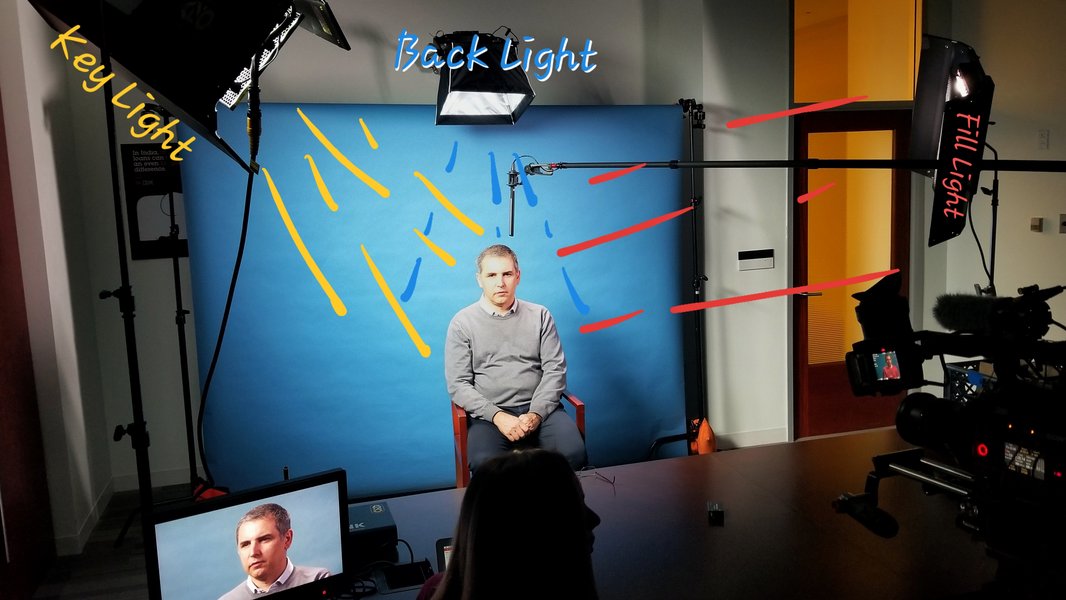
This image depicts a common three-point lighting setup, crucial for well-lit interviews.
Comparing AI Interview Tools
A Look at Existing Solutions
Several AI-powered interview preparation tools already exist, each with its own strengths. Examining these can provide insights into features and approaches.
Here is a table summarizing some key aspects of various AI interview tools based on the provided sources:
| Tool Name | Key Features | Focus |
|---|---|---|
| Interviews by AI | Tailored questions from job descriptions, audio/text input, dashboard for review. | Realistic simulations, personalized feedback. |
| HyperWrite's Job Interview Simulator | Realistic HR interview simulation, feedback on responses. | Common HR questions, general interview practice. |
| Grow with Google / Interview Warmup | Transcribes spoken answers, insights on word usage and talking points, privacy-focused. | Practice with industry expert questions, self-analysis. |
| Codecademy Interview Simulator | Build custom scenarios, personalized feedback. | Technical and general interview skills, customizable practice. |
| Huru | Video interview prep, feedback on answers, body language, vocal delivery. | Comprehensive video and audio analysis. |
| Bossed.ai | Voice-powered, personalized questions from CV/job listing, actionable feedback. | Voice interaction, personalization. |
| AIApply | Tailored mock interviews from job description, real-time advice. | Quick setup based on job description, real-time support during mock interview. |
This table highlights the diverse approaches to AI interview preparation, from focusing on specific question types to analyzing various aspects of delivery. An audio-only app based on a job offer would leverage the strengths of several of these, particularly in tailoring questions and providing targeted audio feedback.
Potential Challenges and Considerations
Navigating Development Hurdles
Developing a sophisticated AI audio interview app is not without its challenges:
-
Accuracy of STT: Ensuring high accuracy in transcribing various voices and accents can be difficult.
-
Naturalness of TTS: Creating truly natural-sounding AI voices can be complex.
-
Sophistication of Feedback: Generating nuanced and truly helpful feedback that goes beyond basic observations requires advanced AI analysis.
-
Handling Ambiguity and Nuance: Human communication involves subtlety and nuance that AI can struggle to fully interpret.
-
Maintaining User Engagement: Keeping users motivated to practice regularly requires a well-designed and engaging application.
Despite these challenges, ongoing advancements in AI, particularly in NLP and speech processing, are continuously improving the capabilities of such applications.
Visual Example of an Interview Setup
A Glimpse into the Interview Environment
While our app is audio-focused, understanding the visual aspect of interviews can still be beneficial for users to feel more prepared for potential video calls. Here's another visual of a common interview setup:

This image shows various camera angles for an interview, emphasizing the importance of visual presentation in video interviews.
Real-time AI Interview Copilot Concepts
Exploring Supportive AI During Interviews
Some of the provided sources touch upon the idea of an "interview copilot" that provides real-time assistance during an interview. While the primary focus of this app is mock interviews, exploring the concept of a supportive AI during practice sessions is relevant.
Here is a video discussing the use of AI to provide answers during an interview. It's important to view this concept through the lens of a practice tool rather than something to be used unethically in a real interview.
This video discusses the concept of using AI to assist during interviews, prompting ethical considerations and highlighting the potential for such technology in practice scenarios.
The concept of a real-time AI assistant raises ethical questions when considered for actual interviews. However, within the controlled environment of a mock interview app, a similar feature could provide hints, suggest relevant points, or help users stay on track if they get stuck. This could be a valuable learning tool during practice sessions.
FAQ
Common Questions About AI Mock Interviews
How accurate is the AI in generating questions?
The accuracy of AI-generated questions depends heavily on the quality of the NLP models used and the clarity of the job description provided. Advanced models can generate highly relevant questions by identifying key requirements and common interview themes for similar roles.
Can the AI understand different accents?
Modern STT engines are designed to handle a wide range of accents, but performance can vary. Training the AI with diverse audio data is crucial for improving its ability to understand different speech patterns.
Is my data kept private?
Reputable AI interview tools prioritize user privacy. Look for applications with clear privacy policies that explain how your data is handled and protected. Data used for improving the AI should ideally be anonymized.
How can the AI provide feedback on delivery?
AI can analyze audio features like pace, volume, and pauses to provide feedback on delivery. Some advanced tools can also detect the use of filler words.
Can the AI simulate different interviewer styles?
Yes, some AI platforms are exploring or offer the ability to simulate different interviewer personalities or styles, which can help users prepare for various interview dynamics.
References
Last updated April 21, 2025