
The Dual Threat: How AI's Evolution Unleashes Unprecedented Cyberattack Vectors
Exploring the sophisticated ways malicious actors can weaponize AI and target its vulnerabilities, assuming limitless resources.
Artificial Intelligence (AI) has rapidly transitioned from a futuristic concept to a ubiquitous technology permeating nearly every aspect of modern life. However, this transformative power brings with it a darker side. As AI capabilities grow, so does its potential for misuse in the realm of cybersecurity. For a security researcher, understanding the multifaceted ways AI can be exploited is paramount. This exploration delves into how all forms of AI—beyond just Large Language Models (LLMs)—can be weaponized to launch attacks, and how AI implementations themselves become targets. We consider a scenario where malicious actors possess unlimited resources, allowing them to leverage the most novel and sophisticated techniques.
Key Insights: The Evolving AI Threat Landscape
- AI as a Force Multiplier for Attackers: AI significantly enhances the speed, scale, personalization, and evasiveness of cyberattacks, from hyper-realistic phishing and deepfakes to self-adapting malware.
- Targeting AI's Core Vulnerabilities: AI systems are susceptible to unique attacks like data poisoning during training, evasion attacks during inference, and model theft, which can have catastrophic consequences.
- The "Unlimited Budget" Scenario Unlocks Frontier Attacks: With limitless resources, attackers can develop zero-day AI exploits, orchestrate cross-modal attacks, and even manipulate physical environments to deceive AI systems on an unprecedented scale.
The Double-Edged Sword: AI in Modern Cyber Warfare
The integration of AI into critical systems and daily operations presents a dual challenge. On one hand, AI offers powerful tools for defense. On the other, it provides malicious actors with capabilities previously unimaginable. This creates an escalating arms race where understanding the offensive applications and inherent vulnerabilities of AI is crucial for developing robust countermeasures. The threat is not monolithic; it spans various AI paradigms including machine learning, computer vision, speech recognition, and reinforcement learning.
Weaponizing Intelligence: AI as an Offensive Cyberattack Tool
When wielded by attackers, AI can automate, refine, and scale cyberattacks to devastating effect. An unlimited budget allows for the development and deployment of highly sophisticated AI-driven offensive capabilities.
Hyper-Personalization and Deception at Scale
Advanced Phishing and Social Engineering
AI algorithms, particularly generative AI, can analyze vast troves of public and breached data (from social media, corporate websites, etc.) to craft hyper-personalized phishing messages. These messages—delivered via email, SMS, or social media—exhibit impeccable grammar, context-awareness, and mimic the communication style of known contacts, significantly increasing their success rate. AI can automate the entire campaign, from target selection to message delivery and interaction.
Generation of Synthetic Media for Disinformation and Fraud
Deepfake technology, powered by AI, allows for the creation of highly realistic but entirely fabricated video and audio content. Attackers can generate deepfakes of executives authorizing fraudulent transactions, political figures making inflammatory statements, or trusted individuals divulging sensitive information. This synthetic media can also be used to bypass biometric authentication systems (voice or facial recognition) or to fuel large-scale disinformation campaigns designed to manipulate public opinion, incite unrest, or destabilize markets.
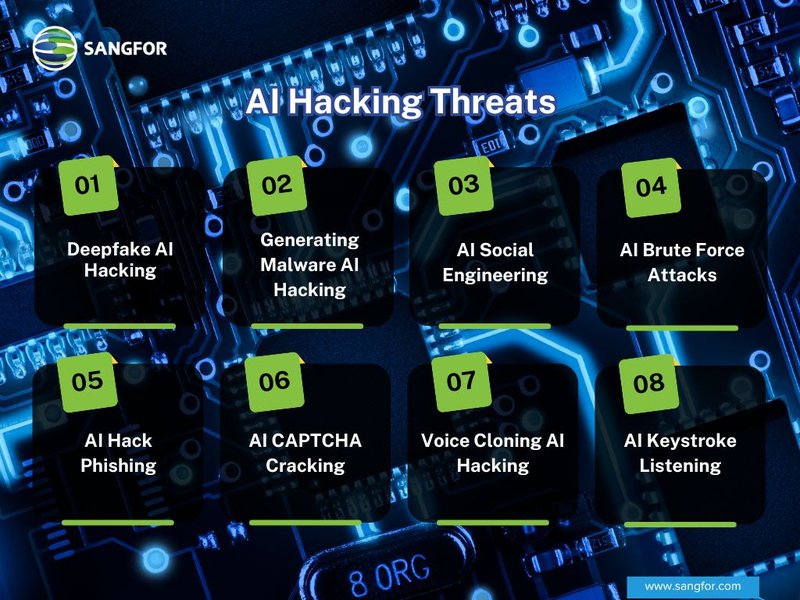
AI can be employed to automate and enhance various hacking activities, posing new cybersecurity threats.
Engineering Sophisticated Malware and Exploits
Intelligent Malware and Ransomware
AI can be used to develop malware that is significantly more evasive and resilient. Such malware can embed machine learning models to dynamically adapt its behavior in response to detection systems, learn security patterns within a target environment, and mutate its code (polymorphic or metamorphic malware) to evade signature-based and heuristic-based defenses. AI-powered ransomware can automate target research, identify optimal system vulnerabilities for encryption, and even conduct ransom negotiations using sophisticated AI chatbots.
Automated Vulnerability Discovery and Exploitation
With sufficient resources, AI systems can be trained to automatically probe networks, applications, and software for vulnerabilities, including zero-day exploits that are unknown to defenders. Reinforcement learning and generative adversarial networks (GANs) can be employed to discover novel attack vectors and craft optimized exploit sequences far faster and more efficiently than human researchers. AI also enhances traditional attack methods like brute-force password cracking and credential stuffing by learning password patterns and user behaviors.
Orchestrating Complex and Large-Scale Attacks
AI-Driven Botnets and Swarm Attacks
AI can coordinate vast networks of compromised devices (botnets), including IoT devices, to launch highly effective Distributed Denial of Service (DDoS) attacks. These AI-controlled botnets can dynamically shift tactics, targets, and communication patterns to evade detection and overwhelm defenses. The concept extends to "swarm attacks," where numerous autonomous AI agents collaborate to achieve a malicious objective.
Automation of the Cyber Kill Chain
AI has the potential to automate and optimize every stage of the cyber kill chain: reconnaissance, weaponization, delivery, exploitation, installation, command and control (C2), and actions on objectives. This end-to-end automation dramatically increases the speed, efficiency, and sophistication of attacks, allowing adversaries to operate at an unprecedented scale.
Novel Offensive AI Applications (Unlimited Budget)
AI-Enabled Supply Chain Attacks
Attackers can use AI to monitor software updates, open-source repositories, and development pipelines for opportunities to inject malicious code. This includes techniques like dependency hijacking, package poisoning, or even subtly altering AI-generated code suggestions to include vulnerabilities. With an unlimited budget, these attacks can become extremely sophisticated, targeting critical infrastructure or widely used software libraries.
Automated Cyber Espionage
Generative AI and other machine learning techniques can automate the extraction, processing, and analysis of vast amounts of data from compromised networks. This facilitates large-scale cyber espionage operations, enabling attackers to quickly identify and exfiltrate sensitive intellectual property, state secrets, or strategic plans.
Targeting the Brain: Attacks Against AI Systems and Implementations
Beyond using AI as a tool, attackers can directly target AI systems themselves. These "adversarial AI" attacks exploit vulnerabilities inherent in how AI models are trained, deployed, and operated. An attacker with an unlimited budget can invest heavily in developing and executing these complex attacks.
Undermining AI Learning: Attacks During the Training Phase
Data Poisoning
Data poisoning involves an attacker subtly manipulating the data used to train an AI model. By injecting carefully crafted malicious, biased, or mislabeled data, the attacker can corrupt the model's learning process. This can cause the deployed model to make systematically incorrect decisions, exhibit biases, fail in specific scenarios, or even leak sensitive information it was trained on. Advanced "adaptive poisoning" techniques aim to make the poisoned data nearly indistinguishable from legitimate data, thereby bypassing common data sanitization and validation defenses.
Model Backdooring (Trojan Attacks)
In a backdoor attack, the adversary implants a hidden "trigger" within the AI model during its training phase. The model behaves normally under most circumstances, but when the specific trigger (a particular input pattern, image, phrase, etc.) is presented, the backdoor activates, causing the model to perform a malicious action, misclassify data in a way desired by the attacker, or grant unauthorized access.
Deceiving Trained Models: Attacks During Inference
Evasion via Adversarial Examples (Digital)
Evasion attacks occur after a model is trained and deployed. The attacker crafts "adversarial examples"—inputs that are slightly modified in a way often imperceptible to humans but cause the AI model to make an incorrect prediction or classification. For instance, adding a tiny amount of specially designed noise to an image could cause an image recognition system to misidentify a stop sign as a speed limit sign. Common techniques include the Fast Gradient Sign Method (FGSM), Projected Gradient Descent (PGD), and Carlini & Wagner (C&W) attacks.
Physical Adversarial Attacks
These attacks extend adversarial examples into the real world. Instead of just manipulating digital data, attackers alter physical objects or environments. Examples include placing specially designed stickers on a stop sign to fool an autonomous vehicle's perception system, wearing adversarial glasses to deceive facial recognition systems, or creating 3D-printed objects designed to be misclassified by AI scanners. These attacks highlight the risks to AI systems interacting with the physical world.

A printed adversarial patch can be used to deceive AI-powered image recognition systems in real-world scenarios.
Audio Adversarial Attacks
Similar to image-based adversarial examples, attackers can craft subtle perturbations to audio signals that are often inaudible or sound like minor noise to humans but can cause speech recognition systems to transcribe entirely different words or commands. This could be used to manipulate voice assistants or bypass voice-based security systems.
Stealing and Compromising AI Models
Model Extraction and Theft
Attackers can attempt to steal or replicate a proprietary AI model, often by repeatedly querying it (if it's accessible via an API) and observing its inputs and outputs. By analyzing these query-response pairs, the attacker can infer the model's architecture, parameters, or functionality, effectively creating a copycat model. This stolen model can then be used for malicious purposes, to craft more effective adversarial attacks, or to bypass paywalls for AI services.
Membership Inference and Privacy Breaches
Membership inference attacks aim to determine whether a specific individual's data was part of an AI model's training set. If successful, this can lead to significant privacy violations, especially if the training data contained sensitive personal information (e.g., medical records, financial data). Attackers might also use model inversion techniques to reconstruct parts of the training data from the model's outputs.
Disrupting AI Operations
Denial of Service and System Manipulation
AI systems can be subjected to Denial of Service (DoS) attacks. "Sponge attacks" involve overwhelming an AI model with computationally expensive queries, degrading its performance or rendering it unavailable. "Policy puppetry" attacks, particularly relevant to LLMs, involve crafting specific prompts to force the AI to generate unintended, harmful, or biased outputs, effectively manipulating its behavior.
Exploiting AI Agents and Governance
If AI systems employ autonomous agents, attackers might try to impersonate legitimate agents or inject rogue agents to disrupt operations or exfiltrate data. Furthermore, AI governance and monitoring systems (e.g., logging and auditing mechanisms) can be targeted to hide malicious activities or sabotage transparency efforts.
Comparative Analysis of AI Attack Vector Categories
The following chart provides a comparative overview of different AI attack vector categories based on several key characteristics. These are subjective assessments intended to illustrate relative differences. An "unlimited budget" scenario can shift these, particularly by enabling higher sophistication and potentially improving evasion for any category.
This radar chart visualizes how different categories of AI-driven attacks compare across dimensions such as novelty, potential impact, ability to evade detection, scalability, and the technical sophistication required by the attacker. It underscores that attackers with significant resources can pursue highly sophisticated and impactful strategies across all categories.
The Unlimited Budget Arsenal: Frontier AI Attack Vectors
With hypothetical unlimited resources, attackers could push the boundaries of AI-driven attacks even further, developing and deploying methods that are currently theoretical or in early research stages. These frontier attacks represent the most advanced and potentially devastating threats.
Advanced Adversarial Techniques
Next-Generation Adversarial Training by Attackers
Attackers could invest heavily in developing highly sophisticated adversarial training algorithms. These would not only generate more potent and subtle adversarial examples but also learn to actively evade existing and future defense mechanisms by, for example, making poisoned data statistically indistinguishable from clean data or by learning the patterns of defensive models.
Cross-Modal Adversarial Attacks
Imagine attacks that seamlessly combine adversarial manipulations across multiple data modalities (e.g., visual, audio, and textual). For instance, a deepfake video could be accompanied by adversarial audio and subtly manipulated text in captions or surrounding content, all designed to synergistically fool an AI system's multi-modal perception and decision-making processes.
Exploiting the AI Ecosystem at Scale
Zero-Day Exploits in AI Frameworks and Models
Significant resources could be poured into discovering novel, previously unknown vulnerabilities (zero-day exploits) in popular AI models, frameworks (like TensorFlow or PyTorch), and underlying hardware. This would involve extensive reverse engineering, fuzzing, and in-depth analysis of AI architectures, leading to exploits that bypass standard security measures.
AI-Orchestrated Full Lifecycle Supply Chain Attacks
Attackers could infiltrate and poison AI models and tools at various stages of their development and deployment pipeline. This includes compromising data providers, cloud services hosting training data or MLaaS platforms, software libraries, pre-trained models, or even the specialized hardware used for AI development and inference. The goal would be to embed persistent, hard-to-detect vulnerabilities or backdoors across the AI ecosystem.
Bridging Digital and Physical Worlds with Greater Impact
Sophisticated Real-World Physical Attacks
Beyond simple adversarial patches, an unlimited budget could facilitate complex, large-scale physical manipulations designed to consistently trick AI systems in critical applications. This might involve creating "adversarial environments" (e.g., subtly altering road markings over large areas to mislead autonomous vehicles) or designing custom hardware that emits imperceptible signals to influence autonomous systems or sensor networks.
Subverting AI's Core Functioning and Ethics
Manipulating Ethical AI Safeguards
Attackers could train specialized "meta-adversary" AI systems designed to find and exploit weaknesses in the ethical reasoning, safety constraints, or alignment mechanisms built into advanced AI. The aim would be to cause AI systems to prioritize malicious outcomes, exhibit discriminatory behavior in subtle ways, or bypass their intended operational or ethical boundaries.
Poisoning Reinforcement Learning Environments
For AI systems trained via reinforcement learning (RL), such as autonomous agents or robotic systems, attackers could subtly alter the reward signals, the simulated environment, or the agent's perception of the environment during training. This could lead the RL agent to learn undesirable, harmful, or unsafe behaviors that only manifest in specific real-world scenarios.
Visualizing the Landscape of AI-Driven Cyber Threats
The following mindmap illustrates the primary categories and sub-types of AI-driven cyber threats, encompassing both AI used as an offensive tool and attacks that directly target AI systems and their components.
This mindmap provides a hierarchical view of the diverse ways AI can intersect with cybersecurity threats, offering a quick reference to the complex attack surface.
Understanding Adversarial AI
Adversarial AI is a field focused on understanding and mitigating attacks that are specifically designed to fool or compromise machine learning models. The following video provides a good overview of what adversarial AI entails.
CertMike explains the fundamentals of Adversarial AI, covering its deliberate misuse and impact on AI systems.
This video discusses how AI algorithms can be deliberately misused to attack the system itself, highlighting the importance of developing defenses against such threats. It covers concepts relevant to evasion attacks and the broader challenges in securing AI.
Summary Table of Key AI Attack Vectors
The table below summarizes some of the prominent AI attack vectors, categorizing them by whether AI is used as a tool or if the AI system itself is the target, along with their novelty and an illustrative example.
| Attack Category | Attack Type | Description | Primary Target | Novelty Level | Example |
|---|---|---|---|---|---|
| AI as an Offensive Tool | AI-Generated Deepfakes | Using AI to create hyper-realistic fake videos/audio for social engineering or disinformation. | Human / Organization | High | CEO voice impersonation to authorize fraudulent transactions. |
| AI as an Offensive Tool | AI-Powered Adaptive Malware | Malware that uses ML to change its behavior, evade detection, and optimize attacks. | Systems / Networks | High | Ransomware that dynamically alters encryption methods based on defenses. |
| Attacks on AI Systems (Training) | Data Poisoning | Injecting malicious data into an AI model's training set to corrupt its learning and future behavior. | AI Model Integrity | High | Skewing a fraud detection model to ignore certain types of fraud. |
| Attacks on AI Systems (Training) | Backdoor/Trojan Attacks | Embedding hidden malicious functionalities within an AI model, triggered by specific inputs. | AI Model Integrity | High | A facial recognition model that misidentifies a specific person when they wear certain glasses. |
| Attacks on AI Systems (Inference) | Evasion Attacks (Adversarial Examples) | Crafting subtle, human-imperceptible changes to input data to cause an AI model to misclassify it. | AI Model Accuracy | High | Altering pixels in an image to make an object classifier identify a cat as a dog. |
| Attacks on AI Systems (Inference) | Physical Adversarial Attacks | Applying physical modifications (e.g., stickers) to real-world objects to deceive AI perception systems. | AI Sensor Systems | High | Stickers on a stop sign causing an autonomous vehicle to misinterpret it. |
| Attacks on AI Systems (Data/Model) | Model Stealing / Extraction | Querying an AI model to reconstruct its architecture or parameters, or replicate its functionality. | AI IP / Functionality | Medium-High | Creating a copy of a proprietary translation model by observing its outputs. |
| Attacks on AI Systems (Data/Model) | Membership Inference | Determining if a specific individual's data was part of an AI model's training set. | Data Privacy | Medium-High | Identifying patients whose medical records were used to train a diagnostic AI. |
| Frontier AI Attack Vectors | AI-Orchestrated Full Lifecycle Supply Chain Attack | Compromising AI models or tools at various stages of their development and deployment pipeline. | AI Ecosystem | Very High | Injecting vulnerabilities into popular ML libraries or pre-trained models. |
| Frontier AI Attack Vectors | Reinforcement Learning Environment Poisoning | Manipulating the reward signals or environment of an RL agent to teach it malicious or unsafe behaviors. | AI Agent Behavior | Very High | Causing an autonomous drone to learn to crash into specific targets. |
Frequently Asked Questions (FAQ)
What is the difference between AI used as an attack tool and attacks on AI systems?
Are deepfakes a significant threat in AI-driven attacks?
How can data poisoning affect AI models?
What are physical adversarial attacks?
With an unlimited budget, what is the most concerning novel AI attack vector?
Conclusion
The capacity for AI to be used or abused in cyberattacks is expanding at a formidable pace. For security researchers, staying ahead requires a deep understanding of both how AI can be weaponized and how AI systems themselves can be compromised. An attacker with unlimited resources could exploit these avenues to an unprecedented degree, developing novel attack vectors that challenge current defensive paradigms. The ongoing evolution of AI necessitates continuous research, development of robust defenses (such as adversarial training, input validation, and model verification), and a proactive approach to identifying and mitigating emerging threats across the entire AI lifecycle.
Recommended Further Exploration
- What are the latest defense mechanisms against adversarial AI attacks?
- How is AI being used to enhance cybersecurity defenses against sophisticated attacks?
- Explore the ethical implications of developing and deploying autonomous AI agents in cybersecurity.
- Investigate real-world case studies of AI-driven cyberattacks and their impact.
References
Last updated May 21, 2025