
Navigating AI Governance: Bridging Technical Types with EU AI Act Risk Classifications
A comprehensive guide to creating a compliant and robust AI inventory and risk register for your organization.
Key Insights into AI Inventory and Risk Management
- Harmonize Classifications: Overcome the ambiguity between the EU AI Act's risk-based classifications and common AI technical types by creating a two-tiered system that maps each AI system's technological foundation to its regulatory risk level.
- Leverage Frameworks: Implement a robust AI risk management strategy by integrating the comprehensive guidance from the NIST AI Risk Management Framework (AI RMF), security insights from OWASP AI Top 10, and governance best practices from ISO/IEC 42001.
- Dynamic Risk Register: Develop a living AI register that details AI systems, their identified risks, associated vulnerabilities, potential threats, and the specific controls and mitigation strategies applied, ensuring ongoing oversight and compliance.
Building a Comprehensive AI Inventory: Reconciling Regulatory and Technical Classifications
Creating an effective AI inventory requires a clear understanding of both the regulatory landscape, specifically the EU AI Act, and the underlying technological paradigms of AI systems. The key to resolving the ambiguity between the EU AI Act's risk-based classifications and common AI types (like Machine Learning, Deep Learning, Generative AI, Agentic AI, and Large Language Models) lies in establishing a structured, two-level classification framework. This approach ensures that your inventory not only identifies the technical characteristics of each AI system but also accurately assesses its regulatory obligations and potential impact.
Understanding the EU AI Act's Risk-Based Approach
The EU AI Act categorizes AI systems primarily based on the level of risk they pose to health, safety, and fundamental rights. This risk-based approach guides the stringent requirements for compliance and oversight. The core classifications are:
- Unacceptable Risk AI Systems: These are AI systems deemed a clear threat to fundamental rights and safety and are, therefore, prohibited. Examples include social scoring by governments or the exploitation of vulnerable groups.
- High-Risk AI Systems: These systems pose significant potential harm to health, safety, or fundamental rights. They are subject to strict requirements, including conformity assessments, risk management systems, and human oversight. High-risk categories include AI in critical infrastructure, education, employment, law enforcement, and safety components of products.
- Limited Risk AI Systems: This category includes AI systems that require specific transparency obligations. Users must be informed when interacting with the AI, and AI-generated content (like deepfakes) must be clearly labeled. Chatbots often fall into this category.
- Minimal or No Risk AI Systems: These are AI systems that do not pose significant risks, such as spam filters or AI-enabled video games. While generally safe, they are still subject to general data protection rules.
- General Purpose AI (GPAI) Models: The Act also addresses GPAI models, which are AI systems designed for general tasks and can be adapted for many contexts. The risk level of a GPAI model depends on its specific use case and whether it's deployed in a high-risk application.
The EU AI Act's focus is on the application and societal impact of AI, rather than its technical architecture. This distinction is crucial for effective classification.
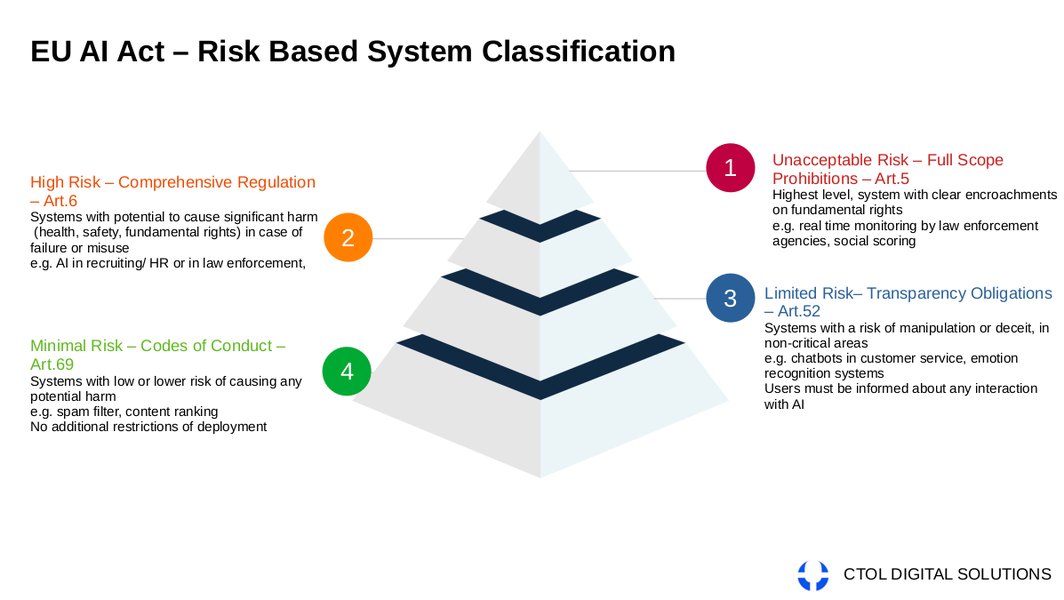
Visual representation of the EU AI Act's risk-based classification system for AI.
Categorizing Common AI Types: A Technical Perspective
In contrast to the EU AI Act, common AI types describe the underlying technologies, methodologies, or functional capabilities of AI systems. These include:
- Machine Learning (ML): Algorithms that learn from data to make predictions or decisions without explicit programming.
- Deep Learning (DL): A subset of ML that uses neural networks with multiple layers to learn complex patterns, commonly used in image recognition, speech processing, and natural language processing.
- Generative AI (GenAI): AI systems capable of producing new content, such as text, images, audio, or video, often using techniques like diffusion models or GANs (Generative Adversarial Networks).
- Agentic AI: AI systems designed to autonomously perform tasks, make decisions, and interact with environments or other agents, such as autonomous robots or intelligent assistants.
- Large Language Models (LLMs): Advanced deep learning models trained on vast text datasets to understand, generate, and process human language, capable of various natural language processing tasks.
Mapping AI Types to EU AI Act Classifications
To bridge the gap between these two classification systems, your AI inventory should implement a two-level framework:
- Level 1: EU AI Act Risk Category: This is the primary classification, assigned based on the AI system's specific application and its potential impact on health, safety, or fundamental rights.
- Level 2: AI Technology Type: This secondary classification describes the underlying AI methodology or model employed by the system.
This dual approach allows for precise identification of regulatory obligations alongside a clear understanding of the technical specifics of each AI system. Below is an illustrative table demonstrating how common AI types can be mapped to EU AI Act risk categories based on their use cases:
| AI System Name | AI Technology Type(s) | Function/Use Case | EU AI Act Risk Classification | Rationale for Classification |
|---|---|---|---|---|
| Fraud Detection System | Machine Learning (ML) | Identifies fraudulent financial transactions | High-Risk | Affects financial services and potential impact on fundamental rights (e.g., access to services). |
| Autonomous Driving System | Deep Learning (DL), Agentic AI | Navigates vehicles without human input | High-Risk | Safety-critical component of a product in transportation, posing significant risk to life. |
| Customer Service Chatbot | Large Language Model (LLM), Generative AI | Answers customer queries and generates responses | Limited Risk | Requires transparency that it is an AI system; potential for misleading information. |
| Medical Image Diagnosis AI | Deep Learning (DL), Machine Learning (ML) | Assists in diagnosing diseases from medical images | High-Risk | Used in healthcare for critical decisions impacting health and safety. |
| Content Generation Tool | Generative AI | Creates marketing copy or basic articles | Minimal Risk | Low potential for harm, though transparency may be required if used for deepfakes. |
| AI-Powered Recruitment Tool | Machine Learning (ML) | Screens job applications and recommends candidates | High-Risk | Impacts fundamental rights related to employment and fair treatment. |
This table structure clarifies how different AI technologies, depending on their deployment, fall into specific regulatory categories. Your AI inventory should reflect this detailed mapping for every AI system your organization develops or uses.
Comprehending and Mitigating AI Risks: A Robust AI Register
Beyond classification, a crucial component of AI governance is a comprehensive AI risk register. This register should document identified risks, associated vulnerabilities, potential threats, and the controls implemented to mitigate them. To establish such a register, it's essential to draw upon established frameworks like the NIST AI Risk Management Framework (AI RMF), the OWASP AI Top 10, and ISO/IEC 42001.
Core AI Risk Categories
AI introduces unique risks that go beyond traditional IT security concerns. These include:
- Bias and Discrimination: AI models can perpetuate or amplify societal biases present in their training data, leading to unfair or discriminatory outcomes.
- Safety and Security Risks: AI systems, especially in autonomous or critical applications, can have failures leading to physical harm or system instability. They are also susceptible to cybersecurity vulnerabilities.
- Privacy Risks: AI models can inadvertently expose sensitive personal data used in training, or their outputs might reveal private information.
- Explainability and Transparency Deficits: Many advanced AI models (e.g., deep neural networks) operate as "black boxes," making their decision-making processes difficult to understand or audit, leading to a lack of trust and accountability.
- Robustness and Reliability: AI models can be vulnerable to adversarial attacks, where subtle changes to input data can cause drastic and incorrect outputs, or they may degrade over time (model drift).
- Misuse & Dual Use: AI technologies can be intentionally misused for harmful or unethical purposes, such as generating convincing deepfakes for disinformation or developing autonomous weapons.
- Governance and Accountability: Lack of clear policies, roles, responsibilities, and audit trails can lead to unmanaged risks and difficulty in assigning accountability when issues arise.
Leveraging AI Risk Management Frameworks
To effectively manage these risks, organizations can integrate guidance from leading frameworks:
NIST AI Risk Management Framework (AI RMF)
The NIST AI RMF is a voluntary framework designed to help organizations integrate trustworthiness considerations into the design, development, deployment, and evaluation of AI systems. It is structured around four core functions:
- Govern: Focuses on establishing a strong AI risk management culture, policies, processes, and procedures. This includes defining organizational context, setting risk tolerance, and ensuring accountability.
- Map: Involves identifying AI risks and their potential impacts. This includes characterizing the AI system, understanding its context of use, and identifying potential harms (e.g., bias, privacy breaches, safety failures).
- Measure: Dedicated to assessing, analyzing, and tracking AI risks. This function involves developing metrics, collecting data, and evaluating the effectiveness of risk mitigation strategies.
- Manage: Focuses on implementing actions to mitigate identified AI risks. This includes prioritizing risks, implementing controls (technical and organizational), and establishing continuous monitoring and improvement processes.
The NIST AI RMF provides a holistic approach, guiding organizations through the entire AI lifecycle to build trustworthy AI systems. The NIST AI RMF Playbook offers practical actions and examples for each core function.
OWASP AI Top 10 Risks
The OWASP (Open Web Application Security Project) AI Top 10 focuses specifically on security vulnerabilities and privacy issues within AI systems. While OWASP traditionally targets web application security, its principles and identified risks are highly relevant to AI, highlighting concerns such as:
- ML Model Vulnerabilities: Risks like adversarial attacks, data poisoning, and model inversion.
- Insecure AI Supply Chains: Vulnerabilities introduced through third-party models or data.
- Large Language Model Exposure: Risks associated with sensitive data leakage or prompt injection in LLMs.
OWASP complements broader risk frameworks by providing specific, actionable security controls for AI systems.
ISO/IEC 42001:2023 - AI Management Systems
ISO/IEC 42001 is the world's first international standard for Artificial Intelligence Management Systems (AIMS). It provides requirements for establishing, implementing, maintaining, and continually improving an AIMS. Key aspects include:
- Systematic Approach: Offers a structured way to identify, evaluate, and address AI-related risks throughout its lifecycle.
- Risk Management and Impact Assessment: Outlines requirements for conducting AI system impact assessments and managing identified risks.
- Ethical Considerations and Transparency: Emphasizes integrating ethical principles, transparency, and data protection measures into AI design and deployment.
- Compatibility: Designed to be compatible with other management system standards (e.g., ISO/IEC 27001 for information security), facilitating integrated governance.
ISO 42001 provides a robust management system framework to operationalize responsible AI practices and regulatory compliance.
Visualizing AI Risk Management Capabilities
To further illustrate how these frameworks contribute to a comprehensive AI risk management capability, consider the following radar chart. It demonstrates how different aspects of AI risk management can be assessed and improved by integrating the principles and controls from NIST AI RMF, OWASP AI Top 10, and ISO/IEC 42001. Each spoke represents a critical dimension of AI governance, with higher values indicating stronger capability.
Radar chart illustrating an organization's AI risk management capabilities across various dimensions, influenced by integrated frameworks.
Structuring Your AI Risk Register
Your AI risk register should be a dynamic document that provides a granular view of risks and controls for each AI system. It should include:
- AI System Identification: Name, description, purpose, current status (development, deployed, deprecated), and the mapped EU AI Act classification.
- Identified AI Risks: Specific risks relevant to the system (e.g., algorithmic bias, data leakage, safety critical failure).
- Associated Vulnerabilities: Technical weaknesses or design flaws in the AI system or its environment (e.g., unrepresentative training data, lack of explainability, insecure API endpoints).
- Threats: Potential actors or events that could exploit vulnerabilities (e.g., malicious actors, data drift, environmental interference, internal misuse).
- Mitigation Controls: Specific actions, policies, and technologies implemented to reduce or eliminate identified risks. These should be directly mapped from NIST AI RMF, OWASP AI Top 10, and ISO/IEC 42001.
- Compliance and Documentation: Evidence of risk assessments, conformity assessments, audit trails, and justification for classifications.
- Responsible Party & Status: Clear ownership for risk management and the current status of mitigation efforts.
By integrating these elements, your AI register becomes a powerful tool for proactive risk management and regulatory compliance.
The Interplay of AI Risk Management Frameworks
The synergy between these frameworks is crucial. NIST AI RMF provides the overarching structure for managing AI trustworthiness. OWASP AI Top 10 offers specific security and privacy vulnerabilities, which can be mapped to the "Map" function of NIST AI RMF, and their mitigation strategies feed into the "Manage" function. ISO/IEC 42001 then provides the management system requirements for integrating these practices into an organization's broader governance structure, ensuring continuous improvement and compliance across the AI lifecycle. For instance, the "Govern" function of NIST AI RMF aligns perfectly with the management system requirements of ISO 42001, setting the organizational tone and policies for responsible AI.
Mindmap illustrating the interconnected components of AI governance, from classification to risk management frameworks.
Empowering Responsible AI: Practical Implementation
Building an AI inventory and register is not a one-time task but an ongoing process. To effectively implement these frameworks, consider the following practical steps:
- Initial AI System Mapping: Begin by inventorying all AI systems within your organization. For each system, identify its primary technical type (ML, LLM, etc.) and its intended use case. Then, apply the EU AI Act's risk-based classification based on the potential impact of that use case.
- Conduct Comprehensive Risk Assessments: For each AI system, perform a detailed risk assessment. Use the NIST AI RMF's "Map" function to identify potential harms (bias, privacy, safety), and leverage OWASP AI Top 10 to pinpoint specific security and privacy vulnerabilities.
- Define and Implement Controls: Based on the identified risks and vulnerabilities, select and implement appropriate controls. Draw from the "Manage" function of NIST AI RMF, the security practices suggested by OWASP, and the management system requirements of ISO 42001. Controls can range from data anonymization, regular bias audits, and adversarial robustness testing to robust human oversight and clear user notifications.
- Establish Governance and Accountability: Implement the "Govern" function of NIST AI RMF by defining clear roles, responsibilities, and policies for AI development, deployment, and oversight. ISO 42001 is particularly useful here for establishing an organizational AIMS.
- Continuous Monitoring and Auditing: AI systems are dynamic; their risks can evolve. Implement continuous monitoring processes (NIST AI RMF's "Measure" function) to track performance, identify new risks, and ensure the effectiveness of controls. Regular audits are crucial for ongoing compliance and trust.
- Documentation and Transparency: Maintain thorough documentation for every AI system, including its classification, risk assessments, and implemented controls. For limited risk systems, ensure transparency measures are in place to inform users about AI interaction or AI-generated content.
By following these steps, organizations can create a robust and compliant AI inventory and risk register, fostering responsible AI innovation and deployment.
Understanding the NIST AI RMF: A Deep Dive
The NIST AI RMF is a cornerstone for managing AI risks responsibly. It is designed to be flexible and adaptable, allowing organizations of all sizes and sectors to apply its principles. The framework aims to foster the development of trustworthy AI systems by promoting a proactive approach to risk management. This involves not just identifying negative outcomes but also understanding the trade-offs between various trustworthiness characteristics, such as fairness, privacy, security, transparency, and reliability. The framework emphasizes that AI risk management should be an integrated part of an organization's broader enterprise risk management strategy, not an isolated process. By applying the four core functions—Govern, Map, Measure, and Manage—organizations can establish a continuous feedback loop that allows for iterative improvement of their AI systems and their risk profiles. The NIST AI RMF Playbook provides practical guidance and examples for implementing each of these functions, helping organizations translate the framework's high-level guidance into actionable steps for their specific AI applications.
This video, titled "Your AI Governance Blueprint: A Guide to ISO 42001 & NIST," provides an excellent overview of how ISO 42001 and NIST AI RMF can be integrated to form a robust AI governance strategy. It is highly relevant as it directly addresses the synergy between these two critical frameworks, offering a clear roadmap for organizations to align their AI initiatives with established standards for risk management and compliance. The video delves into practical aspects of combining these frameworks, which is central to building a comprehensive AI inventory and register.
Frequently Asked Questions (FAQ)
What is the primary difference between the EU AI Act's classification and common AI types?
How does the NIST AI RMF help in managing AI risks?
Why is ISO/IEC 42001 important for an AI inventory and risk register?
Can OWASP AI Top 10 be used for non-security related AI risks?
What is a General Purpose AI (GPAI) model under the EU AI Act?
Conclusion
Creating a robust AI inventory and a comprehensive AI risk register is fundamental for responsible AI governance and compliance, especially with evolving regulations like the EU AI Act. By diligently mapping common AI technical types to the EU AI Act's risk classifications and leveraging established frameworks such as the NIST AI Risk Management Framework, OWASP AI Top 10, and ISO/IEC 42001, organizations can overcome classification ambiguities. This structured approach ensures that AI systems are not only cataloged efficiently but also managed proactively against potential risks, vulnerabilities, and threats, fostering trustworthiness and accountability throughout the AI lifecycle. The integration of these frameworks provides a holistic blueprint for organizations to navigate the complexities of AI, ensuring both innovation and ethical deployment.
Recommended Searches
- How to implement ISO 42001 for AI governance?
- Best practices for AI bias detection and mitigation strategies
- Understanding adversarial attacks on large language models
- Deep dive into NIST AI RMF Playbook applications
