
Unlock Your Innovation Potential: Revolutionize Patent Strategy with AI
Leverage Generative AI for comprehensive patent landscape analysis, strategic R&D guidance, and proactive IP risk management.
Highlights
- Identify Untapped Opportunities: Pinpoint "white spaces" in the innovation landscape where your company can lead and patent with minimal competition.
- Gain Competitive Intelligence: Monitor competitor patent activities and R&D focus in real-time to inform your strategic positioning and anticipate market shifts.
- Optimize R&D Investment: Make data-driven decisions on research directions, ensuring alignment with market needs and maximizing the patentability of innovations.
The Challenge: Navigating the Modern IP Landscape
In today's rapidly evolving technological environment, staying ahead requires a deep understanding of the global intellectual property (IP) landscape. Traditional methods of patent analysis are often slow, labor-intensive, and struggle to keep pace with the exponential growth in patent filings and scientific publications worldwide. This makes it challenging to identify genuine innovation opportunities, track competitor movements effectively, guide R&D efforts strategically, and mitigate the risk of costly IP conflicts.
Conceptual visualization of AI processing patent information.
The Solution: AI-Powered Patent Landscape Analysis
Harnessing Generative AI for Strategic Advantage
We propose a strategic alternative leveraging cutting-edge Generative AI (GenAI) to transform your approach to patent intelligence. This AI-driven solution automates and enhances the process of scanning, synthesizing, and analyzing vast amounts of complex data from global patent databases (like USPTO, EPO, WIPO) and scientific literature. By processing information at speeds and depths unattainable through manual efforts, GenAI provides actionable insights crucial for strategic decision-making.
Core Capabilities
Our AI-supported patent landscape analysis offers several key capabilities:
Scanning and Data Acquisition
Leveraging advanced algorithms, GenAI tools automatically collect and digest patent filings, applications, and relevant scientific publications from across the globe. This ensures a comprehensive and up-to-date information base tailored to your specific technology domains and areas of interest.
Synthesis and Analysis
GenAI goes beyond simple data collection. It employs Natural Language Processing (NLP) and machine learning to synthesize the gathered information, identifying complex patterns, relationships, citation networks, and technological overlaps that might be missed by human analysts. This deep analysis yields critical intelligence.
Strategic Output Generation
The analysis results are translated into clear, actionable outputs, including:
- White Space Identification: Pinpointing underexplored or unoccupied technology areas with high innovation potential and lower patent density, offering clear avenues for R&D and patenting.
- Competitor Monitoring: Providing detailed insights into the patent strategies, R&D focus, and filing trends of key competitors, enabling proactive strategic adjustments.
- Trend Analysis & Forecasting: Detecting emerging technological trends, patenting hotspots, and potential future directions based on global filing patterns and scientific advancements.
- R&D Guidance: Informing strategic R&D investment decisions by highlighting technological gaps, assessing patentability, and aligning research efforts with market opportunities and IP strength.
- IP Conflict Avoidance: Proactively identifying potential overlaps and conflicts with existing patents through comprehensive prior art searches, minimizing infringement risks and associated legal costs.
- Informing Patenting Strategies: Guiding the development of robust patenting strategies, especially for novel innovations involving or driven by GenAI itself, ensuring strong protection for your valuable IP assets.

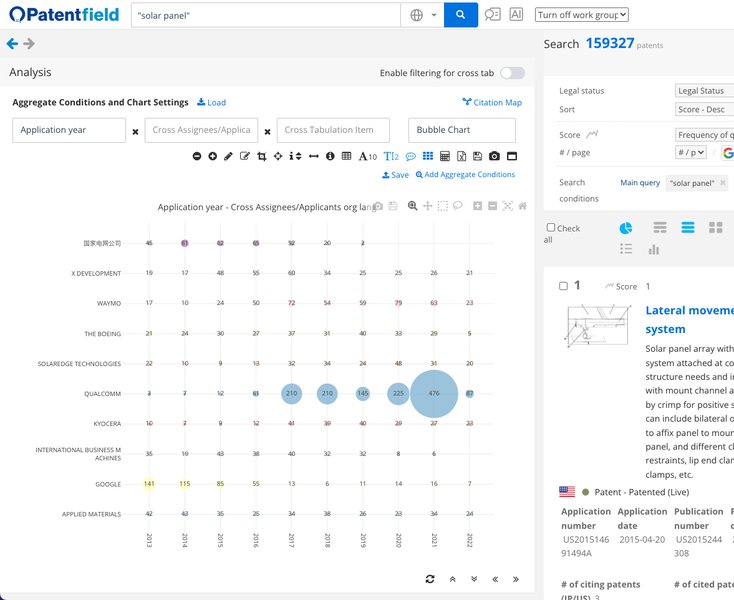
Example dashboard showing AI-driven patent landscape analytics.
Visualizing the AI Advantage
Comparing AI-Powered vs. Traditional Patent Analysis
To illustrate the significant advantages of leveraging AI, the radar chart below compares AI-powered patent landscape analysis against traditional manual methods across several key performance dimensions. As depicted, AI consistently offers superior speed, broader scope, deeper insights, enhanced accuracy, better trend prediction capabilities, and improved cost-effectiveness over time.
This comparison highlights how AI transforms patent analysis from a reactive, resource-intensive task into a proactive, strategic intelligence function.
Understanding the Process Flow
The mindmap below illustrates the interconnected components of the AI-supported Patent Landscape strategy. It starts with diverse data inputs, flows through the core AI processes of scanning, synthesizing, and analyzing, and results in tangible strategic outputs that drive innovation and competitive advantage.
(USPTO, EPO, WIPO, etc.)"] id1b["Scientific Publications
& Literature"] id1c["Competitor Filings"] id1d["Market Data"] id2["AI Core Process"] id2a["Scanning
(Automated Data Collection)"] id2b["Synthesizing
(NLP, Pattern Recognition)"] id2c["Analyzing
(Trend Analysis, Relationship Mapping)"] id3["Strategic Outputs"] id3a["White Space Identification"] id3b["Competitor Intelligence"] id3c["R&D Guidance & Optimization"] id3d["Emerging Trend Reports"] id3e["IP Risk Assessment
& Mitigation"] id3f["Informed Patenting Strategies"] id4["Business Impact"] id4a["Accelerated Innovation"] id4b["Reduced R&D Costs"] id4c["Minimized IP Litigation Risk"] id4d["Enhanced Competitive Edge"] id4e["Stronger IP Portfolio"]
Tangible Benefits for Your Company
Adopting an AI-supported patent landscape approach offers significant advantages:
- Increased Efficiency and Speed: Dramatically reduce the time and resources required for comprehensive patent analysis, turning weeks or months of work into hours or days. GenAI can process volumes of data far exceeding human capacity.
- Enhanced Accuracy and Depth: Uncover subtle patterns, relationships, and insights within complex datasets that are often missed by traditional methods, leading to more reliable and nuanced intelligence.
- Strategic R&D Focus: Align R&D investments with validated opportunities and areas of high patentability, maximizing ROI and minimizing wasted effort on saturated or high-risk domains.
- Proactive Risk Management: Identify potential IP conflicts early in the innovation cycle, allowing for adjustments to R&D direction or licensing strategies, thus avoiding costly legal battles.
- Improved Competitive Positioning: Gain a clearer understanding of the competitive landscape, anticipate competitor moves, and identify opportunities to differentiate and lead.
- Democratized IP Intelligence: Lower the barrier to accessing sophisticated IP analytics, empowering R&D teams and strategists with timely intelligence for faster exploration and decision-making.
- Future-Proofing Strategy: Stay ahead of the curve by identifying emerging technological trends and navigating the evolving legal and regulatory landscape for patents, particularly concerning AI and GenAI innovations.
Comparative Overview: Traditional vs. AI-Powered Patent Landscaping
The following table provides a side-by-side comparison of key aspects between traditional manual patent landscaping and the proposed AI-powered approach.
| Feature | Traditional Manual Analysis | AI-Powered Analysis |
|---|---|---|
| Speed | Slow (Weeks/Months) | Fast (Hours/Days) |
| Data Volume Handling | Limited, Sample-Based | Massive, Comprehensive |
| Scope | Often Narrowed | Global, Cross-Disciplinary |
| Depth of Analysis | Surface-Level Patterns | Deep Insights, Hidden Relationships |
| Accuracy | Prone to Human Error/Bias | Higher Consistency, Reduced Bias |
| Trend Identification | Lagging, Difficult | Early Detection, Predictive Potential |
| White Space Detection | Labor-Intensive, Often Missed | Efficient, More Accurate |
| Resource Requirement | High (Human Hours) | Lower (Computationally Intensive, but Scalable) |
| Repeatability | Difficult to Replicate Consistently | Highly Repeatable and Scalable |
See GenAI in Action: Revolutionizing Patent Analysis
Insights from Industry Experts
The following video explores how Generative AI is fundamentally changing the field of patent landscape analysis. It discusses the practical applications of AI in scanning databases, identifying trends, and assisting in drafting, providing a valuable overview of the technology's impact and potential. Understanding these advancements highlights why adopting an AI-powered strategy is becoming essential for innovation-driven companies.
As the video illustrates, GenAI tools are not just automating existing tasks but are enabling entirely new levels of strategic insight by synthesizing complex information from patents and related technical documents. This capability is crucial for navigating the complexities of modern IP and maximizing the value derived from R&D investments.
Implementation Roadmap
We propose a phased approach to integrate AI-powered patent landscape analysis into your strategic processes:
- Phase 1: Discovery & Scoping: Collaborate to define your core technology areas, strategic objectives, key competitors, and specific analysis parameters to tailor the AI deployment.
- Phase 2: Data Aggregation & AI Configuration: Configure and deploy GenAI tools to scan, collect, and structure relevant data from global patent databases and scientific literature sources based on the defined scope.
- Phase 3: Initial Analysis & Insight Generation: Run the initial AI analysis to generate the first comprehensive patent landscape report, highlighting key findings such as white spaces, competitor activity, major trends, and potential risks.
- Phase 4: Strategic Workshop & Integration: Review the findings in a strategic workshop, translate insights into actionable recommendations for R&D and IP strategy, and plan integration into ongoing innovation and decision-making processes.
- Phase 5: Continuous Monitoring & Refinement: Establish an ongoing monitoring framework using AI tools to track changes in the landscape, provide regular updates and alerts, and iteratively refine the analysis based on evolving business needs and market dynamics.
- Phase 6: Training & Support: Provide necessary training and ongoing support to your IP and R&D teams to effectively utilize the AI tools and insights for continuous strategic advantage.

Example of AI tools providing patent summaries and insights.
Frequently Asked Questions (FAQ)
What kind of AI is used in this process?
The core technology involves Generative AI (GenAI) combined with advanced machine learning (ML) algorithms and Natural Language Processing (NLP). GenAI excels at understanding context, synthesizing information, and generating human-like text, making it ideal for analyzing complex patent documents and scientific papers. ML algorithms identify patterns and trends, while NLP enables the understanding and processing of technical language across vast datasets.
How accurate is AI-driven patent analysis?
AI-driven analysis significantly enhances accuracy compared to purely manual methods by reducing human error and bias, and processing data more comprehensively. However, accuracy depends on the quality of the input data and the sophistication of the AI models. Best practices involve using AI insights as a powerful decision-support tool, complemented by expert human review and validation for critical strategic decisions. Continuous model training and refinement also improve accuracy over time.
What data sources are used?
The system scans a wide range of sources, including major global patent office databases (e.g., USPTO, EPO, WIPO, CNIPA), non-patent literature (scientific journals, conference proceedings, technical publications), and potentially market data or news sources to provide a holistic view of the innovation landscape.
How does this help identify "white spaces"?
AI identifies white spaces by mapping the existing patent landscape based on technology classifications, keywords, and semantic relationships. It analyzes the density of patent filings in different technical areas and identifies clusters of innovation versus relatively unexplored territories. By visualizing patent density and connections, AI highlights areas with low activity but potential relevance, suggesting opportunities for novel R&D and patenting.
Can this system monitor specific competitors?
Yes, the system can be configured to specifically track the patenting activities of designated competitors. It can monitor their new filings, analyze the technological areas they are focusing on, track their patent citation networks, and provide alerts on significant developments in their IP portfolio. This provides valuable, real-time competitive intelligence.
Recommended Next Steps
To delve deeper into related strategic areas, consider exploring these topics:
- How can AI patent analytics be effectively integrated into existing R&D workflows?
- What are the most current global trends in patent filings related to Generative AI technologies?
- What are the best practices for using artificial intelligence to mitigate intellectual property infringement risks?
- How can a company calculate the return on investment for implementing AI-powered patent analysis tools?
References
Last updated May 5, 2025