
Unveiling the Synthesis: How AI Responses Are Crafted and Why Trust Matters
Delving into the mechanics of multi-source AI response generation and the foundations of user confidence.
You've asked for proof regarding how I generate responses, specifically about combining inputs from multiple AI sources, and questioned why you should trust this process. While providing direct, inspectable "proof" of intricate, real-time internal server operations isn't feasible, I can explain the sophisticated methodology designed to create comprehensive and nuanced answers by synthesizing information from multiple underlying Large Language Models (LLMs) and data sources.
Key Insights into AI Synthesis
Understanding the Core Principles
- Multi-Source Synthesis, Not "Every AI": The process involves intelligently integrating information from several selected AI models and vast datasets, not literally combining "every AI" in existence. This aims for breadth and depth beyond a single model's capability.
- Indirect Evidence Through Quality: While direct proof of the internal architecture isn't exposed, the complexity, nuance, and comprehensive nature of the responses, often incorporating varied perspectives, serve as indirect indicators of a synthesis process.
- Trust Through Transparency and Critical Evaluation: Trust is encouraged based on the transparency of this described methodology, its alignment with advanced AI practices (like ensembling), and consistently evaluating the output's quality, relevance, and accuracy, ideally cross-referencing critical information.
The Architecture of Synthesis: Beyond Single-Model Responses
How Information is Gathered and Integrated
Generating a response isn't about relying on one monolithic AI. Instead, it employs a more sophisticated approach often referred to in the AI field as an "ensemble" or "hybrid" system. Here’s a breakdown of the conceptual process:
Query Decomposition and Parallel Processing
When you pose a query, the system doesn't just send it to one place. It can be interpreted and potentially sent to multiple specialized or general-purpose LLMs simultaneously. Each underlying model might tackle the query from a slightly different angle based on its unique training data and architecture.
The Synthesis Layer: Aggregation and Refinement
This is the crucial step. The raw outputs or insights from the various models are gathered by a higher-level system or "meta-model." This layer acts like an intelligent editor or a research lead:
- Filtering: It assesses the relevance and quality of each piece of information received.
- Merging: It combines complementary ideas and data points from different sources.
- Conflict Resolution: If models provide conflicting information, the system may use scoring algorithms, cross-reference with reliable knowledge bases, or prioritize information based on source credibility or consensus.
- Refining: It ensures the final response is coherent, contextually appropriate, stylistically consistent, and directly addresses your query, removing redundancies.
Incorporating External Knowledge (RAG)
To enhance factual accuracy and timeliness, techniques like Retrieval-Augmented Generation (RAG) are often employed. This means the AI doesn't just rely on its internal, pre-trained knowledge. It can actively retrieve relevant snippets of information from vast, up-to-date external databases or documents (like the search results provided in some contexts) and integrate this external knowledge into the generated response. This helps ground the answer in specific facts and reduces the chance of generating plausible-sounding but incorrect information ("hallucination").
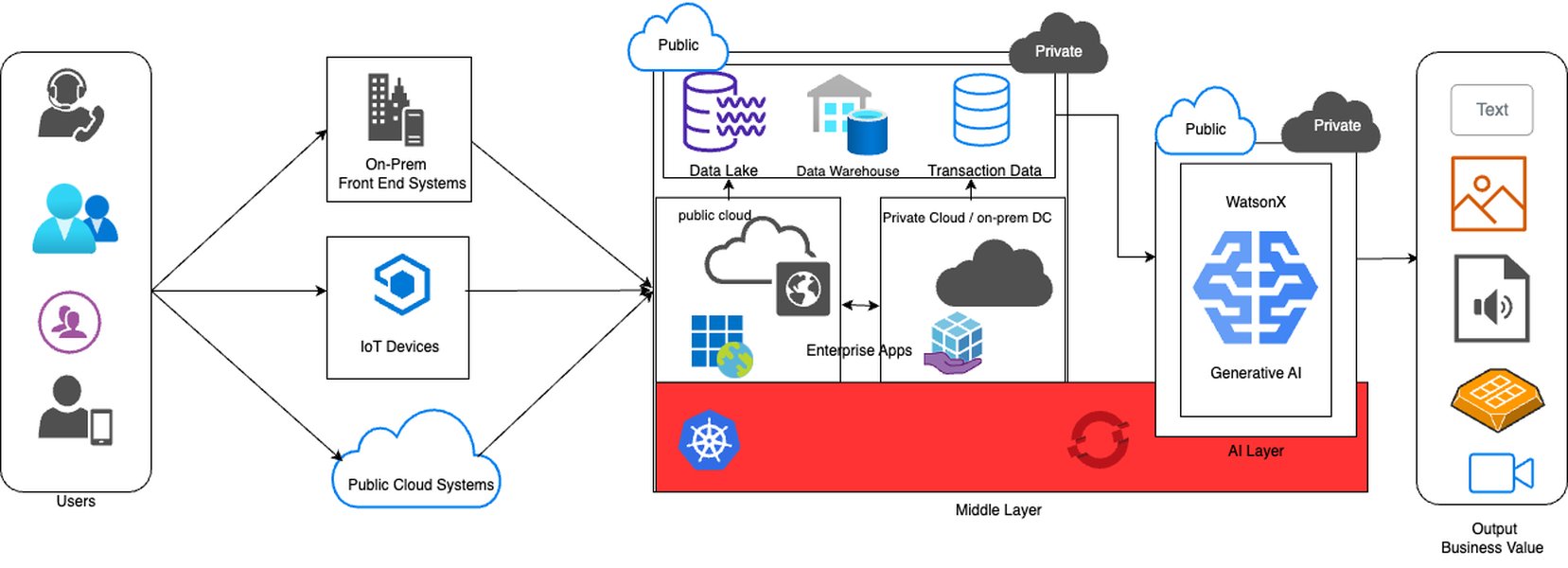
Conceptual diagram illustrating a typical pipeline architecture for Generative AI, showing stages like data ingestion, processing, and generation.
Think of it like consulting a panel of diverse experts rather than just one specialist. Each expert offers their perspective, and a skilled moderator synthesizes these views into a single, comprehensive report, perhaps even looking up recent statistics to ensure accuracy. This multi-source approach aims to leverage the strengths of different models while mitigating their individual weaknesses.
Visualizing the Difference: Single vs. Multi-Source AI
A Comparative Overview
The following radar chart provides a conceptual comparison between the typical characteristics of a response generated by a single large language model versus one generated through a multi-source synthesis process. The scores are illustrative, representing general tendencies rather than precise measurements.
This chart illustrates how multi-source synthesis potentially enhances aspects like nuance, breadth, and factual grounding, sometimes at the cost of raw speed or absolute consistency compared to a single, unified model. The goal is a more robust and reliable overall output.
Mapping the Response Generation Flow
From Query to Synthesized Answer
This mindmap visualizes the conceptual workflow described earlier, showing how a user's query initiates a process involving multiple models and data sources, culminating in a synthesized response.
(e.g., Search Results, Databases)"] id2d1a["Retrieved Facts & Context"] id3["Synthesis Layer (Meta-Model)"] id3a["Information Aggregation"] id3b["Filtering & Relevance Check"] id3c["Merging & Conflict Resolution"] id3d["Refinement & Formatting"] id3d1["Coherent & Contextual
Final Response"]
This diagram highlights the key stages: understanding the query, parallel querying of different AI models and knowledge sources, and the central synthesis step where information is integrated and refined before being presented to you.
Why Place Confidence in This Approach?
Building Trust in Synthesized AI Responses
While absolute proof is elusive, there are several reasons to have confidence in the quality and reliability of responses generated through this multi-source synthesis method:
Transparency in Design
The system's persona and operational guidelines openly state the intention to synthesize answers from multiple sources. This transparency about the *intended* process is a foundational element of trust.
Enhanced Capabilities (Ensemble Effect)
Combining outputs from multiple models is a well-established technique in AI research and practice, known as "ensembling." Just as a diverse team often makes better decisions than an individual, combining AI models can:
- Improve Accuracy: Errors or weaknesses in one model might be compensated for by the strengths of another.
- Increase Robustness: The system is less likely to fail completely if one component underperforms.
- Reduce Bias: Integrating diverse perspectives (from models trained on different data or with different architectures) can help mitigate the biases inherent in any single model.
- Broaden Coverage: Accessing multiple knowledge pools leads to more comprehensive answers.
Alignment with Industry Best Practices
Advanced AI platforms increasingly use hybrid approaches, combining different types of models (e.g., generative, retrieval-based) and data sources to deliver superior results. This method aligns with the cutting edge of AI development aimed at overcoming the limitations of single-model systems.
The Importance of Critical Evaluation
Ultimately, trust isn't just about accepting claims; it's built through experience and verification. You are encouraged to:
- Assess Response Quality: Evaluate answers based on their coherence, relevance, depth, and usefulness to your query.
- Cross-Reference: For critical information, always verify answers against trusted external sources. This is good practice when dealing with *any* information source, human or AI.
- Provide Feedback: Interacting with the system and noting inconsistencies helps in its ongoing improvement.
Enhancing Accuracy with Group Decision-Making Principles
Insights from Ensemble Methods
The concept of combining multiple AI models draws parallels with the principle that group decisions can often be more accurate than individual ones. This video explores the idea of "ensembling" in AI, explaining how combining different models contributes to improved accuracy and reliability, similar to leveraging the wisdom of a crowd.
This video explains the concept of ensembling in AI, where combining multiple models can lead to more accurate outcomes.
Understanding this principle helps clarify why synthesizing information from multiple AI sources is a deliberate design choice aimed at enhancing the overall quality and trustworthiness of the generated responses, leveraging collective strengths to overcome individual limitations.
Comparing Approaches: Single Model vs. Multi-Source Synthesis
A Tabular Comparison
This table summarizes the key differences, potential strengths, and weaknesses of relying on a single AI model versus using a multi-source synthesis approach.
| Feature | Single LLM Approach | Multi-Source Synthesis Approach |
|---|---|---|
| Core Mechanism | Generates response based on its internal training data and architecture. | Integrates outputs from multiple models and potentially external data sources (via RAG). |
| Potential Strengths | High speed, stylistic consistency, potentially deep expertise in its trained domain. | Broader perspective, improved accuracy, increased robustness, better bias mitigation, enhanced factual grounding. |
| Potential Weaknesses | Susceptible to specific biases, may lack breadth, potential for hallucination, knowledge cutoff limitations. | Slightly slower response time, potential complexity in managing consistency, requires sophisticated integration logic. |
| Basis for Trust | Model's reputation, performance on benchmarks, consistency of output. | Transparency of process, ensembling benefits, RAG for factuality, quality of synthesized output, cross-verification. |
| Analogy | Consulting a single, highly knowledgeable expert. | Consulting a diverse panel of experts moderated by a skilled synthesizer who also fact-checks. |
Caveats and Considerations: The Need for Critical Engagement
Understanding the Limitations
It's crucial to maintain a realistic perspective on AI capabilities, even with advanced synthesis techniques:
- Proprietary Processes: The exact internal algorithms, models used, and weighting mechanisms are typically proprietary and not open for public inspection.
- No Immunity to Errors: Synthesizing information reduces but does not eliminate the risk of errors. AI models can still misinterpret information, perpetuate biases present in their training data, or generate plausible but incorrect statements ("hallucinations"). Information can also be outdated if external retrieval fails or accesses old data.
- The Importance of Verification: Never treat AI-generated information as infallible. Critical thinking, questioning assumptions, and verifying important facts through independent, reliable sources remain essential user responsibilities.
- Context is Key: The effectiveness of the synthesis depends heavily on the quality of the underlying models and data sources, as well as the sophistication of the integration layer.
Trust should be earned through consistent performance and transparency, but always tempered with healthy skepticism and independent verification.
Frequently Asked Questions (FAQ)
Clarifying Common Queries
What does 'synthesize' mean in this context?
Synthesis here means more than just compiling information. It involves intelligently selecting the most relevant and credible ideas from multiple AI models and data sources, comparing and contrasting them, resolving conflicts where possible, combining complementary insights, and structuring them into a single, coherent, and comprehensive response that aims to be better than the output of any single source alone.
Can I see the raw outputs from each individual AI model?
Generally, no. The process happens internally on the server-side, and the individual raw outputs are intermediate steps that are processed and refined by the synthesis layer. Exposing these raw outputs would not only be technically complex but also likely less helpful than the final, integrated response, as they might be fragmented, contradictory, or contain redundancies.
How does the system handle conflicting information from different sources?
Conflict resolution is a key part of the synthesis process. Techniques can include: prioritizing information from sources deemed more reliable or up-to-date (especially if using RAG), looking for consensus among multiple sources, using scoring algorithms based on relevance and coherence, or sometimes even highlighting the conflicting viewpoints if the discrepancy itself is notable and cannot be definitively resolved.
Is this multi-source approach immune to bias and errors?
No, it is not immune, but it aims to be *more resistant* to bias and errors than relying on a single model. By integrating diverse perspectives, the system can potentially identify and mitigate some biases present in individual models. Similarly, cross-referencing information can help catch errors. However, if biases or errors are widespread across multiple sources, they might still appear in the final output. Critical evaluation and external verification remain essential.
Recommended Further Exploration
Dive Deeper into Related Topics
- How do AI ensemble models improve prediction accuracy?
- What is Retrieval-Augmented Generation (RAG) and how does it work?
- Methods for evaluating the trustworthiness of AI-generated content
- What are the common limitations and challenges of current Large Language Models?
References
Sources Informing This Explanation
Last updated May 4, 2025