
Unveiling the Colossus: A Deep Dive into the Airbus A380's Landing Gear
Explore the intricate engineering, massive scale, and critical systems supporting the world's largest passenger jet on the ground.
The Airbus A380, renowned as the world's largest passenger aircraft, relies on an extraordinarily complex and robust landing gear system. This critical assembly is not just about wheels; it's a sophisticated integration of hydraulics, mechanics, and advanced electronics designed to manage the immense forces involved in supporting, moving, and stopping this aviation giant during all ground operations.
Highlights of the A380 Landing Gear
- Massive Scale: Comprising five individual gear sets with a total of 22 wheels, the system is engineered to support a staggering Maximum Takeoff Weight (MTOW) of approximately 575,000 kg (575 tonnes or 1.27 million pounds).
- Integrated Complexity: It masterfully combines hydraulic power, mechanical linkages, and electrical control systems for reliable extension, retraction, steering, and powerful braking capabilities.
- Advanced Engineering for Safety: Features such as body wheel steering for enhanced maneuverability, specialized high-strength materials, and rigorous maintenance protocols underscore its commitment to operational safety and reliability.

The imposing landing gear of an Airbus A380 undergoing maintenance, showcasing its scale.
The Foundation: Overall Configuration
The sheer size and weight of the A380 necessitate a unique landing gear configuration to distribute the load effectively and ensure compatibility with airport infrastructure.
Five Pillars of Support
Unlike smaller aircraft, the A380 employs five separate landing gear assemblies:
- One Nose Landing Gear (NLG): Located beneath the cockpit, providing steering control.
- Two Wing Landing Gears (WLG): Positioned under each wing, offering lateral stability and support.
- Two Body Landing Gears (BLG): Situated further aft under the fuselage, bearing a significant portion of the aircraft's weight.
This distributed arrangement is crucial for minimizing stress on runway and taxiway pavements, allowing the A380 to operate at airports designed for large aircraft despite its exceptional weight.
Wheel Distribution and Load Bearing Capacity
The 22 wheels are strategically distributed across the five gear sets:
- Nose Landing Gear (NLG): 2 wheels
- Wing Landing Gears (WLG): 4 wheels each (8 total)
- Body Landing Gears (BLG): 6 wheels each (12 total)
This configuration enables the landing gear system to safely support the aircraft's immense weight variations, from its maximum takeoff weight (MTOW) of around 575 tonnes down to its maximum landing weight of approximately 391 tonnes.
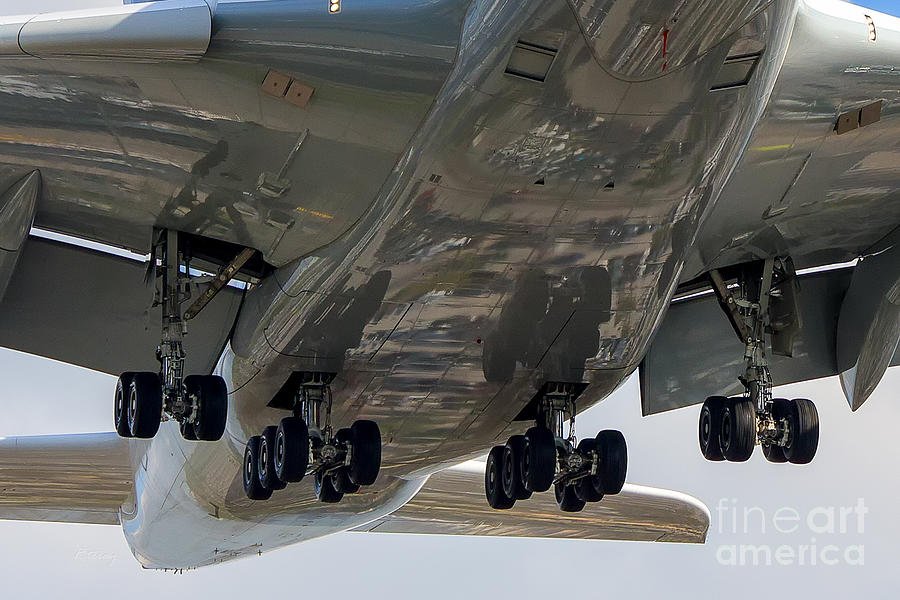
A close view of a main landing gear bogie, highlighting the multi-wheel arrangement.
Engineering Marvels: Components and Systems
Each part of the A380's landing gear system is a product of meticulous design and advanced materials, working in concert to ensure safe and efficient ground operations.
Nose Landing Gear (NLG): The Steering Head
Design and Function
The twin-wheeled NLG is located directly below the flight deck. It retracts forward into a dedicated bay in the fuselage. Beyond supporting the aircraft's nose, its primary role is steering during taxiing.
Key Supplier
Safran Landing Systems is responsible for the design, manufacture, and support of the A380's nose landing gear.
Main Landing Gear (MLG): The Weight Bearers
The MLG consists of the Wing and Body Landing Gears.
Wing Landing Gear (WLG)
Each WLG, equipped with four wheels, is mounted beneath the wing structure. They retract inwards into fairings integrated into the wing root area. They provide crucial support and stability, particularly during takeoff and landing.
Body Landing Gear (BLG)
The two BLGs, each featuring a complex six-wheel bogie, are mounted under the fuselage. These bear the majority of the aircraft's massive weight. Like the WLGs, they retract inwards into the fuselage belly. Their six-wheel design significantly helps in distributing the load over a wider area.
Unique Tilt Feature
Interestingly, the main landing gear wheels are designed to tilt slightly downwards towards the front. This configuration assists during the rotation phase of takeoff, aligning with the aircraft's pitch angle and optimizing lift generation without compromising structural integrity.
Wheels and Brakes: Rolling and Stopping Power
Wheels
The A380's wheels are constructed from high-strength, lightweight materials like 2014-T6 aluminum alloy. They feature specific designs, such as 23-inch rims, deep cavities, and venting holes, to enhance durability, dissipate heat generated during braking, and ensure reliability under extreme loads. Honeywell is a key supplier for these advanced wheels.
Brakes
Stopping the colossal A380 requires immense braking power. The aircraft is equipped with 16 braked wheels on the main landing gear (the NLG wheels are typically not braked). The brakes are carbon-based, known for their high energy absorption capacity and fade resistance. They are hydraulically actuated and integrated with a sophisticated anti-skid system to prevent wheel lockup and maintain directional control during deceleration. Both Safran Landing Systems and Honeywell contribute to the A380's braking system components.
Shock Absorption: Cushioning the Impact
Each landing gear strut incorporates a large oleo-pneumatic shock absorber. These units use compressed gas (typically nitrogen) and hydraulic fluid to absorb and dampen the enormous kinetic energy generated upon touchdown, ensuring a smooth landing and protecting the airframe structure from excessive stress.
System Interconnectivity: A Mindmap View
The following diagram illustrates the main components and subsystems of the Airbus A380 landing gear, showing how they interrelate to form a cohesive system.
This mindmap provides a visual hierarchy, starting from the overall system and branching down to individual gear types, their components, the crucial control subsystems, and key industry partners involved in its production.
Precision in Motion: Operation and Control
The flawless operation of the A380 landing gear relies on sophisticated control systems that manage extension, retraction, steering, and braking with precision.
Extension and Retraction System (LGERS)
While commanded electrically from the cockpit, the physical movement of the landing gear is achieved through a combination of hydraulic actuators and mechanical linkages. The system ensures the gears deploy and lock securely for landing and retract smoothly after takeoff. The NLG retracts forward, while the WLG and BLG retract inwards. Hydraulically and mechanically operated doors close flush over the gear bays once retracted, minimizing aerodynamic drag during flight.
Steering Control System (SCS)
Maneuvering the A380 on the ground requires advanced steering capabilities:
- Nose Wheel Steering (NWS): Primarily controlled via the tiller in the cockpit, the NWS allows for precise directional control during taxiing. It is typically powered by the aircraft's 'Green' hydraulic system, with alternate power sources available for redundancy.
- Body Wheel Steering (BWS): Uniquely, the A380 also features steering on the aft axles of the Body Landing Gears. BWS operates automatically as a function of the NWS angle and is powered by the 'Yellow' hydraulic system. This significantly improves the aircraft's turning radius and reduces tire scrub during tight turns on the ground.
Control inputs and system logic are managed by dedicated Core Processing Input/Output Modules (CPIOMs).
Braking Control System (BCS)
The BCS manages the application of the 16 powerful carbon brakes on the main landing gear wheels. It incorporates an essential anti-skid function that modulates brake pressure to prevent wheels from locking up, ensuring maximum braking efficiency and maintaining directional stability, especially on potentially slippery runways.
Monitoring Systems
Continuous monitoring enhances safety and operational awareness:
- Tire Pressure Indicating System (TPIS/TPMS): Monitors the pressure in each of the 22 tires, alerting the crew to potential under-inflation or other issues.
- Oleo Pressure Monitoring: Keeps track of the pressure within the shock absorbers, indicating their status and readiness.
Comparative System Attributes
This chart provides a relative comparison of key attributes of the A380 landing gear system against typical large wide-body aircraft standards. The values represent a qualitative assessment highlighting the A380's advanced nature.
As illustrated, the A380's system scores highly across the board, particularly in load capacity, complexity due to its size and features like BWS, and enhanced steering capability. Its design also emphasizes redundancy and aims for pavement friendliness despite the aircraft's weight, though this comes with increased maintenance intensity compared to less complex systems.
Key Specifications Summary
The table below provides a concise summary of the core specifications of the Airbus A380 landing gear system:
| Feature | Specification | Details |
|---|---|---|
| Configuration | 5 Gear Sets | 1 Nose Landing Gear (NLG), 2 Wing Landing Gears (WLG), 2 Body Landing Gears (BLG) |
| Total Wheels | 22 | NLG: 2, WLG: 4 each (8 total), BLG: 6 each (12 total) |
| Max Takeoff Weight (MTOW) Support | Approx. 575,000 kg (575 tonnes) | Equivalent to ~1.27 million lbs |
| Max Landing Weight Support | Approx. 391,000 kg (391 tonnes) | - |
| Actuation | Electro-Hydraulic/Mechanical | Electrically controlled, hydraulically/mechanically powered |
| Steering Systems | Nose Wheel Steering (NWS) & Body Wheel Steering (BWS) | NWS powered by Green Hydraulic System, BWS powered by Yellow Hydraulic System |
| Braking System | 16 Carbon Brakes (MLG) | Hydraulically actuated with anti-skid |
| Key Suppliers | Multiple | Safran Landing Systems (NLG, Brakes), Honeywell (Wheels, Brakes), UTC Aerospace Systems (Components) |
| Retraction | NLG: Forward, MLG: Inward | Into dedicated fuselage and wing bays |
Visualizing the Mechanics: Gear in Action
Observing the landing gear deployment provides a fascinating look at the system's intricate mechanics. The video below offers a close-up view of the A380's landing gear sequence, illustrating the coordinated movement of the gear struts, bogies, and doors during extension.
Airbus A380 Landing Gear Deployment Sequence (Super Close Up).
This perspective highlights the engineering precision required to orchestrate the movement of these massive components smoothly and reliably, preparing the aircraft for a safe landing.
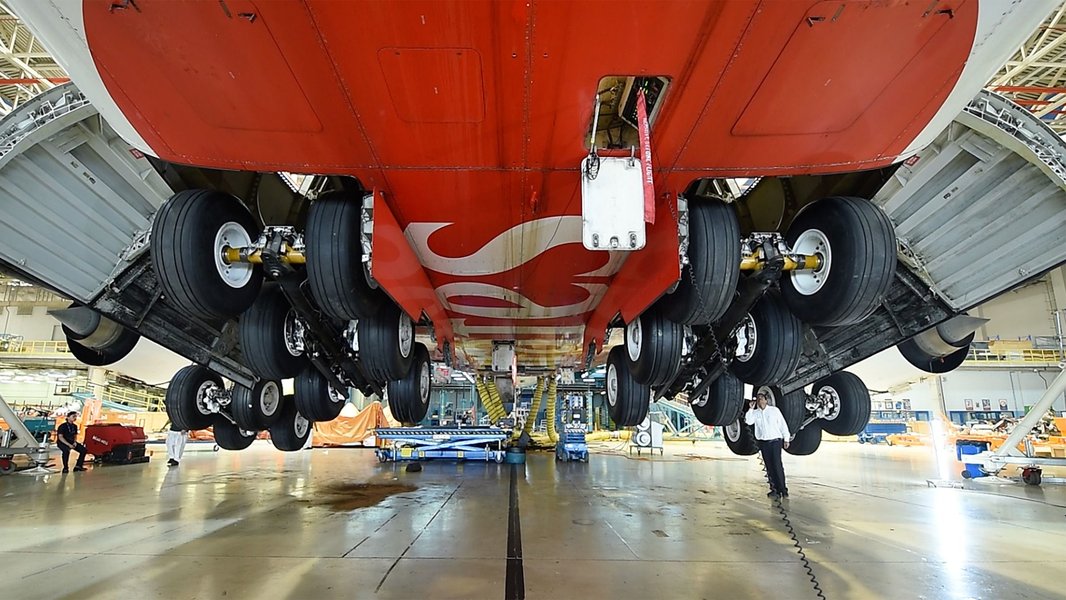
An Emirates A380 undergoing a complex landing gear replacement procedure.
Keeping the Giant Grounded: Maintenance and Reliability
Maintaining the A380's landing gear is a significant undertaking due to its complexity and the critical safety role it plays. Rigorous inspection and maintenance schedules are essential.
Routine Checks and Inspections
Before every flight, pilots and ground mechanics perform visual inspections of the landing gear, checking tires for wear and correct inflation, examining brake components, and looking for any signs of hydraulic leaks or structural damage.
Major Overhauls and Replacement
The landing gear undergoes extensive inspection and overhaul during heavy maintenance events known as 'D checks'. However, the entire landing gear system typically requires replacement after approximately 10 years of service or 18,000 flight cycles, whichever comes first. This is a highly complex procedure:
- It requires specialized, powerful jacks to lift and support the massive weight of the A380 airframe.
- The process involves removing the old gear sets and installing refurbished or new ones, connecting all hydraulic, electrical, and mechanical interfaces, and performing rigorous testing.
- A full landing gear replacement can take a dedicated team around 14 days and thousands of labor hours to complete. Emirates performed the first-ever full A380 landing gear replacement on aircraft A6-EDF back in May 2018.
This intensive maintenance ensures the continued airworthiness and safety of the landing gear throughout the aircraft's operational life.
Frequently Asked Questions (FAQ)
How many wheels does the Airbus A380 have?
The Airbus A380 has a total of 22 wheels distributed across its five landing gear sets (2 on the nose gear, 4 on each of the two wing gears, and 6 on each of the two body gears).
Why does the A380 need so many wheels?
The large number of wheels is necessary to distribute the aircraft's immense weight (up to 575 tonnes at takeoff) over a larger area. This reduces the load on each wheel and minimizes stress on airport pavements (runways and taxiways), ensuring compatibility with existing infrastructure designed for large aircraft.
How does the A380 steer on the ground?
The A380 uses a combination of Nose Wheel Steering (NWS), controlled by the pilots via a tiller, and automated Body Wheel Steering (BWS) on the rear wheels of the body landing gear. The BWS works in conjunction with the NWS angle to significantly improve maneuverability and reduce the aircraft's turning radius during taxiing.
How often is the landing gear replaced?
Complete landing gear replacement is typically required approximately every 10 years or after 18,000 flight cycles, depending on operational factors and regulatory requirements. This involves swapping out the entire gear assemblies for overhauled or new units.
What happens if the hydraulic system fails during gear operation?
Aircraft like the A380 are designed with significant redundancy. The landing gear system utilizes multiple independent hydraulic systems (e.g., Green and Yellow systems power different aspects like NWS and BWS). In case of a primary system failure, backup hydraulic sources or alternative extension/retraction mechanisms (which can include gravity-assist or mechanical backups, depending on the specific failure scenario) are typically available to ensure the gear can still be deployed safely for landing.
Recommended
- How does the A380's landing gear compare to the Boeing 747's system?
- Can you explain Body Wheel Steering (BWS) in more detail?
- What advanced materials are used to build aircraft landing gear?
- What is involved in the overhaul process for aircraft landing gear?
References
Last updated April 26, 2025