
Unveiling the Brains Behind the Voice: A Deep Dive into Amazon Alexa's Architecture
Exploring the sophisticated blend of AI, cloud, and hardware that powers Amazon's ubiquitous virtual assistant.


- 1.Key Insights into Alexa's Engineering Marvel
- 2.The Foundational Pillars: Internal Structure and Data Flow
- 3.Core Technologies Driving Alexa's Capabilities
- 4.The Evolution: Generative AI and Beyond
- 5.The Technical Components in Detail
- 6.Quantifying Alexa's Capabilities and Progress
- 7.A Visual Journey into Alexa's Functionality
- 8.Challenges, Scalability, and Future Directions
- 9.Frequently Asked Questions
- 10.Conclusion
- 11.Recommended Further Exploration
- 12.Referenced Search Results
Key Insights into Alexa's Engineering Marvel
- Cloud-Centric Intelligence: Alexa's core processing, including Automatic Speech Recognition (ASR) and Natural Language Understanding (NLU), primarily resides in the cloud, enabling scalability, continuous learning, and sophisticated AI capabilities.
- Generative AI Revolution: Recent advancements, particularly with Alexa+, integrate large language models (LLMs) and generative AI, transforming Alexa from a rule-based system into a more conversational, context-aware, and proactive assistant capable of complex reasoning and real-world actions.
- Multi-Layered Architecture: From on-device hardware for wake word detection and audio capture to a robust cloud infrastructure for processing, skill execution, and response generation, Alexa operates through a meticulously designed distributed system.
Amazon Alexa, launched in 2014, has rapidly evolved into a pervasive cloud-based voice service powering millions of smart devices globally. More than just a voice interface, Alexa represents a sophisticated integration of artificial intelligence, machine learning, and cloud computing designed to understand and respond to human language. Its architecture allows it to perform a vast array of tasks, from playing music and setting alarms to controlling smart home devices and providing complex information, demonstrating a remarkable blend of hardware and software innovation.
The Foundational Pillars: Internal Structure and Data Flow
Alexa's internal structure is meticulously engineered as a distributed system, seamlessly bridging user-facing devices with Amazon's vast cloud infrastructure. This client-server model ensures that while interactions feel instantaneous, the heavy computational lifting happens off-device, allowing for constant improvement and access to extensive datasets.
On-Device Intelligence and Hardware Integration
The journey of a user's command begins with the device layer. Echo devices and other Alexa-compatible hardware are equipped with specialized components designed for precise audio capture and initial processing. These devices typically feature:
- Far-Field Microphones: Often arranged in arrays (e.g., seven in a circular configuration), these microphones are optimized to capture voice commands from various directions within a room.
- Beamforming Technology: This advanced signal processing technique helps Alexa devices isolate the user's voice from background noise and acoustic echoes, ensuring clarity even in challenging environments.
- Wake Word Detection: A crucial on-device function, wake word detection ("Alexa," "Computer," etc.) occurs locally. This means the device is constantly listening for the specific trigger word, and only upon its detection is the subsequent audio stream sent to the cloud. This local processing is vital for responsiveness and privacy, as not all audio is continuously streamed.
- Local Signal Conditioning: Before transmission to the cloud, the captured audio undergoes further processing to reduce interference and optimize it for downstream cloud analysis.
Devices with screens, such as the Echo Show, also integrate visual display capabilities, managed by the Alexa Presentation Language (APL) architecture, which defines how templates are rendered and content is displayed on-screen.
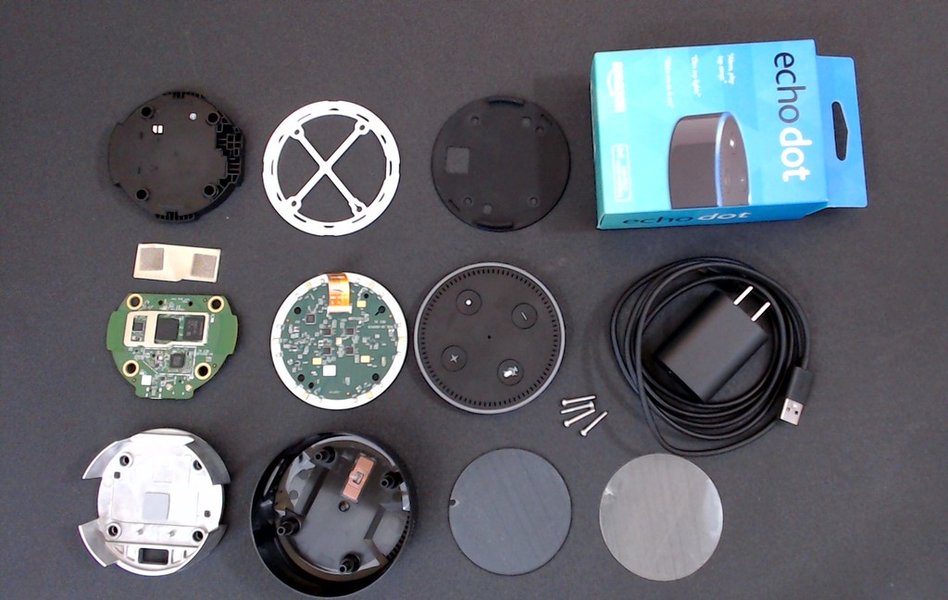
An Amazon Echo Dot device teardown, revealing its intricate internal hardware.
The Cloud Brain: Alexa Voice Service (AVS)
Once the wake word is detected and the utterance captured, the audio data is encrypted and streamed to Amazon's cloud servers, where the Alexa Voice Service (AVS) takes over. AVS is the central intelligence hub, comprising a sophisticated suite of APIs and microservices responsible for interpreting, processing, and responding to user commands.
The cloud layer is broadly divided into frontend and backend components. The frontend handles input ingestion and output synthesis, while the backend orchestrates the complex interpretation and execution. This modular, microservices-based design hosted on AWS ensures scalability, fault tolerance, and high availability.
Core Technologies Driving Alexa's Capabilities
Alexa's ability to understand and respond intelligently relies on a sophisticated interplay of cutting-edge technologies, primarily rooted in artificial intelligence and machine learning.
Automatic Speech Recognition (ASR)
The first critical step in the cloud is ASR, which converts the spoken words into text. Alexa's ASR system utilizes deep learning models, including recurrent and convolutional neural networks, trained on vast, diverse datasets encompassing various accents and languages. Contextual ASR further enhances accuracy by considering previous dialogue, improving transcription by 20-30% in multi-turn conversations.
Natural Language Understanding (NLU)
Once the audio is transcribed into text, NLU comes into play. This component's role is to parse the text, extracting the user's intent (the goal of the command) and relevant slots (parameters needed to fulfill the intent). For example, in "Set a timer for 10 minutes," "set a timer" is the intent, and "10 minutes" is a slot. NLU is powered by advanced machine learning models that continuously learn and improve from user interactions, handling ambiguities and different linguistic nuances.
Skill Selection and Dialog Management
With the user's intent and slots identified, Alexa must determine the appropriate action or "skill" to execute. A highly scalable neural architecture, often employing a hierarchical shared encoder and a personalized skill attention mechanism, processes utterances into vectors. This allows Alexa to efficiently match the request against tens of thousands of user-enabled skills with extremely low latency (p99 at approximately 15ms). Dialog management handles multi-turn conversations, maintaining context and learning user preferences to provide a more natural and fluid interaction.
Natural Language Generation (NLG) and Text-to-Speech (TTS)
After the appropriate action is taken or information is retrieved, Alexa needs to formulate a coherent and natural-sounding response. NLG is responsible for crafting human-like text responses, which are then converted into audible speech by the TTS engine. TTS employs deep learning models to generate speech with natural prosody, inflections, and tones, streaming it back to the user's device. For multimodal devices, APL dictates how visual elements accompany the audio.
A mindmap illustrating the hierarchical components and interconnected processes within Amazon Alexa's architecture.
The Evolution: Generative AI and Beyond
Alexa's architecture has undergone a significant transformation, moving beyond traditional rule-based and domain-specific models to embrace generative AI and large language models (LLMs). This strategic pivot, often referred to as "Alexa+," represents a fundamental rebuild aimed at enhancing conversational capabilities, enabling more complex reasoning, and facilitating real-world actions.
Integrating LLMs for Enhanced Intelligence
The integration of LLMs from Amazon Bedrock, such as Amazon Nova and Anthropic Claude, allows Alexa to:
- Improve Conversational Flow: Generative AI enables Alexa to engage in more natural, multi-turn conversations, retaining context and adapting to user preferences with greater fluidity.
- API Connectivity and Orchestration: The new generative AI core connects to thousands of services via API-aware LLMs, allowing Alexa to orchestrate complex tasks like making reservations or coordinating actions across different platforms. This agentic AI capability moves Alexa towards being a proactive, task-oriented assistant.
- Reduced Latency: Smart model routing minimizes the time taken for generative AI models to process requests, contributing to a more responsive user experience.
- Personalization: LLMs enhance personalization by allowing Alexa to recall facts and affinities specific to a user, leading to more tailored and empathetic interactions.
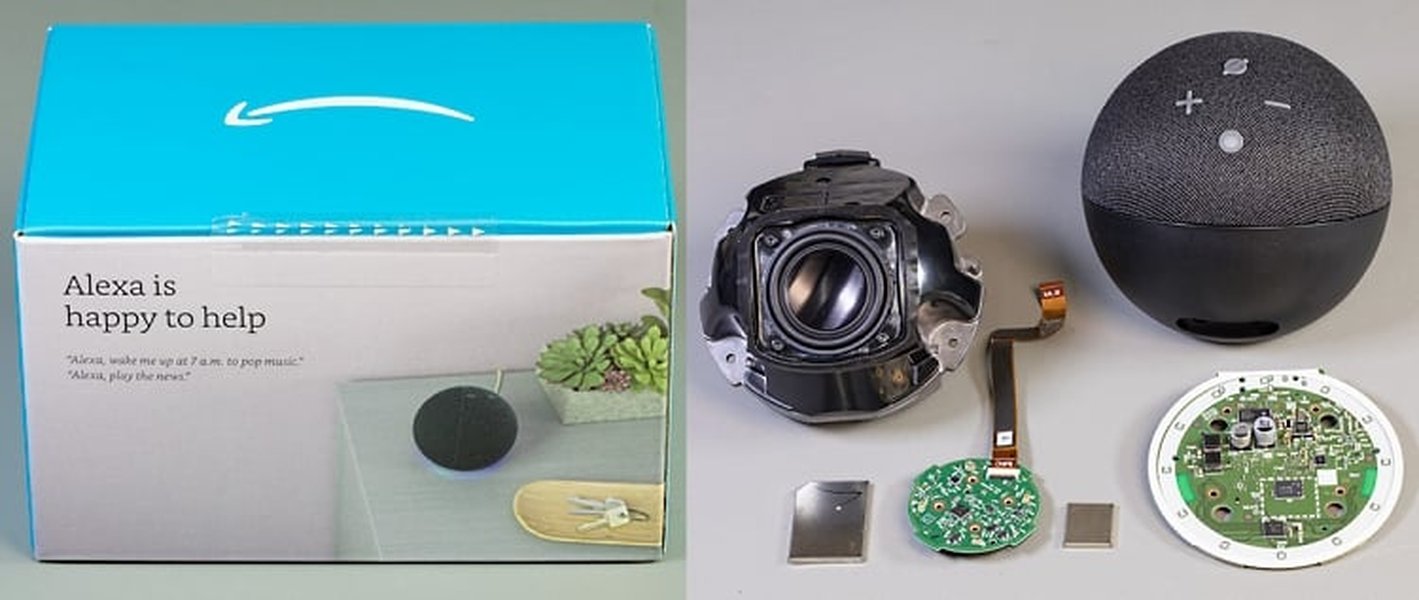
An image showing the internal components of an Amazon Echo Dot 4th Generation, showcasing the hardware density.
Smart Home and IoT Integration
Beyond conversational AI, Alexa is a central hub for smart home ecosystems. It supports various local protocols like Zigbee, Matter, and Bluetooth Low Energy (BLE) mesh, allowing for low-latency, even offline, control of connected devices. This integration extends through the Alexa Skills Kit, which enables device manufacturers to link their products, and AWS IoT Core for managing data flow from IoT devices.
The Technical Components in Detail
To summarize the intricate components and their functions within Alexa's operational framework, the following table provides a detailed overview of the core technologies and their roles:
| Component | Key Technology/Description | Primary Function | Architectural Layer |
|---|---|---|---|
| Device Layer | Far-field microphones, Beamforming, Acoustic Echo Cancellation, Wake Word Detector | Audio capture, noise reduction, local wake word detection | Edge (User Device) |
| Automatic Speech Recognition (ASR) | Deep neural networks, Contextual ASR | Converts spoken words into text | Cloud (AVS) |
| Natural Language Understanding (NLU) | Machine learning models, Intent/Slot extraction, Tokenization, Entity Recognition | Interprets user intent and extracts critical information from text | Cloud (AVS) |
| Skill Selection | Scalable neural architecture, Hierarchical shared encoder, Personalized skill attention | Identifies and routes user requests to the most relevant skill or service | Cloud (AVS) |
| Dialog Management | Generative AI, Contextual awareness, Preference learning | Manages multi-turn conversations, maintains context, learns user preferences | Cloud (AVS) |
| Natural Language Generation (NLG) | ML models, Generative AI | Crafts human-like text responses | Cloud (AVS) |
| Text-to-Speech (TTS) | Deep learning models, Natural prosody synthesis | Converts text responses into audible speech | Cloud (AVS) |
| Alexa Presentation Language (APL) | Templating system, Rendering engine | Defines and renders visual content on screen-enabled devices | Both (Cloud definition, Device rendering) |
| Smart Home Integration | Zigbee, Matter, BLE mesh protocols, AWS IoT Core | Connects and controls smart home devices | Both (Device local control, Cloud management) |
| Generative AI Core (Alexa+) | Large Language Models (LLMs), API orchestration, Agentic AI | Enables advanced conversational abilities, complex reasoning, and task execution through APIs | Cloud (AVS) |
Quantifying Alexa's Capabilities and Progress
To further illustrate the advancements and core strengths of Alexa, we can visualize certain aspects of its performance and architectural focus. The following radar chart provides an opinionated analysis of Alexa's current standing across key technological dimensions, while the bar chart highlights its evolution in handling complex user interactions.
This radar chart provides an comparative overview of Alexa's capabilities across several key dimensions, contrasting its current state with its performance before the significant integration of generative AI. Values are scaled from 1 (lowest) to 5 (highest).
This bar chart illustrates the perceived effectiveness of Alexa in handling various types of user interactions, comparing its performance with and without the advanced capabilities brought by generative AI. Scores are on a scale of 0 to 10, reflecting an increased ability to handle more nuanced and complex requests.
A Visual Journey into Alexa's Functionality
To further contextualize the discussion, this video provides an in-depth look into how Amazon Alexa operates, explaining the fundamental principles behind its voice control and artificial intelligence. It serves as an excellent complement to understanding the theoretical and architectural aspects described in this research.
An insightful video detailing the mechanisms of how Amazon Alexa works, from speech processing to intelligent responses.
Challenges, Scalability, and Future Directions
Developing and maintaining a system as complex and pervasive as Alexa presents numerous challenges. These include ensuring high accuracy in diverse linguistic environments, minimizing latency for real-time interactions, and continually enhancing privacy and security protocols. The architecture is designed for scalability, capable of processing millions of requests per minute, utilizing auto-scaling clusters and event-driven microservices.
Future developments are heavily focused on deepening generative AI capabilities for more empathetic and proactive interactions. This includes further advancements in agentic AI, allowing Alexa to engage in multi-step reasoning and independently complete more complex tasks. Edge computing advancements are also critical for further reducing latency and enabling more robust on-device processing.
Frequently Asked Questions
What is the primary difference between Alexa's pre-generative AI architecture and its current iteration?
How does Alexa maintain user privacy given its reliance on cloud processing?
Can Alexa operate without an internet connection?
What are "skills" in the context of Alexa's architecture?
Conclusion
Amazon Alexa stands as a testament to the power of integrating advanced AI, machine learning, and cloud computing into everyday technology. Its internal structure, spanning robust on-device hardware to a sophisticated cloud-based processing engine, is a marvel of distributed systems design. The continuous evolution, particularly the recent pivot to generative AI, underscores Amazon's commitment to creating an increasingly intelligent, conversational, and capable virtual assistant. As the landscape of AI continues to develop, Alexa's architecture will undoubtedly serve as a crucial benchmark, influencing the next generation of human-computer interaction.
Recommended Further Exploration
- How Amazon is leveraging LLMs for next-generation Alexa experiences
- Deep dive into Alexa's Natural Language Understanding (NLU) mechanisms
- The role of AWS services in scaling Amazon Alexa's infrastructure
- Future trends in voice assistant technology and edge computing
Referenced Search Results
 aboutamazon.com
amazon.science
developer.amazon.com
 aws.amazon.com
 docs.aws.amazon.com
developer.amazon.com
 amazon.com
 alexa.amazon.com
amazon.science
developer.amazon.com
developer.amazon.com
developer.amazon.com