
Alexander Fleming: The Accidental Discovery That Revolutionized Medicine
Uncover the story of the Scottish scientist whose chance observation led to one of humanity's greatest medical breakthroughs.
Knowledge cutoff: Thursday, 2025-05-15
Key Insights into Fleming's Legacy
- The Serendipitous Discovery: Penicillin, the world's first true antibiotic, was discovered by Alexander Fleming in 1928 through a fortunate accident involving a contaminated petri dish.
- Pioneering Work Beyond Penicillin: Fleming also discovered lysozyme in 1922, an enzyme with antibacterial properties, showcasing his early interest in natural defenses against infection.
- Collaborative Triumph: While Fleming made the initial discovery, the transformation of penicillin into a life-saving drug was a collaborative effort, notably by Howard Florey, Ernst Chain, and Norman Heatley, leading to a shared Nobel Prize in 1945.
The Formative Years of a Future Pioneer
From Scottish Farmlands to London's Medical Hub
Alexander Fleming was born on August 6, 1881, at Lochfield Farm, near Darvel in Ayrshire, Scotland. He was the third of four children born to Hugh Fleming and Grace Stirling Morton from his father's second marriage. His father, a farmer, passed away when Alexander was only seven years old. Growing up in a rural environment fostered an early appreciation for the natural world.
Fleming's early education took place at Loudoun Moor School and Darvel School, followed by a scholarship to Kilmarnock Academy. At the age of 13, he moved to London to live with his older brother, Tom, who was a physician. In London, he attended the Royal Polytechnic Institution. After completing his schooling, Fleming worked in a shipping office for four years. A timely inheritance from an uncle, John Fleming, allowed him to pursue a medical career.
In 1903, at the age of 20, he enrolled at St. Mary's Hospital Medical School in Paddington, London. He qualified with distinction in 1906 and began research at St. Mary's under Sir Almroth Wright, a pioneer in vaccine therapy and immunology, in the Inoculation Department. Fleming would remain associated with St. Mary's for his entire career, eventually becoming a professor of bacteriology at the University of London in 1928, and Emeritus Professor of Bacteriology in 1948.
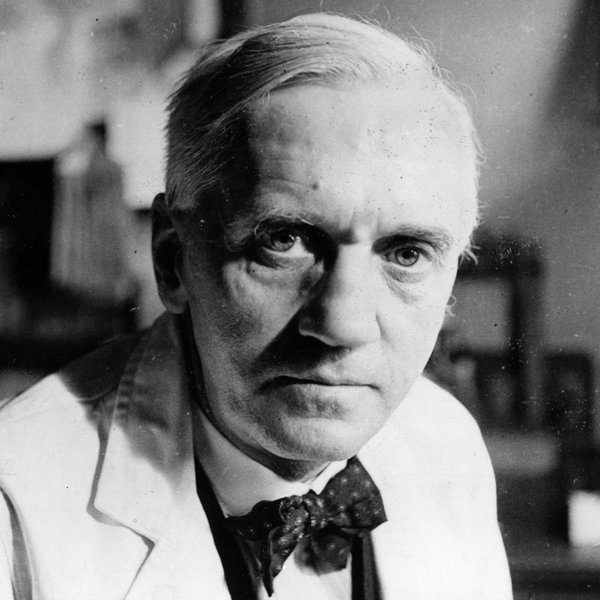
Alexander Fleming at work, a testament to his dedication to bacteriological research.
Landmark Discoveries: Lysozyme and Penicillin
Unveiling Nature's Antibacterial Secrets
Before his most famous discovery, Fleming made another significant contribution to science. His experiences as a captain in the Army Medical Corps during World War I, where he witnessed many soldiers die from infected wounds, profoundly influenced his research direction. He observed that antiseptics used at the time often did more harm than good to the body's natural defenses.
The Discovery of Lysozyme (1922)
In 1922, Fleming discovered lysozyme. The story goes that while suffering from a cold, a drop of his nasal mucus fell onto a culture of bacteria. To his surprise, the bacteria in the vicinity of the mucus were destroyed. He identified the active agent as lysozyme, an enzyme found in bodily fluids such as tears, saliva, and mucus, as well as in egg whites. Lysozyme possessed mild antibacterial properties by breaking down the cell walls of certain bacteria. While lysozyme did not prove to be a potent therapeutic agent against highly pathogenic bacteria, its discovery was significant as it highlighted the existence of naturally occurring antimicrobial substances and the body's own defense mechanisms.
The Accidental Breakthrough: Penicillin (1928)
Fleming's most celebrated discovery occurred serendipitously in September 1928. Upon returning to his laboratory at St. Mary's Hospital after a month's holiday, he began sorting through petri dishes containing cultures of Staphylococcus bacteria. He noticed something unusual on one dish that had been inadvertently left near an open window and had become contaminated with a blue-green mold, later identified as Penicillium notatum (now known as Penicillium rubens or P. chrysogenum).
Crucially, Fleming observed a clear ring around the mold where the staphylococcal colonies had been lysed (destroyed) or their growth inhibited. He realized that the mold was producing a substance that was lethal to the bacteria. He cultured the mold in pure form and found that the "mould juice" was effective against a wide range of bacteria, even when greatly diluted. He named this active substance "penicillin."
Fleming published his findings in the British Journal of Experimental Pathology in June 1929. He noted penicillin's low toxicity to animal cells and suggested its potential as an antiseptic for treating infections. However, he faced significant challenges in isolating, purifying, and stabilizing penicillin. It was a difficult compound to work with, and its production in large quantities was problematic with the resources available to him. Consequently, its profound therapeutic potential remained largely unrealized for over a decade, though Fleming continued to use crude penicillin preparations for treating localized infections and as a tool in bacteriological research to isolate penicillin-insensitive bacteria.

The historic laboratory at St. Mary's Hospital where Fleming made his groundbreaking discovery of penicillin.
The Journey from Discovery to Wonder Drug
Collaboration Unlocks Penicillin's Potential
While Fleming discovered penicillin, the arduous task of transforming it from a laboratory curiosity into a clinically viable antibiotic fell to a team of scientists at the University of Oxford. In the late 1930s, pathologist Howard Florey, biochemist Ernst Boris Chain, and their colleague Norman Heatley began to systematically investigate promising antimicrobial substances, including penicillin.
Heatley devised innovative techniques for extracting and purifying penicillin in larger quantities than Fleming had managed. By 1940, the Oxford team had enough purified penicillin to conduct crucial animal experiments. They demonstrated that penicillin could protect mice from lethal doses of streptococci. This success paved the way for human trials.
The first human trial occurred on February 12, 1941, with Albert Alexander, a 43-year-old policeman suffering from a severe staphylococcal and streptococcal infection. He showed remarkable improvement after receiving penicillin. However, the limited supply of the drug ran out after five days, and Alexander tragically relapsed and died. Despite this outcome, the trial demonstrated penicillin's potent therapeutic effects.
The pressing need for effective treatments during World War II accelerated penicillin's development. With Britain's resources stretched, Florey and Heatley traveled to the United States in 1941 to seek help with mass production. They collaborated with American scientists and pharmaceutical companies, including those at the U.S. Department of Agriculture's Northern Regional Research Laboratory (NRRL) in Peoria, Illinois. The NRRL team made crucial contributions, such as discovering a more productive strain of Penicillium chrysogenum (found on a moldy cantaloupe) and developing deep-tank fermentation methods, which significantly increased yields.
By 1943, penicillin was being produced on a large scale and became a life-saving drug for Allied soldiers, drastically reducing deaths and amputations from infected wounds. After the war, it became available to the civilian population, revolutionizing the treatment of bacterial infections like pneumonia, syphilis, gonorrhea, diphtheria, scarlet fever, and bacterial endocarditis.
Visualizing Fleming's Impact and the Path of Penicillin
The development of penicillin was a multi-faceted process involving scientific insight, technological innovation, and international collaboration. The following radar chart helps visualize key aspects related to Fleming's discovery and the subsequent evolution of penicillin as a therapeutic agent. The scores (out of 10) are illustrative, representing the relative significance or intensity of each aspect.
This chart illustrates how Fleming's initial serendipitous discovery (high score for him) faced challenges in purification and stabilization. The Oxford team and US collaboration excelled in clinical development and mass production, leading to penicillin's widespread impact during WWII and beyond, culminating in a shared Nobel Prize and a lasting medical revolution.
Honors, Later Life, and Enduring Legacy
Global Recognition for a Medical Milestone
Alexander Fleming's groundbreaking work garnered numerous accolades. He was elected a Fellow of the Royal Society in 1943 and knighted by King George VI in 1944, becoming Sir Alexander Fleming. The pinnacle of his recognition came in 1945 when he, along with Howard Florey and Ernst Chain, was awarded the Nobel Prize in Physiology or Medicine "for the discovery of penicillin and its curative effect in various infectious diseases."
Fleming received many other honors from universities and societies worldwide. He was named one of the 100 Most Important People of the 20th century by *Time* magazine in 1999 and was included in the BBC's list of the 100 Greatest Britons. Despite his fame, Fleming remained a modest and reserved individual. He continued his research at St. Mary's, serving as Director of the Wright-Fleming Institute of Microbiology until his retirement in 1954. He also delivered numerous lectures, often cautioning about the dangers of antibiotic overuse and the potential for bacteria to develop resistance—an issue of profound relevance today.
Sir Alexander Fleming passed away from a heart attack in London on March 11, 1955, at the age of 73. He was buried in St. Paul's Cathedral, a testament to his esteemed position in British society.
His legacy is immense. The discovery of penicillin ushered in the age of antibiotics, transforming medicine and dramatically increasing human life expectancy by providing effective treatments for once-lethal bacterial diseases. The laboratory where he made his discovery at St. Mary's Hospital (now part of Imperial College London) has been preserved as the Alexander Fleming Laboratory Museum, allowing visitors to see the setting of this historic event. Several institutions and buildings are named in his honor. The discovery and development of penicillin was recognized as an International Historic Chemical Landmark by the American Chemical Society and the Royal Society of Chemistry in 1999.
Mapping Fleming's Contributions
To encapsulate Alexander Fleming's multifaceted contributions and their far-reaching consequences, the following mindmap provides a visual summary of his life, key discoveries, and the subsequent impact on medical science.
(1881-1955)"] id1["Early Life & Education"] id1a["Born in Ayrshire, Scotland"] id1b["St. Mary's Hospital Medical School"] id1c["Influence of Sir Almroth Wright"] id1d["WWI Medical Corps Service"] id2["Major Scientific Discoveries"] id2a["Lysozyme (1922)"] id2a1["Observed antibacterial properties
in bodily fluids"] id2a2["Highlighted natural defenses"] id2b["Penicillin (1928)"] id2b1["Accidental discovery
from *Penicillium notatum* mold"] id2b2["Observed inhibition of
*Staphylococcus* growth"] id2b3["Initial challenges in purification
and stabilization"] id3["Development & Impact of Penicillin"] id3a["Collaboration with Florey & Chain"] id3a1["Oxford team's purification &
clinical trials"] id3a2["Mass production efforts (WWII)"] id3b["Medical Revolution"] id3b1["Treatment of bacterial infections
(pneumonia, syphilis, etc.)"] id3b2["Reduced mortality rates"] id3b3["Dawn of the antibiotic era"] id4["Awards & Recognition"] id4a["Knighthood (1944)"] id4b["Nobel Prize in Physiology or
Medicine (1945) - shared"] id4c["Numerous global honors"] id5["Later Life & Legacy"] id5a["Director of Wright-Fleming Institute"] id5b["Warnings about antibiotic resistance"] id5c["Alexander Fleming Laboratory Museum"] id5d["Enduring impact on modern medicine"]
This mindmap highlights the key stages of Fleming's life, from his early influences to his pivotal discoveries and the ultimate global impact of penicillin, which continues to shape medical practice today.
Timeline of a Medical Revolution
The journey of Alexander Fleming and the antibiotic he discovered is marked by several key milestones. The table below summarizes these important dates and events.
| Year | Event | Significance |
|---|---|---|
| 1881 | Alexander Fleming born | Birth of the future Nobel laureate in Darvel, Ayrshire, Scotland. |
| 1906 | Fleming graduates from St. Mary's Hospital Medical School | Beginning of his career in bacteriology under Sir Almroth Wright. |
| 1914-1918 | Fleming serves in the Royal Army Medical Corps during WWI | His experiences with wound infections influenced his later research. |
| 1922 | Discovery of Lysozyme | Fleming identifies an enzyme with antibacterial properties in bodily fluids. |
| 1928 | Discovery of Penicillin | Fleming observes the antibacterial effect of *Penicillium notatum* mold on *Staphylococcus* bacteria. |
| 1929 | Publication of Penicillin findings | Fleming shares his discovery with the scientific community in the *British Journal of Experimental Pathology*. |
| 1939-1941 | Florey, Chain, and Heatley at Oxford University work on Penicillin | They successfully isolate, purify, and test penicillin, demonstrating its therapeutic potential. |
| 1941 | First human trial of Penicillin | Albert Alexander is treated, showing penicillin's effectiveness but also the need for larger supplies. |
| 1941-1945 | Mass production of Penicillin | US and UK collaboration leads to large-scale production, crucial for treating WWII casualties. |
| 1944 | Fleming knighted | Recognized for his scientific contributions. |
| 1945 | Nobel Prize in Physiology or Medicine | Awarded jointly to Fleming, Howard Florey, and Ernst Chain for penicillin. |
| 1955 | Alexander Fleming dies | Passing of one of the 20th century's most influential scientists. |
| 1999 | Penicillin discovery named International Historic Chemical Landmark | Acknowledges the profound global impact of penicillin. |
This timeline underscores the progression from initial observation to global medical impact, highlighting Fleming's pivotal role and the subsequent collaborative efforts that brought penicillin to the world.
Visualizing Fleming's World: A Discovery Unfolds
The story of Alexander Fleming and penicillin is not just one of scientific brilliance but also of keen observation and the pursuit of knowledge. The following video provides further insights into his life and the monumental discovery that changed the course of medicine.
This documentary excerpt, "How Alexander Fleming Changed the World," delves into the circumstances surrounding the discovery of penicillin, the first effective antibiotic. It highlights Fleming's role as a Scottish doctor and microbiologist and explains the profound impact his work had on treating bacterial infections and on humanity as a whole. The video reinforces the narrative of a chance observation leading to a medical revolution, saving millions of lives and shaping the future of pharmaceutical development.
Frequently Asked Questions (FAQ)
What was Alexander Fleming's most famous discovery?
Alexander Fleming is most famous for discovering penicillin in 1928. This was the first substance identified that could effectively kill a wide range of harmful bacteria without harming the patient, making it the world's first true antibiotic.
How did Fleming discover penicillin?
The discovery was accidental. In September 1928, Fleming returned from a holiday to find that a petri dish containing Staphylococcus bacteria had been contaminated by a mold (Penicillium notatum). He noticed that the bacteria around the mold had been killed. He isolated the mold, grew it in pure culture, and found it produced a substance—penicillin—that killed many common bacteria.
Did Fleming discover any other important substances?
Yes, in 1922, Fleming discovered lysozyme. This is an enzyme with mild antibacterial properties found in bodily secretions like tears, saliva, and mucus, as well as in egg whites. While not as powerful as penicillin, its discovery was important in understanding natural defenses against infection.
Who helped develop penicillin into a usable drug?
While Fleming made the initial discovery, the development of penicillin into a mass-produced, life-saving drug was primarily carried out by a team at the University of Oxford, led by Howard Florey and Ernst Chain, with crucial contributions from Norman Heatley. Their work in the late 1930s and early 1940s, along with efforts in the United States during World War II, made penicillin widely available.
What awards did Alexander Fleming receive for his discovery?
Alexander Fleming received numerous awards, the most prestigious being the Nobel Prize in Physiology or Medicine in 1945. He shared this prize with Howard Florey and Ernst Chain for their collective work on penicillin. Fleming was also knighted in 1944 for his contributions.
Recommended Further Exploration
- What were the specific challenges in purifying and mass-producing penicillin after its discovery?
- How did the discovery of penicillin impact medical treatments during World War II?
- Explore the problem of antibiotic resistance that Alexander Fleming warned about.
- Who were Howard Florey and Ernst Chain, and what were their specific roles in developing penicillin?
References
Last updated May 15, 2025