
Unveiling the Structure of Alpha-Cadinene
A Deep Dive into a Key Sesquiterpenoid Hydrocarbon
Alpha-cadinene, also known as α-cadinene, is a fascinating organic compound classified as a sesquiterpenoid hydrocarbon. These compounds are a diverse group of terpenes characterized by having three isoprene units, resulting in a chemical formula of C15H24. Alpha-cadinene is particularly noteworthy as it belongs to the cadinene family of isomers, which are widely found in the essential oils of various plants.
Key Highlights of Alpha-Cadinene Structure Elucidation
- Core Structure: Alpha-cadinene possesses a bicyclic structure based on the cadinane skeleton.
- Chemical Formula: Its molecular formula is consistently C15H24, indicative of its sesquiterpene nature.
- Stereochemistry: Specific stereoisomers, such as the (1S,4aR,8aR) configuration, are recognized forms of alpha-cadinene, highlighting the importance of spatial arrangement.
The Cadinene Family: Isomers with a Common Ancestry
The term "cadinene" refers to a group of isomeric hydrocarbons derived from the cadinane skeleton. These isomers share the same fundamental carbon framework but differ in the position of double bonds and their stereochemical arrangement. The name "cadinene" itself originates from the Cade juniper (Juniperus oxycedrus L.), from which cadinene isomers were first isolated from the wood oil.
Due to the complexity arising from various double-bond positions and stereoisomers, the cadinene class is further subdivided based on the relative stereochemistry at the isopropyl group and the two bridgehead carbon atoms.
Delving into Sesquiterpenoids
Alpha-cadinene falls under the broader category of sesquiterpenoids. Sesquiterpenes are a class of terpenes composed of three isoprene units (each with five carbon atoms), totaling 15 carbon atoms. They are derived from farnesyl pyrophosphate (FPP).
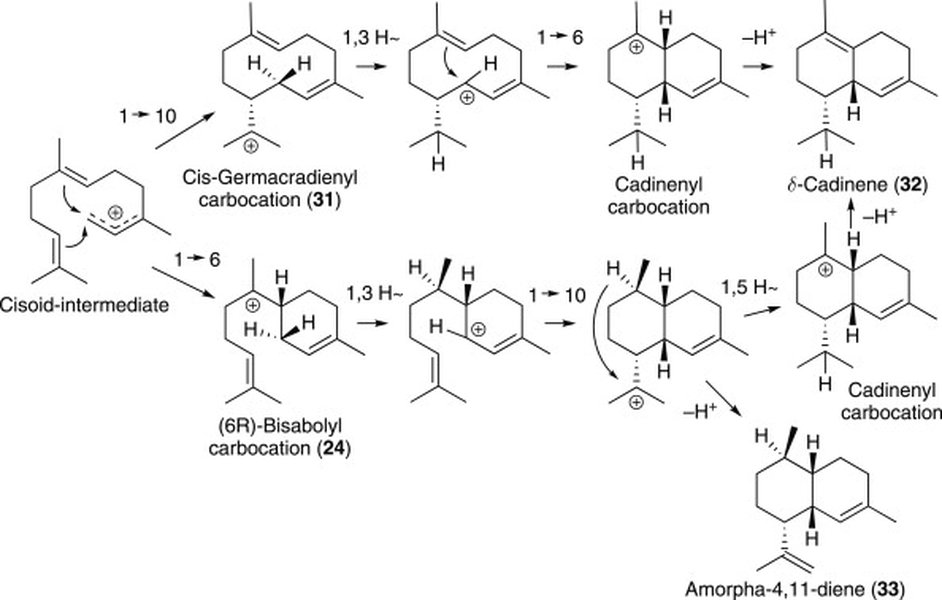
The biosynthesis of these compounds often involves complex enzymatic processes that lead to the formation of diverse cyclic and acyclic structures. In the case of delta-cadinene, an intermediate in the biosynthesis of gossypol, the process involves a cisoid farnesyl carbocation derived from (E,E)-FPP undergoing an initial C1–C10 ring closure.
Sesquiterpenoids are known for their wide range of biological activities and are found in many plants, contributing to their fragrances, flavors, and defense mechanisms.
Structural Elucidation: Unraveling Alpha-Cadinene's Architecture
The structural elucidation of alpha-cadinene involves determining its precise arrangement of atoms and the nature of the bonds between them. This process typically utilizes a combination of spectroscopic techniques and chemical analysis.
Key Structural Features
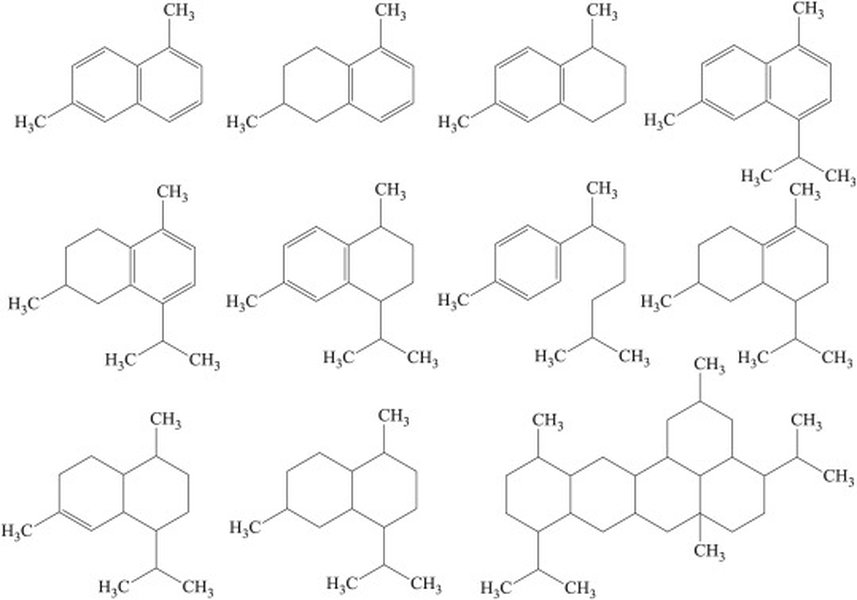
Alpha-cadinene is characterized by a bicyclic structure, meaning it contains two fused rings. Specifically, it is a hexahydronaphthalene derivative with an isopropyl group and two methyl substituents.
The IUPAC name for a specific stereoisomer of alpha-cadinene is (1S,4aR,8aR)-4,7-dimethyl-1-propan-2-yl-1,2,4a,5,6,8a-hexahydronaphthalene. This systematic name provides crucial information about the compound's structure, including the position of substituents and the stereochemistry at specific carbon centers.
Let's break down the IUPAC name to understand the structural components:
- Hexahydronaphthalene: Indicates a bicyclic system derived from naphthalene that has been partially saturated with hydrogen atoms.
- 1,2,4a,5,6,8a-hexahydro: Specifies the positions of saturation in the naphthalene ring system.
- 4,7-dimethyl: Indicates the presence of two methyl (CH3) groups at positions 4 and 7.
- 1-(propan-2-yl): Shows an isopropyl group attached to position 1. The "propan-2-yl" indicates that the isopropyl group is attached via its second carbon atom.
- (1S,4aR,8aR): These notations describe the stereochemistry (the three-dimensional arrangement of atoms) at carbon positions 1, 4a, and 8a. The letters (S and R) denote the configuration at chiral centers according to the Cahn-Ingold-Prelog priority rules.
Chemical Formula and Molecular Weight
The chemical formula of alpha-cadinene is C15H24. This formula is consistent with it being a sesquiterpene hydrocarbon, having 15 carbon atoms and 24 hydrogen atoms. The molecular weight can be calculated based on this formula.
\[ \text{Molecular Weight of } \text{C}_{15}\text{H}_{24} = (15 \times \text{Atomic Weight of } \text{C}) + (24 \times \text{Atomic Weight of } \text{H}) \] \[ \text{Molecular Weight} \approx (15 \times 12.011 \text{ amu}) + (24 \times 1.008 \text{ amu}) \] \[ \text{Molecular Weight} \approx 180.165 \text{ amu} + 24.192 \text{ amu} \] \[ \text{Molecular Weight} \approx 204.357 \text{ amu} \]Resonance Structures and Isomers
While the basic carbon skeleton and functional groups define alpha-cadinene, the presence of double bonds allows for the possibility of different isomers. Alpha-cadinene itself is one specific isomer within the broader cadinene family. Resonance structures are not typically applicable to saturated or partially saturated hydrocarbons like alpha-cadinene, but the position of the double bond within the hexahydronaphthalene ring system is crucial for defining alpha-cadinene as opposed to other cadinene isomers.
Physical and Chemical Properties
Alpha-cadinene exhibits several characteristic physical and chemical properties:
- Odor: It is known to have a woody and dry odor.
- Predicted Boiling Point: Approximately 271.5 ± 30.0 °C.
- Predicted Density: Approximately 0.876 ± 0.06 g/cm³.
- Solubility: As a hydrocarbon, it is generally insoluble in water but soluble in organic solvents.
Occurrence in Nature
Alpha-cadinene is a natural product found in the essential oils of numerous plants. Some notable sources include:
- Juniper
- Cypress
- Teucrium Stocksianum bioss
- Humulus lupulus (hops)
- Alcoholic beverages (as a constituent from hops)
Its presence in these plants contributes to their distinctive aromas and may also play roles in plant defense mechanisms.
Representative structure of a compound related to the cadinene family.
Biological Significance and Applications
While the primary focus here is on the structure of alpha-cadinene, it's worth noting that compounds within the cadinene family, including alpha-cadinene itself and its derivatives, exhibit various biological activities and have potential applications.
Gossypol and Artemisinin: Prominent Cadinane Derivatives
Two well-known examples of biologically active compounds derived from the cadinane skeleton are gossypol and artemisinin. Gossypol, found in cotton plants, is a potent toxin that provides insect resistance. Artemisinin is a powerful antimalarial drug.
Structures of Gossypol and Artemisinin, showcasing their cadinane origins.
The biosynthesis of gossypol proceeds via a delta-cadinene intermediate, highlighting the importance of cadinene derivatives in the production of these significant natural products.
Potential Bioactivities
Research has explored the potential bioactivities of alpha-cadinene and other cadinenes, including antinociceptive (pain-relieving) potential, as seen in studies on the essential oil of Teucrium Stocksianum bioss. Some studies also investigate their potential in areas like anti-coronavirus research, often through in silico (computational) studies.
However, it is important to note that some cadinene-related compounds, like gossypol, can be toxic. A study on cadinene assessed in the BlueScreen assay found it positive for cytotoxicity (toxic to cells) but negative for genotoxicity (damaging to genetic material).
Spectroscopic Techniques in Elucidation
Determining the structure of complex organic molecules like alpha-cadinene relies heavily on spectroscopic techniques. These methods provide data about the molecule's functional groups, carbon-hydrogen framework, and connectivity.
Commonly Used Techniques
-
Nuclear Magnetic Resonance (NMR) Spectroscopy: Provides detailed information about the carbon and hydrogen atoms and their connectivity within the molecule. Different types of NMR (e.g., 1H NMR, 13C NMR, COSY, HSQC) help in mapping the carbon-hydrogen framework and identifying adjacent atoms.
-
Mass Spectrometry (MS): Determines the molecular weight of the compound and can provide fragmentation patterns that help in deducing structural fragments.
-
Infrared (IR) Spectroscopy: Identifies the presence of specific functional groups based on their characteristic absorption frequencies of infrared radiation.
-
Ultraviolet-Visible (UV-Vis) Spectroscopy: Can provide information about the presence of conjugated double bonds, although saturated or singly unsaturated hydrocarbons like alpha-cadinene may have limited UV activity.
By analyzing the data obtained from these spectroscopic methods, chemists can piece together the structural puzzle of alpha-cadinene.
This video provides a general overview of the structural elucidation of Cadinene, offering insights into the process.
The video above offers a general look at the structural elucidation of "Cadinene," which is relevant as alpha-cadinene is a specific isomer within this group. Structural elucidation is a fundamental process in organic chemistry, involving the use of various analytical techniques to determine the precise arrangement of atoms within a molecule. This process is crucial for understanding the properties and potential applications of natural products like alpha-cadinene.
Summary of Alpha-Cadinene Information
To summarize the key information about alpha-cadinene's structure and properties, the following table provides a concise overview:
| Property | Description |
|---|---|
| Chemical Formula | C15H24 |
| Compound Class | Sesquiterpenoid hydrocarbon |
| Structural Type | Bicyclic (Hexahydronaphthalene derivative) |
| Key Substituents | Isopropyl group, two methyl groups |
| IUPAC Name (Example Isomer) | (1S,4aR,8aR)-4,7-dimethyl-1-propan-2-yl-1,2,4a,5,6,8a-hexahydronaphthalene |
| Natural Occurrence | Essential oils of various plants (e.g., juniper, cypress, hops) |
| Odor | Woody, dry |
Frequently Asked Questions about Alpha-Cadinene Structure
What is the basic carbon skeleton of alpha-cadinene?
Alpha-cadinene is based on the cadinane skeleton, which is a bicyclic sesquiterpene framework.
How many carbon atoms are in alpha-cadinene?
As a sesquiterpene, alpha-cadinene contains 15 carbon atoms, derived from three isoprene units.
What functional groups are present in alpha-cadinene?
Alpha-cadinene is a hydrocarbon, meaning it is primarily composed of carbon and hydrogen atoms. Its structure includes a bicyclic ring system and an isopropyl group. It does not contain typical oxygen-containing functional groups like alcohols or ketones in its basic hydrocarbon form, though derivatives may.
Why is stereochemistry important for alpha-cadinene?
Stereochemistry, the three-dimensional arrangement of atoms, is crucial because different spatial arrangements of the same atoms can result in different isomers with potentially different properties. Alpha-cadinene refers to specific stereoisomers within the broader cadinene family.
Where can alpha-cadinene be found naturally?
Alpha-cadinene is found in the essential oils of many plants, including juniper, cypress, and hops.
References
Last updated May 1, 2025