
The Amazon Blueprint: How One Titan Redrew the Map of Global E-Commerce
Unpacking Amazon's transformative influence on online retail, from customer habits to technological frontiers.
Amazon's journey from an online bookstore to a global e-commerce behemoth has irrevocably reshaped the landscape of online retail. Its innovative strategies and relentless focus on the customer have set new benchmarks, compelling businesses worldwide to adapt or risk obsolescence. This "Amazon Effect" touches nearly every facet of e-commerce, influencing consumer expectations, technological adoption, market dynamics, and logistical operations on a global scale.
Key Pillars of Amazon's E-Commerce Revolution
- Elevated Customer Expectations: Amazon has conditioned consumers to expect rapid delivery, unparalleled convenience, and highly personalized shopping experiences, setting a high bar for all online retailers.
- Pioneering Business Models & Technology: Through its marketplace for third-party sellers, dynamic pricing algorithms, and the powerful Amazon Web Services (AWS) cloud platform, Amazon has driven innovation across the digital commerce ecosystem.
- Redefined Logistics and Fulfillment: Massive investments in a global network of fulfillment centers and advanced logistics have made ultra-fast shipping a new standard, fundamentally changing supply chain strategies.
Transforming Customer Expectations: The New Norm
Amazon's most profound impact lies in its radical transformation of customer expectations. What were once considered premium services are now baseline expectations for many online shoppers.
The Trinity of Speed, Convenience, and Personalization
Unprecedented Delivery Speeds
The introduction and popularization of Amazon Prime, with its signature two-day (and increasingly same-day or one-day) shipping, have fundamentally altered consumer patience. This has pressured competitors globally to overhaul their logistics and delivery networks to offer comparable speeds, a costly but increasingly necessary investment.
Seamless Shopping Journey
Features like one-click purchasing, hassle-free returns, comprehensive product information, and readily available customer reviews have streamlined the online shopping process. This focus on minimizing friction has made convenience a paramount factor in consumer choice, forcing other e-commerce players to simplify their interfaces and processes.

Amazon Prime Day, a global shopping event, exemplifies Amazon's strategy to drive sales and reinforce customer loyalty through exclusive deals and fast shipping.
Hyper-Personalization at Scale
Amazon leverages vast amounts of customer data and sophisticated algorithms to offer personalized recommendations, targeted marketing, and customized shopping experiences. This has led consumers to expect a degree of personalization from all online interactions, pushing retailers to invest in data analytics and AI to tailor their offerings.
Innovative Business Models and Market Expansion
Amazon's strategic business model, combining its own retail operations with a vast marketplace for third-party sellers, has been a cornerstone of its dominance and a catalyst for change in e-commerce.
The Power of the Marketplace
By opening its platform to millions of third-party sellers, Amazon exponentially increased its product selection without bearing the full inventory risk. This model has provided a global stage for small and medium-sized businesses (SMBs) to reach customers but has also intensified competition and given Amazon significant influence over these sellers. In 2023, third-party sellers accounted for a significant portion of Amazon's retail sales, underscoring the success of this ecosystem.
Dynamic Pricing and Competitive Strategy
Amazon employs sophisticated algorithms for dynamic pricing, adjusting prices in real-time based on competitor pricing, demand, supply, and market trends. This practice has forced other retailers to adopt similar agile pricing strategies and invest in competitive intelligence tools to remain relevant.
Expansion into New Categories and Services
Amazon has continuously expanded beyond its initial retail focus into diverse sectors:
- Grocery: Through Amazon Fresh and the acquisition of Whole Foods, Amazon has made significant inroads into online grocery retail, with grocery e-commerce sales reaching nearly $50 billion in 2024.
- Cloud Computing: Amazon Web Services (AWS) is the leading cloud platform globally, providing the infrastructure backbone for countless businesses, including many e-commerce competitors. AWS's success enables Amazon to fund further retail innovations.
- Digital Content and Devices: Kindle, Fire TV, Alexa, and Amazon Prime Video have created an ecosystem that locks in customers and provides new avenues for sales and data collection.
- Advertising: Amazon's retail media network has become a major force in digital advertising, allowing brands to target consumers directly at the point of purchase. This is one of the fastest-growing ad channels globally.
Technological Leadership and Logistical Prowess
Amazon's commitment to technological innovation and its massive investment in logistics are key drivers of its influence on e-commerce trends.
The Engine of Innovation: AI, Data, and AWS
Amazon heavily invests in Artificial Intelligence (AI) and Machine Learning (ML) for everything from demand forecasting and inventory management to personalized recommendations and fraud detection. Its voice assistant, Alexa, has opened up new channels for voice commerce. Furthermore, AWS provides the robust and scalable infrastructure that powers not only Amazon's e-commerce operations but also a large portion of the internet, including other retailers who use its services to improve their own digital capabilities.
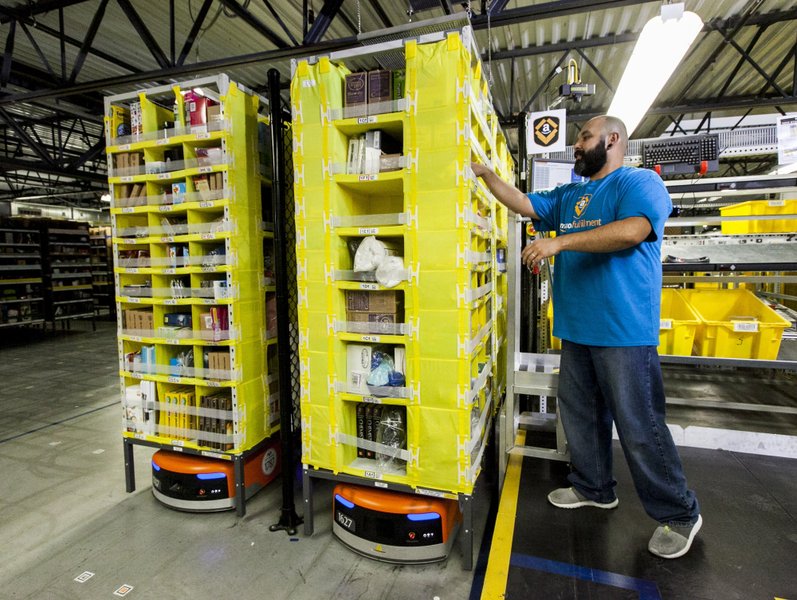
An Amazon fulfillment center, a hub of advanced robotics, AI-driven inventory management, and efficient logistics, crucial for rapid order processing and delivery.
Revolutionizing Fulfillment and Delivery
Amazon's global network of fulfillment centers, equipped with advanced robotics and sophisticated sorting systems, is unparalleled. This infrastructure, combined with its own expanding delivery network (including Amazon Flex, Amazon Air, and experiments with drone delivery), allows Amazon to control more of the customer experience and push the boundaries of delivery speed and efficiency. This has compelled other retailers to invest heavily in their own supply chain and last-mile delivery capabilities.
This video discusses "The Amazon Effect," delving into how Amazon's dominance has disrupted traditional retail and influenced consumer behavior and e-commerce trends, providing further context on its broad impact.
Visualizing Amazon's Multifaceted Impact on E-commerce
Amazon's influence on global e-commerce is not monolithic; it spans various domains, each transformed significantly. The radar chart below offers a visual comparison of key areas where Amazon's strategies have driven change, contrasting a hypothetical "Pre-Amazon Era Benchmark" with the "Current Amazon Influence." This illustrates the magnitude of transformation in aspects like customer experience, logistical capabilities, and technological integration.
As the chart demonstrates, Amazon has dramatically raised the bar across all measured facets of e-commerce, compelling widespread industry adaptation.
Mapping Amazon's Influence: An Interconnected Web
The "Amazon Effect" is a complex interplay of strategies and outcomes that have fundamentally reshaped global e-commerce. The mindmap below visualizes these interconnected areas of influence, showing how innovations in one domain often ripple through others, creating a comprehensive transformation of the online retail landscape. From its customer-centric approach to its technological prowess and logistical innovations, each element reinforces Amazon's market position and sets new industry standards.
(Prime, Same-day Delivery)"] id1b["Personalization
(AI-driven Recommendations)"] id1c["Seamless Experience
(1-Click, Easy Returns)"] id1d["Product Choice & Availability"] id2["Business Model Innovation"] id2a["Marketplace Platform
(Third-Party Sellers)"] id2b["Dynamic Pricing Strategies"] id2c["Subscription Services (Prime)"] id2d["Expansion into New Verticals
(Grocery, Cloud, Media)"] id3["Technological Advancements"] id3a["AI & Machine Learning
(Forecasting, Personalization)"] id3b["Cloud Computing (AWS)"] id3c["Automation & Robotics (Warehouses)"] id3d["Voice Commerce (Alexa)"] id3e["Retail Media Networks"] id4["Logistical Prowess"] id4a["Global Fulfillment Network"] id4b["Advanced Warehousing Tech"] id4c["Last-Mile Delivery Innovations"] id4d["Supply Chain Optimization"] id5["Global Market Impact"] id5a["Accelerated E-commerce Growth"] id5b["Increased Competitive Pressure"] id5c["Globalization of Retail"] id5d["Shifts in Consumer Behavior"] id6["Seller Ecosystem Dynamics"] id6a["Access to Global Customer Base"] id6b["Intense Competition Among Sellers"] id6c["Dependence on Amazon's Platform"] id6d["New Opportunities for SMBs"]
This mindmap illustrates how Amazon's various strategies converge to create a powerful and far-reaching impact on the global e-commerce ecosystem.
The Statistical Footprint: Amazon by the Numbers
Amazon's influence isn't just anecdotal; it's backed by significant market data. The following table highlights key statistics that demonstrate Amazon's scale and impact on global e-commerce trends.
| Metric | Amazon's Figure/Impact | Significance for E-commerce Trends |
|---|---|---|
| Global Net Sales Revenue (2023) | Nearly $575 billion | Demonstrates massive scale and market power, influencing global retail cash flow and investment. |
| U.S. E-commerce Market Share (2024 Est.) | Approximately 39.6%, projected to be 40.9% by 2025 | Highlights dominance in a key market, setting trends that often become global standards. |
| Third-Party Seller Contribution | Over 60% of paid units sold on Amazon are from third-party sellers | Shows the success of the marketplace model, encouraging platform-based e-commerce growth. |
| Amazon Prime Members | Over 200 million worldwide | Cultivates customer loyalty and normalizes expectations for fast, free shipping and bundled services. |
| AWS Cloud Market Share (Q4 2023) | Approximately 31% | Underpins much of the internet, including e-commerce infrastructure for many other retailers, while funding Amazon's retail innovations. |
| Mobile Commerce Leadership | Amazon app is a leading mobile shopping app globally. | Reflects and drives the trend towards m-commerce, influencing app design and mobile-first strategies. |
These figures underscore how Amazon's operations and strategies are not just participating in but actively shaping the direction of global e-commerce.
Frequently Asked Questions (FAQ)
What exactly is the "Amazon Effect"? ▼
The "Amazon Effect" refers to the extensive impact Amazon has had on the retail industry, particularly e-commerce. It encompasses changes in consumer expectations (e.g., demand for fast shipping, vast selection, competitive pricing, personalization), the pressure on traditional retailers to adapt their business models, and the overall disruption of established retail practices due to Amazon's scale, innovation, and customer-centric approach.
How has Amazon Prime specifically changed e-commerce? ▼
Amazon Prime has revolutionized e-commerce by making fast and free shipping a standard expectation. Its subscription model, offering benefits like two-day delivery, streaming services, and exclusive deals, has cultivated immense customer loyalty and significantly raised the bar for delivery speeds and value-added services across the entire e-commerce sector. Retailers worldwide now strive to offer similar loyalty programs and expedited shipping options to compete.
How does Amazon use technology to maintain its leadership? ▼
Amazon leverages cutting-edge technology in numerous ways. Artificial intelligence (AI) and machine learning (ML) are used for personalized recommendations, demand forecasting, dynamic pricing, and optimizing logistics. Amazon Web Services (AWS) provides a robust cloud infrastructure. Robotics and automation are heavily used in fulfillment centers to increase efficiency. Voice technology via Alexa facilitates voice shopping. These technological advantages allow Amazon to innovate rapidly, enhance customer experiences, and operate at a massive scale.
What is Amazon's impact on small businesses and third-party sellers? ▼
Amazon provides a significant platform for small and medium-sized businesses (SMBs) and third-party sellers to reach a vast global customer base, which can lead to substantial growth. However, sellers also face intense competition, pressure on pricing, and reliance on Amazon's policies and fee structures. While Amazon offers tools and services to support sellers (like Fulfillment by Amazon - FBA), it also controls customer data and relationships, creating a complex dynamic of opportunity and challenge.
How is Amazon influencing global e-commerce expansion and cross-border trade? ▼
Amazon facilitates global e-commerce expansion by operating localized marketplaces in numerous countries and enabling cross-border selling for its third-party merchants. This helps businesses reach international customers more easily. Amazon's investments in global logistics, payment processing, and translation services help standardize aspects of international online shopping, making it more accessible for both consumers and sellers, thereby promoting the globalization of retail.
Recommended Further Exploration
- What are the latest technological innovations Amazon is implementing in e-commerce?
- How do third-party sellers thrive on Amazon's marketplace despite the competition?
- What are the primary challenges and opportunities for traditional retailers competing against Amazon?
- How is Amazon's AWS division specifically supporting the growth and innovation of other e-commerce businesses?
References

 sell.amazon.com
 buywithprime.amazon.com

 affiliate-program.amazon.com
Last updated May 13, 2025