
Timeless Ticks vs. Modern Mechanisms: A Deep Dive into Analog Clocks for Your Website
Unpacking the evolution of CoolClock: AA Extensions' legacy adherence versus RicheyWeb's modern reimagining.

- 1.Key Insights into Analog Clock Implementations
- 2.The Enduring Appeal of Analog Clocks in Web Design
- 3.AA Responsive Classical Clock: A Legacy Wrapper
- 4.RicheyWeb's Module - CoolClock: A Modern Renaissance
- 5.Charting the Differences: A Visual Comparison
- 6.A Side-by-Side Feature Comparison
- 7.Visualizing Key Performance Indicators
- 8.The Evolution of CoolClock: A Mindmap
- 9.The Original CoolClock in Action
- 10.Conclusion: Choosing Your Analog Clock Solution
- 11.FAQ
- 12.Recommended Searches
- 13.Referenced Search Results
Key Insights into Analog Clock Implementations
- AA Responsive Classical Clock: This Joomla module primarily acts as a responsive wrapper for Simon Baird's original 15-year-old JavaScript CoolClock, prioritizing ease of integration and a classic aesthetic within the Joomla ecosystem.
- RicheyWeb's Module - CoolClock: The latest version represents a complete rewrite, abandoning the old JavaScript in favor of modern web technologies to deliver enhanced features, broader platform compatibility, and improved performance.
- Core Functionality vs. Modernization: Both aim to provide stylish analog clocks, but AA Extensions focuses on preserving the legacy code with responsiveness, while RicheyWeb embraces a ground-up reconstruction for future-proofing and advanced capabilities.
The digital age, paradoxically, often finds itself drawn to the nostalgic charm of analog displays. For web developers and designers looking to imbue their websites with a touch of classic elegance, analog clocks have remained a popular choice. This desire has led to various implementations, with two prominent examples being the "AA Responsive Classical Clock" by AA Extensions and the "Module - CoolClock" by RicheyWeb. While both draw inspiration from the venerable "CoolClock" JavaScript library by Simon Baird, their approaches to integrating and modernizing this concept diverge significantly. This comparison delves into their core philosophies, technical underpinnings, features, and target audiences to provide a comprehensive understanding of their respective merits.
The Enduring Appeal of Analog Clocks in Web Design
Analog clocks offer a unique blend of functionality and aesthetic appeal that digital clocks often lack. Their visual representation of time as a continuous flow, rather than discrete numbers, can evoke a sense of calm, tradition, and sophistication. For certain website themes—such as vintage-inspired blogs, luxury brand sites, or educational platforms demonstrating mechanics—an analog clock can significantly enhance the user experience and visual coherence.
The original CoolClock JavaScript by Simon Baird, with its configurable nature and skinning system, laid the groundwork for many subsequent implementations. It demonstrated the power of client-side scripting to create dynamic and visually engaging elements without heavy server-side processing. This foundation continues to influence how developers approach analog clock integration today, even as the underlying technologies evolve.
AA Responsive Classical Clock: A Legacy Wrapper
Preserving the Original Charm within Joomla
The "AA Responsive Classical Clock" from AA Extensions is a Joomla module designed to bring the classic analog clock aesthetic to Joomla 3.x–5.x websites. Its primary characteristic is its reliance on Simon Baird's 15-year-old JavaScript CoolClock. Rather than rewriting the original code, AA Extensions has chosen to wrap it within a modern Joomla module, focusing on making it responsive and easy to integrate.
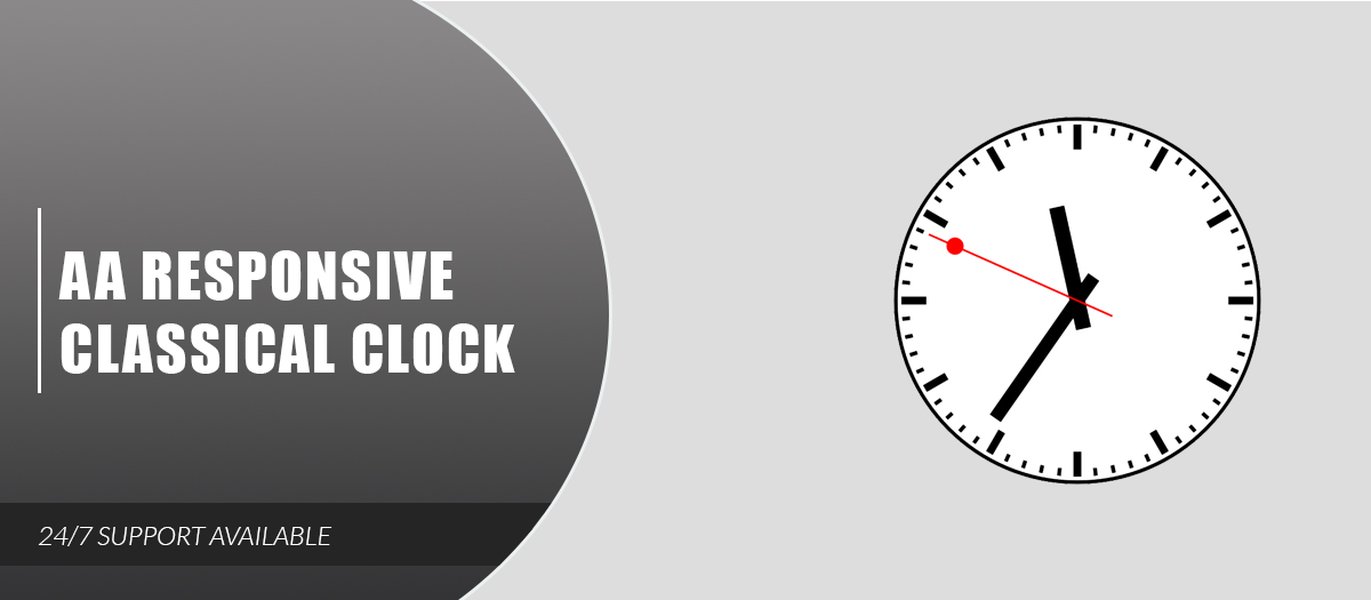
The classic design of the AA Responsive Classical Clock module.
Core Philosophy and Technical Approach
The philosophy behind AA Responsive Classical Clock is one of preservation and accessibility. By encapsulating the proven CoolClock JavaScript, AA Extensions provides a straightforward, plug-and-play solution for Joomla users. This approach minimizes development effort on the core clock mechanism, allowing the focus to be on module integration, responsiveness, and cross-browser compatibility.
This module maintains the original JavaScript's rotational formulas for the hands (e.g., 6° per second for the second hand, 0.5° per minute for the hour hand), ensuring the authentic analog movement that users expect. It prioritizes a lightweight footprint and SEO-friendly implementation, aiming to deliver a stylish clock without burdening website performance.
Key Features and Limitations
- Responsiveness: The module is explicitly designed to adapt its display across various devices, from desktops to tablets and mobile phones, ensuring a consistent visual experience.
- Joomla-Centric: It is a dedicated Joomla module, making installation and configuration within the Joomla environment seamless. It supports Joomla 3.x, 4.x, and 5.x.
- Classic Aesthetic: The clock maintains a clean, elegant layout, appealing to those seeking a traditional analog look.
- Ease of Use: Integration with Joomla page builders and module positions is straightforward, requiring minimal technical expertise.
However, the reliance on a 15-year-old JavaScript library can present limitations. While wrapped to be responsive, the underlying code might not fully leverage modern web standards or performance optimizations inherent in newer technologies. Advanced features like granular timezone support or digital/analog hybrids are generally not a focus of this module.
RicheyWeb's Module - CoolClock: A Modern Renaissance
Rebuilding for the Future of Web Development
In stark contrast to AA Extensions, RicheyWeb's latest version of "Module - CoolClock" takes a radical departure from Simon Baird's original JavaScript. RicheyWeb has opted for a complete ground-up rewrite, abandoning the legacy code to build a modern replacement. This strategic decision aims to leverage contemporary web technologies like Canvas or SVG for superior performance, features, and future compatibility.
Core Philosophy and Technical Approach
RicheyWeb's philosophy is rooted in modernization and extensibility. Recognizing the limitations of a 15-year-old codebase in a rapidly evolving web landscape, they undertook a significant rewrite to ensure the module is robust, scalable, and compliant with current web standards. This means moving beyond jQuery dependencies and embracing native browser capabilities for rendering and interactivity.
The rewrite incorporates all the features of the original CoolClock, such as extensive skinning options, while adding optimizations for modern environments. This includes better handling of high-DPI displays, improved cross-browser support, and potentially better performance on devices utilizing WebGL or advanced CSS rendering.
Key Features and Advantages
- Complete Rewrite: This is the most significant differentiator, allowing for a modern, optimized codebase free from the constraints of legacy JavaScript.
- Rich Customization: The module typically offers a wider array of predefined skins (e.g., 19 to 22 presets) and robust support for creating custom skins, providing extensive visual flexibility.
- Advanced Features: Modern implementations often include enhanced timezone support, options for displaying date, 24-hour formats, and greater control over background and element customization.
- Broader Platform Support: While available as a Joomla module, the modern rewrite often implies a more adaptable core that can be ported to other platforms, such as WordPress, demonstrating wider ecosystem adoption.
- Future-Proofing: By building on current web standards, RicheyWeb's CoolClock is less susceptible to obsolescence and better positioned to integrate with future web technologies.
Charting the Differences: A Visual Comparison
To further illustrate the distinctions between these two approaches, let's consider their characteristics across several key dimensions. The radar chart below provides a visual overview of their strengths based on modernization, customization, and platform focus.
The radar chart clearly illustrates that while AA Responsive Classical Clock excels in legacy code adherence and immediate Joomla integration, RicheyWeb's Module - CoolClock dominates in modernization, customization depth, and potential for cross-platform adaptability. This reflects their distinct development philosophies.
A Side-by-Side Feature Comparison
For a more detailed breakdown, the following table summarizes the key aspects where these two implementations differ and converge.
| Aspect | AA Responsive Classical Clock (AA Extensions) | Module - CoolClock (RicheyWeb) |
|---|---|---|
| JavaScript Base | Uses Simon Baird's 15-year-old JavaScript CoolClock, wrapped for responsiveness. | Complete ground-up rewrite, abandoning old code for modern implementation (e.g., Canvas/SVG). |
| Platform Focus | Joomla-specific module (3.x–5.x). | Primarily Joomla module, but the modern rewrite implies broader compatibility (e.g., WordPress variants exist). |
| Customization | Focus on classic look; basic layout tweaks and color options within Joomla module settings. | Extensive skin system (e.g., 19-22 presets), support for custom skins, more granular control over elements. |
| Advanced Features | Basic real-time analog clock; responsiveness is the main enhancement over original code. | Advanced features like timezone support, date display, noSeconds option, digital/analog hybrids possible. |
| Responsiveness | Designed to adapt to various screen sizes; "responsive wrapper" around legacy code. | Modern rewrite inherently optimized for fluid layouts and current device standards. |
| Maintenance & Future-Proofing | Relies on legacy code; potential for browser compatibility issues as web standards evolve. | Updated for modern web standards; more future-proof with better performance and security. |
| Development Philosophy | Preservation of legacy code; simplicity and quick integration. | Modernization and extensibility; rebuild for longevity and enhanced capabilities. |
Visualizing Key Performance Indicators
Beyond feature sets, the underlying technical approach impacts performance and adaptability. The bar chart below assesses these modules on dimensions critical for modern web development, offering an opinionated view on their comparative performance.
The bar chart reinforces that RicheyWeb's modern rewrite offers significant advantages in performance, security, and broad browser compatibility, as well as greater flexibility for developers. AA Extensions' offering, while having a potentially smaller resource footprint due to its older, simpler codebase, faces challenges in keeping pace with the rapidly evolving web.
The Evolution of CoolClock: A Mindmap
The journey of the CoolClock concept from its original JavaScript implementation to its modern Joomla module forms an interesting case study in software evolution. This mindmap outlines the lineage and key developments.
This mindmap illustrates the divergent paths taken by AA Extensions and RicheyWeb, with the former maintaining a direct link to the original codebase and the latter undertaking a comprehensive re-engineering effort.
The Original CoolClock in Action
To understand the foundation upon which both modules are built, it's helpful to observe the original CoolClock concept. While specific videos for AA Extensions or RicheyWeb's modules are not readily available, the spirit of Simon Baird's creation is often showcased through tutorials and demonstrations of simple analog clocks.
A tutorial demonstrating how to build a basic analog clock using HTML, CSS, and JavaScript, akin to the foundational principles of Simon Baird's original CoolClock.
This video, while not directly showcasing the modules themselves, demonstrates the fundamental principles of creating an analog clock with web technologies. It provides context for the kind of visual output both AA Extensions and RicheyWeb aim to achieve, whether through a direct wrapper or a modern rewrite.
Conclusion: Choosing Your Analog Clock Solution
The choice between AA Responsive Classical Clock and RicheyWeb's Module - CoolClock ultimately depends on a user's priorities and project requirements. If the goal is a quick, straightforward integration of a classic analog clock within a Joomla environment, with minimal fuss and a strong preference for maintaining the original CoolClock aesthetic and underlying code, the AA Responsive Classical Clock is a suitable option. It offers a reliable, albeit legacy-bound, solution for those who value simplicity and direct historical lineage.
Conversely, for developers and designers seeking a more robust, feature-rich, and future-proof analog clock solution, RicheyWeb's Module - CoolClock stands out. Its complete rewrite leverages modern web standards, offering superior customization, better performance, enhanced security, and broader adaptability. This makes it ideal for projects that demand cutting-edge capabilities, extensive visual control, and long-term compatibility with evolving web technologies. RicheyWeb's approach aligns with the broader industry trend of rebuilding and modernizing older concepts to meet contemporary demands, ensuring that the charming analog clock remains a vibrant and performant element in web design.
FAQ
Recommended Searches
- Explore modern JavaScript analog clock libraries and their features.
- Discover best practices for developing responsive and secure Joomla modules.
- Compare the performance implications of using Canvas versus SVG for web graphics.
- Learn techniques for creating custom skins and themes for web-based analog clocks.
Referenced Search Results
 wordpress.com
 sunilsindal.blogspot.com