
Analyzing a Complex Logical Statement: A Deep Dive into Propositional Logic
Understanding the Structure and Truth Values of [(p∨ ∼ r) ∧ (r∨ ∼ q)] → (p ↔ q)
Key Insights
- Complex Structure: The statement involves multiple logical connectives, including disjunction (∨), negation (∼), conjunction (∧), conditional (→), and biconditional (↔), requiring a systematic approach for analysis.
- Truth Table as a Primary Tool: Constructing a truth table is the most reliable method to determine the truth value of the entire statement for all possible combinations of truth values of the simple propositions p, q, and r.
- Understanding Connectives is Crucial: Accurately evaluating the truth value of the compound statement hinges on a firm grasp of how each logical connective functions and its corresponding truth conditions.
Introduction to Propositional Logic and the Statement
Propositional logic is a fundamental branch of logic that deals with propositions, which are declarative statements that can be either true or false. It provides a framework for analyzing and combining these statements using logical connectives. The statement we are examining, [(p∨ ∼ r) ∧ (r∨ ∼ q)] → (p ↔ q), is a compound proposition formed by combining the simple propositions p, q, and r using a variety of logical connectives.
To fully understand and evaluate this complex statement, we need to break it down into its constituent parts and analyze how the truth values of the simple propositions (p, q, and r) affect the truth value of the entire expression. This is best achieved through the construction of a comprehensive truth table.
Deconstructing the Statement: Components and Connectives
Let's dissect the given statement to identify its individual components and the logical connectives used:
Simple Propositions:
p
q
r
Logical Connectives:
Disjunction (∨): Represents "or". A disjunction p ∨ q is true if at least one of p or q is true. It is false only when both p and q are false.
Negation (∼): Represents "not". The negation ∼p is true if p is false, and false if p is true.
Conjunction (∧): Represents "and". A conjunction p ∧ q is true only when both p and q are true. It is false if at least one of p or q is false.
Conditional (→): Represents "if...then...". A conditional p → q (read as "p implies q") is false only when p is true and q is false. In all other cases, it is true. This is also referred to as logical implication.
Biconditional (↔): Represents "if and only if". A biconditional p ↔ q is true when p and q have the same truth value (both true or both false). It is false when p and q have different truth values.
The statement [(p∨ ∼ r) ∧ (r∨ ∼ q)] → (p ↔ q) can be interpreted as: "If (p or not r) and (r or not q), then (p if and only if q)."
Constructing the Truth Table
To determine the truth value of the entire statement for every possible scenario, we will construct a truth table. With three simple propositions (p, q, and r), there are \(2^3 = 8\) possible combinations of truth values.
We will build the truth table step-by-step, evaluating the truth value of each subexpression before finally evaluating the entire statement.
| p | q | r | ∼ r | ∼ q | p ∨ ∼ r | r ∨ ∼ q | (p ∨ ∼ r) ∧ (r ∨ ∼ q) | p ↔ q | [(p ∨ ∼ r) ∧ (r ∨ ∼ q)] → (p ↔ q) |
|---|---|---|---|---|---|---|---|---|---|
| T | T | T | F | F | T | T | T | T | T |
| T | T | F | T | F | T | F | F | T | T |
| T | F | T | F | T | T | T | T | F | F |
| T | F | F | T | T | T | T | T | F | F |
| F | T | T | F | F | F | F | F | F | T |
| F | T | F | T | F | T | F | F | F | T |
| F | F | T | F | T | F | T | F | T | T |
| F | F | F | T | T | T | T | T | T | T |
Explanation of Truth Table Columns:
p, q, r: These columns represent the truth values of the simple propositions. We list all 8 possible combinations.
∼ r, ∼ q: These columns show the negation of the truth values of r and q, respectively.
p ∨ ∼ r: This column shows the truth value of the disjunction of p and ∼ r. It is true if p is true or ∼ r is true (or both).
r ∨ ∼ q: This column shows the truth value of the disjunction of r and ∼ q. It is true if r is true or ∼ q is true (or both).
(p ∨ ∼ r) ∧ (r ∨ ∼ q): This column shows the truth value of the conjunction of (p ∨ ∼ r) and (r ∨ ∼ q). It is true only when both (p ∨ ∼ r) and (r ∨ ∼ q) are true.
p ↔ q: This column shows the truth value of the biconditional of p and q. It is true when p and q have the same truth value.
[(p ∨ ∼ r) ∧ (r ∨ ∼ q)] → (p ↔ q): This is the final column representing the truth value of the entire statement. It is a conditional statement where the antecedent is (p ∨ ∼ r) ∧ (r ∨ ∼ q) and the consequent is (p ↔ q). This column is false only when the antecedent is true and the consequent is false.
Analyzing the final column of the truth table, we can see the truth values of the entire statement for each possible assignment of truth values to p, q, and r.
Analyzing the Results
Based on the truth table, the statement [(p∨ ∼ r) ∧ (r∨ ∼ q)] → (p ↔ q) is not a tautology (always true) nor a contradiction (always false). Its truth value depends on the truth values of p, q, and r. Specifically, the statement is false in the following cases:
-
When p is True, q is False, and r is True.
-
When p is True, q is False, and r is False.
In all other six cases, the statement is true. This indicates that the antecedent [(p∨ ∼ r) ∧ (r∨ ∼ q)] being true does not always guarantee that the consequent (p ↔ q) is also true.
Logical Equivalence and Implication
Understanding logical equivalence and implication is crucial in propositional logic. Two statements are logically equivalent if they have the same truth value in every possible scenario. This is often denoted by ≡. The biconditional connective (↔) is closely related to logical equivalence; p ↔ q is a tautology if and only if p and q are logically equivalent.
Logical implication, represented by the conditional connective (→), signifies a relationship where the truth of the antecedent guarantees the truth of the consequent. If p → q is a tautology, we say that p logically implies q.
In our case, since the statement [(p∨ ∼ r) ∧ (r∨ ∼ q)] → (p ↔ q) is not a tautology, the antecedent [(p∨ ∼ r) ∧ (r∨ ∼ q)] does not logically imply the consequent (p ↔ q).
Many common logical equivalences exist and are often used to simplify or manipulate logical expressions. These laws, such as De Morgan's Laws or the law of contraposition (which states that p → q is logically equivalent to ∼q → ∼p), can be verified using truth tables.
Applications of Propositional Logic
Propositional logic has numerous applications in various fields, including mathematics, computer science, and philosophy. In computer science, it is fundamental to the design of digital circuits and the development of programming languages. Logic gates, the basic building blocks of digital circuits, directly implement logical connectives like AND, OR, and NOT.
Here are some examples of how logical connectives are represented in logic gates:
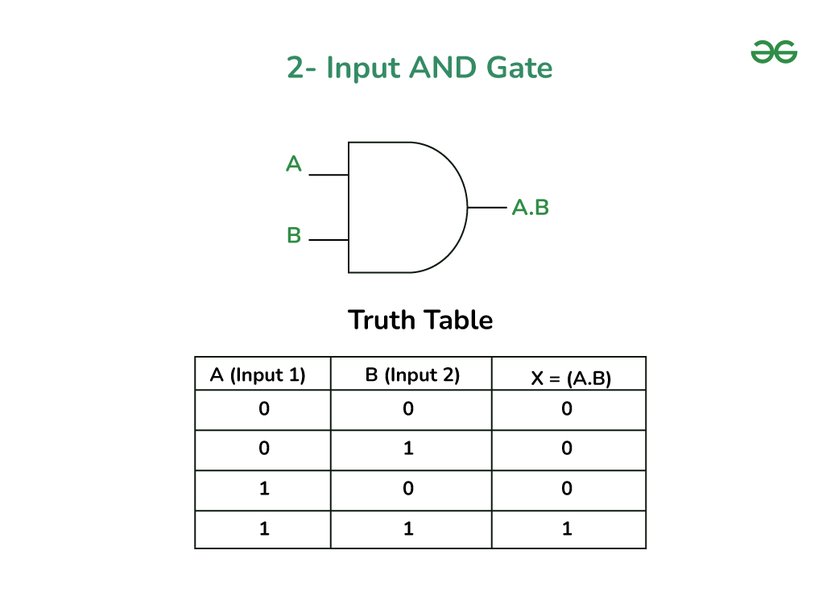
Figure 1: Symbol for an AND Gate.
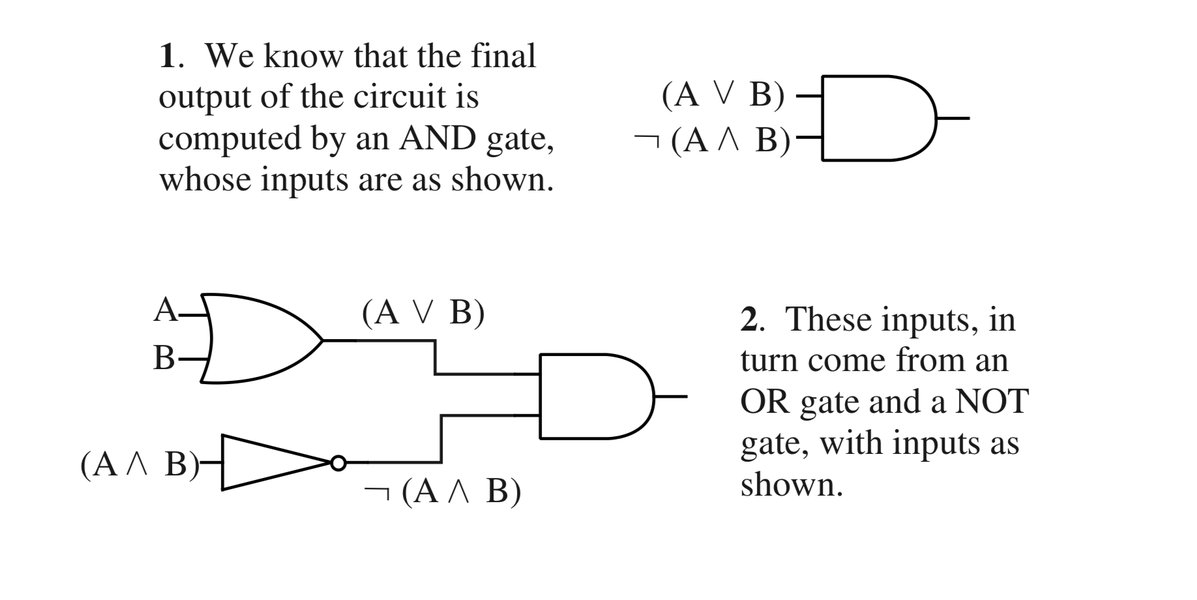
Figure 2: Symbols for OR and NOT Gates.
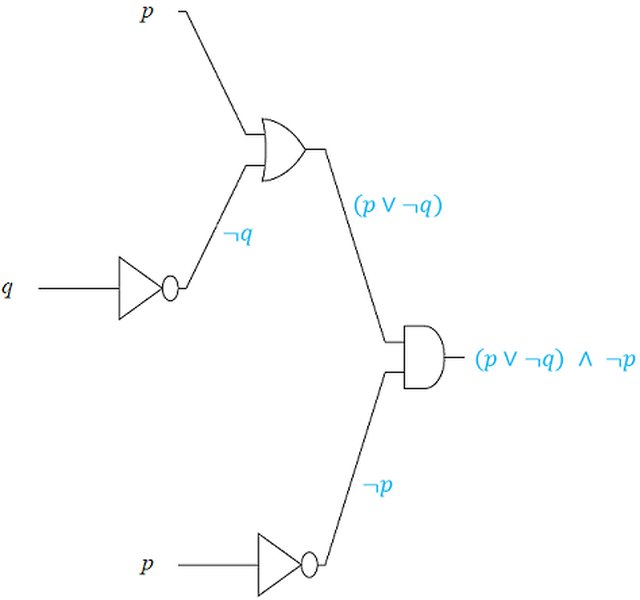
Figure 3: Symbol for an XOR Gate, which relates to the biconditional.
The analysis we performed using a truth table is analogous to how engineers design and verify the behavior of digital circuits. By evaluating the truth values for all possible inputs, they can ensure the circuit performs the desired logical function.
Further Exploration: Logical Implication in Detail
The concept of logical implication (the conditional statement) is particularly important and can sometimes be counterintuitive. The statement "if p, then q" is only false when p is true and q is false. This means that if the antecedent (p) is false, the conditional statement (p → q) is always true, regardless of the truth value of the consequent (q). This is often summarized as "false implies anything is true."
Consider the statement "If the moon is made of cheese, then basketballs are round." In classical propositional logic, this statement is considered true because the antecedent ("the moon is made of cheese") is false. The truth value of the consequent ("basketballs are round") does not matter.
This characteristic of material implication is a defined logical connective. As long as the propositions involved have truth values, the implication can be evaluated.
Frequently Asked Questions
What is a proposition in logic?
A proposition is a declarative statement that can be definitively determined to be either true or false. It is the basic building block of propositional logic.
How do truth tables help analyze logical statements?
Truth tables provide a systematic way to evaluate the truth value of a compound logical statement for all possible combinations of truth values of the simple propositions involved. They are essential for determining if a statement is a tautology, contradiction, or contingent.
What is the difference between a conditional and a biconditional?
A conditional statement (p → q, "if p then q") is false only when the antecedent (p) is true and the consequent (q) is false. A biconditional statement (p ↔ q, "p if and only if q") is true only when the two propositions (p and q) have the same truth value (both true or both false).
When are two statements considered logically equivalent?
Two statements are logically equivalent if they have identical truth values in every row of their truth tables. This means they effectively say the same thing from a logical perspective.
What is logical implication?
Logical implication is the relationship between two propositions in a conditional statement (p → q) where the truth of the first proposition (p) guarantees the truth of the second proposition (q). If p → q is a tautology, we say that p logically implies q.
References
Last updated May 2, 2025