

Navigating the requirements for a thesis can be a daunting task, but adhering to APA (American Psychological Association) style, particularly the 7th edition, provides a clear and widely accepted framework for academic writing. This guide will provide a comprehensive overview, equipping you with the knowledge to structure, format, and cite your thesis with precision and confidence, ensuring your scholarly work meets the highest standards.
Key Insights for APA Thesis Success
- Structure is paramount: A well-organized thesis following the APA standard progression (Title Page, Abstract, Introduction, Method, Results, Discussion, References, Appendices) provides clarity and professionalism.
- Formatting precision matters: Adherence to guidelines for font, spacing, margins, and headings is crucial for readability and compliance with academic standards.
- Accurate citation is essential: Proper in-text citations and a meticulously formatted reference list are fundamental to acknowledging sources and maintaining academic integrity.
The Foundational Elements of an APA Thesis
A thesis written in APA style is more than just a research paper; it's a comprehensive scholarly document that reflects rigorous research, critical analysis, and clear communication. The 7th edition of the APA Publication Manual provides the definitive guidelines for academic writing in many fields, including social sciences, education, and nursing. Understanding these foundational elements is the first step toward a well-crafted thesis.
General Formatting Guidelines: The Visual Blueprint
The visual presentation of your thesis is just as important as its content. APA style mandates specific formatting to ensure consistency and readability across academic publications. These guidelines apply universally to the entire document.
Font and Spacing: Ensuring Readability
While previous editions were more restrictive, APA 7th edition offers flexibility regarding font choices, prioritizing legibility. Common recommendations include 12-point Times New Roman. Regardless of the font chosen, it must be used consistently throughout the document. Double-spacing is a universal requirement for the main text, ensuring adequate space for comments and edits. One-inch margins on all sides (top, bottom, left, and right) are standard, creating a clean and professional appearance.
Page Numbering and Running Head: Navigational Aids
Pages should be numbered consecutively starting from the title page, with the page number placed in the upper right-hand corner. For student papers, a running head is generally not required. However, for professional papers, including dissertations and theses intended for publication, a running head (a shortened title) is included in the header of every page, aligning with the page number.
Essential Thesis Sections: Building Blocks of Your Research
A typical APA thesis follows a logical progression, guiding the reader through your research journey from inception to conclusion. While specific institutional requirements may vary, the core sections remain consistent.
Title Page: Your Thesis's Identity Card
The title page is the very first impression of your thesis. It includes the full title of your research, your name, institutional affiliation, the course name and number, instructor's name, and the due date. For professional theses, an author's note may also be included. The title should be centered and bold, clearly and concisely reflecting the essence of your work.
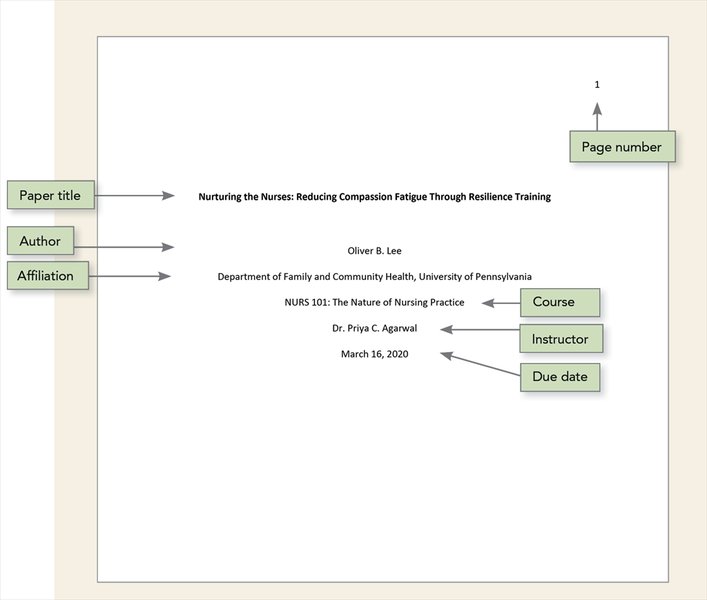
Example of a student title page in APA 7th Edition.
Abstract: The Research Snapshot
Following the title page, the abstract provides a concise summary of your entire thesis, typically between 150 and 250 words. It should be on its own page, labeled "Abstract" (centered and bold), and present a snapshot of your research problem, methodology, key results, and main conclusions. The abstract paragraph is block-formatted, meaning no indentation for the first line.
Introduction: Setting the Stage
The introduction begins broadly, establishing the background and context of your research. It should clearly state the research problem, its significance, and a review of relevant previous research, generally discussed in the past tense. Crucially, the introduction culminates in a clear and focused thesis statement, which outlines your main argument or the purpose of your study. This statement should be placed at the end of the introduction.
This video explains how to write an effective opening paragraph for an APA style paper, focusing on the hook and thesis statement.
This video provides excellent guidance on crafting the crucial opening paragraph of an APA paper. It highlights the importance of starting broadly to engage the reader ("hook") and then narrowing down to a clear, concise thesis statement. This aligns perfectly with the APA 7th edition's emphasis on guiding the reader through the research narrative from the very beginning. An effective thesis statement, as discussed, is not just a summary of your topic but an arguable point or a statement of purpose that your entire thesis will explore and support.
Method: How You Conducted Your Research
The method section details the design of your study, participants, materials, and procedures. This section is typically written in the past tense, providing enough detail for another researcher to replicate your study. It should be precise and transparent, enabling readers to evaluate the validity and reliability of your research.
Results: What You Discovered
In the results section, you present the findings of your study objectively, primarily in the past tense. This section focuses on reporting the data, often using tables and figures to illustrate key findings. It should describe what you found without interpreting the implications of the results, saving that for the discussion section.
Discussion: Interpreting Your Findings
The discussion section is where you interpret your results, relate them back to your research questions and existing literature, and discuss their implications. This section may use a combination of past tense (for discussing your results and limitations) and present or future tense (for discussing implications and future research). It's an opportunity to explain how your findings contribute to the broader field of study and to acknowledge any limitations of your research.
References and Appendices: Supporting Your Claims
The references section lists all sources cited within your thesis, formatted strictly according to APA guidelines. Appendices, if applicable, contain supplementary materials that are too lengthy or detailed to include in the main body, such as questionnaires, raw data, or detailed statistical outputs. They should be clearly labeled and referenced within the main text.
Navigating Citations and References in APA Style
Accurate citation is the cornerstone of academic integrity. APA style provides detailed rules for citing sources both within the text and in a comprehensive reference list at the end of your thesis. Understanding these rules is crucial to avoid plagiarism and give credit where it's due.
In-Text Citations: Acknowledging Sources Within Your Narrative
Whenever you incorporate information from another source—whether it's a direct quote, a paraphrase, or a summary of an idea—you must provide an in-text citation. The basic format includes the author's last name and the year of publication (e.g., Smith, 2020). For direct quotations, a page number or range must also be included (e.g., Smith, 2020, p. 45).
Different Formats for Different Situations
APA style distinguishes between different types of in-text citations, such as narrative citations (where the author's name is part of the sentence) and parenthetical citations (where the author's name and date are in parentheses at the end of the sentence). Variations exist for multiple authors, corporate authors, and sources without a named author.
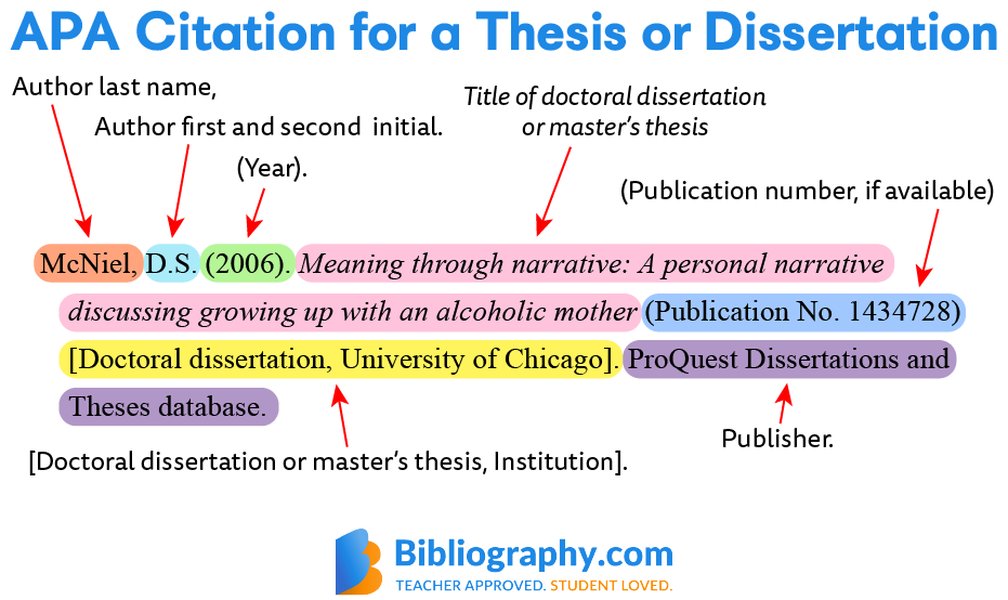
Breakdown of APA citation for a thesis or dissertation.
Reference List: The Comprehensive Source Directory
The reference list, appearing on a new page after the main body of your thesis, provides complete bibliographic information for every source cited in your text. Each entry must follow specific formatting rules, including details like author, publication date, title, and source information (e.g., journal name, publisher, URL).
Citing Theses and Dissertations
When citing other theses and dissertations, special attention is required. Distinctions are made between published and unpublished works. For published works, details like the database where it was found (e.g., ProQuest Dissertations and Theses Global) and any publication numbers are included. For unpublished works, the institution that awarded the degree is typically specified.
Structuring Your Argument with Headings
Headings are vital for organizing your thesis logically and making it easy for readers to navigate. APA 7th edition uses a five-level heading system, each with specific formatting.
APA Heading Levels: A Hierarchy of Information
Using headings effectively creates a clear hierarchy of information, guiding the reader through your arguments and sub-sections. All headings are bold, and their formatting (centering, alignment, capitalization) changes based on their level.
Mermaid mindmap illustrating the hierarchical structure of APA headings.
This mindmap visually represents how APA headings are structured hierarchically. Starting from the main sections (Level 1), it branches out to sub-sections (Level 2, 3, 4, and 5), demonstrating how information can be progressively broken down into finer details. This structure ensures that your thesis is not only well-organized but also easily digestible, allowing readers to quickly grasp the flow of your arguments and locate specific information.
Institutional and Committee Guidelines: The Ultimate Authority
While the APA Publication Manual provides general guidelines, your specific academic institution or thesis committee may have additional or slightly different requirements. These are often outlined in a thesis or dissertation handbook provided by your university or department.
Tailoring to Specific Requirements
It is crucial to consult these specific departmental or institutional guidelines early in your thesis-writing process. They might cover nuances such as specific title page layouts, inclusion of an author's declaration, or particular formatting for tables of contents and lists of figures. Adhering to these specific instructions ensures your thesis meets all local academic standards for submission and approval.
Student vs. Professional Papers
APA provides separate guidelines for student papers and professional papers. Theses typically fall under the professional paper category, which may involve additional elements like a running head or a more formal title page, especially if the thesis is intended for eventual publication or public access. Be sure to clarify which set of guidelines applies to your thesis.
| Feature | Student Paper (General) | Professional Paper (Thesis/Dissertation) |
|---|---|---|
| Running Head | Not required | Required |
| Title Page | Includes paper title, author, institution, course, instructor, due date | Includes title, author, institution, and often an author note, university seal, and degree information |
| Abstract | Often required | Almost always required (150-250 words) |
| Table of Contents | Not typically included | Often required for theses/dissertations |
| Page Numbering | Upper right corner | Upper right corner |
| Font/Spacing/Margins | 12pt Times New Roman recommended, double-spaced, 1-inch margins | Same general guidelines, but verify specific institutional preferences |
| Submission Context | Course assignments | Formal academic degree requirement (e.g., Master's, PhD) |
This table outlines key differences between student and professional APA paper formatting, relevant for thesis writers.
Frequently Asked Questions
What is the latest APA edition for thesis writing?
What are the essential sections of an APA style thesis?
What are the basic formatting requirements for an APA thesis?
Do I need a running head for my thesis?
How do I cite a thesis or dissertation in my reference list?
Conclusion: Your Path to a Polished APA Thesis
Writing a thesis in APA style, particularly the 7th edition, is a meticulous process that combines rigorous research with precise formatting and citation. By diligently adhering to the structural guidelines, mastering the nuances of in-text citations and reference list entries, and paying close attention to general formatting and language, you can produce a scholarly work that is both academically sound and professionally presented. Remember to always consult your institution's specific guidelines, as they are the ultimate authority for your thesis submission. With these principles in mind, you are well-equipped to embark on and successfully complete your thesis journey.
Recommended Further Exploration
- Explore an in-depth guide to APA 7th edition heading levels for complex documents.
- Discover best practices for effectively incorporating tables and figures into your APA thesis.
- Learn advanced APA citation techniques for handling less common source types in your research.
- Gain valuable tips for comprehensive proofreading and editing an APA-style dissertation.