
Impact of Apple's $110 Billion Stock Buyback on Its Stock Price
Analyzing the Potential Effects of a Major Share Repurchase Program
Key Takeaways
- Investor Confidence Boost: A significant buyback signals Apple's confidence in its financial health, potentially increasing investor interest and demand for its stock.
- EPS and Share Value Enhancement: Reducing the number of shares outstanding can lead to higher earnings per share (EPS), potentially making the stock more attractive and supporting a higher stock price.
- Market and Economic Factors Influence: The actual impact on the stock price depends on various factors, including overall market conditions, investor sentiment, and Apple's performance post-buyback.
Understanding Stock Buybacks
What is a Stock Buyback?
A stock buyback, also known as a share repurchase, occurs when a company buys back its own shares from the marketplace. This reduces the number of outstanding shares, which can have multiple effects on the company’s financial metrics and stock price. Companies undertake buybacks for various reasons, including to return capital to shareholders, improve financial ratios, or signal confidence in the company's future prospects.
Apple's $110 Billion Buyback Program
In May 2024, Apple announced a substantial stock buyback plan worth $110 billion. This move is part of Apple's ongoing strategy to return value to shareholders and manage its capital structure efficiently. Such a large-scale buyback is indicative of Apple's strong cash flow and confidence in its long-term prospects. The buyback represents approximately 4% of Apple's total market value, underscoring the company's significant commitment to enhancing shareholder value.
Mechanics of the Buyback and Its Potential Impact
Reduction in Shares Outstanding
Apple's buyback of $110 billion would significantly reduce the number of its outstanding shares. Using the current stock price of $227.63, we can estimate the number of shares repurchased:
Shares Bought Back Calculation
The formula for calculating the number of shares repurchased is:
Shares Bought Back = Buyback Amount / Current Stock Price
= $110,000,000,000 / $227.63
≈ 483,000,000 shares
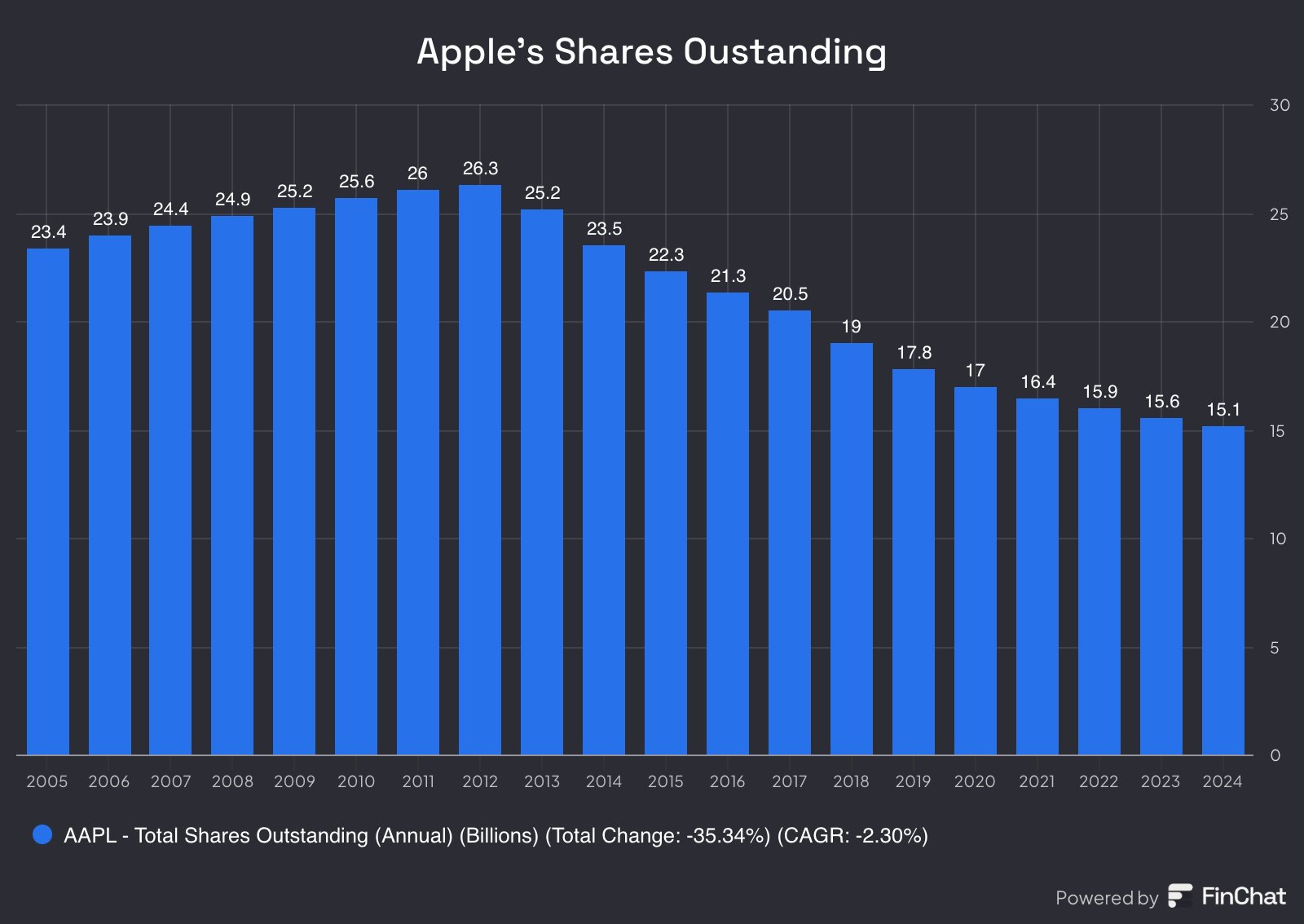
By repurchasing approximately 483 million shares, Apple's total shares outstanding would decrease from 15.02 billion to approximately 14.54 billion. This reduction in the share count is a primary mechanism through which buybacks can influence stock price.
Impact on Earnings Per Share (EPS)
With fewer shares outstanding, the company's earnings per share (EPS) is likely to increase, assuming net income remains constant or grows. EPS is calculated as:
EPS = Net Income / Shares OutstandingAn elevated EPS can make the stock more attractive to investors, potentially contributing to a higher stock price as the company appears more profitable on a per-share basis.
Return on Equity (ROE) Enhancement
Return on Equity (ROE) measures the profitability relative to shareholders' equity. By reducing the equity base through buybacks, ROE can improve:
ROE = Net Income / Shareholders' EquityHigher ROE indicates more efficient use of shareholder funds, which can positively influence investor perceptions and stock valuation.
Market Reactions and Investor Sentiment
Immediate Market Reaction
Historically, announcements of large buybacks have been met with positive reactions from the stock market. For example, following Apple's buyback announcement in May 2024, the stock price rose nearly 8% within 24 hours and continued to climb, reaching a 16% increase as of June 7, 2024. This substantial immediate increase indicates strong investor confidence in Apple's decision to repurchase its shares.
Long-Term Impacts
In the long term, the impact of the buyback on Apple's stock price will depend on multiple factors, including the company's continued financial performance, the broader economic environment, and market trends. A sustainable increase in EPS and potential appreciation in stock value hinge on Apple's ability to maintain growth and operational efficiency post-buyback.
Investor Perception and Confidence
Buybacks are often interpreted as a sign that management believes the company's stock is undervalued. This perception can enhance investor confidence, leading to increased demand for the stock. Moreover, buybacks can attract institutional investors who may prioritize companies with active share repurchase programs.
Financial Metrics Affected by Buybacks
Earnings Per Share (EPS) Boost
EPS is a crucial metric that reflects a company's profitability on a per-share basis. A reduction in the number of shares outstanding, achieved through buybacks, directly increases EPS, making the company appear more profitable per share. This can lead to a higher stock valuation as investors often seek companies with strong EPS growth.
Return on Equity (ROE) Improvement
ROE measures the profitability relative to shareholders' equity. By reducing the equity base through buybacks, ROE can improve, signaling potentially higher efficiency in generating profits from shareholders' investments. An improved ROE can make the company more attractive to investors, potentially boosting the stock price.
Shareholder Value Enhancement
Buybacks can be an effective way to return capital to shareholders, potentially leading to increased shareholder value as the reduced share count can elevate stock prices and distribute earnings more effectively. Additionally, buybacks provide flexibility to shareholders who may prefer capital gains over dividends for tax efficiency.
Impact on Price-to-Earnings (P/E) Ratio
The P/E ratio, calculated as the current share price divided by EPS, can be influenced by buybacks. With an increase in EPS due to a reduction in shares, the P/E ratio may decrease if the stock price remains constant, potentially making the stock more attractive to value investors.
Potential Risks and Considerations
Market Volatility
Even with a substantial buyback, stock prices are subject to market volatility and external economic factors. A downturn in the market or adverse economic conditions can offset the positive effects of the buyback, potentially limiting the anticipated stock price increase.
Opportunity Cost
The funds allocated for buybacks could alternatively be used for other investments, such as research and development, acquisitions, or debt reduction. It's important to assess whether the buyback is the most effective use of capital to drive long-term growth. Allocating funds to high-return projects may offer greater value creation compared to buybacks.
Buyback Execution Risks
Not all buybacks translate to lasting increases in stock price. The effectiveness is contingent upon the buyback being executed at a favorable share price and the company's ability to sustain earnings growth post-buyback. Poor execution, such as buying back at high valuations, can negate the potential benefits.
Regulatory and Tax Implications
Large-scale buybacks may attract regulatory scrutiny, especially if perceived as a tool to artificially inflate stock prices or executive compensation. Additionally, tax policies can influence the attractiveness of buybacks versus dividends, affecting investor preferences and the overall impact on stock price.
Comparative Analysis with Previous Buybacks
Historical Buyback Performance
Apple has a history of successful buyback programs. For example, the reduction in share count from 26.2 billion in 2013 to 15.3 billion demonstrates a consistent strategy to return capital to shareholders. Historical data suggest that large-scale buybacks can provide a significant headwind to stock price appreciation by reducing supply and increasing demand.
Market Perception
Investors often view buybacks as a sign of confidence from the company's management. A well-executed buyback can enhance market perception of the company's financial stability and growth prospects. This positive sentiment can lead to increased institutional investments and higher stock valuations.
Future Buyback Plans and Sustainability
Apple's commitment to ongoing buybacks underscores its dedication to returning value to shareholders. Maintaining a balance between buybacks and other investment opportunities is crucial for sustaining long-term growth and avoiding potential liquidity issues. Future buyback plans will likely consider Apple's financial performance, market conditions, and shareholder expectations.
Projected Stock Price Post-Buyback
While it is challenging to predict the exact stock price following a buyback, several models and historical precedents can provide estimated ranges:
Estimating Stock Price Increase
Based on projected EPS increases and historical market reactions, Apple's stock price could experience a notable increase. The following table outlines the potential impact:
| Metric | Before Buyback | After Buyback | Impact |
|---|---|---|---|
| Shares Outstanding (in billions) | 15.02 | 14.54 | Reduced by 0.48 billion shares |
| Buyback Amount | $110 Billion | Allocated for repurchasing shares | |
| EPS Increase | Assuming Net Income: $X Billion | EPS increases by ~3.3% | Higher EPS makes stock more attractive |
| Projected Stock Price Increase | $227.63 | $227.63 * (1 + 0.108 to 0.23) | Potential rise to approximately $253 to $280 per share |
Based on projections considering EPS increases and market reaction, Apple's stock price could see an increase ranging from approximately 10.8% to 23%, potentially rising its stock price to between $253 and $280 per share. However, this is an estimated range, and actual performance may vary based on the factors discussed earlier.
Calculating the Expected Stock Price
Using the estimated buyback impact, the projected stock price can be calculated as follows:
Projected Stock Price = Current Stock Price * (1 + Percentage Increase)

Where:
- Current Stock Price = $227.63
- Percentage Increase = 10.8% to 23%

Thus:

Projected Stock Price Range = $227.63 * 1.108 ≈ $252.29
Projected Stock Price Range = $227.63 * 1.23 ≈ $280.89
This calculation suggests that, under favorable conditions, Apple's stock price could increase to approximately $252 to $281 per share following the buyback.
Broader Economic and Market Considerations
Overall Market Conditions
The effectiveness of the buyback in boosting Apple's stock price is influenced by overall market conditions. In a bullish market, the buyback may amplify positive trends, leading to a more significant stock price increase. Conversely, in a bearish or volatile market, the buyback's impact may be muted or offset by broader negative sentiments.
Macroeconomic Factors
Factors such as interest rates, inflation, and economic growth rates play a crucial role in determining investor behavior. High interest rates may make alternative investments more attractive compared to stocks, potentially dampening the buyback's positive impact. Inflationary pressures could also affect consumer spending and corporate profitability, influencing stock performance.
Sector Performance
Apple operates within the technology sector, which is subject to rapid changes and innovation. The performance of the technology sector as a whole can influence Apple's stock price. Positive advancements and strong performance within the sector can enhance the buyback's effectiveness, while sector-wide challenges may limit its impact.
Strategic Implications for Apple
Capital Allocation Strategy
Apple's decision to allocate $110 billion towards a stock buyback reflects its capital allocation strategy. By prioritizing buybacks, Apple aims to optimize its capital structure, manage excess cash, and enhance shareholder returns. Balancing buybacks with investments in growth initiatives is essential for maintaining sustainable long-term growth.
Debt Management
While Apple has ample cash reserves, efficient debt management remains a critical aspect of its financial strategy. By balancing buybacks with debt reduction, Apple can maintain a healthy debt-to-equity ratio, lowering financial risk and potentially improving credit ratings.
Innovation and Growth Investments
Investing in research and development (R&D), new technologies, and market expansion is vital for Apple's continued success. Allocating a portion of capital to these areas ensures that the company remains competitive and can drive future revenue growth, complementing the benefits of the buyback program.
Case Studies: Buybacks from Other Companies
Example 1: Microsoft
In recent years, Microsoft has implemented substantial buyback programs, which have positively impacted its stock price. By reducing the number of shares outstanding, Microsoft has seen improvements in EPS and ROE, similar to the anticipated effects for Apple.
Example 2: ExxonMobil
ExxonMobil's aggressive buyback strategy has also led to stock price appreciation. Despite fluctuations in oil prices, the buyback program has helped stabilize the stock by providing consistent shareholder returns.
Lessons Learned
These case studies demonstrate that effective buyback programs can enhance stock performance by improving key financial metrics and boosting investor confidence. However, the success of such programs depends on the company's financial health, market conditions, and execution strategy.
Tax Considerations for Investors
Capital Gains vs. Dividends
Stock buybacks offer tax advantages compared to dividends. When a company buys back shares, investors may realize capital gains, which can be taxed at favorable rates compared to dividend income. This tax efficiency makes buybacks an attractive option for returning capital to shareholders.
Impact on Shareholder Tax Obligations
Investors who sell shares back to the company during a buyback will incur capital gains taxes based on the difference between their purchase price and the buyback price. Long-term capital gains are typically taxed at lower rates, providing potential tax benefits for shareholders.
Corporate Tax Strategies
From a corporate perspective, buybacks can be a strategic tool for managing tax liabilities and optimizing the company's effective tax rate. By adjusting share counts and capital structure, companies can influence their tax obligations and financial performance.
Conclusion
Apple's $110 billion stock buyback program is a significant financial maneuver that signals strong investor confidence and aims to enhance shareholder value through the reduction of outstanding shares. While such buybacks typically result in positive stock price movements and improved financial metrics like EPS and ROE, the actual impact on the stock price will be influenced by broader market conditions, Apple's continued financial performance, and strategic capital allocation decisions. Investors should consider both the benefits and risks associated with large-scale buybacks when assessing their investment strategies. Overall, if executed effectively within favorable market conditions, the buyback has the potential to substantially increase Apple's stock price, aligning with shareholder interests and reinforcing the company's market position.
References
Last updated February 9, 2025