

- Foundation of Measurement: Definite integrals serve as a fundamental tool for calculating precise measurements like areas, volumes, and accumulated change.
- Versatile Problem Solvers: From engineering and physics to economics and biology, definite integrals provide critical insights into complex systems.
- Bridging Theory and Practice: They translate abstract mathematical concepts into practical solutions for real-world challenges, offering a powerful framework for analysis and prediction.
The concept of the definite integral is a cornerstone of calculus, extending beyond mere mathematical abstraction to become an indispensable tool in a multitude of scientific, engineering, and economic disciplines. At its core, a definite integral represents the accumulated effect of a quantity varying over an interval. This powerful mathematical operation allows us to precisely quantify phenomena that are constantly changing, providing answers to questions that simple arithmetic cannot address. Whether it's determining the area under a curve, the volume of an irregularly shaped object, or the total work done by a variable force, definite integrals offer a rigorous and elegant solution.
The Essence of Definite Integrals: Accumulation and Area
Historically, the idea of integration originated from the desire to calculate areas and volumes. Ancient Greek mathematicians, such as Archimedes, developed early methods for approximating these quantities. However, it was Isaac Newton and Gottfried Leibniz in the 17th century who independently formalized the principles of integration, conceptualizing the area under a curve as an infinite sum of infinitesimally small rectangles. Bernhard Riemann later provided a more rigorous definition, solidifying the definite integral as a limit of Riemann sums.
Formally, the definite integral of a function \(f(x)\) from \(a\) to \(b\) is denoted as:
\[ \int_{a}^{b} f(x) \, dx \]This notation represents the net signed area between the graph of \(f(x)\) and the x-axis, from \(x=a\) to \(x=b\). If the function is above the x-axis, the area is positive; if below, it's negative. The Fundamental Theorem of Calculus establishes a crucial link between differentiation and integration, providing a powerful method for evaluating definite integrals by finding the antiderivative of the function.
Diverse Applications Across Disciplines
The utility of definite integrals spans an impressive range of fields, offering solutions to problems that involve accumulation, rates of change, and the measurement of continuous quantities.
Physics and Engineering: Quantifying Motion, Work, and Forces
In physics and engineering, definite integrals are fundamental for understanding and modeling various physical phenomena.
Understanding Displacement and Velocity
If we know the velocity function \(v(t)\) of an object, the definite integral allows us to calculate the total displacement over a given time interval. Similarly, integrating an acceleration function yields the velocity. This is crucial in fields like aerospace engineering for trajectory prediction and mechanical engineering for analyzing motion.
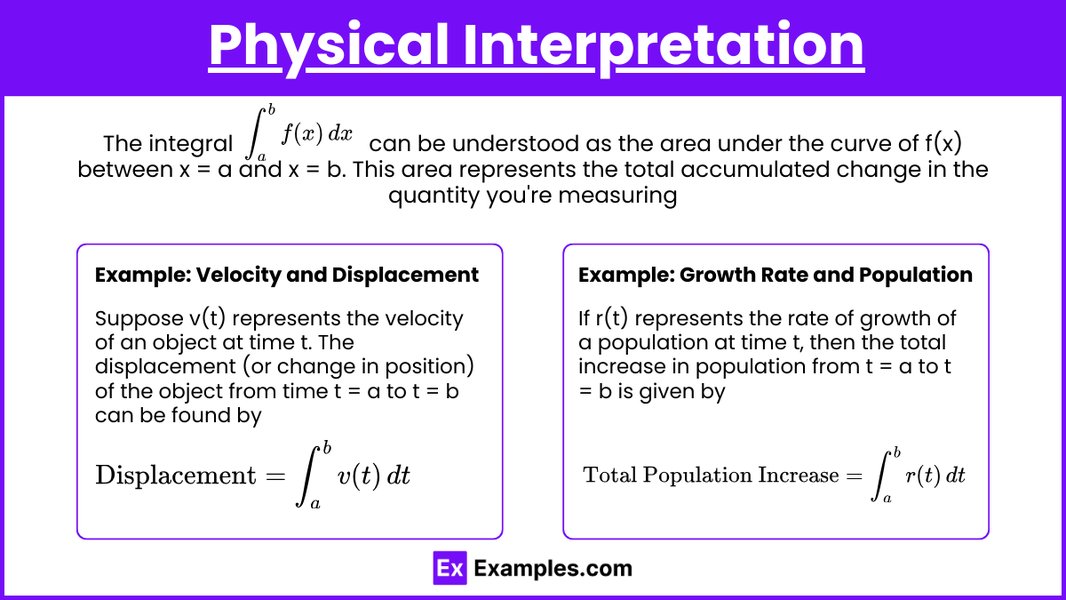 Visualizing the physical interpretation of definite integrals for accumulated change.
Calculating Work Done
When a force is variable, the work done in moving an object cannot be calculated by simple multiplication. Definite integrals are used to sum up the work done by infinitesimally small forces over a distance. This is essential in understanding energy transfer in mechanical systems.
Hydrostatic Force and Pressure
Engineers use definite integrals to calculate the force exerted by fluids on submerged surfaces, such as dams. This involves integrating the pressure over the area of the surface, which varies with depth.
Center of Mass and Moment of Inertia
For irregularly shaped objects, definite integrals are employed to determine the center of mass and moment of inertia, critical parameters in designing stable structures and predicting rotational behavior.
Economics and Business: Analyzing Revenue, Cost, and Growth
In economics, definite integrals provide valuable insights into market dynamics and business decisions.
Total Revenue and Cost Functions
By integrating marginal revenue or marginal cost functions, businesses can determine total revenue or total cost over a specific production range. This information is vital for profit margin analysis and strategic planning.
Consumer and Producer Surplus
Definite integrals are used to calculate consumer surplus (the benefit consumers receive by paying less than they are willing to pay) and producer surplus (the benefit producers receive by selling at a higher price than they are willing to accept). These concepts are fundamental in welfare economics.
Modeling Population Growth and Decay
In various business and biological contexts, definite integrals model exponential growth and decay phenomena, such as the growth of investments or the depreciation of assets.
Biology and Environmental Science: Population Dynamics and Resource Management
Definite integrals are powerful tools for biologists and environmental scientists.
Population Dynamics
Modeling population growth, decay, and the impact of environmental factors often involves differential equations that are solved using integration. This helps in understanding species conservation, disease spread, and resource management.
Glacier Mass Balance
In environmental science, definite integrals can be applied to calculate the mass balance of glaciers, which involves integrating accumulation (snowfall) and ablation (melting) over the glacier's area. This is critical for climate change studies.
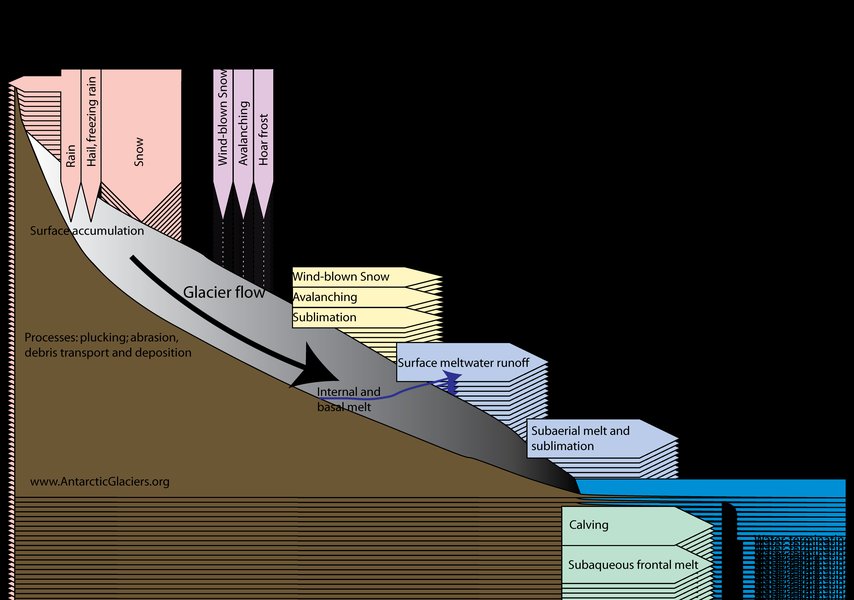 Conceptual model of glacier mass balance, a system analyzed using definite integrals.
Statistics and Probability: Quantifying Likelihood
Definite integrals play a crucial role in probability theory.
Probability Density Functions (PDFs)
In statistics, the probability of a continuous random variable falling within a certain range is determined by integrating its probability density function over that range. This is fundamental to statistical inference and risk assessment.
Key Concepts and Practical Applications Illustrated
The following mindmap further breaks down the core applications and interpretations of definite integrals, providing a structured overview of their utility.
This mindmap highlights the interconnectedness of various applications, all stemming from the fundamental concept of accumulation that definite integrals represent. From basic geometric calculations to complex physical and economic models, the definite integral provides a robust mathematical framework.
Real-World Impact: Engineering Mathematics in Action
Definite integrals are particularly prevalent in engineering, where they are used to solve complex problems ranging from structural analysis to signal processing. The following video delves into definite integral problems often encountered in engineering mathematics, offering practical examples and problem-solving techniques.
This video from "Alex Maths Engineering" provides a clear illustration of how definite integrals are applied in an engineering context, showcasing the practical steps involved in solving such problems. Understanding these examples is crucial for anyone pursuing a career in engineering or related technical fields, as it demonstrates the direct applicability of calculus concepts to real-world challenges.
A Comparison of Definite Integral Applications by Complexity and Frequency
To further contextualize the breadth of definite integral applications, the following table provides a comparison based on their typical complexity in computation and how frequently they are encountered in various academic and professional settings.
| Application Area | Typical Complexity (1-5, 5 being highest) | Frequency of Use (High/Medium/Low) | Key Examples |
|---|---|---|---|
| Area Under Curve / Between Curves | 2 | High | Geometric calculations, basic physics problems |
| Volume of Solids of Revolution | 3 | High | Designing mechanical parts, fluid containers |
| Work Done by Variable Force | 3 | Medium | Spring compression, pumping liquids |
| Displacement from Velocity | 2 | High | Kinematics, trajectory analysis |
| Hydrostatic Force | 4 | Medium | Dam design, underwater vehicle engineering |
| Center of Mass / Moment of Inertia | 4 | Medium | Structural stability, rotational dynamics |
| Consumer/Producer Surplus | 3 | Medium | Economic policy analysis, market studies |
| Population Growth/Decay | 3 | Medium | Ecology, demographic studies, finance |
| Probability Density Functions | 4 | High | Statistical inference, risk management |
| Arc Length / Surface Area | 4 | Low | Specialized geometric design, material science |
This table showcases that while some applications, like calculating area and volume, are frequently encountered and relatively straightforward, others, such as hydrostatic force or center of mass for complex geometries, demand a deeper understanding and more intricate computational methods. Regardless of complexity, the definite integral remains a vital analytical tool.
FAQ
What is the primary purpose of a definite integral?
How do definite integrals differ from indefinite integrals?
Can definite integrals be used for functions that go below the x-axis?
What is the Fundamental Theorem of Calculus's role in definite integrals?
Conclusion
Definite integrals are far more than just a mathematical concept taught in calculus classes; they are a fundamental analytical tool with widespread applications across virtually every quantitative discipline. From providing the foundational understanding of accumulated change and precise measurements of areas and volumes, to enabling complex modeling in physics, engineering, economics, and biology, their utility is undeniable. The ability of definite integrals to translate continuous rates of change into total quantities makes them an essential component for problem-solving in a dynamic and complex world. As technology advances, the application of these powerful mathematical constructs continues to expand, solidifying their role as an indispensable part of scientific and technological progress.
Recommended Searches
- Real-world problems solved by integration
- Calculus applications in engineering
- History and development of definite integrals
- How definite integrals are used in data science