
Unlocking the Power of Collective Intelligence: Diverse Applications of Distributed AI
Explore how Distributed AI is revolutionizing industries from healthcare to smart cities through collaborative and decentralized intelligence.
Key Insights into Distributed AI Applications
- Enhanced Scalability and Robustness: Distributed AI (DAI) systems excel by distributing computational tasks across multiple nodes, enabling them to handle massive datasets and complex operations far more efficiently and reliably than centralized systems.
- Real-time Decision Making and Efficiency: By processing data closer to its source, often at the 'edge' of a network, DAI minimizes latency and facilitates instantaneous insights, crucial for applications like autonomous vehicles and real-time fraud detection.
- Privacy-Preserving Collaboration: Techniques such as federated learning, inherent in DAI, allow multiple entities to collaborate on AI model training without centralizing sensitive data, addressing critical privacy and security concerns in sectors like healthcare and finance.
Distributed Artificial Intelligence (DAI) is a transformative subfield of AI that deviates from traditional centralized models by enabling multiple intelligent agents or nodes to work collaboratively or competitively. This decentralized approach distributes computational tasks, enhancing scalability, robustness, and efficiency across various sectors. DAI leverages the collective intelligence of interconnected devices and systems, fostering collaborative learning, problem-solving, and decision-making in real-time. This dynamic paradigm is reshaping how industries operate, offering innovative solutions to complex challenges.
Revolutionizing Sectors with Distributed Intelligence
DAI's impact spans a multitude of industries, driven by its inherent advantages in processing large, dispersed datasets and facilitating real-time interactions. The following sections delve into specific applications across key domains, showcasing how distributed intelligence is driving innovation.
Transforming Healthcare and Medical Diagnostics
In the healthcare sector, DAI is a game-changer, significantly improving diagnostic accuracy and treatment personalization. By analyzing vast amounts of medical data distributed across various hospitals and clinics, DAI systems enable:
- Personalized Diagnosis and Treatment: DAI facilitates early disease detection through advanced medical imaging analysis, providing robust diagnostic support and enabling tailored treatment plans based on individual patient data.
- Collaborative Healthcare Research: Through techniques like federated learning, DAI allows for multi-institutional data sharing and analysis for research purposes without compromising patient privacy, as sensitive data remains localized.
- Robotic Surgery and Assistance: Distributed AI coordinates multiple robotic agents, enhancing precision and responsiveness in complex surgical procedures and patient care.
Advancing Smart Cities and Urban Management
DAI is instrumental in creating more efficient, safer, and responsive urban environments. Its applications in smart cities include:
- Traffic Flow Optimization: Distributed AI agents monitor traffic in real-time, optimizing signal timings, reducing congestion, and improving overall road safety by processing data from a network of distributed sensors and cameras.
- Public Safety and Security: Coordinated DAI systems analyze data from diverse sources such as CCTV, social media, and emergency services to enhance crime detection, disaster response, and general urban safety.
- Smart Energy Management: DAI can optimize energy distribution and consumption within smart grids, contributing to sustainable urban development.
The image below illustrates the integration of AI, IoT, and smart city infrastructure for enhanced urban management.
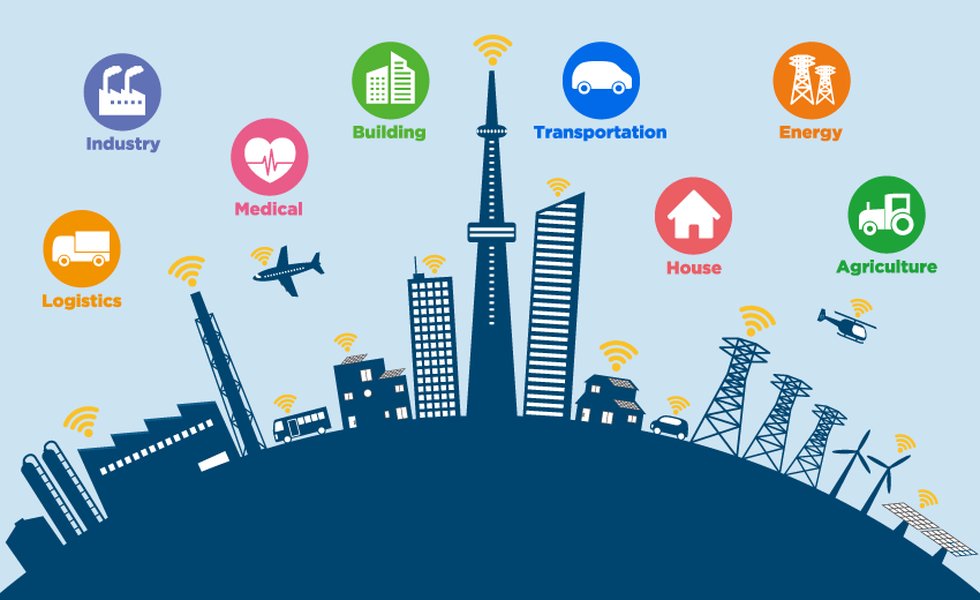
Seamless integration of IoT and AI in smart city infrastructure.
Innovating Industrial Automation and Robotics
In manufacturing and industrial environments, DAI fosters greater efficiency, precision, and collaboration:
- Swarm Robotics: Inspired by natural systems, DAI enables large groups of simple robots to collectively perform complex manufacturing, monitoring, or maintenance tasks autonomously, enhancing flexibility and resilience.
- Factory Scheduling and Resource Allocation: Multiple intelligent agents collaboratively optimize production schedules, supply chain logistics, and maintenance operations to maximize overall efficiency and throughput.
- Collaborative Robotics: DAI allows robots to work safely alongside humans by sharing situational awareness and dynamically coordinating tasks, leading to more flexible and adaptive production lines.
- Predictive Maintenance: By analyzing real-time and historical data from distributed sensors, DAI models can forecast potential equipment failures, enabling proactive maintenance and minimizing unplanned downtime.
Robots leveraging distributed AI for enhanced training and efficiency in industrial applications.
Optimizing Supply Chain and Logistics
DAI enhances the agility and responsiveness of supply chains:
- Demand Forecasting and Inventory Management: DAI networks monitor supply and demand conditions in real-time, optimizing inventory levels, transportation routes, and delivery schedules to reduce costs and improve responsiveness to market fluctuations.
- Fraud Detection: DAI systems are crucial for detecting fraudulent activities in financial transactions by analyzing patterns across distributed datasets.
Enhancing Financial Services and E-Commerce
The financial sector benefits immensely from DAI’s capacity for real-time analysis and secure data handling:
- Algorithmic Trading Strategies: Distributed AI agents analyze vast financial data streams from diverse markets, collaboratively refining trading strategies and managing risk without centralizing sensitive data.
- Model Drift Management: Financial services companies use DAI to manage model drift, ensuring that AI models remain accurate and relevant over time in dynamic financial markets.
Powering Autonomous Systems and Transportation
DAI is foundational for the advancement of autonomous technologies:
- Autonomous Driving: Advanced applications like autonomous vehicles require real-time data processing and decision-making, which is effectively facilitated by edge computing and DAI. DAI enables fleets of autonomous vehicles or drones to communicate, share environmental information, and coordinate movements for traffic efficiency and accident prevention.
- Advanced Driver-Assistance Systems (ADAS): DAI refines AI algorithms for ADAS, significantly improving vehicle safety features.
Boosting Telecommunications and Network Management
DAI optimizes network performance and security:
- Bandwidth Allocation and Traffic Management: AI agents dynamically allocate bandwidth, manage traffic loads, and detect or respond to cyber threats in network infrastructure distributed across various geographic regions.
- Cellular Network Optimization: Research is ongoing to optimize cellular networks using Multi-Agent Reinforcement Learning (MARL), a subset of DAI.
Enabling Distributed Machine Learning and Big Data Analytics
DAI is critical for handling the scale and complexity of modern data:
- Large-Scale Data Analysis: DAI is capable of processing very large datasets, often operating on sub-samples or hashed impressions due to its scale, facilitating sophisticated data analytics for real-time decision-making.
- Privacy-Preserving Analytics: Training AI models on large datasets spread across multiple locations or devices without central aggregation of data, leveraging federated learning for enhanced privacy compliance.
- Distributed AI Inferencing: This focuses on deploying AI models to deliver real-time, actionable insights and outcomes, with a significant shift towards this in 2025. It involves optimizing traffic flow in smart cities and improving public security.
Enhancing Customer Experience and Business Operations
DAI supports a wide range of business applications, improving efficiency and customer satisfaction:
- Chatbots and Virtual Agents: Multi-agent AI systems manage complex human interactions, customer inquiries, and workflow automation across distributed service platforms, providing instant responses in various industries.
- Content Creation and Generation: AI-driven tools leverage DAI to distribute the computational load for generating diverse creative outputs like music, art, images, and scripts, allowing for faster rendering and more complex creations.
- E-Discovery: AI streamlines document searches in legal cases by processing distributed data efficiently.
- Workplace Enhancement: Conversational agents built with DAI assist HR administrators and people managers with company policy information and other administrative tasks.
- Identity Validation: DAI-powered solutions manage scale and security in validating real identities, critical for financial services and other secure applications.
- Search Engine Optimization and Web Indexing: Search engines like Google employ DAI to crawl, index, and rank billions of webpages in real-time, distributing AI algorithms across a network of servers for quick and accurate search results.
Below is a Mermaid.js mindmap illustrating the core applications of Distributed AI across various domains.
Quantitative Impact and Comparative Advantages of DAI
To further illustrate the strengths of Distributed AI, we can assess its performance across key attributes compared to traditional centralized AI systems. While specific metrics can vary, a comparative analysis highlights DAI's inherent advantages in areas crucial for modern applications.
The radar chart below visually compares Distributed AI against Centralized AI across several critical dimensions based on their typical characteristics and benefits:
This radar chart visually represents how Distributed AI generally outperforms Centralized AI in key areas such as scalability, robustness, and real-time processing due to its decentralized nature. While centralized systems might offer some advantages in initial setup cost for smaller applications, DAI's long-term benefits in large-scale, complex environments are evident.
Understanding Key Advantages of Distributed AI
The diverse applications of DAI are underpinned by several inherent advantages that make it a compelling alternative to traditional centralized AI approaches:
| Advantage | Description | Impact on Applications |
|---|---|---|
| Scalability | DAI systems can efficiently scale to handle large datasets and a multitude of users or devices by distributing the computational load across multiple nodes. | Enables processing of massive data in search engines, supports extensive IoT networks, and scales generative AI deployments. |
| Robustness & Fault Tolerance | System resilience improves significantly as the failure of a single node does not compromise the entire system, thanks to its decentralized architecture. | Ensures continuous operation in critical systems like smart city infrastructure, autonomous vehicles, and financial trading platforms. |
| Data Privacy & Security | By processing data closer to its source and utilizing techniques like federated learning, DAI enhances privacy compliance by keeping sensitive data localized and sharing only aggregated insights or models. | Crucial for healthcare applications involving patient data, financial fraud detection, and maintaining confidentiality in enterprise operations. |
| Real-Time Processing & Low Latency | Distributed AI processes data closer to its origin (edge computing), facilitating quicker responses and reducing network latency. | Essential for time-sensitive applications such as autonomous driving, real-time traffic management, and high-frequency algorithmic trading. |
| Cost Efficiency | While initial setup might vary, DAI can lead to long-term cost savings by optimizing resource utilization, reducing reliance on expensive centralized infrastructure, and minimizing data transfer costs. | Benefits include optimized resource allocation in cloud computing, efficient supply chain management, and reduced maintenance costs for large distributed systems. |
| Enhanced Efficiency | DAI optimizes resource allocation, scheduling, and load balancing across distributed environments, leading to more efficient utilization of computational resources. | Improves performance in areas like smart energy management, factory scheduling, and large-scale data analysis by ensuring efficient resource deployment. |
Deep Dive: AI Agents as Distributed Systems and Reliability
The concept of AI agents operating as distributed systems is gaining significant traction, particularly as the complexity and scale of AI applications grow. These agents, often autonomous, need to communicate, cooperate, and sometimes compete to achieve collective goals. Ensuring their reliability in a distributed environment is paramount for real-world deployment.
One of the critical challenges in building reliable distributed AI agent systems is managing their interactions and state across various nodes. This requires robust mechanisms for coordination, fault tolerance, and consistent data sharing, preventing issues like data inconsistencies or agent failures from cascading throughout the system.
The following video from Temporal.io discusses how AI agents, as distributed systems, require reliability. It highlights the architectural considerations and patterns necessary to build resilient AI applications that can withstand failures and operate consistently in complex, real-world scenarios.
Insights into building reliable AI agents as distributed systems.
The video emphasizes that the reliability of distributed AI agents is not merely about preventing individual agent failures but about ensuring the overall system's stability and correct functioning under diverse conditions. This includes handling network partitions, node crashes, and transient errors, all of which are common in distributed computing environments. It underscores the importance of robust error handling, retry mechanisms, and state persistence to ensure that AI agents can complete their tasks effectively, even in the face of unforeseen challenges.
Frequently Asked Questions about Distributed AI Applications
What is the core difference between Distributed AI and Centralized AI?
How does Distributed AI enhance data privacy?
Can Distributed AI handle real-time decision making?
What is an example of Distributed AI in everyday technology?
How does Distributed AI contribute to smart cities?
Conclusion: The Ubiquitous Reach of Distributed AI
Distributed Artificial Intelligence represents a significant evolution in the field of AI, moving beyond centralized systems to leverage collective intelligence across multiple agents and nodes. Its applications are expansive and transformative, impacting nearly every sector from healthcare and finance to smart cities and industrial automation. By prioritizing scalability, robustness, real-time processing, and data privacy, DAI offers compelling solutions to complex, large-scale problems that are often intractable for traditional AI. As technology continues to advance, the distributed paradigm of AI will undoubtedly become even more integral to modern innovation, driving efficiency, enhancing security, and fostering a new era of intelligent, interconnected systems.
Recommended Further Exploration
- How does federated learning work in distributed AI?
- What are the challenges of implementing distributed AI systems?
- Explore the role of edge computing in distributed AI applications
- Case studies of distributed AI in supply chain optimization
