
Unlock Publication-Worthy Results: Building a High-Performance Arabic Handwriting Recognition Model
Your guide to navigating the complexities of AHR, leveraging state-of-the-art techniques, and achieving publishable accuracy.
Key Insights for Success
- Embrace Deep Learning: Modern Arabic Handwriting Recognition (AHR) relies heavily on advanced architectures like Convolutional Neural Networks (CNNs), Recurrent Neural Networks (RNNs, especially BiLSTMs), and Transformers, often combined in hybrid models with Connectionist Temporal Classification (CTC) loss.
- Address Unique Challenges: Success requires tackling the specific complexities of Arabic script, including its cursive nature, contextual letter shapes, diacritics, ligatures, and diverse handwriting styles.
- Focus on Novelty and Rigor: For publication, aim beyond high accuracy (low Character Error Rate - CER / Word Error Rate - WER) by introducing novel approaches, conducting thorough evaluations on benchmark datasets (e.g., KHATT, AHCD), and comparing against existing state-of-the-art methods.
Understanding the Unique Challenges of Arabic Handwriting
Developing a high-performing AHR model requires grappling with the inherent complexities of the Arabic script, which differ significantly from Latin-based languages. Recognizing these challenges is the first step towards building effective solutions.
Cursive and Connected Script
Arabic is predominantly written in a cursive style, meaning letters within a word are typically connected. This makes traditional segmentation (dividing words into individual characters) extremely difficult and often unreliable. Models must either handle text holistically (segmentation-free approaches) or employ sophisticated segmentation techniques.
Contextual Letter Shapes
The appearance of an Arabic letter changes depending on its position within a word: initial, medial, final, or isolated. A recognition system must learn to identify the same underlying letter despite these significant shape variations.
Diacritics and Dots
Arabic uses diacritical marks (harakat for short vowels, tanwin for nunation) and dots (i'jam) placed above or below the main letter body to distinguish letters and indicate pronunciation. In handwriting, these marks can be inconsistently placed, sized, or even omitted, creating ambiguity and posing a major challenge for OCR systems.
Ligatures
Certain letter combinations form obligatory ligatures (a single glyph representing multiple letters, e.g., Lam-Alef لا). Models need to correctly recognize these composite forms.
Variability in Handwriting Styles
Like all handwriting, Arabic script exhibits significant variation between writers in terms of slant, size, stroke thickness, spacing, and overall style (e.g., Naskh, Ruq’ah). Models need to be robust to these variations.
Right-to-Left Directionality
The right-to-left writing direction requires specific handling during data preprocessing and within certain model architectures (like RNNs).
Dataset Availability
While improving, the number and size of publicly available, high-quality Arabic handwriting datasets are still somewhat limited compared to resources for Latin scripts, which can impact the training of very large deep learning models.
Essential Datasets for AHR Model Development
Choosing the right dataset(s) is crucial for training and evaluating your AHR model. Several benchmark datasets are commonly used in the research community:
- KHATT: A significant offline Arabic handwriting dataset featuring text lines written by 1,000 different writers. It's a standard benchmark for evaluating line-level recognition systems.
- AHCD (Arabic Handwritten Characters Dataset): Contains isolated Arabic handwritten characters, often used for character-level recognition tasks. Some studies report high accuracies (upwards of 97%) on this dataset using CNNs.
- Hijja: Focuses specifically on Arabic handwriting by children, presenting unique challenges due to developing writing skills. Contains over 47,000 characters.
- IFN/ENIT: A well-known dataset containing handwritten Tunisian town/village names, often used for word-level recognition tasks.
- AHTID/MW (Arabic Handwritten Text Images Database): Offers multi-writer text samples, useful for testing model generalization.
- HICMA: A more recent dataset containing image-text pairs with style labels, useful for training models robust to different handwriting styles.
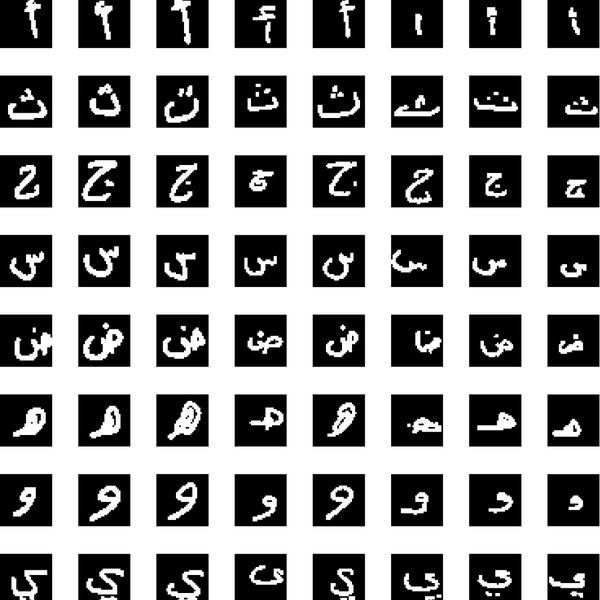
Image representing the AHCD dataset card on Kaggle.
For publication, it's essential to train and test your model on one or more standard benchmark datasets and compare your results (CER, WER) against published state-of-the-art figures for those specific datasets.
Data Augmentation
Given the potential limitations in dataset size and the high variability of handwriting, data augmentation is crucial. Techniques include:
- Geometric Transformations: Rotation, scaling, shearing, elastic distortions.
- Noise Injection: Adding random noise to simulate scanning imperfections.
- Synthetic Data Generation: Using techniques like Generative Adversarial Networks (GANs) to create realistic synthetic handwriting samples, potentially increasing dataset size and diversity.
Preprocessing: Preparing Handwriting Data for Analysis
Effective preprocessing is vital for improving the performance of AHR models by standardizing the input and reducing noise.
Common Preprocessing Steps:
- Binarization: Converting grayscale images to black and white, separating text from the background. Adaptive thresholding methods are often preferred.
- Noise Reduction: Applying filters (e.g., median filter) to remove salt-and-pepper noise or other artifacts.
- Skew Correction: Detecting and correcting the overall slant of the text lines or page.
- Normalization: Standardizing aspects like baseline height, stroke width, or overall image size.
- Baseline Detection: Identifying the main line upon which Arabic characters rest, which is important for feature extraction and segmentation (if used).
- Segmentation (Optional): While many modern approaches are segmentation-free, some methods might involve segmenting lines into words or potential character pieces (Piecewise Arabic Character Segments - PACS). Zone segmentation (upper, middle, lower) can help capture features related to diacritics and ascenders/descenders.
The specific preprocessing pipeline may depend on the chosen model architecture and the characteristics of the dataset.
State-of-the-Art Model Architectures
Recent advancements in AHR have been driven by deep learning. Selecting or designing an appropriate architecture is key to achieving high accuracy.
Convolutional Neural Networks (CNNs)
CNNs excel at learning spatial hierarchies of features directly from pixel data. In AHR, they are primarily used as powerful feature extractors, identifying strokes, loops, dots, and other relevant patterns in the handwritten image. Architectures like VGG, ResNet, or custom CNNs can be employed, often forming the initial layers of more complex models. They have shown strong performance, especially on character-level datasets like AHCD and Hijja.
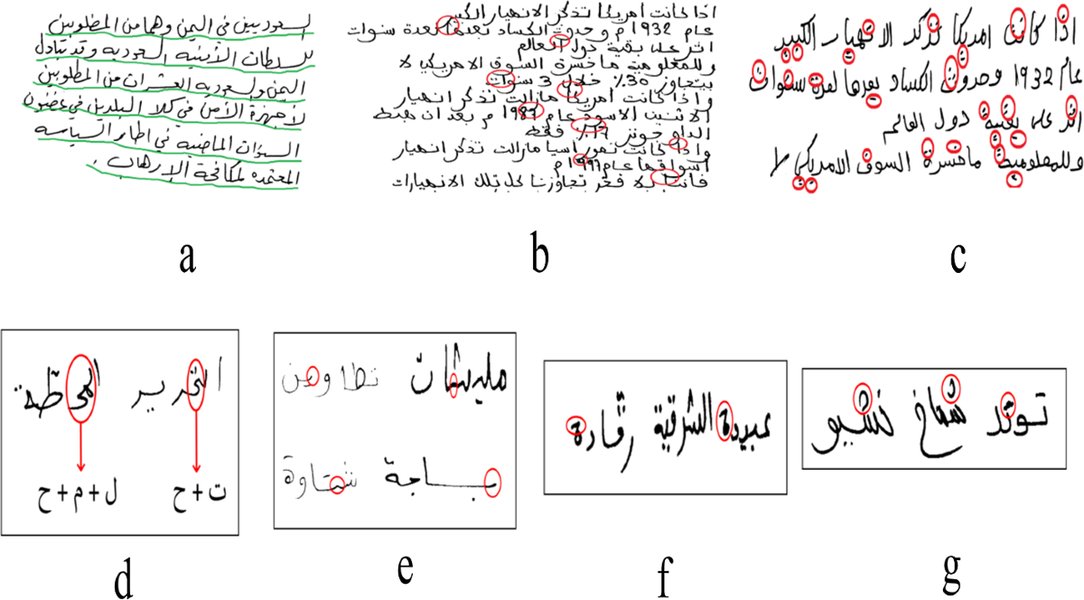
Conceptual diagram showing components often used in CNN-based AHR models (Source: Springer).
Recurrent Neural Networks (RNNs/LSTMs/GRUs)
RNNs, particularly Long Short-Term Memory (LSTM) and Gated Recurrent Unit (GRU) variants, are designed to process sequential data. Given the sequential nature of text (even when written cursively), RNNs are well-suited for AHR. They can capture long-range dependencies within the sequence of features extracted (often by a preceding CNN). Bidirectional LSTMs (BiLSTMs) are commonly used as they process the sequence in both forward (right-to-left for Arabic) and backward directions, providing richer contextual information for each step.
Transformer Models
Transformers, utilizing self-attention mechanisms, have revolutionized sequence processing tasks, including NLP and computer vision. They are increasingly being applied to AHR, showing promising results, sometimes outperforming RNN-based approaches. Attention mechanisms allow the model to weigh the importance of different parts of the input sequence (or image features) when making predictions, which can be particularly beneficial for handling long dependencies and focusing on relevant features like diacritics or specific letter shapes. Research explores their use in both online (stroke data) and offline (image data) AHR.
Hybrid Architectures (CNN-RNN/LSTM-CTC)
Combining the strengths of different architectures is a prevalent and often state-of-the-art approach. A common hybrid model uses CNN layers for initial feature extraction from the image, followed by BiLSTM layers to model the sequence of features temporally, and finally, a Connectionist Temporal Classification (CTC) output layer. CTC is particularly valuable because it allows the model to be trained end-to-end without requiring precise alignment between the input image frames and the output character sequence, thus bypassing the need for explicit, error-prone segmentation.
Advanced Techniques to Boost Performance
Beyond the core architecture, several advanced techniques can further enhance your model's accuracy and robustness.
(KHATT, AHCD, Hijja)"] id3b["Transfer Learning"] id3c["Hyperparameter Tuning"] id3d["Cross-Validation"] id4["Advanced Techniques"] id4a["Data Augmentation
(Geometric, Noise, GANs)"] id4b["Attention Mechanisms"] id4c["Language Modeling
(Post-processing)"] id4d["Ensemble Methods"]
This mindmap outlines key areas for enhancing your Arabic Handwriting Recognition model, from initial data preparation through advanced refinement techniques. Combining robust preprocessing, suitable architectures, effective training, and advanced methods like data augmentation and attention can significantly improve performance.
Attention Mechanisms
Even within hybrid models, incorporating attention mechanisms can help the network focus on the most salient image regions when predicting each character, potentially improving the handling of diacritics or overlapping strokes.
Language Modeling
Integrating an external Arabic language model during decoding or as a post-processing step can significantly improve results. The language model uses contextual information (probabilities of word sequences) to correct errors made by the visual recognition model, favouring linguistically plausible outputs.
Transfer Learning
Using models pre-trained on larger datasets (even from different domains or languages, if applicable) and fine-tuning them on your specific AHR dataset can lead to better performance, especially when training data is limited. Deep transfer learning can be effective for feature extraction layers.
Ensemble Methods
Combining the predictions of multiple independently trained models can often yield better results than any single model.
Evaluating Your Model: Metrics and Benchmarking
Rigorous evaluation is essential for understanding your model's performance and comparing it to others, especially for publication.
Standard Metrics
- Character Error Rate (CER): The primary metric for AHR. It measures the Levenshtein distance (minimum number of single-character edits: insertions, deletions, substitutions) between the predicted text and the ground truth, normalized by the length of the ground truth. Lower CER is better.
- Word Error Rate (WER): Similar to CER, but calculated at the word level. It measures the minimum number of word edits needed. Lower WER is better.
- Accuracy/Precision/Recall/F1-Score: Sometimes used, particularly for character-level classification tasks on datasets like AHCD.
Benchmarking
Evaluate your model on standard, publicly available datasets (like KHATT, IFN/ENIT, AHCD) and report your CER/WER. Crucially, compare these results to previously published state-of-the-art results on the *same splits* of those datasets. This contextualizes your performance and highlights your contribution.
Illustrative Performance Comparison (Hypothetical)
The radar chart below provides a *hypothetical* illustration of how different AHR model types might compare across various dimensions. Note that actual performance depends heavily on specific implementation, data, and training. This is purely for conceptual understanding.
This chart visualizes trade-offs: Simple CNNs might excel on isolated characters (AHCD) and train fast but struggle with cursive text (KHATT) and require segmentation. Hybrid CNN-BiLSTM-CTC models offer a strong balance, achieving good accuracy without explicit segmentation. Transformer models potentially offer the highest robustness and accuracy but might be computationally more expensive to train.
Dataset Summary and Benchmarks
The following table summarizes key datasets and typical performance ranges often cited in research (Note: SOTA changes rapidly, these are indicative ranges):
| Dataset | Type | Typical Content | Approx. Size Indication | Common Metric | Indicative SOTA Range (Approx.) |
|---|---|---|---|---|---|
| KHATT | Offline | Handwritten Lines | ~1000 writers, paragraph text | CER / WER | 5-15% CER |
| AHCD | Offline | Isolated Characters | ~16k training, ~5k testing images | Accuracy | 97-99% Accuracy |
| Hijja | Offline | Children's Characters | ~47k characters | Accuracy | ~88-95% Accuracy (varies by model) |
| IFN/ENIT | Offline | Handwritten Words (Tunisian Towns) | ~32k words, ~930 unique names | WER / Accuracy | 5-10% WER |
| HICMA | Offline | Lines/Paragraphs with style labels | Varied historical/modern texts | CER / WER | Highly variable; benchmark in progress |
Ablation Studies
For publication, include ablation studies where you systematically remove components of your model (e.g., a specific layer type, data augmentation technique, attention mechanism) to demonstrate their individual contribution to the overall performance.
Strategies for Achieving Publication-Worthy Results
Getting your work published requires more than just a working model; it needs to represent a contribution to the field.
Novelty
Your work should offer something new. This could be:
- A novel model architecture or a unique combination of existing techniques.
- A new preprocessing method specifically designed for Arabic script challenges.
- Application of a recent technique (e.g., a specific Transformer variant) to AHR for the first time, with strong results.
- A new, challenging dataset or a significant improvement on existing benchmarks.
- A unique application domain (e.g., historical documents, specific dialect recognition).
Rigorous Evaluation and Comparison
Thoroughly evaluate your model using standard metrics (CER, WER) on multiple benchmark datasets. Critically, compare your results against several established state-of-the-art methods, clearly tabulating the performance differences. Discuss *why* your model performs better or differently.
Detailed Methodology
Clearly document your entire process: dataset selection and splits, preprocessing steps, model architecture details (layers, parameters), training procedure (optimizer, learning rate, epochs), and evaluation protocol. Ensure your work is reproducible.
Insightful Analysis
Go beyond just reporting numbers. Analyze the errors your model makes. Visualize activations or attention maps to understand what the model is learning. Discuss the limitations of your approach and suggest directions for future work.
Code and Model Sharing (Optional but Recommended)
Sharing your code (e.g., on GitHub) and potentially pre-trained models greatly increases the impact and reproducibility of your research, which is highly valued by the scientific community.

Example illustrating code sharing via GitHub for an AHR project.
Target Appropriate Venues
Submit your work to relevant conferences or journals specializing in computer vision, pattern recognition, document analysis, or natural language processing. Examples based on the provided search results include venues covered by MDPI, Springer, IEEE, and platforms like arXiv for pre-prints.
Relevant Visualizations and Resources
Visual aids and practical demonstrations can significantly clarify concepts in AHR.
Video: CNN for Arabic Handwritten Characters
This video provides a visual demonstration related to using Convolutional Neural Networks (CNNs) for recognizing Arabic handwritten characters. Watching such demonstrations can help visualize how CNN architectures process character images and make classifications, illustrating concepts like feature extraction discussed earlier. Understanding these basic building blocks is fundamental before tackling more complex sequence models for full words or lines.
Frequently Asked Questions (FAQ)
What is a good CER/WER score for publication?
There's no single threshold, as "good" depends heavily on the dataset's difficulty and the current state-of-the-art (SOTA) for that specific dataset. For established datasets like KHATT, achieving a CER significantly lower than published SOTA (e.g., pushing below 5-10% CER, depending on current benchmarks) would be noteworthy. For less common datasets or novel tasks, demonstrating substantial improvement over baseline methods is key. Always compare against relevant benchmarks.
Should I use segmentation or a segmentation-free approach?
Most state-of-the-art approaches for Arabic handwriting recognition are now segmentation-free, particularly those using RNNs/Transformers with CTC loss. Explicitly segmenting cursive Arabic script into characters is notoriously difficult and error-prone, and errors in segmentation propagate to the recognition stage. Segmentation-free models (like CNN-BiLSTM-CTC) learn an implicit alignment between the image features and the output sequence, generally leading to better performance for cursive scripts.
How important is handling diacritics?
Very important for full accuracy, although some applications might tolerate ignoring them. Diacritics distinguish meaning and pronunciation. Their small size, variable placement, and occasional omission in handwriting make them challenging. Models that explicitly or implicitly handle diacritics well (perhaps through attention mechanisms or higher resolution feature extraction) tend to achieve lower error rates. Evaluate your model's performance both with and without considering diacritics if possible.
Which deep learning framework is best: TensorFlow or PyTorch?
Both TensorFlow and PyTorch are excellent, widely used frameworks capable of building state-of-the-art AHR models. The choice often comes down to personal preference, existing codebase familiarity, or specific pre-trained models/libraries available. Both have strong community support and extensive documentation. Performance differences are usually negligible; focus on mastering one and implementing your architecture effectively within it.
Recommended Next Steps
Explore these related queries for deeper insights:
- Compare CTC loss versus attention mechanisms for sequence-to-sequence Arabic handwriting recognition.
- Investigate techniques for generating synthetic Arabic handwriting data using Generative Adversarial Networks (GANs).
- Learn how Transformer models are specifically adapted for offline Arabic handwriting recognition tasks.
- Find the latest state-of-the-art performance benchmarks reported on the KHATT dataset for AHR.
References
Last updated May 4, 2025