

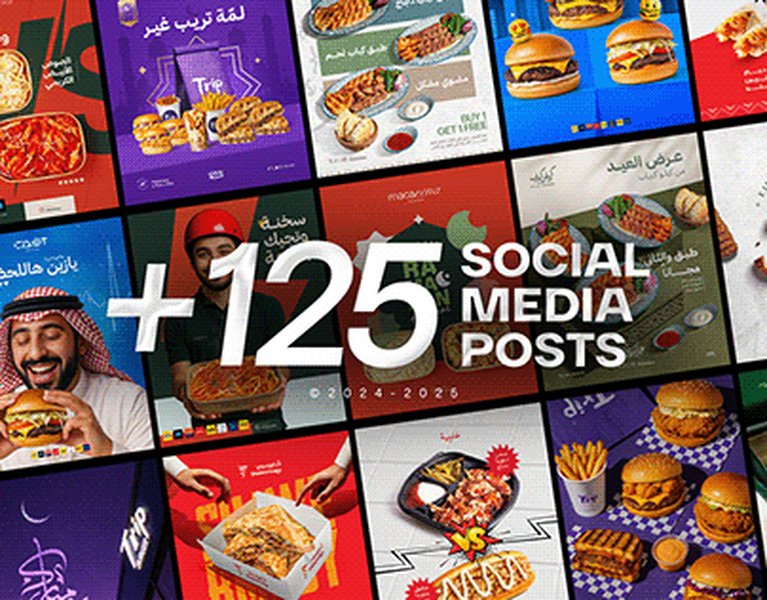
Visual representation of Arabic social media posts, highlighting design and content nuances.
Key Insights for Your Arabic Sentiment Analysis Project
- Leverage Transformer Models: Advanced models like AraBERT and other BERT variants are crucial for capturing the nuances of Arabic language on social media, offering superior accuracy compared to traditional methods.
- Address Dialectal Challenges: Arabic's rich dialectal diversity is a significant hurdle. Incorporating dialect-specific datasets, models, or ensemble approaches can drastically improve the performance and relevance of your analysis.
- Comprehensive Preprocessing is Paramount: Arabic text requires specialized preprocessing steps, including meticulous handling of diacritics, elongations, and tokenization using tools designed for the language, such as CAMeL Tools or Farasa.
Your graduation project, "Arabic Sentiment 3: Analysis for Social Media" in Python, is a highly relevant and impactful undertaking. The digital landscape is increasingly filled with Arabic content, particularly on social media, making sentiment analysis a critical tool for understanding public opinion, market trends, and social dynamics. This comprehensive guide will equip you with a structured approach, essential techniques, and valuable resources to ensure your project's success.
The Multifaceted Challenge of Arabic Sentiment Analysis
Arabic sentiment analysis presents unique challenges that differentiate it from sentiment analysis in other languages like English. The language's rich morphology, the prevalence of diverse dialects (e.g., Levantine, Gulf), and the informal nature of social media communication all contribute to its complexity. Standard NLP techniques often fall short without adaptation, necessitating specialized tools and models.
Understanding Arabic Linguistic Nuances
Arabic is a Semitic language characterized by a complex root-and-pattern morphology, where words are often derived from a three-letter root. This makes tasks like stemming and lemmatization more intricate than in agglutinative or isolating languages. Additionally, the presence of diacritics (short vowels) and varying writing styles on social media (e.g., character elongations, mixed Arabic-English text) further complicates text processing.
The Dialectal Divide in Social Media
Social media content in Arabic is predominantly written in various dialects rather than Modern Standard Arabic (MSA). These dialects can differ significantly in vocabulary, grammar, and pronunciation, posing a substantial challenge for sentiment analysis models trained solely on MSA. Addressing this requires either robust models capable of handling dialectal variations, or the use of dialect-specific datasets and models.
A Structured Workflow for Your Project
A systematic approach from data collection to model deployment is crucial for a successful graduation project. Below is a detailed workflow outlining each stage.
Collecting Relevant Arabic Social Media Data
The foundation of any robust sentiment analysis project is a high-quality dataset. For social media analysis, tweets are an excellent source of real-time opinions. You can leverage the Twitter API (v2) with Python libraries like Tweepy to collect fresh Arabic tweets. Filtering by language (lang:ar) is essential.
Alternatively, numerous pre-labeled datasets are available and highly recommended for initial experimentation and benchmarking:
- ASTD (Arabic Sentiment Tweets Dataset): Contains approximately 10,000 tweets classified into positive, negative, mixed, and objective categories, making it ideal for multi-class classification.
- ArSenTD-LEV: A dataset of around 4,000 Levantine dialect tweets from Jordan and Lebanon, specifically useful for projects focusing on dialectal variations.
- KAUST Arabic Sentiment Analysis 2021: Another valuable dataset containing tweets labeled as positive, negative, or neutral, often used in Kaggle competitions.
- Motaz Saad's Tweet Collector: A GitHub repository that can be adapted to gather and initially label tweets based on positive/negative emojis.
Meticulous Data Cleaning and Preprocessing
Arabic text requires specific preprocessing steps to enhance model performance. This stage involves transforming raw text into a clean, normalized format suitable for analysis.
- Noise Removal: Eliminate URLs, mentions (
@user), hashtags, and irrelevant symbols using regular expressions. - Normalization: Address character elongations (e.g., "كككك" for laughter), remove Arabic diacritics (tashkeel), and standardize variations in character forms. Libraries like
pyarabicorCAMeL Toolsare indispensable here. - Tokenization: Break down text into individual words or sub-word units. Standard NLTK tokenizers are often insufficient for Arabic; instead, use Arabic-specific tools like
CAMeL ToolsorFarasafor more accurate segmentation. - Stemming/Lemmatization: Reduce words to their root or base form. This is particularly complex in Arabic due to its morphological structure.
- Stopword Removal: Remove common words (ee.g., "the," "is") that carry little semantic value for sentiment analysis.
Here's an illustrative Python code snippet for basic Arabic text preprocessing:
import re
from camel_tools.tokenizers.word import simple_word_tokenize

def preprocess_arabic_text(text):
    # Remove URLs
    text = re.sub(r'http\S+|www\S+|https\S+', '', text, flags=re.MULTILINE)
    # Remove mentions and hashtags
    text = re.sub(r'@\w+|#\w+', '', text)
    # Remove non-Arabic characters, punctuation, and numbers
    text = re.sub(r'[^\u0600-\u06FF\s]', '', text)
    # Normalize Arabic letters (e.g., standardize hamza forms)
    text = re.sub(r'[أإآ]', 'ا', text)
    text = re.sub(r'ة', 'ه', text)
    text = re.sub(r'ى', 'ي', text)
    # Remove extra spaces
    text = re.sub(r'\s+', ' ', text).strip()
    # Tokenization using CAMeL Tools
    tokens = simple_word_tokenize(text)
    return ' '.join(tokens)

sample_tweet = "هذا مشروع رائع! @user #تخرج https://example.com"
cleaned_tweet = preprocess_arabic_text(sample_tweet)
print(cleaned_tweet)
# Expected output: "هذا مشروع رائع"
Transforming Text into Actionable Features
Before applying machine learning models, text data must be converted into numerical representations (features). Common techniques include:
- TF-IDF (Term Frequency-Inverse Document Frequency): A statistical measure that reflects how important a word is to a document in a collection or corpus. It's a robust baseline for many NLP tasks.
- Word Embeddings: Dense vector representations of words where words with similar meanings have similar vector representations. Examples include Word2Vec, GloVe, and FastText.
- Transformer-based Embeddings: Contextualized embeddings generated by models like BERT, which capture word meaning based on the surrounding text. These are particularly powerful for capturing semantic nuances in Arabic.
Building and Training Sentiment Classification Models
Your project can explore a range of models, from traditional machine learning to advanced deep learning architectures.
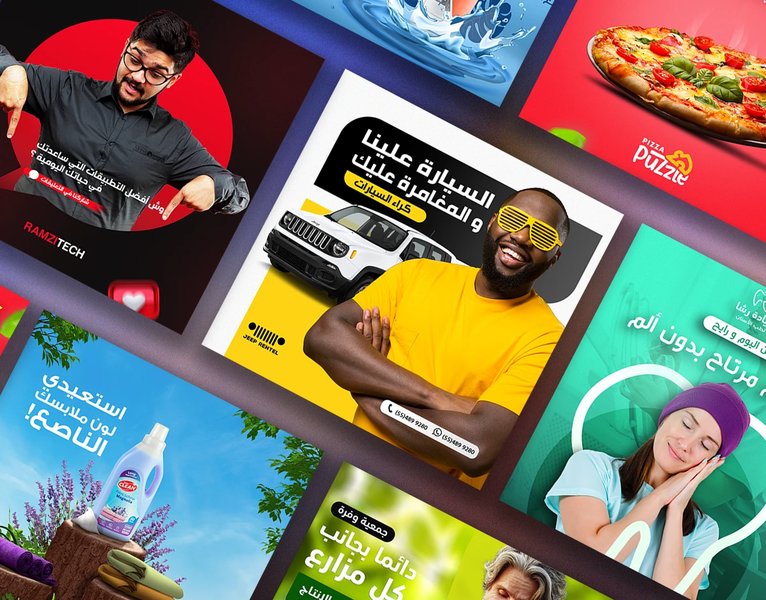
An example of an Arabic social media post design, highlighting the visual context often accompanying text.
Traditional Machine Learning Approaches
These models serve as excellent baselines for comparison and are often quicker to train.
- Naive Bayes: A probabilistic classifier based on Bayes' theorem, assuming independence between features.
- Logistic Regression: A linear model used for binary classification, but extendable to multi-class problems.
- Support Vector Machines (SVM): Powerful algorithms that find an optimal hyperplane to separate classes.
- Random Forest: An ensemble learning method that constructs a multitude of decision trees during training.
Advanced Deep Learning and Transformer Models
For state-of-the-art performance in Arabic sentiment analysis, especially on social media data, transformer-based models are highly recommended due to their ability to understand context and handle complex linguistic structures.
- AraBERT and its Variants: Pre-trained BERT models specifically fine-tuned on large Arabic corpora. These models significantly outperform traditional methods.
- AraBERT-LSTM: A hybrid approach combining the contextual embeddings from AraBERT with the sequential processing capabilities of Long Short-Term Memory (LSTM) networks, often leading to improved accuracy on noisy social media text.
- Attention-based Architectures: Integrating attention mechanisms allows models to focus on the most relevant parts of the input text when making sentiment predictions.
- Ensemble Models: Combining predictions from multiple models (e.g., different BERT variants or classical ML with deep learning) can further boost accuracy and robustness, especially for dialectal Arabic.
Here's a conceptual code structure for using AraBERT with Hugging Face Transformers:
from transformers import AutoTokenizer, AutoModelForSequenceClassification
from transformers import Trainer, TrainingArguments
import torch
from datasets import Dataset # Assuming your data is loaded into a Hugging Face Dataset object

# Load pre-trained tokenizer and model for Arabic BERT
tokenizer = AutoTokenizer.from_pretrained('aubmindlab/bert-base-arabertv02')
model = AutoModelForSequenceClassification.from_pretrained('aubmindlab/bert-base-arabertv02', num_labels=3) # Example for 3 sentiment classes

# Assume you have train_texts and train_labels
# You would need to tokenize your dataset
# Example:
# def tokenize_function(examples):
#     return tokenizer(examples["text"], padding="max_length", truncation=True)
#
# tokenized_train_dataset = your_raw_dataset.map(tokenize_function, batched=True)

# Define training arguments
training_args = TrainingArguments(
    output_dir='./results',
    num_train_epochs=3,
    per_device_train_batch_size=16,
    per_device_eval_batch_size=16,
    warmup_steps=500,
    weight_decay=0.01,
    logging_dir='./logs',
    logging_steps=10,
    evaluation_strategy="epoch"
)

# Initialize Trainer
trainer = Trainer(
    model=model,
    args=training_args,
    train_dataset=your_train_dataset, # Replace with your tokenized training dataset
    eval_dataset=your_eval_dataset    # Replace with your tokenized evaluation dataset
)

# Train the model
trainer.train()
Rigorous Model Evaluation
To assess your model's performance, use appropriate metrics and evaluation strategies.
- Metrics:
- Accuracy: The proportion of correctly classified instances.
- Precision: The ratio of true positives to the sum of true positives and false positives.
- Recall: The ratio of true positives to the sum of true positives and false negatives.
- F1-Score: The harmonic mean of precision and recall, particularly useful for imbalanced datasets. Macro F1-score is recommended for multi-class classification.
- Confusion Matrix: A table that describes the performance of a classification model on a set of test data for which the true values are known.
- Train/Validation/Test Splits: Ensure clear separation of data for training, hyperparameter tuning, and final evaluation to prevent overfitting.
Testing and Potential Deployment
After training and evaluation, test your model on a completely unseen dataset. For deployment, consider building a simple user interface. A basic GUI using Python's Tkinter or a web application framework like Streamlit can allow users to input Arabic text and receive sentiment predictions.
Recommended Python Libraries and Tools
A successful project heavily relies on the right toolkit. Python offers a rich ecosystem of libraries for NLP and machine learning:
- Core NLP/ML Libraries:
NLTK(for basic NLP, though specialized Arabic tools are often preferred),scikit-learn(for classical ML models and evaluation metrics). - Deep Learning & Transformers:
Hugging Face Transformers(essential for implementing AraBERT and other transformer models),PyTorchorTensorFlow(backend for deep learning models). - Arabic NLP Specifics:
CAMeL Tools(comprehensive toolkit for Arabic normalization, tokenization, stemming, and more),pyarabic(for Arabic text processing utilities). - Data Handling:
PandasandNumPyfor efficient data manipulation and numerical operations. - Visualization:
MatplotlibandSeabornfor plotting sentiment trends, word clouds, and other analytical visualizations. - Deployment (Optional):
Tkinterfor simple desktop GUIs orStreamlitfor interactive web demos.
Navigating the Landscape of Arabic Sentiment Analysis Research
The field of Arabic sentiment analysis is continuously evolving, with new research addressing its unique complexities. Staying updated with recent advancements can provide novel ideas and robust methodologies for your project.
Key Research Themes and Innovations
- Dialect-Agnostic Models: Research is ongoing to develop models that perform well across various Arabic dialects without explicit dialect identification.
- Multilingual Models: Leveraging multilingual BERT models fine-tuned for Arabic, which can transfer knowledge from other languages.
- Sarcasm and Irony Detection: A significant challenge in sentiment analysis, especially on social media. Advanced contextual models are being explored to identify these subtle linguistic phenomena.
- Code-Switching: Handling instances where Arabic and other languages (e.g., English) are mixed within a single social media post.
For a deeper understanding of current research and contextual background, this video provides insights into Arabic Language Understanding with BERT, which is directly relevant to your project.
This video, "Arabic Language Understanding with BERT - Wissam Antoun," offers valuable context on how BERT-based models are applied to Arabic, providing an excellent foundation for understanding the advanced techniques used in your project. It delves into the nuances of fine-tuning these powerful models for specific Arabic NLP tasks, including sentiment analysis.
Comprehensive Comparison of Key Sentiment Analysis Approaches
To provide a clear overview of different methodologies, the following table summarizes the characteristics, advantages, and disadvantages of various approaches to Arabic sentiment analysis, specifically tailored for social media content.
| Approach | Description | Key Advantages | Key Disadvantages | Typical Libraries |
|---|---|---|---|---|
| Lexicon-based | Uses pre-defined sentiment lexicons (word lists with sentiment scores) to determine overall sentiment. | Simple, fast, no training data required. Interpretable. | Doesn't capture context, sarcasm, or dialectal nuances well. Limited accuracy. | Custom Python scripts, NLTK (for basic tokenization) |
| Traditional Machine Learning (e.g., SVM, Logistic Regression with TF-IDF) | Converts text to numerical features (like TF-IDF) and trains classical ML models on labeled data. | Relatively simple to implement, good baselines, faster training than deep learning. | Struggles with complex linguistic features, sarcasm, and highly informal text. Lower accuracy on dialectal Arabic. | Scikit-learn, NLTK (for preprocessing) |
| Deep Learning (e.g., LSTM, CNN) | Utilizes neural networks to learn hierarchical features from word embeddings. | Can capture sequential dependencies and some contextual information. Better performance than traditional ML. | Requires more data and computational resources. Still challenged by extreme linguistic complexity and diverse dialects. | TensorFlow, PyTorch, Keras |
| Transformer-based (e.g., AraBERT) | Leverages pre-trained transformer models fine-tuned on large Arabic corpora for contextual embeddings and classification. | State-of-the-art accuracy, excellent at capturing context, handles nuances of dialects and informal language. | High computational requirements (GPU), significant memory usage, longer training times. | Hugging Face Transformers (PyTorch/TensorFlow backend) |
| Hybrid/Ensemble Models (e.g., AraBERT-LSTM) | Combines strengths of different models, such as AraBERT embeddings with LSTM layers, or multiple models via ensemble methods. | Often achieve the highest accuracy, robust against various challenges. | Most complex to implement, highest computational and data requirements, can be difficult to interpret. | Hugging Face Transformers, PyTorch/TensorFlow, custom ensemble logic |
FAQ: Frequently Asked Questions for Your Project
What are the most challenging aspects of Arabic sentiment analysis on social media?
Which Python libraries are essential for this project?
Hugging Face Transformers for advanced models like AraBERT, scikit-learn for traditional ML and evaluation, CAMeL Tools for Arabic-specific preprocessing (tokenization, normalization), and Pandas/NumPy for data handling.
How important is preprocessing for Arabic text in sentiment analysis?
Should I focus on Modern Standard Arabic (MSA) or dialects?
What are the typical performance metrics used to evaluate Arabic sentiment analysis models?
Conclusion: Charting Your Course to Success
Your graduation project on Arabic Sentiment Analysis for Social Media is an ambitious yet highly rewarding endeavor. By meticulously following a structured approach—from robust data collection and specialized preprocessing to the intelligent application of advanced transformer-based models like AraBERT, coupled with rigorous evaluation—you will build a powerful system capable of understanding the complex emotional landscape of Arabic social media. Embracing the unique challenges of Arabic morphology and dialectal diversity will not only elevate your project's technical sophistication but also its practical impact. Good luck with your project!
Recommended Further Exploration
- Fine-tuning AraBERT for specific Arabic dialects on social media
- Comparative analysis of classical ML vs. deep learning for Arabic sentiment
- Techniques for sarcasm and irony detection in Arabic social media posts
- Building a real-time Arabic sentiment dashboard using Streamlit