
The Salinity Puzzle: Why Not Add Salt Brine to the Arctic Ocean?
Exploring the Complex Dynamics of Arctic Ocean Salinity and Proposed Interventions
The idea of adding salt brine to the Arctic Ocean to address the increasing freshwater content is an interesting one. However, the Arctic Ocean's salinity is a complex issue influenced by various factors, and such a solution would have far-reaching and potentially detrimental consequences. Instead of directly increasing salinity with salt brine, scientists are more focused on understanding the complex interactions between freshwater input, ice melt, and ocean circulation to predict future changes and their impacts.
Key Considerations Regarding Arctic Salinity
- Freshwater Overload: The Arctic Ocean is experiencing increased freshwater input due to melting ice and changing precipitation patterns, reducing surface water salinity.
- Density Stratification: Low salinity surface water creates a barrier that prevents mixing with deeper, warmer, saltier water, affecting heat distribution and sea ice formation.
- Ecological Impacts: Changes in salinity can disrupt marine ecosystems, affecting the distribution and survival of marine species.
Understanding Arctic Ocean Salinity Dynamics
The Arctic Ocean's salinity is influenced by a delicate balance of factors, including freshwater input from rivers and melting ice, the exchange of water with the Atlantic and Pacific Oceans, and the formation and melting of sea ice. The Arctic Ocean has the lowest average salinity among the five major oceans due to low evaporation rates, substantial freshwater inflow, and restricted connections to other oceanic waters.
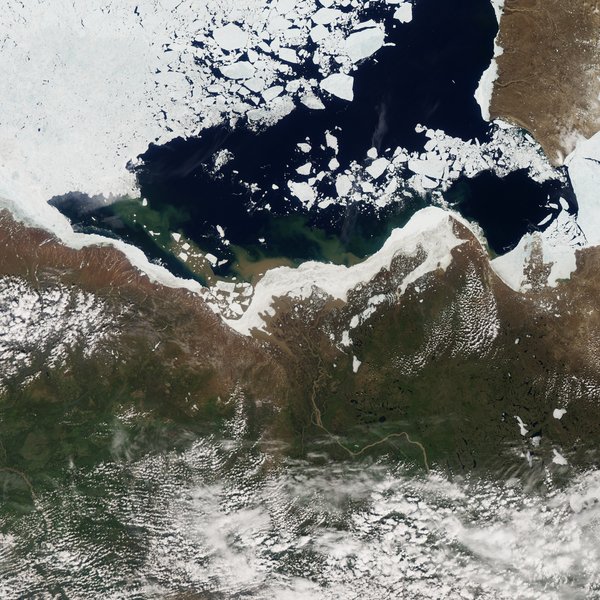 River discharge into the Arctic Ocean significantly affects salinity levels.
The Arctic Halocline
A key feature of the Arctic Ocean is the halocline, a layer where salinity increases sharply with depth, separating the fresher surface layer from the saltier waters below. This stratification plays a crucial role in maintaining the stability of the water column.
The halocline is maintained because the effect of salinity on density is greater than the effect of temperature. The surface layer gets freshwater from large Siberian and Canadian rivers like the Ob, Yenisei, Lena, and Mackenzie, which essentially floats on the denser, saltier water underneath.
Regional Variations in Salinity
Arctic Ocean salinity varies significantly by region, influenced by unique geographical and hydrological processes:
- Beaufort Sea: Located north of Alaska and Canada, this sea has relatively low salinity due to substantial freshwater input from the Mackenzie River.
- Chukchi Sea: While it receives freshwater from the Yukon and Kolyma rivers, its connection to the Bering Sea allows for water exchange with the Pacific Ocean, contributing to its salinity levels.
- Barents Sea: Located between Norway and Russia, this sea exhibits higher salinity levels due to the inflow of salty water from the North Atlantic Ocean.
Why Adding Salt Brine Is Not a Viable Solution
While the concept of adding salt brine might seem like a direct way to address the freshening of the Arctic Ocean, several factors make it impractical and potentially harmful.
Scale of the Problem
The sheer volume of freshwater entering the Arctic Ocean is immense. Rivers discharge approximately 3,300 cubic kilometers of freshwater into the Arctic Ocean annually, about 10% of the total volume of water that all the world's rivers transport to the oceans per year. The melting of sea ice also contributes significantly to this freshwater influx. Counteracting this with salt brine would require an unimaginable amount of salt, making it logistically infeasible.
Impact on Ocean Circulation
The density differences caused by salinity gradients drive major ocean currents. Adding large quantities of salt brine could disrupt these established patterns, with potentially unpredictable consequences for global climate. For example, increased freshwater in the Arctic Ocean has been linked to a potential weakening of the Gulf Stream. Introducing salt could counteract this freshening effect but might also destabilize other critical ocean processes.
Ecological Consequences
Arctic marine ecosystems are adapted to specific salinity ranges. A sudden and substantial increase in salinity could stress or even kill marine organisms, leading to cascading effects throughout the food web. Brine channels within sea ice, for example, are habitats for microscopic organisms. Radical changes to salinity could devastate these unique ecosystems.
The following table shows the impact of salinity concentration on the density and freezing point of seawater. The density and freezing point are directly proportional to the salinity of seawater:
| Salinity (PSU) | Freezing Point (°C) | Density (kg/m³) |
|---|---|---|
| 30 | -1.61 | 1024.0 |
| 32 | -1.72 | 1025.6 |
| 34 | -1.83 | 1027.2 |
| 35 | -1.89 | 1028.0 |
Brine Formation and its Role
When sea ice forms, it expels salt, creating brine. This brine increases the salinity and density of the surrounding water, causing it to sink. This process, known as brine rejection, is crucial for ocean circulation and deep water formation. Adding salt brine directly bypasses this natural process and may not replicate its effects accurately. The natural process of brine rejection plays a crucial role in ocean circulation, particularly in coastal polynyas, where it ventilates water masses in the Arctic and Antarctic.
 Brine pools, like this one in the Red Sea, are extreme environments with high salinity.
The Complex Role of Freshwater
While increased freshwater input is a concern, freshwater also plays a role in the Arctic ecosystem. Low-salinity inflow through the Bering Strait contributes to the strong stratification of the western Arctic, influencing nutrient distribution and sea ice cover. Changes in freshwater input can affect these processes, highlighting the need for a comprehensive understanding before attempting interventions.
Focus on Understanding and Mitigation
Instead of directly manipulating salinity, current scientific efforts focus on understanding the underlying causes of Arctic freshening and mitigating climate change, the primary driver of these changes. This includes:
-
Monitoring Salinity Changes: Using satellite measurements and in-situ observations to track changes in sea surface salinity and freshwater content.
-
Improving Climate Models: Refining climate models to more accurately predict future declines in Arctic surface salinity and their effects.
-
Studying Ecological Impacts: Investigating how changes in salinity affect marine ecosystems and identifying vulnerable species and habitats.
-
Reducing Greenhouse Gas Emissions: Addressing the root cause of climate change by reducing emissions of greenhouse gases.
This video from the National Science Foundation discusses the growing amount of fresh water in the Arctic Ocean and its potential impacts on the Earth's climate system. It underscores the importance of continued monitoring and research to understand these complex changes.
FAQ
What is brine rejection, and why is it important?
Brine rejection is the process where salt is expelled from sea ice as it freezes, increasing the salinity and density of the surrounding water. This process drives ocean circulation and the formation of deep water masses, playing a crucial role in the global climate system.
How does melting sea ice affect ocean salinity?
Melting sea ice adds freshwater to the ocean, reducing surface salinity. Since sea ice has a much lower salinity than seawater, its melting dilutes the surrounding waters, contributing to the overall freshening of the Arctic Ocean.
Why is the Arctic Ocean becoming fresher?
The Arctic Ocean is becoming fresher due to increased freshwater input from melting sea ice and glaciers, as well as changing precipitation patterns and river runoff. These factors are primarily driven by climate change and rising global temperatures.
What is the halocline, and why is it important in the Arctic Ocean?
The halocline is a layer in the ocean where salinity increases rapidly with depth. In the Arctic Ocean, the halocline separates the fresher surface layer from the saltier waters below, preventing mixing and maintaining a stable water column. This stratification affects heat distribution, sea ice formation, and nutrient availability.
References

Last updated April 13, 2025