
Exploring the Question of Divine Existence
Philosophical, Theological, and Experiential Perspectives on the Existence of God or Gods
Key Insights into the Question of God's Existence
- The existence of God is not definitively provable or disprovable through empirical or scientific methods alone. It remains a subject of ongoing debate in philosophy and theology.
- Numerous philosophical and theological arguments have been developed over centuries to support the belief in God's existence, including cosmological, teleological, ontological, and moral arguments.
- For many, belief in God is rooted in faith, personal experience, and revelation, rather than solely on rational or empirical evidence.
The question of whether God or gods exist is one of the most fundamental and enduring inquiries in human history. It sits at the intersection of philosophy, theology, and personal belief, prompting diverse perspectives and a rich tradition of argumentation. While empirical science typically deals with the observable and measurable world, the existence of a supreme, often non-physical, being is a concept that extends beyond its direct purview. This does not, however, mean that rational inquiry and forms of evidence are absent from the discussion.
Defining "God" and the Scope of the Question
Understanding the Concept of a Supreme Being
Before delving into arguments for and against divine existence, it's crucial to understand what is generally meant by "God" or "gods." In monotheistic traditions, God is typically conceived as a single, supreme being, the creator, sustainer, and ruler of the universe, often possessing attributes like omniscience (all-knowing), omnipotence (all-powerful), and omnibenevolence (morally perfect). In polytheistic systems, gods are spirits or beings believed to have created or control specific parts of the universe or life.
The debate about the existence of God involves disciplines like epistemology (the study of knowledge) and ontology (the study of being). It also touches upon the theory of value, as some definitions of God include the concept of perfection.
Philosophical Arguments for God's Existence
Tracing a Tradition of Rational Inquiry
The Western philosophical tradition of discussing the existence of God dates back to ancient thinkers like Plato and Aristotle. They proposed arguments for a being responsible for the universe's creation or motion, often categorized as cosmological arguments. Over the centuries, numerous philosophers and theologians have built upon these foundations, developing a variety of arguments.
The Cosmological Argument: The Uncaused Cause
The cosmological argument, in its various forms, posits that the existence of the universe requires an uncaused cause. One of the most famous proponents of this argument was Thomas Aquinas, who presented several "ways" to demonstrate God's existence. His first way, the argument from motion, suggests that everything in motion must be moved by something else, leading to the conclusion of a prime mover that is itself unmoved. Similarly, the argument from efficient cause posits that everything has a cause, and this chain of causes must ultimately lead back to a first efficient cause, which is God.
The Kalam cosmological argument, presented by Islamic philosophers like Al-Ghazali and Al-Kindi, and also discussed in contemporary philosophy, argues that everything that begins to exist has a cause. The universe began to exist; therefore, the universe has a cause, which is God. This argument often incorporates modern scientific findings about the beginning of the universe.
The Teleological Argument: Argument from Design
Also known as the argument from design, the teleological argument points to the perceived order, complexity, and purpose in the universe as evidence for an intelligent designer. The intricate workings of nature, the fine-tuning of physical constants, and the complexity of biological life are often cited as phenomena that are best explained by the existence of a conscious, intelligent creator.
While the argument from design has been influential, it also faces criticisms, particularly from those who argue that apparent design can be explained by natural processes like evolution and the laws of physics without resorting to a supernatural explanation.
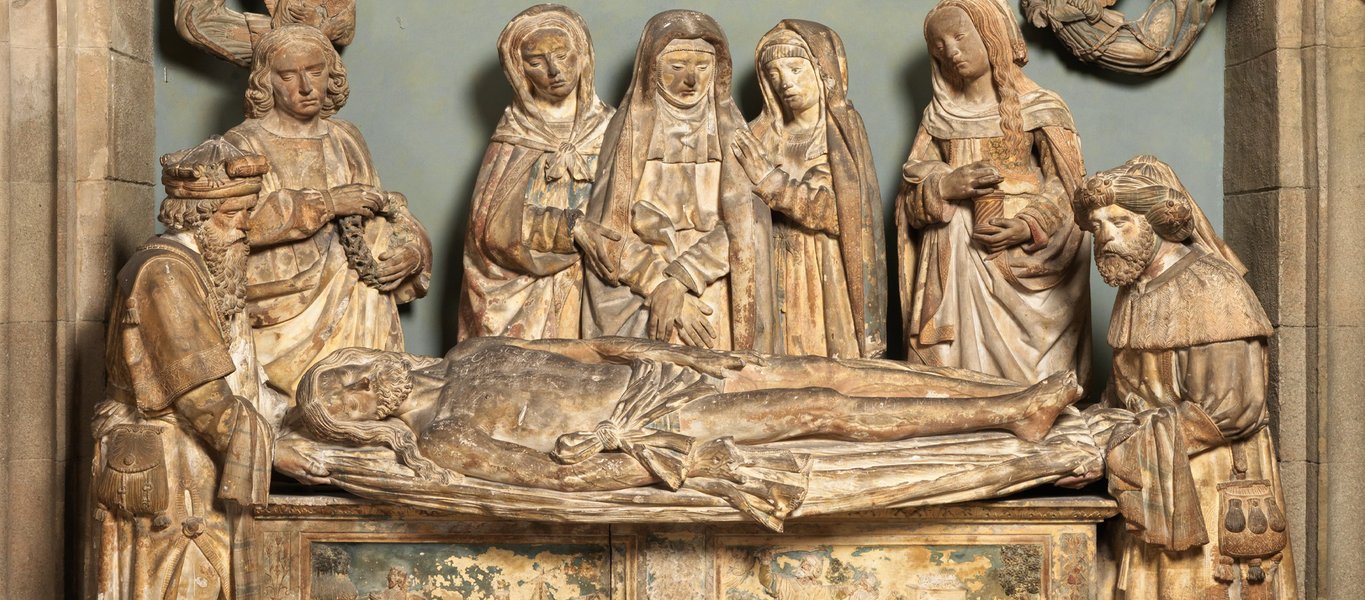
Religious art, such as these Renaissance statues, often reflects beliefs about the divine and its presence in the world.
The Ontological Argument: Existence from Conception
The ontological argument, famously formulated by Anselm of Canterbury and later refined by philosophers like René Descartes and Kurt Gödel, attempts to prove God's existence from the very definition of God. Anselm defined God as "that than which nothing greater can be conceived." The argument then proceeds to claim that if such a being exists only in the mind, a greater being—one that exists both in the mind and in reality—can be conceived. Therefore, to be the greatest conceivable being, God must exist in reality.
Kurt Gödel's ontological proof is a formal, mathematical argument that uses modal logic to argue for the existence of a necessary being with positive properties, which he identifies with God. While Gödel's logical framework has been analyzed and found to be formally correct by some, the argument's soundness depends on the truth of its initial axioms, which are subject to philosophical debate.
The Moral Argument: The Grounding of Morality
Moral arguments for the existence of God reason from some feature of morality to the existence of a divine being. One common form suggests that objective moral values and duties exist, and the best explanation for their existence is God. Without a divine lawgiver, some argue, morality would be purely subjective or a product of social convention.
This argument is based on the idea that certain actions are inherently right or wrong, regardless of human opinion. The existence of a universal moral code, conscience, and the human capacity for moral judgment are seen by proponents as pointers to a transcendent source of morality.
Arguments Against God's Existence
Addressing Challenges to Theistic Belief
Just as there are arguments for God's existence, there are also significant arguments against it. These often highlight perceived inconsistencies in the concept of God or point to phenomena in the world that seem incompatible with the idea of an all-powerful, all-knowing, and all-good deity.
The Problem of Evil
The problem of evil is arguably the most famous argument against the existence of the traditional monotheistic God. It questions how an omnipotent, omniscient, and omnibenevolent God can coexist with the presence of evil and suffering in the world. If God is all-powerful, God could prevent evil; if God is all-knowing, God knows about evil; and if God is all-good, God would want to prevent evil. The existence of evil, therefore, seems to contradict the existence of such a God.
Responses to the problem of evil, known as theodicies, attempt to reconcile God's attributes with the existence of evil. These often involve appealing to concepts like free will, the idea that suffering is necessary for soul-making, or that God's purposes are beyond human understanding.
Logical Inconsistencies
Some arguments against God's existence attempt to expose logical contradictions within the concept of God itself. For example, some question how divine omniscience can be compatible with human free will, or how an immutable (unchanging) God can interact with a changing world. These arguments scrutinize the coherence of the divine attributes as traditionally defined.
Lack of Empirical Evidence
A common stance for those who doubt or deny God's existence is the lack of empirical or scientific evidence. They argue that claims about a supernatural being should be supported by testable and observable evidence, which they contend is not available for God in the same way it is for phenomena in the natural world.
This video explores three common arguments for God's existence: creation, design, and morality.
Faith, Revelation, and Personal Experience
Beyond Rational Proofs
For many believers, the existence of God is not primarily a matter of philosophical proof or scientific evidence but of faith, personal experience, and revelation. Religious traditions often emphasize that knowledge of God is revealed through scriptures, prophets, or personal encounters.
Faith, in this context, is understood as a trust or commitment to beliefs that may not be demonstrable through reason or empirical evidence. Personal religious experiences, such as feelings of awe, transcendence, or a sense of divine presence, are also powerful factors in many individuals' belief in God.
Some philosophical perspectives, such as presuppositionalism, argue that the belief in God is a necessary precondition for the intelligibility of all human experience and knowledge. They suggest that the very act of making statements or judgments about reality inherently presupposes a theistic worldview.

Houses of worship serve as central points for communities of faith to express their beliefs and experience the sacred.
Comparing Arguments: A Visual Representation
Assessing the Perceived Strength of Different Arguments
The strength and persuasiveness of arguments for and against God's existence are often perceived differently by individuals based on their background, worldview, and criteria for evaluating claims. The following radar chart provides a subjective assessment of the perceived strength of various arguments across different dimensions, such as logical coherence, empirical relevance, and intuitive appeal.
This chart illustrates that different arguments are perceived to have varying strengths across different criteria. For example, while the ontological argument might be seen as having high logical coherence by some, its empirical relevance is often considered low. The problem of evil, on the other hand, has significant intuitive appeal and empirical relevance due to the undeniable reality of suffering in the world.
Summary of Major Arguments
A Concise Overview
To provide a clearer picture of the landscape of arguments regarding God's existence, the following table summarizes some of the major points and their associated concepts:
| Argument Type | Core Concept | Key Proponents | Related Concepts |
|---|---|---|---|
| Cosmological | The universe requires an uncaused first cause or prime mover. | Thomas Aquinas, Al-Kindi, Al-Ghazali | Contingency, necessity, infinite regress |
| Teleological | The order and complexity of the universe point to an intelligent designer. | William Paley (watchmaker analogy) | Fine-tuning, irreducible complexity, intelligent design |
| Ontological | God's existence can be deduced from the concept of God as the greatest possible being. | Anselm of Canterbury, René Descartes, Kurt Gödel | Necessity, possibility, definition of God |
| Moral | Objective moral values and duties are best explained by the existence of God. | Immanuel Kant (moral law), C.S. Lewis | Moral realism, conscience, divine command theory |
| Argument from Evil (Counterargument) | The existence of evil and suffering is incompatible with an all-powerful, all-knowing, all-good God. | Epicurus, David Hume | Theodicy, free will defense, natural evil |
The Role of Faith and Personal Belief
Confidence Versus Certainty
Many who believe in God acknowledge that definitive, irrefutable proof in a purely scientific or logical sense may not be possible. C.S. Lewis, for example, suggested that perhaps we should look for "pointers" that suggest belief in the supernatural is more reasonable than its rejection, rather than seeking absolute certainty. For many, a high level of confidence in God's existence is a more realistic expectation than absolute proof.
The Bible itself, according to some interpretations, assumes the existence of God as a foundational truth rather than attempting to prove it. The focus in scripture is often on understanding God's nature and character, and humanity's relationship with the divine, rather than debating God's existence.

Diverse religious traditions around the world reflect varied conceptions of the divine and paths to connecting with it.
Conclusion: A Question of Ongoing Exploration
The Nature of Belief and Knowledge
Ultimately, the question of whether God or gods exist remains a deeply personal and complex one. While philosophical arguments provide frameworks for rational consideration, and various traditions offer perspectives based on faith and revelation, there is no single, universally accepted "proof." The existence of God is not a matter that can be settled in the same way as a scientific hypothesis.
For some, the arguments for God's existence are compelling and provide sufficient rational grounds for belief. For others, the arguments against are more persuasive, or they find the concept of God unnecessary to explain the universe and human experience. Many occupy a position of agnosticism, believing that the existence or non-existence of God is unknown or unknowable.
The debate continues, enriching philosophical and theological discourse and prompting individuals to contemplate the fundamental nature of reality, morality, and existence itself.
Frequently Asked Questions
Recommended Exploration
- Explore the details of various philosophical arguments for God's existence.
- Understand the challenge of evil and philosophical responses to it.
- Investigate the intersection of scientific cosmology and religious perspectives on creation.
- Delve into the nature and significance of faith in religious belief.
References
Last updated May 20, 2025