

Understanding the subtle yet significant differences between "as" and "same" is crucial for mastering English grammar and achieving clarity in expression. While both words are involved in comparisons, their roles, implications, and grammatical structures are distinct. "Same" fundamentally denotes identity or exact likeness, typically functioning as an adjective, whereas "as" is a versatile word, acting as a conjunction, preposition, or adverb, often indicating similarity, equality in degree, or manner.
Key Insights into "As" and "Same"
- "Same" Implies Identity: When you use "same," you are asserting that two or more things are identical or exactly alike in a particular aspect. It nearly always appears with the definite article "the," forming the phrase "the same."
- "As" Conveys Comparison and Role: "As" is a highly flexible word used to express equality in degree (as...as), similarity, time, or role. It does not imply complete identicality on its own but rather a shared characteristic or function.
- "The Same As" is the Standard: For expressing identicality between items, the idiomatic and grammatically correct construction is "the same as." Mistakes like "as same as" are incorrect and should be avoided.
Deconstructing "Same": The Emblem of Identity
The word "same" is primarily an adjective or a pronoun that conveys the concept of exact likeness or identity. When used to compare objects or qualities, it signifies that there is no difference between the items being referred to. It's almost invariably preceded by the definite article "the," forming the common phrase "the same." This construction is fundamental when you want to highlight that two things are indistinguishable in some specified respect.
Grammatical Function and Usage of "Same"
- As an Adjective: "Same" functions as an adjective when placed before a noun, indicating that the noun is identical to another. For example, "They have the same phone," implies their phones are identical models.
- In Comparisons: When "same" is used to draw a comparison, it forms the crucial phrase "the same as." This structure is indispensable for asserting equality between two entities. Consider, "Your car is the same color as mine," which means the colors are identical.
- As a Pronoun: In informal contexts, "same" can sometimes function as a pronoun, as in "Same here," or "Same for me," which are ellipses of "the same thing here" or "the same thing for me."
It's crucial to note that the construction "as same as" is grammatically incorrect. The correct way to express identicality in a comparison is always with "the same as."
Exploring "As": The Conjunction of Comparison and Role
In contrast to "same," the word "as" is remarkably versatile and can function in several ways, primarily as a conjunction, preposition, or adverb. Its role often revolves around expressing similarity, equality in degree, time, or manner, rather than strict identity.
Diverse Functions and Applications of "As"
- As a Conjunction:
- Time: "As" can indicate simultaneous actions, similar to "when" or "while." Example: "As he was walking, he saw a bird."
- Reason/Cause: It can signify cause or reason, akin to "because." Example: "As it was raining, we stayed inside."
- Manner: It can describe how something is done. Example: "She spoke as a professional."
- As a Preposition: When used as a preposition, "as" often means "in the role of" or "in the capacity of." Example: "She works as a doctor."
- In Comparative Constructions ("as...as"): One of the most common uses of "as" is in the structure "as + adjective/adverb + as." This construction expresses equality in degree or quality between two things, without necessarily implying they are identical. For instance, "Your house is as big as my house" means both houses share the same size, but they are not the same house.
The phrase "as...as" implies equivalence in a particular attribute, such as "as heavy as," "as fast as," or "as good as."
The Interplay: "The Same As" vs. "As" (Alone)
The key to understanding when to use "the same as" versus "as" alone lies in the nuance of the comparison you intend to make:
- Use "the same as" for Identicality: This phrase is specifically used when you want to emphasize that two things are identical in some aspect. For example, "This book is the same as the one you recommended" means they are the exact same book or an identical copy.
- Use "as" for Similarity or Equality in Degree: When you use "as" in structures like "as...as," you are comparing a specific quality or characteristic, suggesting equivalence in degree rather than full identicality. For instance, "He runs as fast as a cheetah" compares his speed to a cheetah's, not suggesting he is literally a cheetah.
A common mistake to avoid is using "same than" or "same like." The correct and standard comparative form is "the same as."
This video explains the proper use of "same as" and "the same as" in both formal and informal English contexts, offering practical examples to enhance understanding.
Grammar in Action: A Comparative Table
To further clarify the distinctions, let's look at a comparative table highlighting the core aspects of "same" and "as" in their most common comparative uses.
| Aspect | "Same" (typically with "the") | "As" (in comparisons or roles) |
|---|---|---|
| Core Meaning | Identical, exactly alike, no difference | Equal in degree, similar in manner/role, at the same time |
| Grammatical Role | Adjective or Pronoun (e.g., "the same car," "Same here") | Conjunction, Preposition, Adverb (e.g., "as...as," "work as," "as he walked") |
| Common Phrases | "the same as," "the same [noun]" | "as...as," "as if," "as though," "as a result" |
| Implication in Comparison | Objects/qualities are indistinguishable; exact match | Objects share a comparable level/feature; equivalence in degree |
| Correct Example | "This book is the same as that one." | "He is as tall as his brother." |
| Incorrect Example | "This book is as same as that one." | "He is same tall as his brother." |
Visualizing Grammatical Distinctions
To further illustrate the nuanced differences and applications of "as" and "same," let's consider some visual representations. These charts and diagrams help to solidify understanding by presenting the concepts in a structured and easily digestible format.
The Semantic Web: "As" vs. "Same" Mindmap
This mindmap illustrates the various semantic relationships and common uses associated with "as" and "same," providing a structured overview of their distinct linguistic territories.
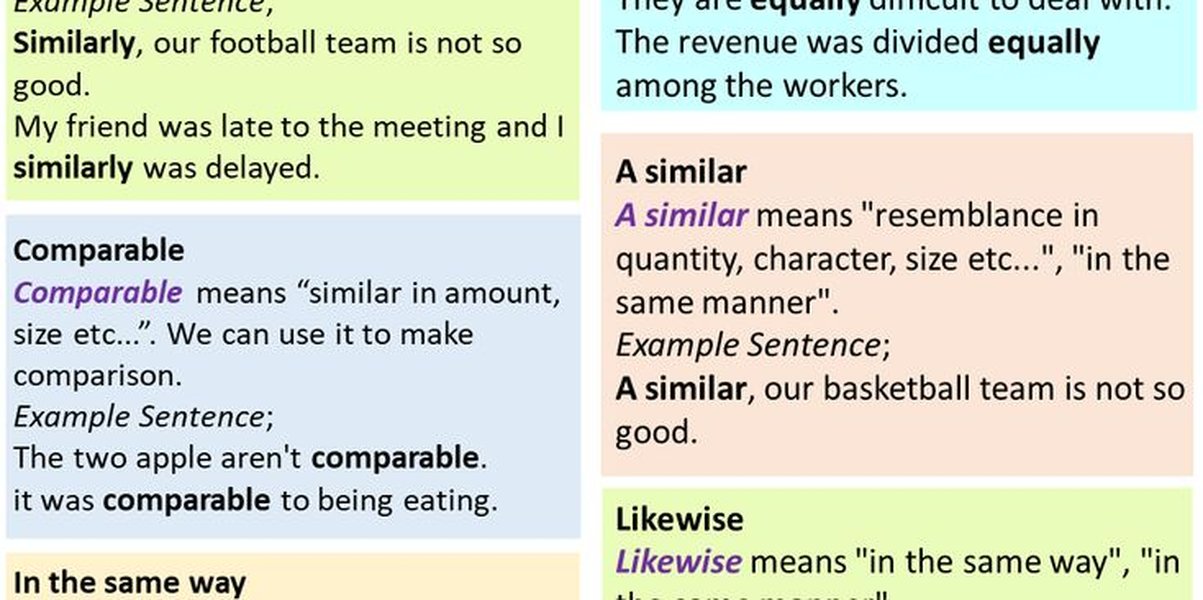
Visualizing comparison conjunctions, including "as" for expressing equality.
Frequently Asked Questions (FAQ)
What is the main difference between "as" and "same"?
Can I use "as same as"?
When should I use "the same as" versus "as...as"?
Does "as" always imply a comparison?
Is it ever correct to omit "the" before "same"?
Conclusion
The distinction between "as" and "same" is fundamental to precise English communication. "Same," consistently used with "the," serves to denote exact identity or identicalness. It asserts that two entities are indistinguishable in a given aspect. Conversely, "as" is a much more flexible term, encompassing roles as a conjunction, preposition, and adverb. Its primary function in comparison is to establish equality in degree or manner, often seen in the "as...as" construction, or to describe a role or concurrent action. Mastering these nuances allows for not only grammatical correctness but also a richer and more accurate conveyance of meaning.
Recommended Explorations
- How to distinguish between "like" and "as" in English grammar?
- Understanding comparative and superlative adjectives for deeper comparisons.
- What are the common grammatical errors to avoid when making comparisons?
- Exploring the multifaceted role of conjunctions in complex sentence structures.