
Taming Your Sloped Lawn: Exploring Automated Grass Cutting Solutions
Discover the best robotic, remote-controlled, and DIY options for effortlessly maintaining your 65x50m grassy incline.
Managing a sizable grassy area like your 65 by 50-meter plot (approximately 3,250 square meters or 0.8 acres) can be demanding, especially with a 15-degree slope (roughly a 27% grade). Fortunately, automating this task is achievable with modern technology. Whether you prefer a ready-made solution or leveraging your mechanical skills for a custom build, several options can effectively handle your specific terrain. This guide explores the possibilities to help you choose the best approach.
Highlights: Key Considerations for Your Sloped Lawn
- Slope Capability is Crucial: A 15-degree slope is moderate, but specialized features like All-Wheel Drive (AWD), tracked systems, or high-traction tires are essential for reliable performance and safety, especially in wet conditions.
- Area Coverage Matters: Ensure the chosen solution, whether a single unit or a DIY build, has the battery capacity and efficiency to cover your ~0.8-acre area effectively, potentially requiring multiple charging cycles.
- DIY Potential vs. Commercial Polish: Your mechanical skills open doors to custom-built or modified mowers, offering tailored solutions potentially at a lower cost, but commercial models provide proven reliability, advanced features, and safety certifications out of the box.
Commercial Automated Mowing Solutions
Several off-the-shelf solutions are designed to tackle slopes and sizable areas like yours. These generally fall into two categories: fully robotic mowers and remote-controlled units.
Robotic Lawn Mowers: Autonomous Slope Masters
Modern robotic lawn mowers have significantly advanced, with many models capable of handling moderate to steep slopes. For a 15-degree incline, numerous options exist.
Key Features for Sloped Terrains:
- Traction Systems: All-Wheel Drive (AWD) or Four-Wheel Drive (4WD) is highly recommended for slopes to prevent slipping and ensure consistent mowing. Some models use specialized high-traction wheels or even rubber tracks.
- Navigation Technology: Options include traditional boundary wires that define the mowing area or newer GPS/RTK and vision-based systems that offer wire-free operation and potentially more precise navigation.
- Slope Handling Ratings: Manufacturers specify maximum slope capabilities, often in degrees or percentage grade. A 15-degree slope (≈27% grade) is well within the range of many slope-focused models.
- Safety Features: Look for tilt sensors, lift sensors, collision detection, and rain sensors that pause operation in unsafe conditions.
- Battery and Coverage: Ensure the mower's battery life and specified area coverage match your 3250 sq meter needs. Most handle this size, often returning to base automatically to recharge before resuming.
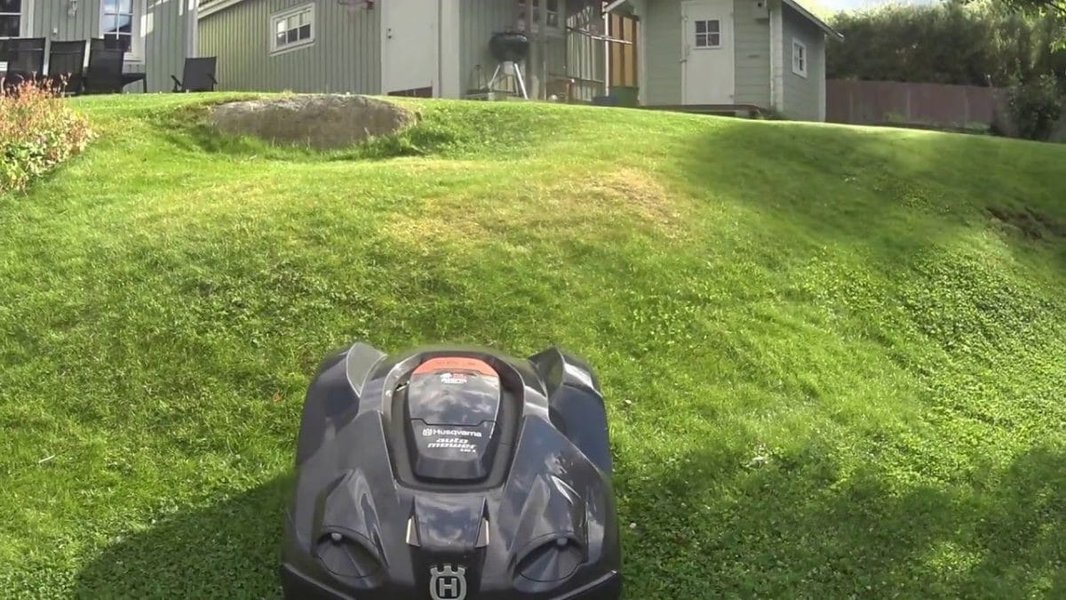
A Husqvarna Automower demonstrating its ability to navigate sloped terrain.
Recommended Robotic Models for Your Needs:
- Husqvarna Automower AWD Series (e.g., 435X AWD, 535 AWD): Renowned for exceptional slope performance (up to 35 degrees / 70% grade) thanks to their articulated bodies and AWD. They utilize GPS-assisted navigation and boundary wires. The 435X covers up to 0.8 acres, fitting your size requirement. Terrain kits can further enhance traction.
- Mammotion LUBA 2 AWD Series: Offers wire-free operation using GPS/RTK and can handle slopes up to 35-45 degrees (depending on the specific model). AWD provides excellent grip, and models cover areas from 0.25 up to 2.5 acres.
- ECOVACS GOAT G1 Series: Another wire-free option using vision and sensors, capable of handling slopes up to 24 degrees (45% grade). Suitable for moderately complex yards.
- Segway Navimow Series: GPS-based wire-free mowers that handle moderate slopes (e.g., i105N up to 17 degrees / 30% grade).
- Honda Miimo: Known for good balance, low center of gravity, and high-traction tires, capable of handling slopes up to 25 degrees (47% grade).
- MowRo & Redback Models: Often cited as capable options for slopes up to 30 degrees, suitable for mid-size yards.
Remote-Controlled Slope Mowers: Power and Precision
If you prefer more direct control or have particularly challenging spots, remote-controlled (RC) mowers designed for slopes are a viable alternative. These are often more robust and can handle taller grass or rougher conditions than typical robotic mowers.
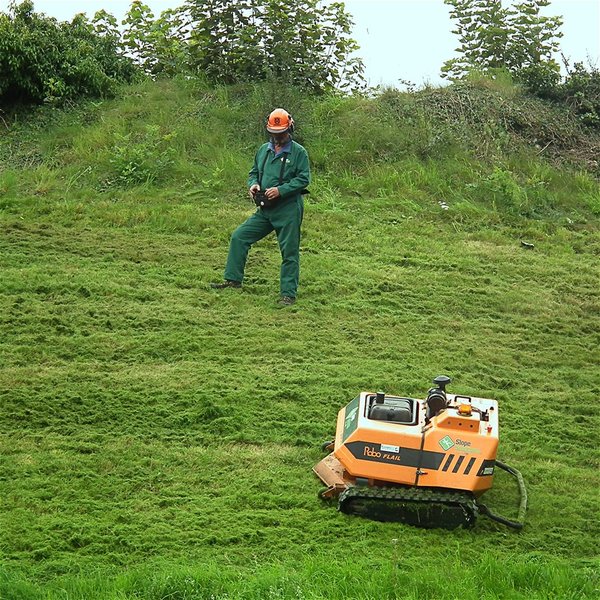
A remote-controlled mower designed specifically for safe operation on steep inclines.
Features and Considerations:
- Steep Slope Capability: Many RC mowers can handle slopes of 50 degrees or more, making your 15-degree incline trivial for them.
- Traction: Often utilize tracks or heavy-duty AWD systems for maximum stability and grip.
- Power Source: Typically battery-powered or sometimes gasoline engines for larger, more powerful units.
- Operation: Requires manual operation via remote control, offering precision but lacking full autonomy.
- Cutting Performance: Can often tackle taller, thicker grass than robotic mowers.
Notable RC Slope Mowers:
- Grator Lowrider: A battery-powered, tracked RC mower designed specifically for steep slopes (up to 70 degrees) and tall grass. Compact and agile.
- RC Mowers R Series: Known for handling slopes up to 50 degrees, suitable for rough terrain and offering good coverage width.
- Spider Mowers: High-end commercial machines capable of extreme slopes (up to 60 degrees), likely overkill but represent the top end of RC slope mowing capability.
- Tracked Remote Control Mowers (Various Brands): Several manufacturers offer tracked RC mowers with varying cutting widths and power, often equipped with cameras for remote visual operation.
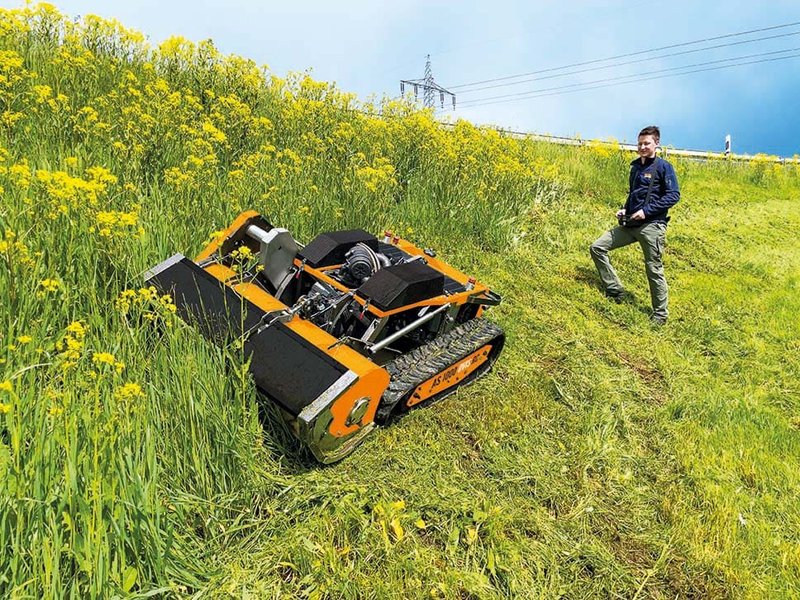
Example of a tracked remote-controlled mower designed for stability on slopes.
DIY Automated Mower: A Project for the Handy
Given your interest in mechanical projects, building or modifying a grass cutter is an exciting possibility. This allows for complete customization to your specific needs and terrain, potentially at a lower cost than high-end commercial units, though it requires significant time, effort, and technical expertise.
Key Considerations for a DIY Build:
- Platform Stability: Design a chassis with a low center of gravity and a wide wheelbase or track system to ensure stability on the 15-degree slope.
- Traction: Implement an effective drive system. All-wheel drive using individual wheel motors or a tracked system provides the best grip on inclines.
- Power Source: Battery power (e.g., Lithium-ion packs) is common for electric operation. Solar charging could be integrated for extended autonomy.
- Cutting Mechanism: Adapt a cutting deck from an existing mower or design a custom one. Ensure it's balanced and securely mounted.
- Control System: This is the most complex part. Options range from simple remote control (RC) to fully autonomous navigation using microcontrollers (like Arduino or Raspberry Pi) and sensors.
- RC Control: Simpler to implement, using standard RC transmitters and receivers.
- Autonomous Control: Requires GPS modules (potentially RTK for precision), Inertial Measurement Units (IMUs) to sense tilt, ultrasonic or LiDAR sensors for obstacle avoidance, and programming for path planning (e.g., using ArduPilot/ArduMower firmware).
- Safety Features: Essential for any automated machine. Include emergency stop buttons (physical and remote), blade disengagement mechanisms (e.g., if tilted or lifted), and robust obstacle detection/avoidance logic. Bumpers can provide physical protection.
Potential Approaches:
- Convert an Existing Mower: Modify a small electric or push mower by adding motors, controls, and sensors.
- Build from Scratch: Design and fabricate a custom chassis, integrating motors, cutting deck, batteries, and electronics.
- Leverage Open-Source Projects: Utilize resources and communities like ArduMower or custom builds shared online (e.g., on platforms like GitHub or DIY forums) for inspiration and guidance.
Building a custom solution requires careful planning regarding weight distribution, motor torque, power requirements, waterproofing, and long-term durability. Research papers on robotic mowers for inclined surfaces also offer insights into advanced concepts like stable propeller control or four-wheel steering for extreme angles, though likely not necessary for a 15-degree slope.
This video from Husqvarna discusses the capabilities of their Automower® series, including handling rain, steep slopes, and narrow passages, illustrating features relevant to your situation.
Comparing Your Automation Options
Choosing between commercial robotic, commercial remote-controlled, and DIY solutions depends on your priorities regarding budget, convenience, customization, time investment, and technical challenge.
Feature Comparison Radar Chart
This chart provides a visual comparison of the different approaches based on key factors. Scores are relative estimates (1=Low, 5=High) to illustrate general trade-offs:
Decision-Making Mindmap
This mindmap outlines the key decision points and factors to consider when choosing your automated grass cutting solution:
Proven Tech, Safety Features"] id2a2["Cons: Higher Cost,
Less Customizable"] id2a3["Examples: Husqvarna AWD,
Mammotion LUBA 2,
ECOVACS GOAT"] id2b["Commercial RC"] id2b1["Pros: Excellent Slope Control,
Handles Tougher Grass"] id2b2["Cons: Requires Manual Operation,
Not Fully Autonomous"] id2b3["Examples: Grator Lowrider,
RC Mowers"] id2c["DIY Project"] id2c1["Pros: High Customizability,
Potential Cost Savings,
Learning Experience"] id2c2["Cons: Time Consuming,
Technical Challenge,
Safety Responsibility"] id2c3["Approaches: Conversion,
Scratch Build, Open-Source"] id3["Key Technical Factors"] id3a["Traction (Critical!)"] id3a1["AWD / 4WD"] id3a2["Tracks"] id3a3["High-Grip Tires"] id3b["Navigation"] id3b1["Boundary Wire"] id3b2["GPS / RTK (Wire-Free)"] id3b3["Vision / Sensors"] id3c["Power System"] id3c1["Battery Capacity"] id3c2["Charging (Auto/Manual)"] id3c3["Solar Option (DIY)"] id3d["Safety Features"] id3d1["Sensors (Tilt, Lift, Collision)"] id3d2["Emergency Stop"] id3d3["Blade Control"]
Commercial Model Comparison Table
Here's a quick comparison of some recommended commercial models suitable for your lawn specifications:
| Model | Type | Max Slope | Max Area | Drive System | Navigation | Estimated Price Range |
|---|---|---|---|---|---|---|
| Husqvarna Automower 435X AWD | Robotic | 35° / 70% | 0.8 acres | AWD | GPS Assisted + Wire | $$$$ |
| Mammotion LUBA 2 AWD 3000 | Robotic | 38° / 80% | 0.75 acres | AWD | GPS/RTK (Wire-Free) | $$$ |
| ECOVACS GOAT G1 | Robotic | 24° / 45% | 0.4 acres (per unit setup) | 2WD | Vision + Sensors (Wire-Free) | $$$ |
| Grator Lowrider | RC | 70° / 170% | Suitable for 0.8 acres (runtime dependent) | Tracks | Remote Control | $$$$ |
| Honda Miimo HRM 310 | Robotic | 25° / 47% | 0.37 acres (multiple units possible) | 2WD (High Traction) | Wire | $$$ |
Note: Price ranges are estimates: $$ = Lower, $$$$ = Higher. Check specific retailers for current pricing. Area coverage can sometimes be extended with strategic placement or multiple units.
Frequently Asked Questions (FAQ)
Can robotic mowers handle wet grass on a slope?
While many robotic mowers are weather-resistant, mowing wet grass, especially on slopes, can increase the risk of slipping and may result in uneven cutting or clumping. Most models have rain sensors that automatically send the mower back to its charging station when it rains. It's generally recommended to let the grass dry before mowing on slopes. AWD or tracked models offer better traction in damp conditions compared to 2WD models.
How difficult is installing a boundary wire or setting up a wire-free system?
Installing a boundary wire involves laying a physical wire along the perimeter of your lawn and around obstacles. This can be time-consuming (several hours depending on complexity) but is a one-time setup. Wire-free systems using GPS/RTK or vision require setting up a charging station and possibly an RTK antenna, then mapping the lawn boundaries using a smartphone app, which is often quicker initially but relies on good satellite/signal reception.
What maintenance do automated mowers require?
Maintenance is generally low compared to traditional mowers. Regular tasks include cleaning the mower deck, checking/replacing cutting blades periodically (they are often small and inexpensive), and ensuring the charging station contacts are clean. Batteries have a limited lifespan (typically several years) and will eventually need replacement. DIY solutions will require maintenance based on the components used.
Are automated mowers safe for pets and children?
Commercial robotic mowers incorporate multiple safety features, including sensors that stop the blades immediately if the mower is lifted or tilted, and collision sensors that make it reverse and turn when encountering obstacles. However, it's always recommended to supervise children and pets when the mower is operating and keep the lawn clear of small objects. DIY solutions must have safety features carefully designed and implemented.
What are the biggest challenges in building a DIY slope mower?
Key challenges include ensuring sufficient traction and stability on the slope, developing a reliable navigation and control system (especially for full autonomy), waterproofing electronics, managing power effectively (battery life vs. weight), and implementing robust safety features. It requires a combination of mechanical, electrical, and programming skills.
Recommended Next Steps
- Compare Husqvarna AWD vs Mammotion LUBA 2 for slope performance.
- What is the cost analysis of building a DIY robotic mower versus buying a commercial model?
- Explore the best practices for installing robotic mowers on sloped lawns.
- Investigate essential safety features to include in a DIY automated lawn mower project.
References

Last updated May 4, 2025