
Unlock Your B2 French Potential: Essential Questions to Master Upper-Intermediate Fluency
Dive into a comprehensive guide of B2 level French questions designed to test and enhance your language proficiency.
Key Insights to B2 French Mastery
- Comprehensive Communication: B2 level French signifies the ability to understand complex texts, engage in spontaneous conversations, and articulate viewpoints on diverse topics.
- Structured Argumentation: A core skill at this level is presenting clear, well-supported arguments and discussing advantages and disadvantages of various options.
- Exam Relevance: The questions provided mirror the challenges found in official B2 assessments like the DELF B2, covering all essential language skills.
Achieving a B2 level in French, as defined by the Common European Framework of Reference for Languages (CEFR), means you can communicate with a degree of fluency and spontaneity that makes regular interaction with native speakers quite possible without strain for either party. You can understand the main ideas of complex text on both concrete and abstract topics, including technical discussions in your field of specialization. This level also requires you to produce clear, detailed text on a wide range of subjects and explain a viewpoint on a topical issue giving the advantages and disadvantages of various options. The following sections provide a variety of B2-level questions to help you practice and assess your skills.
Sharpen Your Speaking Skills (Production Orale)
Engage, Express, and Debate with Confidence
The B2 speaking component, often part of exams like the DELF B2, typically involves a prepared monologue on a given topic and an interactive discussion or debate with an examiner. You'll need to present your ideas clearly, support your opinions with examples, and engage effectively in conversation. Preparation time (usually around 30 minutes) is given for the monologue.
Followed Monologue (Monologue Suivi) Prompts
You will usually choose one of two topics. Here are some examples reflecting common themes:
- "Pensez-vous que les nouvelles technologies améliorent réellement la communication entre les individus ? Présentez votre point de vue argumenté."
- "Le télétravail est de plus en plus répandu. Quels sont, selon vous, les avantages et les inconvénients de ce mode de travail pour les employés et les entreprises ?"
- "L'importance de la protection de l'environnement est un sujet brûlant. Quelles actions individuelles et collectives jugez-vous les plus efficaces pour préserver notre planète ?"
- "Faut-il rendre le vote obligatoire ? Exposez les arguments pour et contre cette mesure."
Interactive Exercise (Exercice en Interaction) Scenarios
This part often builds upon your monologue topic or introduces a related scenario where you need to discuss, negotiate, or defend a point of view with the examiner.
- "Votre voisin se plaint du bruit que vous faites. Vous essayez de trouver une solution à l'amiable. Discutez de la situation et proposez des compromis."
- "Vous participez à une réunion d'association pour organiser un événement caritatif. Discutez des propositions et défendez vos idées pour la collecte de fonds."
- "Débat : L'intelligence artificielle est-elle une menace ou une opportunité pour l'avenir du travail ? Argumentez votre position."
General Thematic Questions for Discussion
These questions can appear in various contexts and are good for practicing sustained speech:
- Personal Background and Experiences:
- "Parlez-moi de votre parcours professionnel et de vos ambitions futures."
- "Décrivez une expérience qui a changé votre façon de voir le monde."
- Daily Life and Routine:
- "Quels sont les avantages et les inconvénients de vivre en ville par rapport à la campagne ?"
- "Comment conciliez-vous vie professionnelle et vie personnelle ?"
- Education and Learning:
- "Selon vous, quelle est l’importance des langues étrangères dans le monde professionnel aujourd’hui ?"
- "Quels sont les avantages et les inconvénients de l’enseignement en ligne ?"
- Society and Environment:
- "Quels sont les défis majeurs que votre société doit relever aujourd’hui ?"
- "Que faut-il faire pour préserver l’environnement ?"
- Culture and Traditions:
- "Comment la culture influence-t-elle notre façon de penser et d’agir ?"
- "Que pensez-vous de la mondialisation culturelle ?"
- Technology and Innovation:
- "Quels sont les avantages et les inconvénients des réseaux sociaux ?"
- "Comment la technologie a-t-elle changé notre façon de travailler ?"
- Health and Well-being:
- "Que faites-vous pour rester en bonne santé ?"
- "Quelle est l’importance du sport dans la vie des jeunes ?"
- Current Affairs and Global Issues:
- "Que pensez-vous de l’actualité politique de votre pays ou d’un autre pays francophone ?"
- "Quel est l’impact des migrations sur les sociétés d’accueil ?"
Practice Tip: Record yourself answering these questions. Focus on structuring your response with an introduction, developed arguments with examples, and a conclusion. Use varied vocabulary and complex sentence structures.
Crafting Compelling Texts (Production Écrite)
Express Your Views with Clarity and Structure
B2 writing tasks assess your ability to produce clear, well-structured texts such as formal or informal letters, essays, or critical reviews. You need to demonstrate a good command of grammar, vocabulary, and appropriate style for the given context.
Example Writing Prompts
- Formal Letter: "Vous avez lu un article dans un journal local critiquant le manque d'initiatives écologiques dans votre ville. Écrivez une lettre au rédacteur en chef pour exprimer votre accord ou désaccord, en argumentant votre position et en proposant des solutions concrètes. (environ 250 mots)"
- Essay/Contribution to a Forum: "De plus en plus de jeunes souhaitent créer leur propre entreprise plutôt que de chercher un emploi salarié. Selon vous, quelles sont les motivations derrière cette tendance et quels défis cela représente-t-il ? Rédigez un texte argumentatif pour un forum de discussion. (environ 250 mots)"
- Review/Report: "Vous avez assisté à un festival culturel (cinéma, musique, etc.). Écrivez un compte-rendu critique pour le journal de votre université, en décrivant l'événement et en donnant votre avis argumenté sur sa qualité et son intérêt. (environ 250 mots)"
Practice Tip: Pay attention to discourse markers (e.g., en effet, par conséquent, néanmoins, d'une part... d'autre part) to connect your ideas logically. Review different text formats (letters, essays) and their conventions.
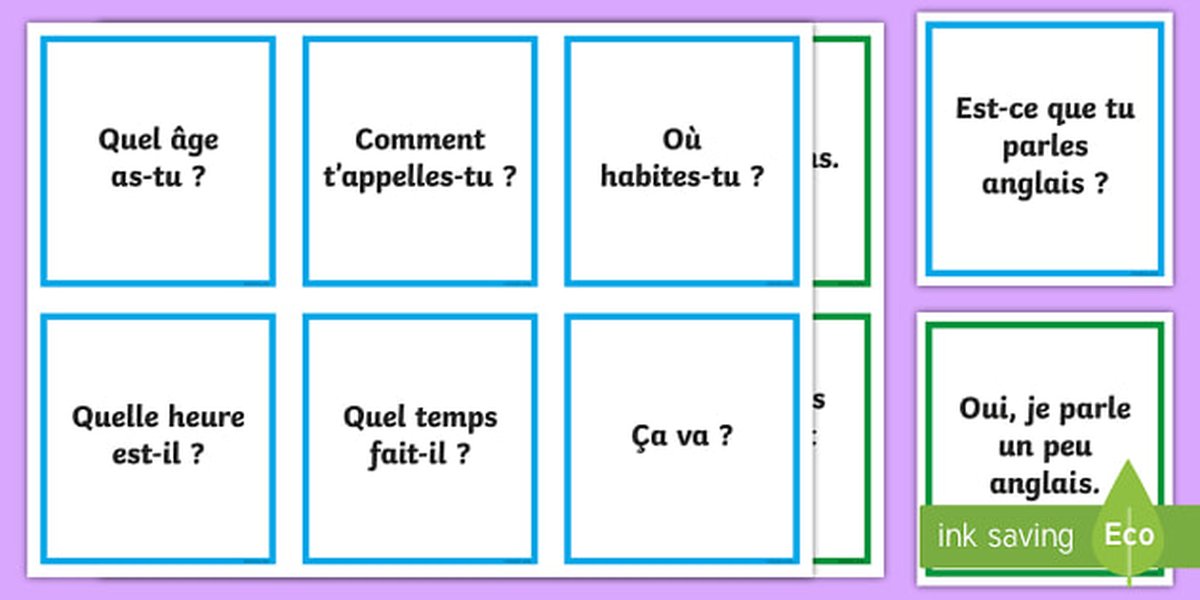
Visual aid depicting French question and answer cards, illustrating the learning process.
Understanding Written French (Compréhension Écrite)
Navigating Complex Texts and Extracting Meaning
At the B2 level, you are expected to understand the main ideas and supporting details of complex texts from various sources, including articles, reports, and literary excerpts. Questions will test your ability to identify facts, opinions, implications, and the author's tone.
Example Reading Comprehension Questions
After reading an article on a societal issue (e.g., urban development, education reform):
- Multiple Choice: "Selon l'auteur, quelle est la conséquence principale de [phénomène décrit dans le texte] ? a)... b)... c)... d)..."
- True/False with Justification: "L'affirmation suivante est-elle vraie ou fausse ? Justifiez votre réponse en citant une phrase ou une expression du texte."
- Short Answer: "Quel est le principal argument avancé par l'auteur pour soutenir sa thèse concernant [sujet du texte] ?"
- Identifying Purpose/Tone: "Quel est l'objectif principal de ce texte ? a) Informer b) Convaincre c) Divertir d) Critiquer"
Practice Tip: Regularly read French newspapers (e.g., Le Monde, Libération), magazines, and online articles on diverse topics. Focus on identifying the main argument, supporting points, and any nuanced opinions.
Mastering Spoken French (Compréhension Orale)
Decoding Speech in Various Contexts
B2 listening comprehension involves understanding extended speech and lectures, and following complex lines of argument provided the topic is reasonably familiar. You should also be able to understand most TV news, current affairs programs, and films in standard dialect.
Example Listening Comprehension Questions
After listening to an audio document (e.g., radio interview, news report, debate):
- Multiple Choice: "Quel est le sujet principal de cette discussion ? a)... b)... c)..."
- Identifying Speaker's Opinion: "Quelle est l'opinion de l'intervenant X concernant [aspect du sujet] ?"
- Note-Taking/Short Answer: "Relevez deux propositions faites par l'expert pour résoudre le problème de [problème discuté]."
- Information Recall: "Selon l'enregistrement, quand l'événement [mentionné] aura-t-il lieu ?"
Practice Tip: Listen to French radio (e.g., France Inter, RFI), podcasts, and watch French TV shows or news broadcasts. Try to summarize the main points and opinions expressed. Don't be afraid to listen multiple times, focusing on different aspects each time.
Refining Vocabulary and Expressions
Enriching Your Lexicon for Nuanced Communication
A rich vocabulary and a good grasp of idiomatic expressions are crucial at the B2 level to understand nuances and express yourself precisely.
Vocabulary and Idiom Questions
- "Que signifie l'expression « avoir un poil dans la main » ?
A) Être très travailleur
B) Être paresseux
C) Avoir froid aux mains"
(Réponse attendue : B) - "Expliquez ce que veut dire l'expression « mettre son grain de sel »."
(Réponse attendue : intervenir dans une conversation, souvent sans y être invité, pour donner son avis.) - "Choisissez le synonyme le plus approprié pour le mot « éminent » dans la phrase : 'C'est un scientifique éminent.'
A) Inconnu
B) Remarquable
C) Ordinaire"
(Réponse attendue : B) - "Que signifie l'expression « prendre les devants » dans un contexte professionnel ?"
A) Arriver en retard
B) Anticiper, agir avant les autres
C) Suivre les instructions à la lettre"
(Réponse attendue : B)
Practice Tip: Read widely and note down new expressions. Try to use them in your own speaking and writing. Flashcards can be helpful for memorization.
Strengthening Your Grammar
Ensuring Accuracy and Complexity in Your Structures
Solid grammatical knowledge is the backbone of clear communication. B2 level requires mastery of complex sentence structures, tenses (including the subjunctive), and agreement rules.
Grammar Questions
- Subjunctive Mood: "Complétez la phrase avec la forme correcte du verbe entre parenthèses au subjonctif présent : Il faut que nous (faire) ____________ attention."
(Réponse attendue : fassions) - Conditional Tenses: "Transformez cette phrase en utilisant le conditionnel passé : Si j'avais eu plus de temps, je (visiter) ____________ le musée."
(Réponse attendue : aurais visité) - Passive Voice: "Mettez la phrase suivante à la voix passive : Le gouvernement a annoncé de nouvelles mesures."
(Réponse attendue : De nouvelles mesures ont été annoncées par le gouvernement.) - Pronouns: "Remplacez les mots soulignés par les pronoms qui conviennent : J'ai donné les documents à mon collègue."
(Réponse attendue : Je les lui ai donnés.) - Conjunctions: "Complétez avec la bonne conjonction : « Je resterai ici __ tu reviennes. » (Options : parce que, bien que, jusqu’à ce que)"
(Réponse attendue : jusqu’à ce que)
Practice Tip: Review grammar rules regularly and do targeted exercises. Pay attention to common mistakes and seek feedback on your written work.
Visualizing B2 French Competencies
A Radar Chart Perspective on Key Skills
To succeed at the B2 level, a balanced development across various linguistic competencies is essential. The radar chart below illustrates the relative importance and typical focus areas for learners aiming for B2 proficiency. While all areas are important, some, like argumentation and nuanced vocabulary, become particularly critical at this upper-intermediate stage.
This chart visually represents how different skills contribute to overall B2 proficiency. For example, "Argumentation Skills" and "Vocabulary Range & Idioms" are rated highly in importance, reflecting the need for nuanced and persuasive communication at this level. "Typical Learner Focus" suggests areas where students often concentrate their efforts, which may or may not align perfectly with all key requirements, highlighting potential areas for adjustment in study plans.
Mapping Your Journey to B2 French
A Mindmap of Core Components
The journey to B2 French proficiency involves mastering several interconnected areas. This mindmap provides a visual overview of the core skills, foundational knowledge, application contexts, and assessment methods typically associated with the B2 level. Understanding these components can help structure your learning approach.
This mindmap highlights that B2 proficiency is not just about individual skills but also how they integrate. For instance, "Foundational Knowledge" in grammar and vocabulary directly supports all "Core Skills" and their "Application" in real-world communication and formal assessments.
Common Themes in B2 French Productive Tasks
A Table of Typical Speaking and Writing Topics
B2 level productive tasks (speaking and writing) often revolve around current societal issues, personal experiences, and cultural topics. This table outlines some common themes you might encounter, the types of questions or tasks associated with them, and the key skills being assessed. Familiarity with these themes can significantly aid in preparation.
| Theme | Example Question/Task Type | Key Skills Tested |
|---|---|---|
| Technology & Society | Discuss the impact of social media on youth. Write an essay on the pros and cons of artificial intelligence. | Argumentation, expressing opinions, vocabulary related to technology, structuring ideas. |
| Environment & Sustainability | Present solutions to reduce plastic pollution. Write a letter to the mayor about local environmental initiatives. | Problem-solving, proposing solutions, vocabulary related to ecology, formal/informal register. |
| Work & Career | Debate the future of work (e.g., remote work, automation). Describe your ideal job and career path. | Expressing preferences, speculating about the future, professional vocabulary, negotiation. |
| Education & Learning | Discuss the effectiveness of online learning. Propose changes to the education system in your country. | Critical thinking, comparing systems, vocabulary related to education, presenting arguments. |
| Culture & Travel | Share a significant travel experience and its impact on you. Discuss the importance of preserving cultural heritage. | Narrative skills, descriptive language, expressing emotions, intercultural awareness. |
| Social Issues & Current Events | Discuss a current news topic and its implications. Express your views on social inequalities. | Understanding current affairs, expressing informed opinions, using persuasive language. |
This table serves as a quick reference for the types of subjects you should be prepared to discuss and write about. Practicing with these themes will build your confidence and repertoire of ideas and vocabulary.
Expert Tips for DELF B2 Preparation
Insights on Passing the Exam
Preparing for a B2 level French exam like the DELF B2 requires a strategic approach. The video below offers valuable tips and insights from someone who has successfully navigated the exam, covering aspects of preparation, what to expect, and common pitfalls to avoid. Understanding the exam structure and examiner expectations is key to success.
The video emphasizes the importance of familiarizing yourself with all four sections of the exam (Listening, Reading, Writing, and Speaking), practicing with sample papers, and actively working on expanding vocabulary and mastering complex grammatical structures. Time management during the exam is also a critical skill highlighted.
Frequently Asked Questions (FAQ)
What is the main difference between B1 and B2 French?
The main difference lies in the complexity of language understood and produced, as well as the degree of fluency and spontaneity. B1 level (Threshold) learners can understand the main points of clear standard input on familiar matters and can deal with most situations likely to arise whilst travelling. They can produce simple connected text on topics which are familiar or of personal interest.
B2 level (Vantage) learners, on the other hand, can understand the main ideas of complex text on both concrete and abstract topics, including technical discussions. They can interact with a degree of fluency and spontaneity that makes regular interaction with native speakers quite possible without strain. They can produce clear, detailed text on a wide range of subjects and explain a viewpoint on a topical issue, giving the advantages and disadvantages of various options. Essentially, B2 requires more nuanced understanding, more sophisticated expression, and greater independence in communication.
How long does it typically take to reach B2 French?
The time it takes to reach B2 level in French varies greatly depending on several factors, including the learner's native language, previous language learning experience, intensity of study, quality of instruction, and opportunities for immersion. According to the Alliance Française, it can take approximately 600-650 cumulative hours of study to reach B2 from a beginner level. If you are already at B1, it might take an additional 200-250 hours of dedicated study. This is just an estimate, and individual progress can be faster or slower.
What are the best resources for practicing B2 French questions?
Several resources are excellent for practicing B2 French questions:
- Official DELF B2 Sample Papers: These are provided by France Education international (formerly CIEP) and are the most authentic practice materials.
- Textbooks for B2 Level: Books like "Réussir le DELF B2," "Alter Ego + 4," or "Edito B2" offer structured lessons and practice exercises.
- Online Platforms: Websites like TV5Monde Apprendre, RFI Savoirs (Exercices), Kwiziq, and various YouTube channels dedicated to French learning offer B2 level content and exercises.
- Language Exchange Partners or Tutors: Practicing speaking with native speakers or qualified tutors is invaluable for the oral production part.
- French Media: Regularly engaging with French newspapers, radio, podcasts, and TV shows helps improve comprehension and vocabulary in context.
Are idiomatic expressions very important for the B2 level?
Yes, understanding and appropriately using idiomatic expressions become increasingly important at the B2 level. While you don't need to know every idiom, incorporating some common ones into your speaking and writing can demonstrate a higher level of fluency and a more natural command of the language. It also helps in understanding native speakers, as idioms are frequently used in everyday conversation and media. Examiners often look for the ability to use language flexibly and effectively for social, academic, and professional purposes, which includes understanding and using some idiomatic language.
Recommended Next Steps
Explore Further to Deepen Your Understanding
- How can I improve my French argumentation skills for B2 level?
- What are common mistakes to avoid in the DELF B2 writing section?
- Can you list essential French vocabulary and idioms for B2 proficiency?
- What are effective strategies for DELF B2 listening comprehension practice?
References
Sources and Further Reading
Last updated May 19, 2025