
Charting Your Course: From Backend Engineer to AI Architect Mastery
A comprehensive, practical roadmap to leverage your software engineering prowess and ascend to an experienced AI Architect role.
Key Highlights for Your Transformation
- Leverage Your Strong Foundation: Your existing expertise as a staff backend software engineer in system design, API development, scalability, and deployment pipelines provides an invaluable springboard into the world of AI architecture.
- Master AI-Specific System Design: The core of your transition will be learning to design and implement end-to-end AI solutions, encompassing data ingestion and processing, model training and deployment (MLOps), and seamless integration with cloud platforms and existing enterprise systems.
- Embrace Continuous, Diverse Learning: Success hinges on a blend of theoretical knowledge, intensive hands-on project experience to build a robust portfolio, and an unwavering commitment to staying abreast of the rapidly evolving AI landscape.
Embarking on the journey from a staff backend software engineer to an experienced AI Architect is a challenging yet incredibly rewarding endeavor. Your current skill set in building robust and scalable backend systems gives you a significant advantage. This practical learning path is designed to build upon that foundation, guiding you through the necessary steps to acquire specialized AI knowledge and architectural expertise.
Phase 1: Fortifying Your AI & ML Foundations
This initial phase focuses on building a solid understanding of the fundamental concepts that underpin artificial intelligence and machine learning. Your analytical skills from backend development will be highly transferable here.
Core AI and Machine Learning Principles
Understanding the Building Blocks
Begin by diving deep into core AI concepts. This includes a thorough understanding of:
- Machine Learning (ML) Algorithms: Study supervised learning (e.g., regression, classification), unsupervised learning (e.g., clustering, dimensionality reduction), and reinforcement learning. Understand their use cases, strengths, and limitations.
- Deep Learning (DL): Explore neural networks, including Convolutional Neural Networks (CNNs) for image processing and Recurrent Neural Networks (RNNs) for sequential data. Grasp concepts like activation functions, backpropagation, and optimization algorithms.
- Natural Language Processing (NLP): Learn about techniques for text analysis, sentiment analysis, machine translation, and language modeling. Familiarize yourself with concepts like tokenization, embeddings (e.g., Word2Vec, BERT), and transformer models.
- Computer Vision (CV): Gain an understanding of how machines "see" and interpret images and videos, including object detection, image segmentation, and facial recognition.
Essential Mathematical Grounding
The Language of Data
A strong grasp of certain mathematical concepts is crucial for understanding and innovating in AI:
- Linear Algebra: Essential for understanding how data is represented (vectors, matrices) and how algorithms like neural networks operate.
- Probability and Statistics: Fundamental for data analysis, hypothesis testing, understanding model performance metrics, and working with probabilistic models.
- Calculus: Important for understanding optimization algorithms used in training machine learning models (e.g., gradient descent).
Key Programming Languages and Frameworks
Tools of the Trade
Your programming skills are a major asset. Focus on mastering tools prevalent in the AI domain:
- Python: The de facto language for AI/ML due to its extensive libraries and frameworks. Deepen your Python skills, particularly with libraries like NumPy (for numerical operations), Pandas (for data manipulation), and Matplotlib/Seaborn (for data visualization).
- AI/ML Frameworks: Gain hands-on experience with major frameworks such as TensorFlow, PyTorch, and scikit-learn. Understand how to build, train, and evaluate models using these tools.
Phase 2: Mastering AI System Design and Architecture
This phase is where your backend engineering experience truly begins to merge with AI. You'll learn to design robust, scalable, and maintainable AI systems.
Principles of AI System Architecture
Blueprint for Intelligent Systems
An AI Architect's primary role is to design the overarching structure of AI solutions. This involves:
- Understanding AI System Components: Learn about the different parts of an AI system, including data ingestion, preprocessing, feature engineering, model training, model serving, inference engines, and monitoring components.
- Scalability and Reliability: Apply your backend knowledge of designing for scale and fault tolerance to AI workloads, which often involve large datasets and computationally intensive processes. Consider patterns like microservices for deploying AI components.
- Integration with Enterprise Systems: Design AI solutions that can be seamlessly integrated with existing business applications, databases, and legacy systems. This often involves designing APIs for AI model consumption.
- Real-time vs. Batch Processing: Understand the architectural implications of different processing requirements for AI applications (e.g., real-time fraud detection vs. batch recommendation generation).
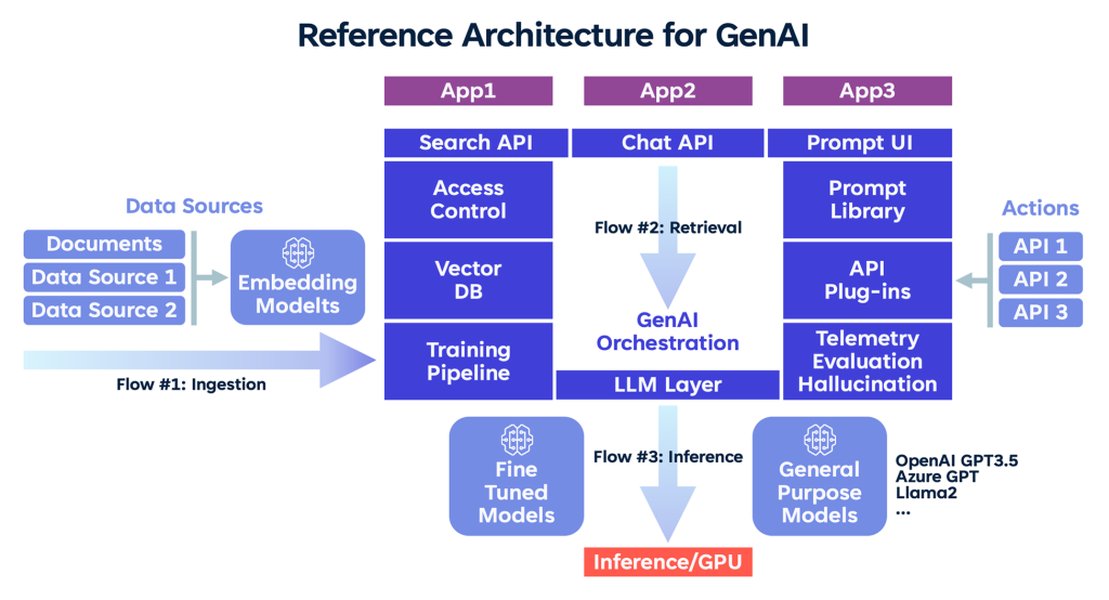
An example of a Generative AI Reference Architecture, showcasing key components and interactions.
Data Engineering for AI
Fueling AI Models with Quality Data
AI systems are heavily reliant on high-quality data. As an AI Architect, you'll need to design effective data strategies:
- Data Pipelines: Design and oversee the creation of robust data pipelines for collecting, cleaning, transforming (ETL/ELT), and storing data from various sources. Your experience with backend data management will be crucial.
- Data Governance and Quality: Understand principles of data governance, data security, privacy (e.g., GDPR, CCPA), and ensuring data quality for model training and inference.
- Feature Stores: Learn about feature stores for managing and serving machine learning features consistently across training and serving environments.
Understanding MLOps (Machine Learning Operations)
Streamlining the AI Lifecycle
MLOps applies DevOps principles to machine learning workflows. This is critical for operationalizing AI models effectively:
- CI/CD for ML: Implement continuous integration, continuous delivery, and continuous training pipelines for ML models. This includes automating model testing, validation, and deployment.
- Model Versioning and Management: Learn tools and practices for versioning datasets, code, and models to ensure reproducibility and traceability.
- Model Monitoring: Design systems for monitoring model performance in production, detecting data drift, model drift, and concept drift, and triggering retraining or alerts when necessary.
- Infrastructure as Code (IaC): Apply IaC principles to manage and provision the infrastructure required for AI workloads.
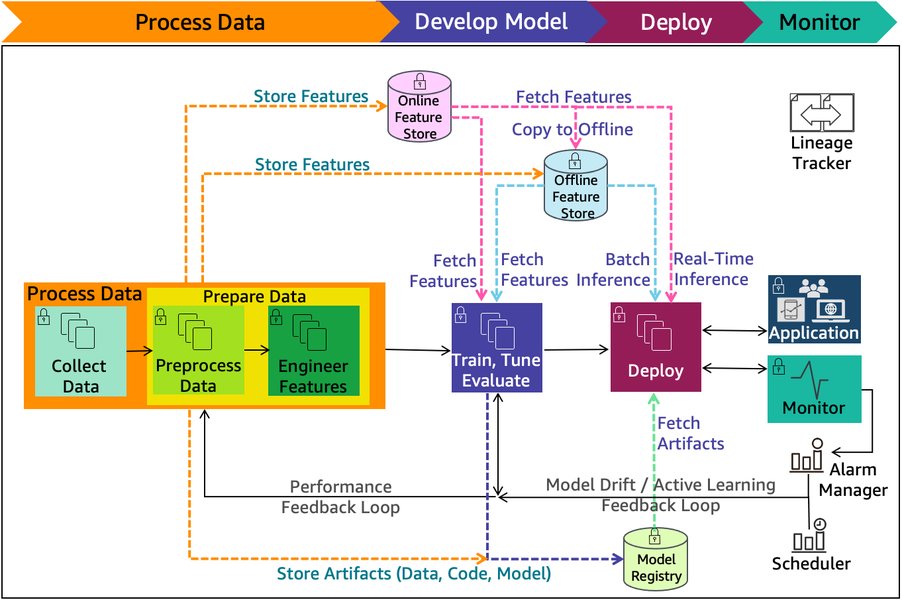
Visualizing the comprehensive Machine Learning Lifecycle, from data processing to model deployment and monitoring.
Phase 3: Deep Dive into Cloud Platforms and Big Data Technologies
Modern AI solutions are often built and deployed on cloud platforms, leveraging their scalability and specialized services. Familiarity with big data technologies is also essential.
Proficiency in Cloud AI Services
Leveraging Managed AI Infrastructure
Gain expertise in the AI/ML offerings of major cloud providers:
- AWS: Amazon SageMaker, AWS Lambda for serverless functions, S3 for storage, EC2 for compute, and various AI services (e.g., Rekognition, Comprehend).
- Google Cloud Platform (GCP): Vertex AI, Google Kubernetes Engine (GKE), BigQuery for data warehousing, and specialized AI APIs.
- Microsoft Azure: Azure Machine Learning, Azure Kubernetes Service (AKS), Azure Blob Storage, and Cognitive Services.
Working with Big Data Tools
Handling Data at Scale
Many AI applications involve processing vast amounts of data. Familiarize yourself with:
- Apache Spark: A powerful open-source framework for distributed data processing and machine learning.
- Apache Hadoop: An ecosystem for distributed storage (HDFS) and processing (MapReduce) of large datasets.
- Data Warehousing Solutions: Technologies like Snowflake, Amazon Redshift, or Google BigQuery for storing and querying large analytical datasets.
- Stream Processing: Tools like Apache Kafka, Apache Flink, or cloud-native services for real-time data ingestion and analysis.
- Containerization and Orchestration: Master Docker for containerizing applications and Kubernetes for orchestrating containerized AI workloads, ensuring scalability and portability.
Skill Development Focus Radar
The journey to becoming an AI Architect involves developing a diverse set of skills. The radar chart below illustrates a suggested focus distribution for key skill domains during your initial learning phase and as you progress towards advanced expertise. This is a conceptual guide; your actual focus may vary based on your projects and specific career goals.
Phase 4: Gaining Practical Experience and Building Your Portfolio
Theoretical knowledge is essential, but practical application is what truly solidifies your skills and demonstrates your capabilities as an AI Architect.
Engaging in Hands-On AI Projects
From Theory to Reality
Actively seek opportunities to work on diverse AI projects:
- Personal Projects: Start with smaller, manageable projects like building a classification model, a simple recommendation system, or an NLP-based text summarizer. Focus on implementing the end-to-end lifecycle: data collection, preprocessing, model training, evaluation, and deployment (even if locally or on a small scale).
- Kaggle Competitions: Participate in Kaggle competitions to work with real-world datasets and learn from others in the community.
- Real-World Problems: As you gain confidence, tackle more complex problems, perhaps related to your current industry or areas of interest. Aim to design and implement a full AI solution.
Creating a Compelling Portfolio
Showcasing Your Architectural Prowess
A strong portfolio is crucial for demonstrating your skills to potential employers:
- Document Your Projects: For each project, document the problem statement, your architectural decisions, the technologies used, challenges faced, and the outcomes. Use GitHub to host your code and project documentation.
- Focus on Architecture: Emphasize the architectural aspects of your projects. Explain your design choices, scalability considerations, MLOps pipeline design, and how different components interact.
- Demonstrate End-to-End Solutions: Highlight projects where you've been involved in the entire lifecycle, from conceptualization to deployment and monitoring.
Leveraging Your Current Role and Open Source
Finding Opportunities for Growth
Look for ways to apply AI within your current backend engineering role. Volunteer for AI-related initiatives or propose AI-driven solutions to existing problems. Contributing to open-source AI projects is another excellent way to gain experience, learn from experienced developers, and build your network.
Visualizing Your AI Architect Journey
The following video provides insights into an AI Architect's roadmap, which can offer valuable perspectives as you chart your own course. Understanding different paths and skill requirements can help you tailor your learning journey effectively.
This video, "AI Architect Roadmap For 2024 | How To Become An AI ...", discusses the skills and steps one might take to become an AI architect, offering a broader view of the career path and what it entails. It can complement this detailed learning plan by providing additional context and motivation.
Phase 5: Cultivating Strategic, Leadership, and Soft Skills
An experienced AI Architect is not just a technical expert but also a strategic thinker, effective communicator, and leader.
Effective Communication and Collaboration
Bridging Technical and Business Worlds
AI Architects must communicate complex technical concepts clearly to diverse audiences:
- Stakeholder Management: Interact effectively with business stakeholders, product managers, data scientists, ML engineers, and operations teams.
- Translating Business Needs: Understand business requirements and translate them into viable AI architectural solutions.
- Documentation and Presentation: Develop strong skills in creating clear architectural diagrams, technical documentation, and impactful presentations.
Leadership and Project Management in AI
Guiding AI Initiatives to Success
As an architect, you will often lead or play a significant role in guiding AI projects:
- Strategic Planning: Contribute to the strategic vision for AI within an organization.
- Project Scoping and Estimation: Define project scope, estimate effort, and identify potential risks.
- Team Leadership: Mentor junior engineers, delegate tasks, and foster a collaborative team environment.
Ethical AI and Responsible Innovation
Building Trustworthy AI Systems
Understanding the ethical implications of AI is paramount:
- Bias and Fairness: Learn to identify and mitigate bias in data and models to ensure fairness.
- Transparency and Explainability (XAI): Explore techniques for making AI models more transparent and their decisions understandable.
- Security and Privacy: Design AI systems with robust security measures and ensure compliance with data privacy regulations.
Mindmap: Your Transition to AI Architect
This mindmap provides a visual overview of the key areas you'll focus on during your transition from a Staff Backend Software Engineer to an experienced AI Architect. It highlights the interconnected nature of foundational knowledge, architectural expertise, practical application, essential soft skills, and the commitment to continuous growth.
(Supervised/Unsupervised Learning,
Deep Learning, NLP, CV)"] id1_2["Mathematics for AI
(Statistics, Probability,
Linear Algebra, Calculus)"] id1_3["Programming & Frameworks
(Python, TensorFlow, PyTorch,
Scikit-learn)"] id2["AI System Design & Architecture"] id2_1["AI Infrastructure
(Cloud Platforms: AWS, Azure, GCP)"] id2_2["Data Engineering & Pipelines
(Ingestion, Preprocessing, Storage,
Governance)"] id2_3["MLOps
(Model Training, Deployment,
Monitoring, CI/CD, Versioning)"] id2_4["Scalability, Reliability & Security"] id3["Practical Application & Experience"] id3_1["Hands-on Projects
(End-to-end solutions, Kaggle)"] id3_2["Portfolio Development
(GitHub, Documented Architectures)"] id3_3["Open-Source Contributions"] id3_4["Internal Company Projects"] id4["Strategic & Soft Skills"] id4_1["Leadership & Project Management"] id4_2["Communication & Collaboration
(Technical & Non-technical audiences)"] id4_3["Problem-Solving & Analytical Thinking"] id4_4["Ethical AI & Responsible Innovation
(Bias, Fairness, XAI)"] id5["Continuous Growth & Validation"] id5_1["Stay Updated with Trends
(Research, Conferences, Communities)"] id5_2["Certifications
(Cloud AI, AI Architect specific)"] id5_3["Networking & Mentorship"]
Phase 6: Validation Through Certifications and Lifelong Learning
The field of AI is dynamic. Certifications can validate your skills, while a commitment to lifelong learning will keep you at the forefront.
Pursuing Relevant Certifications
Demonstrating Your Expertise
Certifications can enhance your credibility and validate your knowledge:
- Cloud Provider Certifications:
- AWS Certified Machine Learning – Specialty
- Google Cloud Professional Machine Learning Engineer
- Microsoft Certified: Azure AI Engineer Associate or Azure Solutions Architect Expert
- Vendor-Neutral AI Architect Certifications: Look for certifications from organizations like aicerts.ai or other recognized bodies that focus specifically on AI architecture.
Committing to Continuous Learning and Community Engagement
Staying Ahead in a Rapidly Evolving Field
AI is constantly evolving. Make lifelong learning a habit:
- Follow AI Research: Keep up with new research papers on platforms like arXiv, and read industry blogs and publications.
- Attend Conferences and Webinars: Participate in AI conferences, workshops, and webinars to learn about the latest trends and network with peers.
- Join AI Communities: Engage with online communities (e.g., LinkedIn groups, Reddit forums, specialized Slack channels) to share knowledge and learn from others.
- Experiment with New Tools and Technologies: Proactively explore emerging AI tools, frameworks, and techniques.
Summary Table: Key Focus Areas for an Aspiring AI Architect
This table summarizes the critical domains of knowledge and skill you will need to develop. Your backend engineering background provides a head start in several of these areas, particularly those related to system design and infrastructure.
| Focus Area | Key Topics & Technologies | Why It's Important for an AI Architect |
|---|---|---|
| Foundational AI & Data Science | Machine learning algorithms (supervised, unsupervised, reinforcement), deep learning (neural networks, CNNs, RNNs), NLP, computer vision, statistics, probability, Python, TensorFlow, PyTorch, scikit-learn. | Forms the core understanding needed to design, select, and evaluate AI models and interpret their outputs. Essential for making informed architectural decisions. |
| AI System Architecture & Pipeline Design | Data pipelines (ETL/ELT), model serving patterns (batch, real-time), microservices, API design for AI, distributed systems, scalability, reliability, fault tolerance. | Crucial for designing robust, efficient, and scalable end-to-end AI systems that can handle real-world demands and integrate with enterprise environments. |
| Cloud Platforms & Big Data Technologies | AWS (SageMaker, S3, EC2), Azure (Azure ML, Blob Storage), GCP (Vertex AI, BigQuery), Docker, Kubernetes, Apache Spark, Hadoop, Kafka. | Enables building and deploying AI solutions at scale, leveraging managed services for efficiency and managing large volumes of data. |
| MLOps (Machine Learning Operations) | CI/CD for ML, model versioning, experiment tracking, automated testing, model monitoring (drift detection), infrastructure as code. | Ensures the reliable and efficient deployment, monitoring, and maintenance of AI models in production, bridging the gap between development and operations. |
| Software Engineering & DevOps for AI | Advanced Python programming, API integration, system automation, monitoring tools (e.g., Prometheus, Grafana), security best practices for AI systems. | Applies robust software engineering principles to AI development, ensuring code quality, maintainability, and operational excellence. Leverages existing backend skills. |
| Strategic & Soft Skills | Communication (technical & non-technical), collaboration, project management, leadership, problem-solving, strategic thinking, ethical AI principles (fairness, transparency, bias mitigation). | Essential for working effectively with diverse teams, understanding business needs, aligning AI solutions with organizational goals, and ensuring responsible AI deployment. |
Frequently Asked Questions (FAQ)
How long will this transition typically take?
The transition time can vary significantly based on your starting point, dedication, and the intensity of your learning. Given your background as a staff backend software engineer, you have a strong foundation. A dedicated individual might start feeling proficient in core AI architecture concepts and be ready for more challenging roles or projects within 8-18 months. This involves consistent learning (e.g., 10-20 hours per week), hands-on project work, and potentially gaining relevant certifications. Some sources suggest a more focused path could take around 8-12 months to be ready for initial AI architect-related roles, with ongoing development to become "experienced."
Are professional certifications essential for becoming an AI Architect?
While not always strictly essential if you have strong practical experience and a compelling portfolio, certifications (e.g., from AWS, Google Cloud, Azure, or specialized AI bodies) can be very beneficial. They help validate your knowledge, demonstrate commitment to the field, and can make your resume stand out to employers. For an AI Architect role, certifications focusing on machine learning, cloud platforms, and solutions architecture are particularly relevant. They complement, but don't replace, hands-on experience.
How can I best leverage my existing backend software engineering experience?
Your backend experience is a significant asset. You already understand system design, scalability, reliability, API development, database management, CI/CD pipelines, and likely cloud infrastructure. Leverage this by:
- Focusing on how AI models are integrated into larger systems (model serving, APIs).
- Applying your knowledge of scalable architecture to AI workloads.
- Understanding the data engineering aspects (pipelines, storage) required to feed AI models.
- Leading the MLOps efforts, given your DevOps/backend operations familiarity.
- Quickly grasping cloud services for AI, as you're likely familiar with cloud environments.
What programming languages and tools are most critical for an AI Architect?
Python is overwhelmingly the most critical programming language due to its extensive ecosystem of AI/ML libraries (TensorFlow, PyTorch, scikit-learn, Pandas, NumPy). Beyond Python, familiarity with languages used in your organization's stack (e.g., Java, Scala, C++) can be beneficial for integration. Key tools and technologies include:
- AI/ML Frameworks: TensorFlow, PyTorch.
- Data Science Libraries: Pandas, NumPy, Scikit-learn.
- Cloud Platforms: AWS, Azure, GCP and their AI/ML services.
- Big Data Technologies: Spark, Hadoop, Kafka.
- Containerization & Orchestration: Docker, Kubernetes.
- MLOps Tools: Kubeflow, MLflow, or cloud-native MLOps solutions.
- Databases: SQL and NoSQL databases.
What is the difference between an AI Engineer and an AI Architect?
While there's overlap and titles can vary, generally:
- An AI Engineer (or Machine Learning Engineer) is typically more focused on developing, building, training, and deploying specific AI/ML models. They are hands-on with coding, experimentation, and optimizing model performance.
- An AI Architect has a broader, higher-level role. They design the overall AI system architecture, define how different AI components (including models developed by engineers) fit together, ensure scalability and reliability, make technology choices, oversee the AI project lifecycle, and bridge the gap between technical teams and business stakeholders. They focus on the "blueprint" of the AI solution and its integration within the enterprise.
Recommended Next Steps & Deeper Dives
To further your learning, consider exploring these related queries:
- How do I design scalable MLOps pipelines on AWS for real-time inference?
- What are the best practices for ensuring fairness and mitigating bias in production machine learning models?
- Can you compare different AI model serving strategies, such as using microservices versus serverless functions?
- How can I build a compelling project portfolio that showcases AI architecture skills for enterprise solutions?
References
This learning path was synthesized from insights found in various expert articles and guides. For further reading, you may find these resources helpful:
Last updated May 18, 2025