
Bambu Lab H2D: More Than Just a 3D Printer, It's a Personal Factory?
An in-depth look at the capabilities, performance, and user reception of Bambu Lab's ambitious multi-tool machine.
Highlights
- Multi-Functional Powerhouse: The H2D integrates high-speed, dual-nozzle 3D printing with optional laser engraving/cutting, digital cutting, and pen plotting, positioning it as a versatile "personal manufacturing hub."
- Performance and Quality Focus: Building on Bambu Lab's reputation, the H2D offers increased build volume, faster printing, an improved Automatic Material System (AMS), and high-quality output, especially with advanced materials.
- Premium Positioning & Reception: Targeted at elite crafters, professionals, and small businesses, the H2D commands a premium price. Initial user feedback is largely positive, praising its capabilities, though acknowledging it's a complex machine with some early software refinements needed.
Introducing the Bambu Lab H2D: A New Era of Desktop Manufacturing?
Beyond Printing: Defining the H2D
The Bambu Lab H2D represents a significant evolution from previous models like the acclaimed X1-Carbon. It's not merely an incremental upgrade but a reimagining of what a desktop machine can offer. Marketed as a "personal manufacturing hub," the H2D aims to consolidate multiple creative and fabrication processes into a single, sophisticated unit. It combines high-performance Fused Filament Fabrication (FFF) 3D printing with capabilities typically requiring separate dedicated machines, targeting users who demand versatility and professional-grade results.
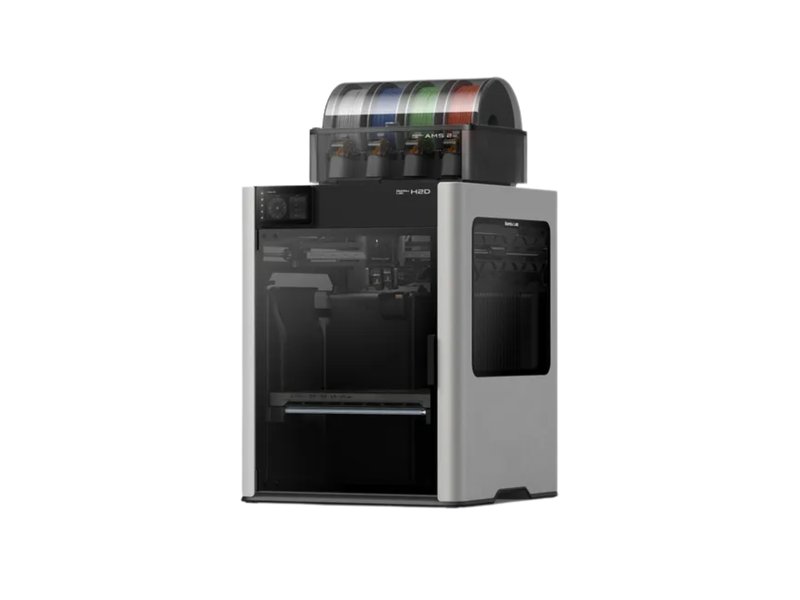
The Bambu Lab H2D, showcasing its design and optional AMS units.
Target Audience: Who is the H2D For?
With its advanced feature set and premium price point (starting around $1,899 and potentially exceeding $3,499 for fully-equipped versions), the H2D is primarily aimed at:
- Serious Crafters and High-End Makers: Individuals who engage in complex projects requiring multiple fabrication techniques.
- Small Business Owners & Entrepreneurs: Users needing rapid prototyping, custom part production, or small-batch manufacturing capabilities.
- Professionals: Designers, engineers, and educators who require a reliable, high-speed, multi-material, and multi-functional tool.
While powerful, its complexity and cost may make it less suitable for absolute beginners to 3D printing or those with basic hobbyist needs.
Deep Dive: Core Features and Technical Specifications
The H2D packs impressive technology designed for speed, precision, and versatility.
Advanced 3D Printing Capabilities
Large Build Volume
The H2D offers a substantial build volume of 350 x 320 x 325 mm, a significant increase over previous Bambu Lab models, enabling the creation of larger single parts or batch production of smaller items.
Dual Hotend System
A key feature is the dual-nozzle hotend configuration. This enables:
- True Multi-Material/Multi-Color Printing: Print with two different materials or colors simultaneously.
- Support Material Efficiency: Use dedicated soluble or breakaway support materials for complex geometries.
- Filament Saving Design: Optimized to reduce waste during material changes compared to single-nozzle multi-material systems.
The all-metal hotend reaches temperatures up to 350°C, while the actively heated chamber maintains up to 65°C. This combination unlocks compatibility with a wide range of engineering-grade filaments, including demanding materials like PAHT-CF (Carbon Fiber reinforced High-Temperature Polyamide), PET-CF, ABS, ASA, PC, and even composites like PPS-CF/GF.
Speed and Precision
Leveraging Bambu Lab's motion control technology, the H2D boasts impressive print speeds reportedly up to 1000 mm/s with high acceleration (20,000 mm/s²). This is complemented by features designed for high precision, including a potential "vision encoder" plate enhancing motion accuracy (down to 50µm) for better calibration and print quality.
Upgraded Automatic Material System (AMS)
The H2D is compatible with Bambu Lab's AMS units (including a newer, potentially faster AMS 2 version) for automated loading and switching of up to 4 filaments per unit (stackable for more capacity). This streamlines multi-material workflows and provides humidity control for sensitive filaments.
The 4-in-1 Multi-Tool Functionality
Beyond its prowess as a 3D printer, the H2D integrates additional tools via a modular head system:
- Laser Engraver/Cutter: Available with optional 10W or powerful 40W diode laser modules. The 40W version significantly enhances cutting capabilities (e.g., up to 15mm plywood reported) and speed for engraving tasks. Features like air assist improve cut quality and safety.
- Digital Blade Cutter: Functions similarly to a craft cutter (like a Cricut), allowing precise cutting of materials like vinyl, paper, cardstock, and fabric.
- Pen Plotter: Allows the machine to draw intricate designs using pens or markers.
This integration transforms the H2D into a compact "craft factory" or "personal manufacturing menagerie," capable of handling diverse projects from prototyping to finished custom goods.
Additional Technical Highlights
- Vision System: Incorporates multiple cameras (Live View, Nozzle Cam, high-resolution BirdsEye) for monitoring, AI-powered failure detection, and potentially enhanced calibration.
- Filtration: Features a robust filtration system combining HEPA H12 and activated carbon filters to manage VOCs and particulates, crucial especially when using the laser module or printing certain materials.
- Build Surface: Utilizes a flexible steel plate system for easy print removal.
- Software: Managed via Bambu Studio (for 3D printing) and the Bambu Suite (for laser, cutting, plotting functions), providing a comprehensive software ecosystem.
Key Specifications Summary Table
This table summarizes the core technical specifications of the Bambu Lab H2D based on available information:
| Specification | Value |
|---|---|
| Build Volume (3D Print) | 350 x 320 x 325 mm |
| Print Technology | Fused Filament Fabrication (FFF) - Dual Nozzle |
| Max Print Speed | Up to 1000 mm/s |
| Max Hotend Temperature | 350°C |
| Max Heated Chamber Temperature | 65°C |
| Max Heatbed Temperature | 120°C |
| Supported Filament Diameter | 1.75 mm |
| Supported Materials | PLA, PETG, ABS, ASA, PC, Nylon (PA), TPU, Composites (CF/GF reinforced), PVA, BVOH, PPS, etc. |
| Laser Options | 10W or 40W Diode Laser (Optional Add-on) |
| Other Tool Functions | Digital Blade Cutting, Pen Plotting (Modular) |
| Filtration | HEPA H12 + Activated Carbon |
| Machine Dimensions | ~492 x 514 x 626 mm |
| Machine Weight | ~31 kg (68.4 lb) |
Performance Analysis: How Does the H2D Stack Up?
Print Quality and Speed
Reviews consistently praise the H2D for its exceptional print quality, delivering high-fidelity results even at remarkable speeds. The combination of robust mechanical construction, advanced motion control algorithms, vibration compensation, and optimized slicing profiles in Bambu Studio contributes to clean, precise prints with minimal artifacts. Users report it being "wicked fast" and significantly quieter than expected for such a high-speed machine.
Multi-Material and Advanced Filament Handling
The dual hotend system is highlighted as a major advantage for complex multi-color or multi-material prints, offering better efficiency than previous single-nozzle purge systems. The heated chamber and high-temperature hotend enable reliable printing with engineering-grade materials that are challenging for less capable printers. Tests involving materials like PAHT-CF have demonstrated its ability to produce strong, functional parts.
Laser, Cutting, and Plotting Performance
The optional laser modules are generally well-regarded, particularly the 40W version, which offers significant cutting power and engraving speed suitable for serious crafting and light production work. The digital cutter and plotter add further versatility, effectively competing with standalone craft machines for tasks like creating stencils, decals, or detailed drawings. However, users note that switching between functions requires using different software suites (Bambu Studio vs. Bambu Suite), which might introduce minor workflow complexities.
Build Quality and User Experience
The H2D is described as having impressive build quality with a premium feel. The "Bambu polish" extends to the user experience, with features like pre-loaded test models and QR codes linking to guides simplifying setup. While the overall ecosystem is generally considered intuitive, the sheer number of features means there's a learning curve, especially for users new to multi-tool machines or advanced filaments. Initial software releases had minor bugs (like slicer profile mismatches or slight temperature variations on the build plate), but Bambu Lab is known for frequent firmware and software updates to address such issues.
Comparative Performance Radar Chart
To visualize the H2D's strengths relative to a hypothetical 'Typical High-End Competitor' (which might excel in some areas but lack the multi-functionality), consider the following radar chart. Scores are based on synthesized review data and represent perceived performance levels (higher is better, scale 1-5, with 5 being outstanding).
This chart highlights the H2D's exceptional multi-functionality and strong performance across speed, quality, and material handling compared to a typical high-end printer focused solely on 3D printing. While ease of use might be slightly lower due to its complexity, its overall capability profile is significantly broader.
Exploring the H2D Ecosystem: A Mindmap Overview
This mindmap provides a visual breakdown of the Bambu Lab H2D's core aspects, illustrating how its features and capabilities connect to create a comprehensive manufacturing system.
Personal Manufacturing Hub"] id1["Core 3D Printing"] id1a["Large Build Volume
(350x320x325mm)"] id1b["Dual Hotend System"] id1b1["Multi-Material / Multi-Color"] id1b2["Efficient Support Material Use"] id1b3["Filament Saving"] id1c["High Speed (Up to 1000mm/s)"] id1d["High Temperature Capability
(350°C Hotend, 65°C Chamber)"] id1e["Advanced Material Support
(CF/GF Composites, Engineering Grades)"] id1f["AMS Integration (Faster)"] id2["Multi-Tool Functionality (Modular)"] id2a["Laser Engraving & Cutting"] id2a1["10W Option"] id2a2["40W Option (High Power)"] id2a3["Air Assist"] id2b["Digital Blade Cutting
(Vinyl, Paper, Fabric)"] id2c["Pen Plotting / Drawing"] id3["Performance & Quality"] id3a["High Print Fidelity"] id3b["Quiet Operation (Relative to Speed)"] id3c["Robust Build Quality"] id3d["Precision & Accuracy (Vision System)"] id4["User Experience & Ecosystem"] id4a["Bambu Studio (Slicer)"] id4b["Bambu Suite (Laser/Cut/Plot)"] id4c["Vision System (Monitoring, AI)"] id4d["HEPA + Carbon Filtration"] id4e["Target Users:
Elite Crafters, Professionals, Small Biz"] id4f["Premium Price Point"]
The mindmap illustrates the H2D's central role, branching into its primary 3D printing strengths, its unique multi-tool capabilities, the resulting performance characteristics, and the overall user ecosystem context.
User Reception: What Do Early Adopters Think?
Overall Sentiment: Strong Enthusiasm Tempered by Realism
Initial user feedback and reviews from sources like Tom's Hardware, TechRadar, CNET, All3DP, and community forums (Bambu Lab forums, Reddit) are predominantly positive. The H2D is frequently described as an "amazing machine," a "worthy successor" to the X1C, and "one of the most capable and complete maker machines" available. Users transitioning from other high-end printers often express being "beyond impressed."
Praised Aspects
- Speed and Print Quality: Consistently cited as top strengths.
- Multi-Functionality: The integration of laser/cutting/plotting is a major draw for many, turning it into a versatile "Swiss Army knife."
- Increased Build Volume: A highly requested improvement over previous models.
- Quiet Operation: Surprisingly quiet performance given its speed.
- Build Quality: Feels robust, stable, and premium.
- Multi-Material Performance: The dual-nozzle system is seen as effective.
Reported Issues and Criticisms
- "Not Fully Baked Yet": Some early reviews and user reports mentioned initial firmware or software glitches (e.g., minor slicer profile issues, small build plate temperature inconsistencies). These are generally seen as fixable via updates.
- High Power Draw: Some users noted a potentially high current draw on 110V circuits.
- Cost: The premium price puts it out of reach for casual hobbyists.
- Complexity: The range of features increases the learning curve compared to simpler printers.
- Integration Philosophy: A minority of users question the value of integrating 2D tools into a high-end 3D printer, preferring dedicated machines.
- Lack of Ethernet (on some configurations): Seen as a drawback for users planning to use it in a production or networked environment.
- Software Workflow: Needing separate software for 3D printing vs. other tools can be slightly cumbersome.
Synthesized User Rating
While no single universal rating exists, aggregating the sentiment from reviews and user discussions suggests an overall positive reception, translating to roughly 4.5 out of 5 stars on average. Professionals and power users needing its specific multi-functional capabilities might rate it higher (closer to 4.7), while those encountering early bugs or finding it overly complex/expensive might rate it slightly lower (around 4.0-4.2). The consensus is that it's a highly capable, innovative machine delivering on most of its promises, albeit with the expectation of ongoing software refinement typical of a newly launched, complex product.
Video Review: Hands-On Insights
For a visual and practical perspective on the Bambu Lab H2D, the review from Adam Savage's Tested provides an excellent hands-on look at the machine's capabilities, including its 3D printing performance and laser functions. They explore its potential for creators and makers.
Adam Savage's Tested reviews the Bambu Lab H2D, focusing on its features as a large-format printer and laser cutter.
This review delves into the practical aspects of using the H2D, showcasing print examples, discussing the integration of the laser module, and offering insights based on their extensive experience with fabrication tools. It complements the technical analysis by providing a real-world usage perspective.
Frequently Asked Questions (FAQ)
Who is the Bambu Lab H2D best suited for? ▶
The H2D is primarily designed for experienced users, including serious crafters, high-end makers, small business owners, prototypers, and professionals who need a versatile, high-performance machine capable of multiple fabrication tasks (3D printing, laser engraving/cutting, digital cutting, plotting) and handling advanced materials. Its complexity and premium price make it less ideal for complete beginners or casual hobbyists.
What are the main advantages of the H2D over the X1-Carbon? ▶
Key advantages include:
- Larger build volume (350x320x325mm vs. 256x256x256mm).
- Dual hotend system for true multi-material/multi-color printing and efficient support use.
- Higher potential print speeds.
- Integrated multi-tool functionality (optional laser, cutter, plotter).
- Higher maximum hotend (350°C vs 300°C) and chamber temperatures (65°C vs ~60°C), improving advanced material compatibility.
- Potentially faster/improved AMS system.
Are there any significant downsides or concerns? ▶
Potential downsides include:
- High Cost: It's a significant investment compared to many desktop 3D printers.
- Complexity: The multi-tool nature and advanced features introduce a steeper learning curve.
- Early Software Refinement: As a new product, users might encounter minor software bugs that require updates.
- Power Consumption: Some reports mention high power draw.
- Workflow Integration: Using separate software for different tool functions might slightly disrupt workflow.
- Lack of Ethernet (Standard?): May be a concern for production environments needing wired network connectivity.
How effective is the laser module? ▶
The optional laser modules (10W and 40W) are reported to be quite effective. The 10W is suitable for engraving and cutting thin materials. The 40W module significantly boosts performance, allowing for faster engraving and cutting of thicker materials (like wood up to 15mm reported). Features like air assist enhance the quality. While perhaps not matching the power of high-end dedicated CO2 lasers, it offers substantial capability integrated within the same machine footprint, making it very appealing for diverse crafting needs.
Recommended
- How does the Bambu Lab H2D compare against the Prusa XL multi-tool printer?
- Can you provide a detailed review of the Bambu Lab H2D's 40W laser cutting and engraving performance?
- What are the best engineering-grade materials to use with the Bambu Lab H2D?
- Are there efficient workflow tips for switching between 3D printing and laser/cutting on the H2D?
References
Last updated May 2, 2025