
In-Depth Analysis of Basalt Fiber Permeable Concrete Research
Exploring Numerical Simulation and CT Technology in Construction Materials
Highlights
- Numerical Simulation Approach: Integration of CT technology to create precise 3D models for assessing the mechanical behavior.
- Basalt Fiber Reinforcement: Investigation of basalt fiber's impact on the compressive and splitting tensile strength of permeable concrete.
- Application in Road Infrastructure: Research focused on balancing durability with water permeability for sustainable construction.
Overview of the Study
The provided DOI link (https://doi.org/10.1016/j.cscm.2022.e01348) directs to a research article titled “Numerical simulation of strength of basalt fiber permeable concrete based on CT technology,” published in Case Studies in Construction Materials in 2022. This study offers a comprehensive examination of basalt fiber reinforcement in permeable concrete, emphasizing the mechanical properties crucial for construction applications such as road pavements.
In recent years, permeable concrete has become a subject of interest due to its sustainability benefits, particularly with regard to drainage and environmental resilience. The integration of basalt fibers not only enhances concrete strength but also contributes to the longevity and performance of road materials under varying conditions. This research employs advanced numerical simulations, empowered by CT (Computed Tomography) technology, to reconstruct a three-dimensional (3D) model of the concrete’s internal microstructure.
Numerical Simulation & CT Technology
Role of CT Technology in Material Analysis
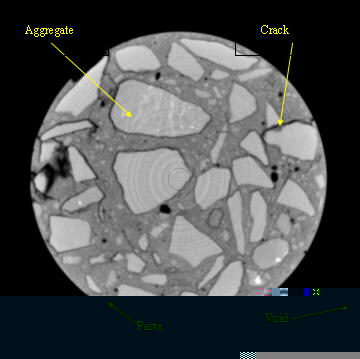
CT technology has revolutionized the field of materials science by enabling the non-destructive visualization of internal structures. In this study, CT scans were used to capture detailed images of the basalt fiber permeable concrete sample. These images were then processed using specialized software (for instance, MIMICS) to reconstruct a 3D finite element model that accurately represents the internal architecture of the material.
Advantages of CT-Based Simulation
The integration of CT technology offers several benefits:
- High-Resolution Imaging: Detailed visualization of the concrete matrix and fiber distribution helps in understanding internal flaws and structural connectivity.
- Accurate Finite Element Modeling: The 3D reconstruction based on real-world data allows for precise numerical simulation of mechanical properties such as compressive and splitting tensile strength.
- Enhanced Predictive Capability: The simulation aids in predicting failure mechanisms under various loading scenarios, which is crucial for ensuring material reliability in construction applications.
By leveraging these advanced imaging and modeling techniques, researchers are able to not only analyze existing structures but also optimize concrete formulations for enhanced performance.
Basalt Fiber Reinforcement in Permeable Concrete
Importance of Fiber Reinforcement
Basalt fibers are gaining popularity due to their excellent durability, high strength, and resistance to environmental degradation. Their application in permeable concrete is particularly critical, as they significantly enhance the mechanical performance of the material while maintaining a balance with physical properties like permeability.
Key Mechanical Properties Assessed
The study primarily focuses on two mechanical properties:
- Compressive Strength: This property measures the ability of concrete to withstand loads that tend to reduce size. Reinforcement with basalt fibers increases the load-bearing capacity, making the material more suitable for road surfaces and structural applications.
- Splitting Tensile Strength: This test evaluates the concrete's resistance to tensile forces, which are usually responsible for cracking. The addition of basalt fibers improves the concrete’s tensile behavior, resulting in a reduced tendency for crack propagation.
These properties are critical for achieving an optimal mix that does not compromise on permeability—essential for ensuring effective drainage and preventing water accumulation on road surfaces.
Practical Implications for Infrastructure
Impact on Road Performance
One of the primary motivators behind this research is the need for sustainable and resilient road infrastructure. Traditional concrete, while strong, may not always offer the drainage properties necessary for regions with high precipitation. Permeable concrete addresses these issues by allowing water to seep through, reducing the risk of hydroplaning and preventing surface flooding.
Correlating Mechanical Strength with Permeability
The incorporation of basalt fibers ensures that while the concrete remains permeable, it also gains enhanced strength to support heavy loads. The research suggests that an optimal basalt fiber content—around 4 kg/m3—can achieve a balanced improvement, ensuring that the concrete remains durable without compromising its permeability.
Such advancements in material engineering have significant implications, especially in urban planning and road design. Infrastructure that utilizes such optimized materials is better equipped to handle environmental stressors, potentially leading to lower maintenance costs and longer service life.
Detailed Analysis and Simulation Data
Methodology Overview
The study uses a combination of high-resolution CT scanning and numerical simulations to evaluate the structural integrity of the basalt fiber reinforced permeable concrete. The procedure involves:
- Acquiring CT images of the concrete specimen to capture the internal distribution of both the concrete matrix and the basalt fibers.
- Processing these images with reconstruction software to generate detailed 3D models, capturing the microstructure with precise accuracy.
- Implementing finite element analysis (FEA) to simulate mechanical tests. This approach predicts how the concrete would respond under various loading conditions.
- Evaluating the simulation outputs to determine key mechanical properties, including compressive and splitting tensile strength, while also verifying the uniformity and distribution of the fibers.
Visualization of Simulation Data
The following table summarizes key parameters and outcomes associated with the simulation:
| Parameter | Description | Outcome |
|---|---|---|
| CT Scan Resolution | High-resolution imaging for detailed 3D reconstructions | Enabled detailed modeling of concrete microstructure |
| Fiber Content | Optimal basalt fiber content, approx. 4 kg/m3 | Enhanced balance of mechanical strength and permeability |
| Compressive Strength | Ability to resist compressive loads | Improved overall load-bearing capacity |
| Splitting Tensile Strength | Resistance to tensile forces and crack development | Reduced susceptibility to cracking under tension |
| Finite Element Modeling | 3D simulation of material behavior under load. | Accurate prediction of failure mechanisms |
Implications for Future Research
The study lays the groundwork for future exploration into advanced materials for construction. The successful implementation of CT-based numerical simulations offers a reliable method for evaluating and optimizing concrete composites. Future research efforts may include:
- Exploring alternative fiber types and comparing their effects on the mechanical properties of permeable concrete.
- Investigating the long-term durability and environmental resistance of basalt fiber reinforced concrete under various climatic conditions.
- Developing real-time monitoring techniques using CT technology to predict material degradation over time.
- Integration of multi-scale modeling approaches to capture both macroscopic and microscopic behavior of advanced concrete mixtures.
Integration with Broader Construction Trends
Sustainable and Resilient Infrastructure
With the growing interest in sustainable construction, permeable concrete has emerged as a material that meets environmental needs by facilitating rainwater management and reducing urban flooding risks. The addition of basalt fibers makes this material even more attractive by ensuring that it can withstand heavy traffic loads without losing its permeability benefits.
Adoption in Urban and Highway Projects
Urban planners and civil engineers are increasingly considering materials that balance strength with environmental performance. The insights from the study provide:
- Design Guidelines: Clear recommendations for fiber content and mix design help in developing standardized procedures for incorporating basalt fibers in permeable concrete mixes.
- Maintenance Reduction: Enhanced durability leads to lower lifecycle costs, which is attractive for public infrastructure projects.
- Predictive Modeling: Advanced numerical simulation techniques can be used to anticipate wear and tear, making predictive maintenance a reality for infrastructure assets.
Related Research and References
The research discussed in this study is complemented by a number of other scholarly articles and publications focused on fiber reinforced composites and numerical simulation techniques in construction materials. These studies further validate the effectiveness of using CT technology for structural assessments and highlight the potential improvements in concrete technology. The consistent theme across these publications is the drive toward developing materials that are not only environmentally sound but also robust in performance.
References
- Numerical simulation of strength of basalt fiber permeable concrete based on CT technology - Case Studies in Construction Materials
-
ScienceDirect - Case Studies in Construction Materials
- Semantic Scholar - Basalt Fiber Reinforced Concrete Study
-
DOI Reference - Additional Research Article
- DOI FAQ - Official DOI Information
Recommended Queries for Further Exploration
Last updated March 16, 2025