
Unveiling the Dance of Light and Matter: A Basic Understanding of Quantum Electrodynamics
Exploring the Fundamental Theory Governing Electromagnetic Interactions at the Quantum Level
Quantum Electrodynamics (QED) stands as a monumental achievement in theoretical physics, providing a framework to understand how light and matter interact at the most fundamental level. It is a cornerstone of the Standard Model of particle physics and is renowned for its incredible accuracy in predicting experimental results. At its heart, QED describes the interactions between electrically charged particles through the exchange of photons, the elementary particles of light. It elegantly merges the principles of quantum mechanics, which governs the behavior of particles at the atomic and subatomic scale, with special relativity, which describes the relationship between space and time.
Key Insights into Quantum Electrodynamics
- Relativistic Quantum Field Theory: QED is a relativistic quantum field theory, meaning it combines quantum mechanics and special relativity to describe the behavior of fields and particles.
- Interaction via Photon Exchange: The fundamental interaction in QED is the exchange of photons between charged particles, mediating the electromagnetic force.
- Exceptional Predictive Power: QED is one of the most accurately tested theories in physics, with predictions matching experimental results to an extraordinary degree of precision, such as the anomalous magnetic dipole moment of the electron and the Lamb shift in atomic energy levels.
What is Quantum Electrodynamics?
The Quantum Dance of Charged Particles and Light
At its core, Quantum Electrodynamics is the quantum field theory that describes how electrically charged particles, such as electrons and positrons, interact with the electromagnetic field. This interaction is not seen as a continuous force field as in classical electromagnetism, but rather as an exchange of discrete packets of energy called photons. Photons are the quanta of the electromagnetic field, acting as the force carriers of the electromagnetic interaction.
Imagine two electrons approaching each other. According to QED, the electrostatic repulsion they experience is not a direct, instantaneous force. Instead, one electron emits a virtual photon, which is then absorbed by the other electron. This exchange of virtual photons mediates the force between them. The "virtual" aspect signifies that these photons are not directly observable as free particles but are rather intermediaries in the interaction process.
Historical Context and Development
The foundation of QED can be traced back to the pioneering work of Paul Dirac in the 1920s, who formulated a relativistic wave equation for the electron. This equation naturally incorporated both quantum mechanics and special relativity, a significant step towards a consistent theory of electron behavior. However, early formulations of QED faced issues with infinities in calculations. The breakthrough came in the late 1940s with the independent work of Shin'ichirō Tomonaga, Julian Schwinger, and Richard Feynman, who developed techniques to handle these infinities through a process called renormalization. Their contributions were so fundamental that they were jointly awarded the Nobel Prize in Physics in 1965.
Richard Feynman's approach, in particular, introduced a highly intuitive and visual method using Feynman diagrams, which graphically depict the interactions between particles. These diagrams, while simplified representations, are powerful tools for performing complex calculations in QED.
A basic Feynman diagram illustrating electron-electron scattering.
Fundamental Principles of QED
Building Blocks of the Theory
QED is built upon several key principles that extend classical electromagnetism and quantum mechanics to the relativistic domain:
- Quantization of Fields: In QED, the electromagnetic field is quantized, meaning that its energy and momentum are packaged into discrete units (photons). Similarly, charged particles like electrons are described as excitations of quantum fields (electron fields). Neither the electromagnetic field nor the electron field is considered more fundamental than the other; they are intertwined components of the theory.
- Relativistic Covariance: QED is a relativistic theory, adhering to the principles of special relativity. This means the laws of QED are the same for all observers in uniform motion, and the theory correctly describes the behavior of particles moving at speeds close to the speed of light.
- Gauge Invariance: QED possesses a fundamental symmetry known as gauge invariance. This principle dictates that certain transformations of the fields in the theory do not change the physical predictions. Gauge invariance is intimately connected to the existence of the photon as a massless particle and the conservation of electric charge.
- Perturbation Theory: Calculations in QED are often performed using perturbation theory, where the interaction between charged particles is treated as a small disturbance (perturbation) to the free fields. This approach involves expanding physical quantities in a power series of the fine-structure constant (\(\alpha\)), a fundamental constant that characterizes the strength of the electromagnetic interaction. Because \(\alpha\) is a small value (approximately 1/137), higher-order terms in the expansion become progressively smaller, allowing for highly accurate approximations.
Key Concepts and Phenomena Explained by QED
Delving into the Details of Light-Matter Interactions
QED provides a precise description of a wide range of electromagnetic phenomena, from the simple repulsion between two electrons to the complex behavior of atoms and the interaction of light with matter. Some of the notable phenomena explained by QED include:
Electron-Electron Scattering (Bhabha Scattering)
When two electrons scatter off each other, QED describes this process as the exchange of virtual photons. Feynman diagrams for this interaction can be quite complex, involving multiple virtual photon exchanges and even the creation and annihilation of virtual electron-positron pairs. The calculations based on these diagrams precisely match experimental observations.
Electron-Positron Annihilation and Creation
QED describes the process where an electron and its antiparticle, a positron, annihilate, producing photons. Conversely, a photon with sufficient energy can create an electron-positron pair. These processes are fundamental in high-energy physics and are accurately predicted by QED.
The Lamb Shift
One of the triumphs of QED was its ability to explain the Lamb shift, a small difference in the energy levels of the hydrogen atom that could not be accounted for by earlier theories. This shift arises from the interaction of the electron with the vacuum fluctuations of the electromagnetic field, a purely quantum effect precisely calculated by QED.
The Anomalous Magnetic Dipole Moment
QED also accurately predicts the anomalous magnetic dipole moment of the electron and muon. The magnetic moment of a charged particle is a measure of its intrinsic magnetic strength. The value predicted by the simplest quantum mechanical theories is slightly different from the experimentally measured value. QED accounts for this small discrepancy by considering the interaction of the electron or muon with virtual particles that momentarily pop in and out of existence in the vacuum.
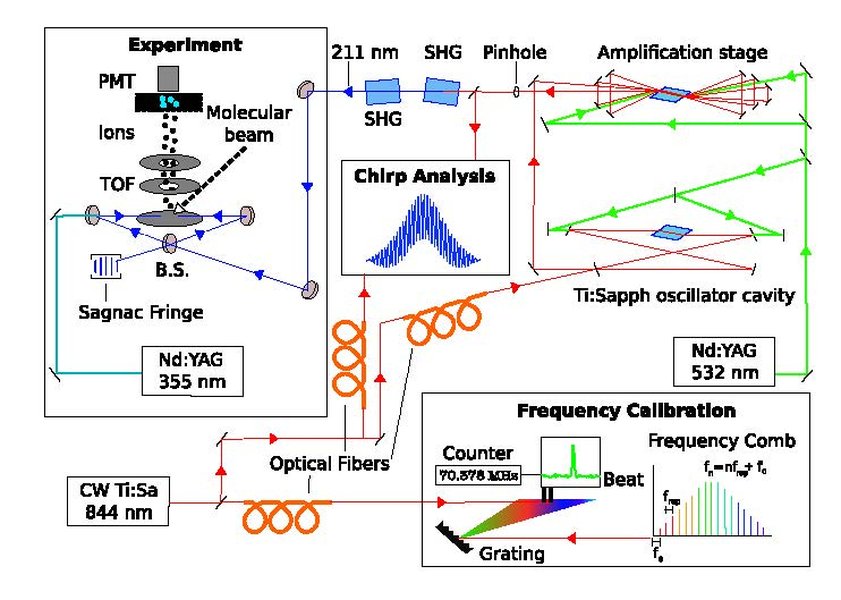
Experimental setups like this are used to test the precise predictions of Quantum Electrodynamics.
The Mathematical Language of QED
Equations and Formalism
While a basic understanding can be grasped conceptually, QED is a highly mathematical theory. It utilizes the framework of quantum field theory, which involves sophisticated mathematical tools such as Lagrangians, field operators, and path integrals. The fundamental equations of QED are derived from a Lagrangian density that describes the dynamics of the electron and photon fields and their interaction.
The QED Lagrangian density (\(\mathcal{L}_{\text{QED}}\)) is typically written as:
\[ \mathcal{L}_{\text{QED}} = \bar{\psi}(i\gamma^\mu \partial_\mu - m)\psi - \frac{1}{4}F_{\mu\nu}F^{\mu\nu} - e\bar{\psi}\gamma^\mu A_\mu \psi \]Let's break down the components:
- \( \psi \) is the Dirac spinor field representing the electron (and positron).
- \( \bar{\psi} = \psi^\dagger \gamma^0 \) is the adjoint spinor.
- \( \gamma^\mu \) are the Dirac matrices, which incorporate special relativity.
- \( \partial_\mu \) is the four-gradient, representing derivatives with respect to spacetime.
- \( m \) is the mass of the electron.
- \( F_{\mu\nu} \) is the electromagnetic field strength tensor, derived from the four-vector potential \( A_\mu \). It encapsulates the electric and magnetic fields.
- \( e \) is the elementary electric charge.
The first term describes the dynamics of the free electron field, the second term describes the dynamics of the free electromagnetic field (related to Maxwell's equations), and the third term describes the interaction between the electron and photon fields. The interaction term is crucial as it dictates how electrons emit and absorb photons.
Relation to Maxwell's Equations
Interestingly, classical Maxwell's equations, which describe the behavior of electric and magnetic fields, can be derived as the classical limit of QED. QED provides a more fundamental description by quantizing these fields and incorporating quantum mechanical effects.
The Success and Limitations of QED
A Highly Successful Theory, But Not the Whole Story
QED is widely regarded as one of the most successful and precisely tested theories in the history of physics. Its predictions for quantities like the anomalous magnetic moment of the electron have been verified to an astonishing degree of accuracy, sometimes exceeding 10 significant figures. This success has made QED a paradigm for constructing other quantum field theories, such as Quantum Chromodynamics (QCD), which describes the strong nuclear force.
However, QED is not a complete theory of everything. It only describes the electromagnetic interaction. The universe is governed by three other fundamental forces: the strong nuclear force, the weak nuclear force, and gravity. The Standard Model of particle physics integrates QED with the theories of the strong and weak forces, providing a more comprehensive description of elementary particles and their interactions (excluding gravity).
This video provides a theoretical overview of Quantum Electrodynamics within the context of the Standard Model.
QED and the Standard Model
QED is a crucial component of the Standard Model. Sheldon Glashow, Steven Weinberg, and Abdus Salam independently showed how the electromagnetic force and the weak nuclear force could be unified into a single electroweak force, a monumental step in the development of particle physics.
Looking Beyond QED
Despite its successes, QED does not incorporate gravity. Unifying gravity with quantum mechanics and the other fundamental forces remains one of the biggest challenges in theoretical physics, leading to research in areas like string theory and loop quantum gravity.
Applications of QED
From Fundamental Physics to Technological Advancements
While QED is a fundamental theory in physics, its principles have implications and applications in various fields:
- Atomic Physics: QED is essential for understanding the structure and properties of atoms, providing precise calculations for atomic energy levels and transitions.
- Particle Physics: QED is a cornerstone of particle physics, used to calculate scattering cross-sections and decay rates of particles involved in electromagnetic interactions.
- Quantum Computing: Principles derived from QED, particularly concerning the interaction of light and matter, are relevant to the development of quantum computing technologies, including the manipulation of qubits using photons.
- Condensed Matter Physics: QED concepts can be applied to understand the collective behavior of electrons in materials.

Understanding quantum phenomena, as described by theories like QED, is crucial for developing future technologies.
Understanding QED: Prerequisites and Further Study
Navigating the Path to Deeper Knowledge
A thorough understanding of QED requires a strong background in several areas of physics and mathematics. Essential prerequisites typically include:
-
Classical Electromagnetism (Maxwell's equations)
-
Quantum Mechanics
-
Special Relativity
-
Classical Mechanics
-
Advanced mathematical methods (Calculus, Linear Algebra, Differential Equations, Complex Analysis)
For those interested in delving deeper, standard graduate-level textbooks on Quantum Field Theory are the primary resources. Richard Feynman's book "QED: The Strange Theory of Light and Matter" provides a non-mathematical introduction for a general audience, capturing the essence of the theory with his characteristic insight.
Summary Table: Key Aspects of QED
A Concise Overview
| Aspect | Description |
|---|---|
| Nature of Theory | Relativistic Quantum Field Theory |
| Fundamental Interaction | Electromagnetic Force |
| Force Carrier | Photon (virtual and real) |
| Particles Involved | Electrically charged particles (electrons, positrons, muons, etc.) and photons |
| Key Principles | Quantum Field Theory, Special Relativity, Gauge Invariance, Perturbation Theory |
| Key Explanations | Light-matter interaction, electron scattering, particle-antiparticle annihilation/creation, Lamb shift, anomalous magnetic dipole moment |
| Mathematical Tools | Lagrangians, Feynman Diagrams, Renormalization |
| Relation to Other Theories | Classical Electromagnetism (classical limit), part of the Standard Model (electroweak unification) |
Frequently Asked Questions About Quantum Electrodynamics
Is QED the theory of everything?
No, QED is not the theory of everything. It only describes the electromagnetic interaction. While incredibly successful in its domain, it does not include the strong nuclear force, the weak nuclear force, or gravity. The Standard Model of particle physics combines QED with the theories of the strong and weak forces, but a unified theory that includes gravity remains an open challenge.
How accurate are the predictions of QED?
The predictions of QED are among the most accurate in all of physics. Experimental measurements of quantities like the anomalous magnetic dipole moment of the electron agree with theoretical calculations from QED to an extraordinary degree of precision, often to many decimal places.
What are Feynman diagrams?
Feynman diagrams are pictorial representations of the interactions between particles in quantum field theories like QED. They provide a visual way to understand and calculate the probabilities of different interaction processes. Lines represent particles, and vertices represent interaction points where particles emit or absorb force carriers (like photons in QED).
What is renormalization in QED?
Renormalization is a mathematical technique used in QED to handle infinities that arise in calculations involving interactions between particles. These infinities appear when considering the effects of virtual particles. Renormalization effectively absorbs these infinities into redefinitions of fundamental quantities like mass and charge, leading to finite and physically meaningful results that can be compared with experiments.
References

Last updated May 2, 2025