
Mastering Your First Spanish Presentation: A Comprehensive Guide
From Basic Introductions to Engaging Delivery, Speak Spanish with Confidence!
Key Highlights for Your Spanish Presentation
- Start Strong with Greetings: Begin your presentation with essential Spanish greetings like "¡Hola!" or time-specific phrases such as "¡Buenos días!" or "¡Buenas tardes!" to immediately engage your audience.
- Introduce Yourself Clearly: Learn the most common and versatile phrases for self-introduction, such as "Me llamo [Your Name]" or "Mi nombre es [Your Name]," and practice them to ensure confident delivery.
- Prepare and Practice Rigorously: Success in an oral presentation in Spanish hinges on thorough preparation, including outlining your speech, understanding grammatical patterns, and practicing pronunciation, tone, and rhythm.
Giving a presentation in a new language can feel daunting, but with a structured approach and consistent practice, you can deliver a compelling and clear Spanish presentation. This guide will walk you through the essential components of a basic Spanish presentation, from initial greetings to effective closing remarks, ensuring you build confidence and impress your audience.
The Foundation: Crafting Your Introduction
A strong introduction is paramount in any presentation, especially when speaking in a foreign language. It sets the tone, captures attention, and establishes your presence. In Spanish, this involves more than just stating your name; it’s about engaging your audience from the very beginning and providing key personal details.
Greeting Your Audience: The First Impression
Your opening greeting is your first opportunity to connect with your audience. The choice of greeting can depend on the formality of the setting and the time of day.
- Formal Greetings:
¡Hola a todos!(Hello everyone!) - A versatile and polite opening.¡Buenos días!(Good morning!) - Used from dawn until noon.¡Buenas tardes!(Good afternoon!) - Used from noon until sunset.¡Buenas noches!(Good evening/night!) - Used after sunset.
- Informal Greetings (less common for formal presentations, but useful for casual settings):
¿Qué tal?(What's up?/How's it going?) - More relaxed, often used among friends.
Remember that in Spanish, exclamation marks are used at both the beginning and end of exclamatory sentences (e.g., ¡Hola!).
Introducing Yourself: Stating Your Identity
Once you’ve greeted the room, it’s time to introduce yourself. There are several common ways to do this, ranging from very direct to slightly more formal.
Me llamo [Your Name].(My name is [Your Name].) - This is the most common and natural way to introduce yourself. It literally translates to "I call myself."Mi nombre es [Your Name].(My name is [Your Name].) - A slightly more formal alternative to "Me llamo."Soy [Your Name].(I am [Your Name].) - A concise and direct way to state your name, also very common.
For example, you might say: "¡Hola a todos! Me llamo [Your Name]."
Adding More Personal Details
To enrich your introduction and give your audience a better sense of who you are, consider adding details about your origin, profession, or current activity.
Soy de [Your Country/City].(I am from [Your Country/City].)Tengo [Your Age] años.(I am [Your Age] years old.) - Note that in Spanish, you "have" years, rather than "are" years old.Trabajo como [Your Profession].(I work as a [Your Profession].)Soy estudiante de [Your Field of Study].(I am a student of [Your Field of Study].)Mis intereses son [Your Interests].(My interests are [Your Interests].)
Putting it all together, a more complete introduction might look like this:
¡Hola a todos! Me llamo [Your Name].
Soy de [Your City/Country].
Trabajo como [Your Profession] y me gusta [Your Interest].
This provides a simple yet comprehensive self-introduction that is suitable for most basic presentation settings.
Structuring Your Presentation: Beyond the Basics
After your introduction, the body of your presentation will convey your main message. While the specific content depends on your topic, certain structural elements are universally beneficial for clarity and engagement.
Opening the Presentation's Topic
It's crucial to clearly state the purpose of your presentation early on. This helps set expectations and guides your audience's understanding.
Hoy voy a hablar sobre...(Today I am going to talk about...)El tema de mi presentación es...(The topic of my presentation is...)Mi presentación trata de...(My presentation is about...)
Organizing Your Main Points
For a basic presentation, focus on 2-3 main points. Using transition words and phrases will help your audience follow your logical flow.
Primero,...(First,...)En segundo lugar,...(Secondly,...)Además,...(Furthermore,...)Por ejemplo,...(For example,...)Sin embargo,...(However,...)
Engaging Your Audience
Interaction can significantly enhance a presentation. Asking rhetorical questions or direct questions to the audience keeps them involved.
¿Qué piensan ustedes sobre...?(What do you all think about...?)¿Alguien tiene alguna pregunta?(Does anyone have any questions?)
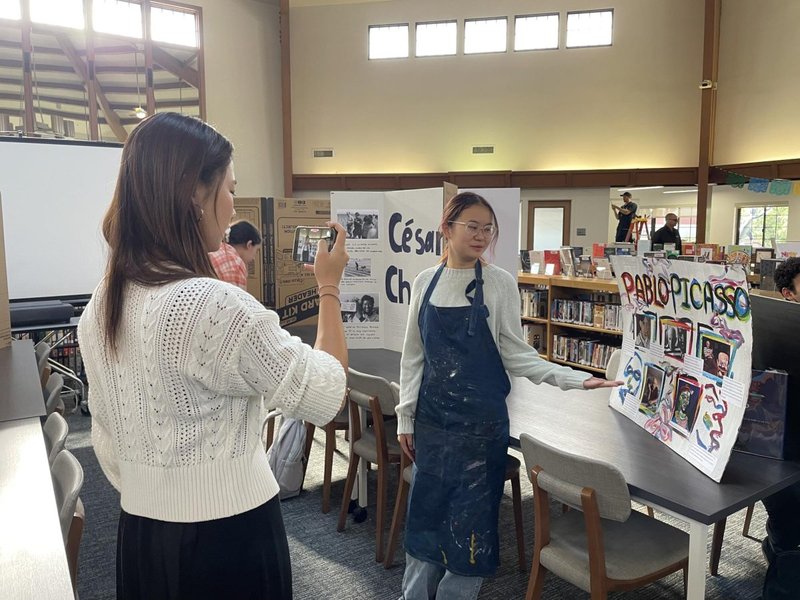
Students actively participating in and listening to a Spanish presentation, demonstrating audience engagement.
Effective Delivery: Tips for Fluency and Confidence
Beyond content, how you deliver your presentation in Spanish is vital. Focus on pronunciation, clarity, and body language to leave a lasting impression.
Pronunciation and Clarity
Practice is key to good pronunciation. Pay attention to common Spanish sounds that might differ from your native language.
- Vowels: Spanish vowels are generally short and clear.
- "R" sounds: Practice the rolling "r" (simple 'r' and trilled 'rr').
- Silent "H": Remember that the 'h' is usually silent in Spanish (e.g.,
holais pronounced "ola").
Speaking clearly and at a moderate pace will ensure your audience understands you. Don't be afraid to make mistakes; they are part of the learning process.
Body Language and Confidence
Non-verbal cues are just as important as your spoken words. Maintain eye contact, use natural gestures, and project a confident posture.
This radar chart illustrates the perceived importance of various elements in delivering an effective Spanish presentation. While content and language accuracy are fundamental, factors like confidence, engagement, and cultural awareness significantly amplify the impact of your message. A balanced approach to these areas is crucial for success.
Closing Your Presentation Effectively
The closing remarks are your final opportunity to reinforce your message and leave a memorable impression. A good conclusion summarizes key points and offers a clear call to action or a simple thank you.
Summarizing Key Points
Briefly reiterate the main takeaways of your presentation. This helps solidify the information for your audience.
En resumen,...(In summary,...)Para concluir,...(To conclude,...)Hemos visto que...(We have seen that...)
Expressing Gratitude and Inviting Questions
Always thank your audience for their time and attention, and invite them to ask questions.
¡Muchas gracias por su atención!(Thank you very much for your attention!) - Formal and polite.¿Tienen alguna pregunta?(Do you have any questions?)Estoy abierto/a a sus preguntas.(I am open to your questions.)
Additional Tips for Success
Beyond the core structure, several practices can significantly improve your Spanish presentation skills.
Visual Aids and Technology
PowerPoint or Google Slides can be invaluable tools. Many free and professional Spanish templates are available to enhance your presentation visually. Ensure your slides are clear, concise, and complement your spoken words, rather than just repeating them.
Consider using visuals that are culturally relevant if appropriate, as this can further engage your audience. Resources like Slidesgo offer a variety of Spanish-themed templates.
Practice Makes Perfect
Rehearse your presentation multiple times. Practice in front of a mirror, record yourself, or present to a friend or native Spanish speaker. This helps with memorization, timing, and identifying areas for improvement in pronunciation or flow. Don't try to memorize a script word-for-word; instead, focus on knowing your outline and key phrases so you can speak more naturally and "off the cuff."
This video provides practical advice on how to deliver a presentation in Spanish, covering key phrases and helpful tips for effective communication, offering valuable insights for beginners and those looking to refine their speaking skills.
Understanding Cultural Nuances
Spanish is spoken in over 21 countries, and accents and certain social norms can vary. While a basic presentation won't require deep dives into regional differences, being aware that formality levels and greetings can differ is beneficial. For instance, handshakes are common, and in many Spanish-speaking countries, a kiss on the cheek (or two) might be typical in friendly introductions between women, or a man and a woman, but observe local customs before initiating.
Essential Phrases & Vocabulary for Your Presentation
Here’s a table summarizing some of the most crucial phrases and vocabulary you can integrate into your Spanish presentation.
| Category | Spanish Phrase | English Translation | Notes |
|---|---|---|---|
| Greetings | ¡Hola! / ¡Buenos días! / ¡Buenas tardes! | Hello! / Good morning! / Good afternoon! | Adapt based on time of day. |
| Self-Introduction | Me llamo [Nombre]. / Soy [Nombre]. | My name is [Name]. / I am [Name]. | Most common ways to state your name. |
| Origin | Soy de [País/Ciudad]. | I am from [Country/City]. | Simple and direct. |
| Profession/Study | Trabajo como [Profesión]. / Soy estudiante de [Estudio]. | I work as a [Profession]. / I am a student of [Study]. | Specify your role. |
| Age | Tengo [Edad] años. | I am [Age] years old. | "Tener" (to have) is used for age. |
| Interests | Mis intereses son... / Me gusta... | My interests are... / I like... | To share personal hobbies. |
| Introducing Topic | Hoy voy a hablar sobre... / El tema es... | Today I am going to talk about... / The topic is... | Clear statement of purpose. |
| Transitions | Primero... / Luego... / Además... / Finalmente... | First... / Then... / Furthermore... / Finally... | For structuring your points. |
| Conclusion | En resumen... / Para concluir... | In summary... / To conclude... | For summarizing key points. |
| Thank You | ¡Muchas gracias por su atención! | Thank you very much for your attention! | Standard closing phrase. |
| Questions | ¿Tienen alguna pregunta? | Do you have any questions? | Inviting Q&A. |
Frequently Asked Questions (FAQ)
What is the most common way to introduce yourself in Spanish?
How do I start a presentation in Spanish?
What are some tips for practicing Spanish pronunciation for a presentation?
Should I memorize my entire Spanish presentation script?
Conclusion: Confident Communication in Spanish
Delivering a basic Spanish presentation is an achievable goal that significantly boosts your language skills and confidence. By mastering essential greetings, clear self-introductions, and effective structural components, you can create a compelling narrative. Remember to leverage visual aids, practice extensively to refine your pronunciation and delivery, and embrace the learning process. The ability to articulate your thoughts and information in Spanish opens doors to new academic, professional, and personal opportunities, allowing you to connect with over 400 million native Spanish speakers worldwide.
Recommended Further Exploration
- How can I enhance my Spanish presentations with advanced rhetorical devices?
- What are the specific cultural etiquettes to observe during business presentations in various Spanish-speaking countries?
- What are effective strategies for managing and responding to questions during a Spanish Q&A session?
- How can I quickly build specialized vocabulary for technical or academic presentations in Spanish?