
Diagnostic Decision Making Using Bayesian Reasoning
Understanding Pre-Test and Post-Test Probabilities in Chest Pain Evaluations
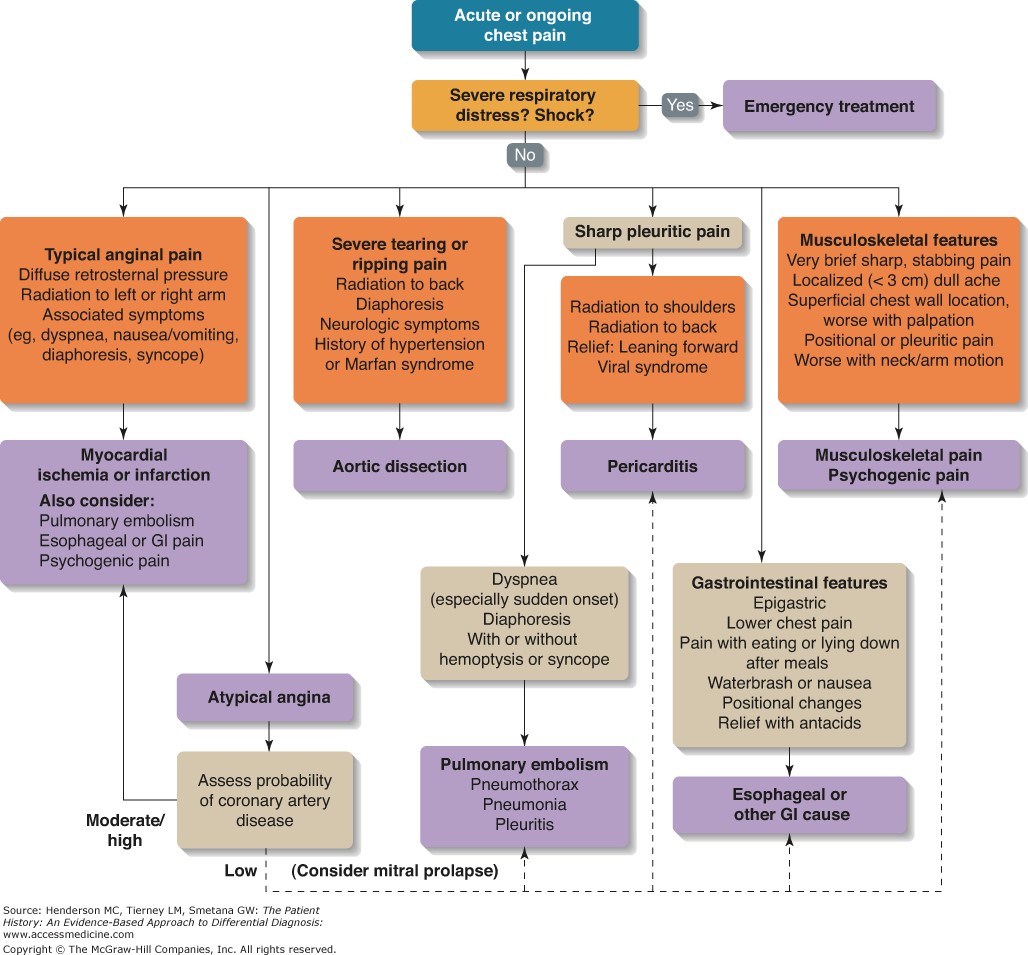
Key Takeaways
- Understanding Diagnostic Probabilities: Pre-test probabilities represent the estimated risk a patient has a condition before testing based on clinical experience and epidemiology, while post-test probabilities update that risk after obtaining test results.
- Role of Bayesian Reasoning: Bayesian reasoning helps clinicians systematically update these probabilities using likelihood ratios derived from diagnostic tests.
- Applying the Concepts: Through explicit case examples, such as a 48-year-old male with chest pain, clinicians can apply basic mathematical calculations to refine diagnosis and guide further testing.
Q&A on Pre-Test and Post-Test Probabilities and Bayesian Reasoning
Q1: What are Pre-Test and Post-Test Probabilities?
Pre-Test Probability is the chance that a patient has a specific condition based solely on initial clinical findings before any diagnostic tests are performed. It is estimated from factors such as epidemiological data, patient history, and clinical experience. For example, if we know that a certain age group or demographic is at higher risk for a disease, that information helps establish the pre-test probability.
Post-Test Probability is the updated probability that a patient has the condition after the results of diagnostic tests are considered. Essentially, it is the integration of new evidence (test results) with the initial clinical suspicion, which helps guide the next steps in the management.
Q2: How Do Clinicians Use These Probabilities in Clinical Practice?
Clinicians use pre-test probabilities to decide whether further diagnostics are necessary. A low pre-test probability might discourage the use of invasive or expensive tests, whereas a moderate or high pre-test probability can prompt further evaluation. The test results are then used to update the initial risk to a post-test probability, which indicates whether a disease is likely enough to warrant treatment or further investigation.
This process helps avoid unnecessary tests or treatments, reduces diagnostic errors, and supports a more evidence-based approach to patient care.
Q3: What is Bayesian Reasoning and Its Role in Clinical Decision Making?
Bayesian reasoning is a statistical method that updates the probability for a hypothesis as additional evidence is acquired. In medicine, it combines the pre-test probability (based on clinical judgment) with the diagnostic test's performance (expressed as likelihood ratios) to estimate a post-test probability. This process is crucial since it ensures that each new piece of information appropriately modifies the likelihood of a disease, leading to more accurate clinical decisions.
The core formula of Bayesian reasoning involves converting probabilities to odds, applying the likelihood ratio, and then converting the resulting odds back to a probability. This formula can be represented as:
\( \text{Pre-test Odds} = \frac{\text{Pre-test Probability}}{1 - \text{Pre-test Probability}} \)
\( \text{Post-test Odds} = \text{Pre-test Odds} \times \text{Likelihood Ratio} \)
\( \text{Post-test Probability} = \frac{\text{Post-test Odds}}{\text{Post-test Odds} + 1} \)
Q4: Can You Provide a Step-by-Step Example of Calculating These Probabilities?
Step-by-Step Explanation with Basic Mathematics
Let’s consider a typical case encountered in primary care:
Case: A 48-year-old male has a 3-day history of intermittent, central chest discomfort described as a dull ache, worsened by stress (not exertion). There is no radiation, no syncope, but he reports mild breathlessness. He has no significant past medical history, but has been experiencing recent work-related stress and poor sleep.
Step 1: Estimate Pre-Test Probability.
Based on the patient’s age, type of pain (atypical, non-exertional), and clinical context, the clinician might estimate the chance of acute coronary syndrome (ACS) as relatively low — for example, 20%. This value reflects the general epidemiology combined with the clinical features.
Step 2: Convert Pre-Test Probability to Odds.
The conversion is as follows:
\( \text{Pre-test Odds} = \frac{0.20}{1 - 0.20} = \frac{0.20}{0.80} = 0.25 \)
Step 3: Use Diagnostic Testing and Likelihood Ratios.
Suppose we perform an ECG and other initial tests. The ECG in this context might have a positive likelihood ratio (LR+) of 5 if abnormalities were noted, or a negative likelihood ratio (LR-) of 0.4 if normal findings are observed. These values quantify how much a test result increases or decreases the odds of having ACS.
Step 4: Calculate the Post-Test Odds Using Likelihood Ratio.
For example, assume the patient undergoes an ECG that yields a finding corresponding to a positive likelihood ratio of 5. The post-test odds then become:
\( \text{Post-test Odds} = \text{Pre-test Odds} \times LR+ = 0.25 \times 5 = 1.25 \)
Step 5: Convert Post-Test Odds to a Probability.
Finally, convert these odds back to a probability:
\( \text{Post-test Probability} = \frac{1.25}{1.25 + 1} = \frac{1.25}{2.25} \approx 55.6\% \)
This increase from 20% to about 55.6% reflects a significant shift in diagnostic thinking, indicating the probability of ACS is now considerable enough to prompt further investigations such as cardiac biomarkers or even imaging.
Q5: How Does Bayesian Reasoning Specifically Improve Clinical Decision Making?
Bayesian reasoning avoids overreliance on any single test result by considering prior clinical assessment and the quantitative value contributed by diagnostic tests. By repeating this process as new data becomes available, clinicians avoid common pitfalls like premature closure—where a diagnosis is made too early—and ensure they consider the complete clinical picture.
The method:
- Integrates Clinical Experience: It factors in both statistical data and the clinician’s judgment regarding patient history and risk factors.
- Quantifies Test Impact: It measures how a test result alters disease probability, providing guidance on whether to order further tests or initiate treatment.
- Facilitates Communication: Explaining probabilities to patients can help them understand complex decisions made during their care.
Q6: Can This Approach Be Applied to Chest Pain Presentations in Primary Care?
Absolutely. In primary care, chest pain is a common complaint with a wide range of potential causes—from benign musculoskeletal issues to serious cardiac events. Given the diversity of underlying causes, using Bayesian reasoning allows the clinician to narrow down the differential diagnoses effectively.
Example Case: 48-Year-Old Male with Chest Pain
Revisiting our case of the 48-year-old male:
- Initial Evaluation: The patient’s intermittent, central chest discomfort is described as a dull ache that worsens with stress. Although his pain is atypical for ACS (since it is not exertion-related and there is no radiation), factors such as age and associated mild breathlessness prompt a cautious approach.
- Estimating the Pre-Test Probability: Based on the clinical features, the clinician may initially estimate a 20% probability of ACS. This reflects an integration of epidemiological data and clinical judgement, considering that atypical symptoms in a 48-year-old male are less likely to be cardiac in nature but not negligible.
- Diagnostic Testing: The clinician orders an ECG. If the ECG yields abnormal findings, a likelihood ratio (for a positive test) might be in the range of 5, whereas a normal ECG may offer a likelihood ratio around 0.4.
- Bayesian Update: Applying the steps in our earlier mathematical example, a positive ECG finding would update the pre-test odds (0.25) to post-test odds (1.25), corresponding to a post-test probability of approximately 55.6%. This significant rise in probability would then prompt further confirmatory tests like cardiac biomarkers, stress testing, or imaging (e.g., echocardiogram).
- Management Decisions: If the post-test probability remains high after subsequent tests, the clinician might refer the patient to cardiology for advanced diagnostics, such as coronary angiography. Conversely, if further tests lower the probability, alternative causes such as gastrointestinal reflux or musculoskeletal pain will be considered and managed accordingly.
Q7: What Mathematical Concepts Should Novice Clinicians Understand?
It is important for novice clinicians to grasp the following mathematical concepts used in Bayesian reasoning:
- Conversion of Probability to Odds: The formula \( \text{Odds} = \frac{P}{1-P} \) converts any probability \(P\) into odds, which are easier to update multiplicatively.
- Likelihood Ratios (LR): These ratios indicate how much more (or less) likely a positive (or negative) test result is in patients with the disease compared to those without the disease. A higher LR+ suggests that a positive test significantly increases the probability of disease; similarly, a lower LR- suggests that a negative test substantially reduces the probability.
- Conversion Back to Probability: Once the odds are updated, converting back to probability using \( \text{Probability} = \frac{\text{Odds}}{1+\text{Odds}} \) provides an intuitive figure for clinical decision-making.
Illustrative Table of Bayesian Calculation
| Parameter | Value | Description |
|---|---|---|
| Pre-test Probability | 20% (0.20) | Initial estimate based on clinical exam and epidemiologic data |
| Pre-test Odds | \( \frac{0.20}{0.80} = 0.25 \) | Converted estimate for performing multiplicative updates |
| Likelihood Ratio (Positive Test) | 5 | How much a positive test (e.g., abnormal ECG) raises the odds of ACS |
| Post-test Odds | \( 0.25 \times 5 = 1.25 \) | Updated odds after considering the test information |
| Post-test Probability | \( \frac{1.25}{1+1.25} \approx 55.6\% \) | Updated probability indicating a significant risk for ACS |
Q8: What are the Limitations of This Approach?
While Bayesian reasoning provides a valuable framework, it involves some limitations:
- Subjectivity in Estimation: The accuracy of the pre-test probability depends largely on the clinician's experience and available epidemiological data.
- Dependence on Test Characteristics: The reliability of the post-test probability is entirely contingent on the sensitivity, specificity, and thus the likelihood ratios of the tests used.
- Complexity in Calculation: While the conceptual approach is straightforward, complex cases may require computer-assisted calculations or established tools like Fagan’s nomogram to ensure accuracy.
- Dynamic Clinical Context: Patient conditions may evolve, requiring clinicians to constantly re-assess probabilities as new information is gathered.
Q9: How Can Clinicians Implement This in Daily Practice?
For novice clinicians, the following steps can facilitate the integration of Bayesian reasoning into everyday decision making:
- Establish a Baseline: Begin with an informed pre-test probability from patient history and existing guidelines.
- Select Appropriate Tests: Choose diagnostic tests known for their validated sensitivity, specificity, and likelihood ratios to ensure that they provide meaningful updates.
- Perform Stepwise Calculations: Utilize standard formulas or online calculators to convert pre-test probabilities to odds, apply the likelihood ratios, and convert back to post-test probabilities.
- Integrate Clinical Judgment: Use Bayesian updates as one facet of the overall clinical picture, ensuring that the patient’s evolving status is always considered.
- Communicate with Patients: Explain to patients in simple terms how test results change the picture, which can be reassuring and promotes shared decision-making.
References
- Bayesian Analysis in Diagnostics - BioMed Central
-
Understanding Diagnostic Test Accuracy - PubMed Central
- Clinical Epidemiology in Practice - Journal of Clinical Epidemiology
- Diagnostic Reasoning in Cardiology - De Gruyter
- Chest Pain Evaluation in Primary Care - Medical Journal of Australia
Recommended Further Reading
Last updated March 9, 2025