
Unveiling the Unseen: How Bayesian Methods Tackle Left-Censored Data in Quantile Estimation
Leveraging probability to understand measurements that fall below the detection limit.
When dealing with data, sometimes measurements fall below a certain threshold, known as the limit of detection (LOD). These are called "left-censored" measurements – we know the value is below the limit, but we don't know its exact value. This poses a challenge for traditional statistical methods, potentially leading to biased results. Bayesian quantile estimation offers a powerful and flexible framework to address this challenge effectively.
Key Insights into Bayesian Handling of Left-Censored Data
- Probabilistic Treatment: Bayesian methods treat the unknown censored values not as fixed replacements (like LOD/2), but as parameters or latent variables within the model, estimating their likely values based on the observed data and prior information.
- Incorporation of Prior Knowledge: The Bayesian framework naturally allows the inclusion of prior beliefs or existing information about the distribution of the data, even below the detection limit, enhancing the robustness of estimates.
- Robust Estimation via MCMC: Techniques like Markov Chain Monte Carlo (MCMC) are used to sample from the posterior distribution of all parameters, including the unobserved censored values, providing a full picture of uncertainty and robust quantile estimates.
The Bayesian Approach: A Probabilistic Solution to Censoring
Left-censored data arise frequently in various fields, including environmental monitoring (pollutant levels below LOD), medical research (viral loads below detection limits), food safety analysis, and metabolomics. Simply ignoring these data points or substituting them with a fixed value (like zero or LOD/2) can introduce significant bias, especially when estimating quantiles, which focus on specific points in the distribution rather than just the mean.
Bayesian quantile estimation provides a principled way to handle this missing information by treating the censored observations probabilistically.
Modeling the Censoring Process
Instead of discarding or arbitrarily replacing censored values, Bayesian methods explicitly model the censoring mechanism. The core idea is to treat the true, unobserved values below the LOD as unknown parameters or latent variables within the statistical model.
Integrating Uncertainty
The likelihood function in a Bayesian model is constructed to account for the fact that for censored observations, we only know the value is *less than* the LOD. This incorporates the uncertainty associated with these unobserved values directly into the estimation process. The model essentially learns about the likely range of these values based on the pattern of the observed data, the assumed distribution, and any prior information provided.
The Role of Prior Information
A key strength of the Bayesian paradigm is its ability to incorporate prior knowledge. If there's existing information about the expected distribution of the measurements (e.g., from previous studies or physical constraints), it can be formalized as a prior distribution. This prior information is combined with the likelihood of the observed data (including the censored information) to yield the posterior distribution.
Informing Estimates Below LOD
Priors can be particularly useful in censored data scenarios. For instance, a prior might suggest that values close to zero are less likely than values just below the LOD, helping the model make more informed estimates about the distribution in the censored region.
Computational Estimation: Markov Chain Monte Carlo (MCMC)
Estimating the posterior distribution in models with censored data often involves complex calculations. MCMC methods, particularly Gibbs sampling, are commonly employed. These algorithms generate samples from the joint posterior distribution of all model parameters, including the unobserved censored values.
Simulating the Unseen
In each iteration of the MCMC algorithm, plausible values for the censored observations are sampled based on the current estimates of the model parameters and the constraint that they must be below the LOD. Simultaneously, the model parameters (like regression coefficients for different quantiles) are updated based on both the observed data and the currently imputed censored values. Over many iterations, this process converges to a stable posterior distribution, providing estimates for the quantiles and measures of their uncertainty (e.g., credible intervals).
Distributional Flexibility: The Asymmetric Laplace Distribution (ALD)
Quantile regression is often linked to the Asymmetric Laplace Distribution (ALD). Minimizing the quantile regression objective function is equivalent to maximizing the likelihood function based on the ALD. Bayesian quantile regression frequently utilizes the ALD framework, which is naturally suited to modeling quantiles and can be adapted to handle censoring within the MCMC estimation process.
Advantages of the Bayesian Approach
Using Bayesian methods for quantile estimation with left-censored data offers several significant advantages compared to traditional frequentist approaches or simple imputation methods:
- Robustness to Censoring: It provides more accurate and reliable estimates, especially when the proportion of censored data is high.
- Handling Non-Normality: Quantile regression itself is robust to outliers and non-normal distributions, and the Bayesian framework enhances this flexibility.
- Full Uncertainty Quantification: Bayesian analysis yields entire posterior distributions for parameters and quantiles, offering credible intervals that naturally represent the uncertainty, including that introduced by censoring.
- Principled Handling of Missing Information: It avoids arbitrary substitutions by probabilistically estimating the censored values based on the available information.
- Flexibility in Modeling: Allows for complex models, such as joint modeling of multiple correlated chemicals with censoring, hierarchical models, partially linear mixed-effects models, and incorporation of covariate measurement error.
- Prior Knowledge Integration: Leverages existing scientific knowledge to improve estimation, particularly valuable with limited or heavily censored data.
Comparing Methodologies: Bayesian vs. Frequentist Approaches
The choice between Bayesian and frequentist methods often depends on the specific problem, data characteristics, and analytical goals. For left-censored quantile estimation, the Bayesian approach offers distinct advantages, particularly in its handling of uncertainty and incorporation of prior knowledge. The radar chart below provides a visual comparison based on several key criteria.
This chart highlights the strengths of the Bayesian approach in handling high levels of censoring, incorporating prior information effectively, and providing comprehensive uncertainty quantification. Frequentist methods might offer simpler computation in some cases but often rely more heavily on asymptotic assumptions or imputation techniques that may not fully capture the uncertainty from censoring.
Visualizing the Process: Key Components
The mindmap below illustrates the interconnected components involved in Bayesian quantile estimation when dealing with left-censored measurements. It shows how data characteristics, Bayesian principles, modeling choices, and computational methods come together to produce robust results.
for Left-Censored Data"] ["Data Challenge"] ["Left-Censored Measurements"] ["Values below LOD"] ["Unknown true value"] ["Bias risk with simple methods"] ["Bayesian Framework"] ["Prior Distributions"] ["Incorporate existing knowledge"] ["Inform estimates below LOD"] ["Likelihood Function"] ["Models observed data"] ["Accounts for censoring (P(Y < LOD))"] ["Posterior Distribution"] ["Combines Prior and Likelihood"] ["Target for inference"] ["Modeling Approach"] ["Quantile Regression"] ["Models conditional quantiles"] ["Asymmetric Laplace Distribution (ALD)"] ["Treating Censored Values"] ["As latent variables/parameters"] ["Probabilistic imputation"] ["Model Complexity"] ["Mixed-effects models"] ["Hierarchical structures"] ["Joint models"] ["Computational Methods"] ["Markov Chain Monte Carlo (MCMC)"] ["Gibbs Sampling"] ["Samples from posterior"] ["Estimates parameters & censored values"] ["Outputs & Advantages"] ["Robust Quantile Estimates"] ["Full Uncertainty Quantification"] ["Credible Intervals"] ["Handles high censoring %"] ["Flexibility"] ["Reduced Bias"]
This map emphasizes that the process involves defining the problem (censored data), applying Bayesian principles (priors, likelihood), choosing appropriate models (quantile regression, handling censoring), using computational tools (MCMC), and ultimately obtaining robust estimates with uncertainty measures.
Illustrating Censored Data
Understanding censoring is crucial. The images below provide conceptual visualizations related to censored data and statistical modeling, helping to grasp the challenge that Bayesian quantile estimation addresses.

Fitting distributions when some data points are censored (image concept related to handling incomplete data).

Censored regression models attempt to estimate relationships even when the outcome variable is subject to censoring (image concept).
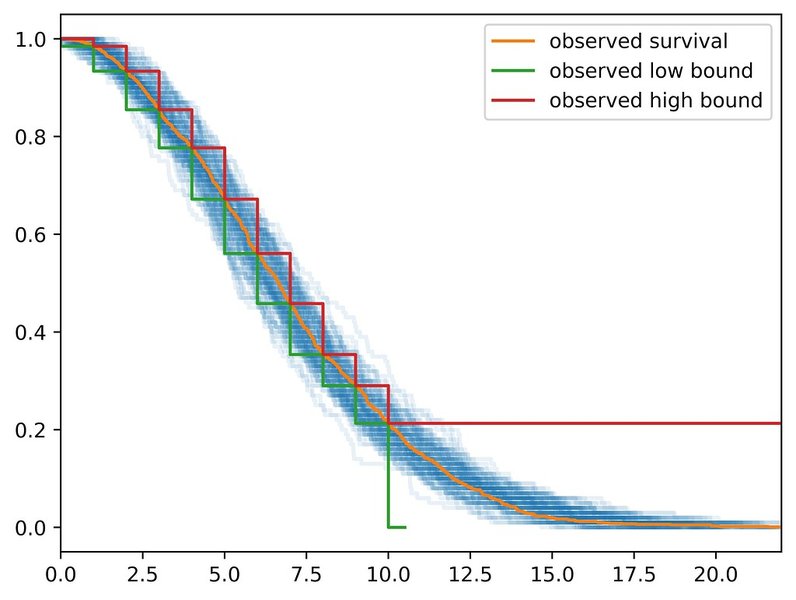
Graphical representations are often used in Bayesian modeling, including survival models which frequently involve censored data (image concept).
These images conceptually relate to the statistical challenges posed by censored data. Bayesian quantile estimation provides a sophisticated framework to build models like these, accurately accounting for the information contained (and not contained) in censored observations.
Addressing Left-Censoring Challenges
Left-censored data present specific statistical hurdles. The table below summarizes these challenges and outlines how Bayesian quantile estimation specifically overcomes them.
| Challenge with Left-Censored Data | How Bayesian Quantile Estimation Addresses It |
|---|---|
| Loss of Information | Instead of discarding data below LOD, it incorporates the information that the value is *less than* LOD into the likelihood function. |
| Bias from Simple Imputation | Avoids fixed substitutions (e.g., 0, LOD/2). Treats censored values as parameters/latent variables to be estimated probabilistically based on all available information (observed data, priors, model structure). |
| Difficulty Estimating Lower Tails | Quantile regression specifically targets different parts of the distribution. Bayesian methods provide robust estimates even for lower quantiles by leveraging the model structure and priors. |
| Underestimation of Variance | Simple imputation often artificially reduces variance. Bayesian MCMC methods naturally propagate uncertainty, providing more realistic variance estimates and credible intervals that reflect the uncertainty due to censoring. |
| Handling Non-Normality/Skewness | Quantile regression is inherently robust to distributional assumptions. The Bayesian framework easily accommodates non-standard distributions (like ALD) suitable for quantile modeling. |
| Complexity in Multivariate Settings | Bayesian hierarchical models and joint modeling approaches allow simultaneous analysis of multiple correlated variables, even when some or all are subject to censoring. |
Understanding Censoring and Bayesian Imputation
The concept of treating censored or missing data within a Bayesian framework is fundamental. While not specific to quantile regression, the following video provides an excellent introduction to how Bayesian methods handle missing data, including censored observations, using imputation techniques driven by the model structure and observed data.
This lecture from the "Statistical Rethinking" series discusses Bayesian imputation. Around the 1 hour 13 minute mark (01:13:16), it specifically touches upon censored observations as a form of missing data that Bayesian models can naturally handle. The core idea is that the model itself predicts or 'imputes' the likely values for the missing/censored data points based on the patterns learned from the complete data and the model's assumptions, fully accounting for the associated uncertainty.
Applications Across Disciplines
The ability of Bayesian quantile estimation to handle left-censored data makes it valuable in numerous fields:
- Environmental Science: Estimating quantiles of pollutant concentrations when measurements are below the LOD, crucial for risk assessment.
- Medical Research & Public Health: Analyzing biomarker levels (e.g., viral loads in HIV studies) or symptom scores where detection limits exist. Assessing exposure to multiple chemicals simultaneously from biomonitoring data.
- Food Safety: Determining contaminant levels in food products where assays have detection limits.
- Metabolomics: Analyzing metabolite concentrations where some fall below the sensitivity of measurement instruments.
- Economics & Finance: Modeling variables that might be censored due to survey design or reporting thresholds (though left-censoring might be less common here than right-censoring).
Frequently Asked Questions (FAQ)
References
-
Evaluation of Bayesian estimation with the Markov chain Monte Carlo method for left‐censored data based on the simulation research - NCBI
-
A Multivariate Bayesian Framework for Assessing Exposure Using Multiple Lines of Evidence Accounting for Left Censored Measurements - NCBI
- Bayesian joint quantile regression models for longitudinal data with multiple covariates subject to detection limits and measurement errors - SAGE Journals
-
Quantile regression for censored mixed-effects models with applications to HIV studies - NCBI
- Bayesian analysis of left-censored data using Weibull mixture model - SpringerLink
- Bayesian quantile regression for censored data - PubMed
- Bayesian analysis of quantile regression for censored dynamic panel data models - SpringerLink
Recommended
Last updated April 10, 2025