
The Enigmatic World of Bear Slumber: Unraveling Their Resting Habits
From Deep Hibernation Dens to Opportunistic Naps, Bears Master the Art of Rest Across Seasons
Bears, fascinating creatures of the wild, exhibit a diverse array of sleeping habits influenced by factors such as species, season, habitat, and even human presence. While the iconic image of a bear hibernating in a cave during winter is widely known, their daily and seasonal resting behaviors are far more nuanced and adapted to their survival needs. From elaborate winter dens to quick, opportunistic naps in various natural settings, bears demonstrate remarkable flexibility in how and where they seek rest.
Key Insights into Bear Sleeping Habits
- Diverse Denning Strategies: Bears utilize a wide range of den types for winter hibernation, including self-dug excavations, hollow trees, rock crevices, brush piles, and even human-made structures. The choice of den is often dependent on local habitat and climate conditions.
- "Super Hibernators" Not Deep Sleepers: Contrary to popular belief, bears do not enter a deep, coma-like sleep during hibernation. Instead, they undergo a state of torpor, a reduced metabolic state where their body temperature, heart rate, and respiration slow significantly, but they can be roused relatively easily.
- Seasonal Sleep Variations: A bear's sleep patterns shift dramatically with the seasons. While they hibernate for months in winter to conserve energy when food is scarce, they become highly active foragers in autumn, often sleeping for fewer hours. During warmer months, they are opportunistic nappers, resting in various sheltered or open locations.
The Winter Sanctuary: Understanding Bear Dens and Hibernation
The concept of bears "sleeping through the winter" is largely tied to their practice of hibernation, a critical survival strategy in environments with harsh cold and limited food availability. However, it's important to differentiate bear hibernation from the deep, unresponsive slumber of true hibernators. Bears enter a state of dormancy known as torpor, which allows them to conserve energy while remaining somewhat responsive to their surroundings. This remarkable adaptation enables them to go months without eating, drinking, urinating, or defecating, effectively recycling waste products and even healing injuries during this period.
Crafting the Perfect Winter Home
The selection and construction of a winter den are crucial for a bear's survival during hibernation. Bears are highly adaptable in their choice of den sites, with preferences varying based on species, geographic location, and available natural resources.
Preferred Den Locations: A Habitat-Driven Choice
Bears exhibit a fascinating adaptability when it comes to choosing their winter dens. While cartoons might depict every bear in a cozy cave, the reality is far more diverse. In many regions, bears primarily dig their own dens. These can be excavated into hillsides or under the extensive root systems of large trees. Such self-made dens often collapse after use, meaning bears rarely reuse the exact same dug den in successive years, though they might return to the same general area.
Beyond self-dug retreats, bears readily utilize natural shelters. Hollow trees are a significant choice, especially in wooded areas like the Sierra Nevada and Carson ranges, offering hidden and protected spaces. Large rock formations, crevices, and natural caves also serve as effective dens, providing protection from the elements and potential disturbances. In Florida, black bears commonly make ground dens in dense thickets, but also use tree cavities and spaces under fallen trees or logs.
Interestingly, bears have also been found denning in more unexpected places, including brush piles, abandoned tires, and even under human porches or in construction subdivisions, highlighting their opportunistic nature when seeking safe, insulated spots.
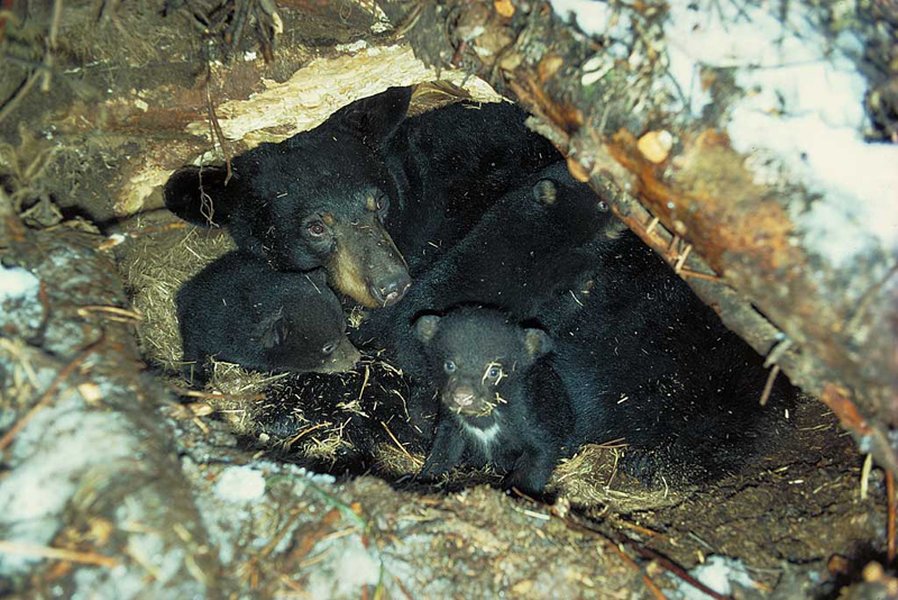 A protective den under a fallen tree provides a safe haven for a mother bear and her cubs during the winter months.
The Engineering of a Den: Insulation and Security
Once a den site is chosen, bears may prepare it for winter occupancy. They often line their dens with insulating materials like grass, leaves, ferns, and moss, creating a more comfortable and thermally efficient space. This bedding helps them conserve body heat, particularly important when the ground is still frozen in early spring. The structural integrity and insulation of the den are paramount for successful hibernation.
In Arctic regions, where permafrost prevents digging into the ground, polar bears exhibit unique denning behavior. Pregnant females dig maternity dens in snow drifts, which consist of an entrance tunnel and several chambers. The insulating qualities of snow are so effective that the internal den temperature can remain significantly warmer than the outside air, even when external temperatures are well below freezing. These snow dens can be vulnerable to wind shifts, which may thin or split the roof, sometimes forcing the female to relocate to a temporary or deserted den.
The Rhythms of Hibernation: More Than Just Sleep
Bear hibernation is a sophisticated biological process that goes beyond simple sleep. It's a state of metabolic depression where their bodies undergo profound physiological changes to endure periods of scarcity.
Metabolic Slowdown and Energy Conservation
During hibernation, a bear's metabolic rate drops dramatically, allowing them to rely almost entirely on stored fat reserves for energy. Their breathing can slow to as little as one breath every 45 seconds, and their heart rate can decrease to just a few beats per minute. This energy-conservation mode is vital for surviving months without food or water. Despite this slowdown, their body temperature only drops slightly (typically 8-12 degrees Fahrenheit), which is why they are not considered "true hibernators" like groundhogs, whose body temperatures plunge much lower and who wake periodically to eat or excrete.
Bears' ability to recycle waste products internally means their dens remain remarkably clean and odor-free. They also maintain muscle mass and bone density, emerging in spring without significant weakness or osteoporosis, a phenomenon that continues to fascinate scientists and holds potential implications for human medicine.
Seasonal Timing of Denning
The onset of denning varies geographically and by individual bear. Factors such as food availability, temperature changes, and the amount of daylight trigger bears to seek out dens. In some northern areas, bears may begin denning before Halloween, while in others, it might not be until January. Pregnant females are typically the first to enter their dens, followed by other females and younger bears. Healthy adult males with ample fat reserves are often the last to den, sometimes not denning at all in milder climates or if food remains abundant.
The length of hibernation also depends on the region. In colder northern parts of Alaska, bears may hibernate for about seven months, while in warmer coastal regions, the duration can be shorter. In Florida, bears den for shorter periods and sleep less deeply.
This radar chart illustrates key physiological differences between bear hibernation and typical true hibernation (like that of a groundhog). As "super hibernators," bears exhibit high capabilities in metabolic rate reduction, waste recycling, bone density maintenance, and muscle mass conservation, while their body temperature drop is relatively modest, and they can be roused with moderate frequency. In contrast, true hibernators experience a more significant body temperature plunge and are less easily aroused, but their ability to maintain bone density and muscle mass during prolonged dormancy is less pronounced compared to bears. This chart highlights the unique evolutionary adaptations that allow bears to survive harsh winters.
Daily and Seasonal Sleep Patterns Beyond Winter
While winter hibernation is a defining characteristic for many bear species, their sleep habits during the warmer months are equally fascinating and demonstrate their adaptability to varying environmental conditions and food availability.
The Daily Rhythms of Rest
Unlike humans who typically sleep in one continuous block, bears are often opportunistic sleepers, taking short naps throughout the day and night. Their activity patterns can be described as diurnal (active during the day), crepuscular (active during dawn and dusk), or even nocturnal (active at night), depending on the species, local habitat, and presence of humans.
Diurnal vs. Nocturnal Habits
Most bear species, including brown bears and black bears, are primarily diurnal, meaning they are most active during daylight hours. They might sleep an hour or two after sunset and wake up half an hour before sunrise. However, in areas with significant human activity, bears may become more crepuscular or nocturnal to avoid human encounters, foraging for food under the cover of darkness. Polar bears, often dictated by hunting opportunities on ice, can have more irregular sleep patterns, taking naps whenever possible.
Opportunistic Naps and Resting Spots
During the active seasons (spring, summer, autumn), bears don't have permanent "beds" in the way they have winter dens. They are highly adaptable and will bed down wherever they feel safe and comfortable. This can include:
- Dense Thickets and Brush Piles: Providing cover and a sense of security from predators or disturbances.
- Under the Crown of Downed Trees or Logs: Offering shelter and insulation.
- Standing Corn Fields or Swamps: Areas with tall vegetation offer excellent concealment.
- Open Woods or Fields: If they feel secure and have a full belly, bears might simply stretch out and snooze wherever they are.
- Tree Branches: Bears, especially black bears, are excellent climbers and may nap high up in trees, sometimes even while feeding.
- Day Beds: In warmer weather, bears may create shallow depressions or "beds" in vegetation to rest. These are often away from human presence and other bears.
Bears will also nap during the hottest part of the day, usually around midday through the early afternoon, to avoid overheating and conserve energy.
This video from the North American Bear Center explains what triggers black bears to go into their dens for winter. It discusses the role of daylight hours and the availability of natural foods as primary motivators for denning, emphasizing that it has little to do with temperature alone.Seasonal Influences on Sleep Duration
The amount of time a bear sleeps outside of hibernation is largely dictated by the season and the availability of food.
- Spring: As bears emerge from their dens, they are incredibly hungry and focused on finding food to replenish lost fat reserves. Sleep duration might be slightly increased compared to summer as they recover from hibernation, but foraging takes precedence.
- Summer: Bears are highly active during summer, focusing on foraging and building up their body fat. They are opportunistic nappers, taking short rest periods throughout the day and night.
- Autumn (Hyperphagia): This is a critical period where bears enter a state of "hyperphagia," meaning they eat voraciously to prepare for winter. They can spend up to 20 hours a day eating, leaving very little time for sleep. Their primary objective is to consume as many calories as possible to build sufficient fat stores for hibernation.
The Significance of Bear Sleep in Research and Conservation
Understanding bear sleeping habits, particularly denning and hibernation, is crucial for wildlife management and conservation efforts. Research teams often track bear den locations to study reproduction, cub survival rates, and overall bear health. This data helps wildlife agencies make informed decisions about bear management zones and population models.
Monitoring Den Locations for Research
Wildlife departments in various states, such as Wisconsin and Minnesota, actively encourage the public to report black bear den locations. Researchers use GPS collars to track sows and their cubs, collecting vital biological data like sex, age, weight, and body measurements. This information is invaluable for understanding bear foraging behavior, litter frequency, litter size, and cub survival rates. For instance, studies are investigating the connection between human food sources and bear reproduction, as diet can significantly impact cub survival.
When a den is reported, wildlife staff prioritize safety and accessibility. They carefully monitor the sow's breathing and heart rate while collecting samples and measurements, ensuring the bear's well-being. This ongoing research helps improve population models and ensures better management and conservation of bear species.
Human-Bear Conflict and Den Disturbance
The increasing overlap between human development and bear habitats means that den locations can sometimes be surprisingly close to human dwellings. Wildlife agencies emphasize the importance of leaving dens undisturbed if encountered. Disturbing a den, especially one with a female and cubs, can cause the bear to abandon the den, potentially endangering the cubs. If a den is inadvertently flushed, it's crucial to leave the area immediately, take a GPS point, and report it to wildlife authorities without returning to the site.
Comparative Overview of Bear Sleeping Habits
The table below provides a comparative overview of sleeping and denning characteristics across different bear species, highlighting the diversity in their adaptations.
| Characteristic | Black Bear | Brown Bear (Grizzly) | Polar Bear |
|---|---|---|---|
| Primary Den Types | Hollow trees, rock crevices, self-dug dens (under roots/hillsides), brush piles, thickets, sometimes under human structures. | Self-dug dens (often on steeper slopes), natural caves, rock fissures. | Snow dens (maternity dens in snow drifts), temporary winter shelters in snow. |
| Hibernation Duration (Approx.) | 3-7 months (varies by region, shorter in warmer climates like Florida). | 3-7 months (varies by food availability and latitude). | Primarily pregnant females den for extended periods (4-8 months); males and non-pregnant bears may enter 'walking hibernation' or take shorter naps. |
| Metabolic State in Winter | Torpor (reduced metabolic state, body temperature drops ~12°F, but easily aroused). | Torpor (reduced metabolic state, body temperature drops slightly, but can be aroused). | Pregnant females: dormant state similar to hibernation, body temperature doesn't decrease as much as other species. Males/others: "walking hibernation." |
| Daily Activity Pattern | Mainly diurnal/crepuscular; can be nocturnal near humans. Opportunistic nappers during day. | Mainly diurnal; can be crepuscular/nocturnal near humans. Opportunistic nappers. | Opportunistic sleepers, often adapting to hunting schedules; takes short naps (1-2 hours). |
| Autumn Sleep/Feeding Balance | Spends up to 20 hours/day eating (hyperphagia), very little sleep. | Spends up to 20 hours/day eating for up to 84,000 calories/day, very little sleep. | Rest for up to 87% of the day during periods of less ice for hunting (July-December). |
| Den Reuse | Dug dens seldom reused; may return to general area; hollow trees/rock dens may be reused. | Rarely reuse the same den, as many collapse; return to same general area. | Maternity dens can be reused, but often collapse or become unsuitable due to wind/thawing. |
Frequently Asked Questions About Bear Sleep
Do bears truly sleep through the entire winter?
Where do bears sleep during the day when not hibernating?
What is "walking hibernation" in bears?
Why do bears eat so much in the autumn?
Conclusion
The sleeping habits of bears are a testament to their incredible adaptability and evolutionary success. From the meticulously chosen and insulated winter dens that protect them during months of torpor, to their opportunistic daytime naps in various natural settings, every aspect of their rest is finely tuned to environmental conditions and survival needs. Bears are not merely "sleepers" but master strategists of energy conservation, preparing diligently for periods of scarcity and optimizing their rest for maximum efficiency. Understanding these intricate patterns not only satisfies our curiosity but also provides crucial insights for their ongoing conservation and harmonious coexistence with humans.
Recommended Further Reading
- How do bear species differ in their hibernation physiology?
- The impact of human presence on bear activity patterns
- Bear hibernation research and its medical implications for humans
- Seasonal foraging strategies of bears before and after hibernation