
Unlock Your Soccer Potential: Master Foot Juggling From Scratch!
Your step-by-step guide to developing silky smooth ball control with just your feet, even if you're a total beginner.
Essential Insights for Aspiring Jugglers
- Focus on Technique First: Prioritize clean contact with your laces and a locked ankle over the number of juggles initially.
- Start Simple & Build Gradually: Begin with basic drop-and-catch drills before attempting consecutive touches or alternating feet.
- Consistency is Key: Short, regular practice sessions (15-20 minutes, several times a week) yield better results than infrequent marathon sessions.
Why Learn to Juggle with Your Feet?
Juggling a soccer ball using primarily your feet is more than just a flashy trick; it's a fundamental skill that significantly enhances your overall game. It directly improves your first touch, ball control, balance, coordination, and focus. For beginners, mastering foot juggling builds confidence and lays a crucial foundation for more advanced ball-handling techniques. While it requires patience and practice, the payoff in improved on-field performance is substantial.
Setting Up for Success: Your First Steps
Choosing Your Gear and Space
The Right Ball
Start with a standard size 5 soccer ball (for adults/older youth). However, many beginners find it easier to control a slightly under-inflated ball initially. A softer ball has less bounce, making it more forgiving as you learn the basic touch. Once you gain confidence, transition to a properly inflated ball. Some sources also suggest practicing occasionally with a smaller ball (size 3 or 4) to refine precision, but your primary practice should be with the size you'll use in games.
The Ideal Environment
Find a flat, open area with plenty of space and minimal distractions, like a park, backyard, or an empty court. Having room to move without obstacles allows you to focus entirely on the ball and your technique.
Mastering the Stance and Body Position
Proper body positioning is crucial for balance and control:
- Feet: Stand with your feet shoulder-width apart.
- Knees: Keep both knees slightly bent – this applies to your standing leg as well as your juggling leg. Bent knees act as shock absorbers and allow for quicker adjustments.
- Posture: Lean slightly forward from your hips, keeping your head and eyes focused on the ball.
- Balance: Stay light on the balls of your feet (your toes), ready to shift your weight. Use your arms slightly out to the sides to aid balance, similar to walking a tightrope.
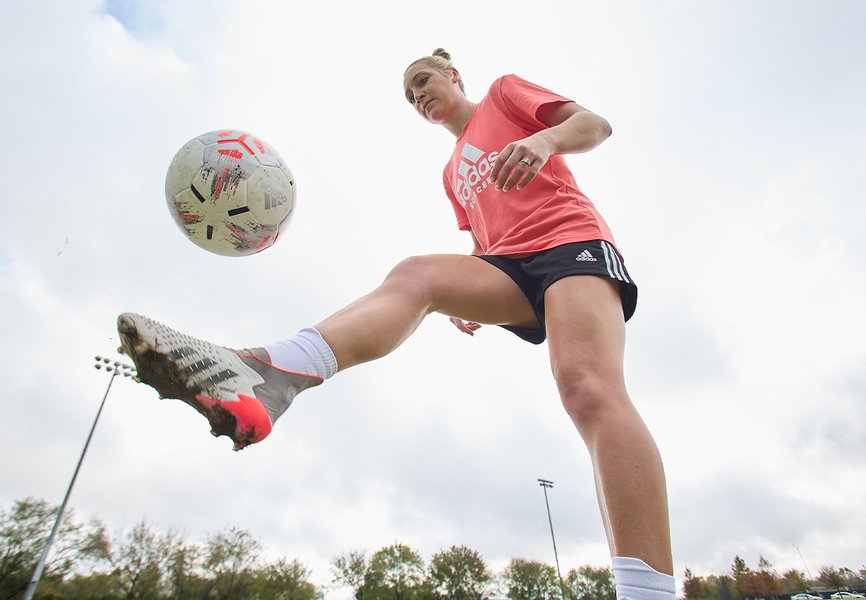
Focus on contacting the ball with the lace area of your shoe.
The Perfect Touch: Foot Contact Technique
How you strike the ball is the most critical element:
- Contact Point: Aim to make contact with the top of your foot, specifically the area covered by your shoelaces, slightly towards the base of your toes. Avoid using the very end of your toes (which sends the ball erratically) or the side of your foot initially.
- Ankle Position: Keep your ankle locked and firm throughout the contact. A floppy ankle leads to inconsistent touches and loss of control. Your foot should be relatively parallel to the ground at the moment of impact, perhaps angled slightly upward.
- Touch Height & Power: Use a gentle, controlled lift rather than a hard kick. For beginners, aim to pop the ball just a few inches (or up to waist height at most). Lower touches are easier to control. Think of cushioning the ball's fall and gently guiding it upward.
- Ball Spin: Try to impart a slight backspin on the ball with each touch. This helps stabilize the ball's flight and makes it return towards you more predictably. Achieve this with a subtle scooping motion as you lift your foot.
Building Your Skills: Beginner Drills
Start with the absolute basics and gradually increase complexity as you gain confidence. Don't rush the process!
Drill 1: The Foundational Drop & Catch
This is the cornerstone of learning foot juggling.
- Hold the ball out in front of you at waist or chest height.
- Drop the ball straight down towards your dominant foot.
- As it descends, step slightly towards it and meet it with your laces, using the technique described above.
- Gently lift the ball straight back up towards your hands (aim for waist height).
- Catch the ball.
- Repeat this 10-20 times successfully before trying your non-dominant foot. Focus entirely on the quality of the touch.
Optional Variation: Some find it helpful to start seated on the ground with legs extended, dropping the ball onto their laces and kicking it back up to their hands. This isolates the foot action.
Drill 2: Single Foot Repetitions
Once the drop-and-catch feels comfortable:
- Drop the ball to your dominant foot.
- Instead of catching, try to get a second touch with the *same* foot, keeping the ball low and controlled.
- Catch the ball after two touches.
- Gradually work your way up: aim for 3 consecutive touches, then 5, then 10, all with the same foot, before catching.
- Dedicate specific practice time to *only* your non-dominant foot using this same progression.
Drill 3: Alternating Feet - The Two-Touch Rhythm
When you can manage several consecutive touches on each foot individually:
- Drop the ball to your dominant foot (e.g., right).
- Touch it gently across to where your non-dominant foot (left) will be.
- As the ball descends, touch it back up with your non-dominant foot.
- Catch the ball. (Right -> Left -> Catch)
- Practice this sequence until smooth. Then try Left -> Right -> Catch.
- Gradually progress to Right -> Left -> Right -> Catch, and so on, building a continuous rhythm.
Drill 4: Incorporating Bounces (Optional Helper)
If continuous juggling is proving difficult, use bounces to slow things down:
- Drop the ball, touch it once with your foot.
- Let the ball bounce once on the ground.
- As it comes back up, get another touch with the same or alternating foot.
- Let it bounce again.
- Continue the pattern: Touch -> Bounce -> Touch -> Bounce. This helps develop timing and rhythm at a slower pace. Gradually try to remove the bounces.
Summary of Beginner Drills
This table provides a quick overview of the core beginner drills and their primary focus:
| Drill Name | Description | Primary Focus |
|---|---|---|
| Drop & Catch | Drop ball, one touch with laces back to hands, catch. | Basic foot contact, ankle lock, touch control. |
| Single Foot Reps | Consecutive touches with the same foot before catching. | Consistency on one foot, building control. |
| Alternating Feet | Touching the ball back and forth between feet. | Rhythm, balance, coordination between feet. |
| Bounce Juggling | Allowing a bounce between each foot touch. | Slower-paced rhythm, timing development. |
Visualizing the Learning Path: Juggling Mindmap
Understanding the progression can help structure your practice. This mindmap outlines the key stages for a beginner focusing on foot juggling:
Key Factors for Juggling Improvement
Success in learning to juggle involves several interconnected factors. This chart visualizes the relative importance of key elements for a beginner's progress. Higher scores indicate greater importance or impact.
As the chart suggests, consistent practice and correct technique are paramount. Patience is also vital, as frustration can hinder progress. Balancing these elements will significantly accelerate your learning curve.
Video Tutorial: Beginner Juggling Guide
Watching experienced players and instructors can provide valuable visual cues. This video offers a straightforward tutorial focusing on the fundamental steps for beginners learning to juggle with their feet.
Pay attention to the instructor's foot positioning, the height of the touches, and the emphasis on starting slow and building repetition. Visualizing the correct form can help reinforce the techniques you're practicing.
Practice Makes Perfect: Routine and Mindset
Consistency Over Duration
Short, focused practice sessions performed regularly are far more effective than long, infrequent ones. Aim for 15-20 minutes of dedicated juggling practice at least 4-5 times per week. This helps build muscle memory without leading to burnout or excessive frustration.
Set Achievable Goals
Track your progress! Set small, realistic goals for each session or week. Examples:
- Achieve 5 consecutive juggles with your non-dominant foot.
- Complete 10 alternating (right-left) touches without dropping the ball.
- Juggle continuously for 15 seconds.
Keep a log of your personal bests (e.g., highest number of consecutive juggles). Trying to beat your own record provides motivation and a clear measure of improvement.
Embrace Patience and Relaxation
Learning to juggle takes time – don't get discouraged! Everyone starts at zero. Stay relaxed; tension in your body, especially your legs and ankles, will make control much harder. If you get frustrated, take a short break and come back fresh. Remember that the goal is gradual improvement, not instant mastery.
Adding Movement
Once you can comfortably juggle while standing still (e.g., 20+ consecutive touches), start incorporating gentle movement. Try walking slowly forward while juggling. This increases the difficulty but makes the skill more applicable to game situations.
Troubleshooting: Common Beginner Mistakes & Fixes
- Mistake: Ball goes too high or flies away.
Fix: Focus on softer touches. Keep your leg movement minimal and controlled. Ensure your foot is angled slightly up, not flat or pointing down. Check ball inflation – slightly less air can help initially. - Mistake: Inconsistent contact / hitting with toes or side of foot.
Fix: Slow down. Return to the drop-and-catch drill, focusing intently on hitting the ball squarely with your laces. Ensure your ankle is locked. - Mistake: Losing balance / constantly chasing the ball.
Fix: Keep your knees bent and stay light on your feet. Use your arms for balance. Aim to keep the touches low and directly in front of you, minimizing the need to move. - Mistake: Ankle feels loose or wobbly.
Fix: Consciously focus on keeping your ankle firm and stable through the entire kicking motion. Practice the drop-catch drill specifically concentrating on the ankle lock. - Mistake: Much better with one foot than the other.
Fix: This is normal! Dedicate extra practice time *specifically* to your weaker foot using the single-foot repetition drill until it starts to catch up.
Frequently Asked Questions (FAQ)
How long does it take to get good at foot juggling?
This varies greatly depending on natural coordination, practice frequency, and quality of practice. With consistent effort (15-20 mins, 4-5 times/week), beginners might achieve 10-20 consecutive juggles within 2-4 weeks. Reaching 50-100+ juggles might take a few months. Focus on consistent progress rather than a strict timeline.
Do I need a special type of soccer ball?
No, a standard size 5 soccer ball is fine. As mentioned, slightly deflating it can make learning easier initially due to reduced bounce. Some players find practicing with different sized balls (smaller ones for precision, larger ones for basic touch) helpful, but it's not essential. The key is consistent practice with whatever ball you have.
Should I only use my feet, or include thighs and head?
As a beginner focusing on improving foot skills, it's best to primarily concentrate on using your feet (laces). Mastering foot juggling provides the most direct benefit to your game's first touch and control. Once you are comfortable with foot juggling, you can certainly start incorporating thigh and head touches to become a more versatile juggler, but solidify the footwork foundation first.
What's the biggest mistake beginners make?
Often, it's trying to do too much too soon (aiming for high numbers immediately) or neglecting proper technique (floppy ankle, kicking too hard, using toes). Focus on quality touches, proper form (especially locked ankle and lace contact), and gradual progression from the basic drop-and-catch drill. Patience and consistency are more important than hitting high numbers with poor form.
Recommended Next Steps
Explore these related topics to further enhance your soccer skills:
- Discover drills specifically designed to improve your first touch receiving passes.
- Learn fundamental dribbling skills to control the ball while moving.
- Find effective solo training methods to sharpen your overall ball mastery.
- Challenge yourself with more complex juggling patterns once you master the basics.
References
Last updated May 5, 2025