
Exploring the Leading Edge of AI Tools in 2025
A Comprehensive Look at Top Artificial Intelligence Solutions
Key Insights into the Best AI Tools
- ChatGPT, Claude, and Gemini are consistently highlighted as top-tier AI models, offering robust capabilities for a wide range of tasks including writing, coding, and information retrieval.
- The "best" AI tool is highly dependent on the specific use case, with specialized tools excelling in areas like content creation, coding assistance, design, and automation.
- Many powerful AI tools offer free tiers or trials, making them accessible for users to experiment and find the best fit for their needs before committing to paid subscriptions.
Understanding the Diverse Landscape of AI Tools
The artificial intelligence landscape in 2025 is incredibly dynamic and diverse, with a vast array of tools designed to address specific needs and enhance productivity across various domains. Identifying a single "best" AI tool is challenging because the optimal choice depends heavily on the user's requirements, whether it's for writing, coding, design, research, or automation.
Major players like OpenAI, Google, and Anthropic continue to develop and refine powerful large language models (LLMs) such as ChatGPT, Gemini, and Claude. These models serve as the foundation for many applications and are widely used for their versatility in understanding and generating human-like text, translating languages, writing different kinds of creative content, and answering your questions in an informative way.
Beyond these general-purpose models, a wealth of specialized AI tools has emerged, each tailored to excel in particular tasks. These include tools for generating images and videos, assisting with coding, automating marketing tasks, enhancing writing quality, and streamlining design workflows. The rapid pace of development means that new and improved tools are constantly appearing, offering users increasingly sophisticated capabilities.
Leading AI Models and Their Strengths
General-Purpose Powerhouses: ChatGPT, Claude, and Gemini
When considering general-purpose AI models, ChatGPT by OpenAI, Claude by Anthropic, and Gemini by Google are frequently cited as the top contenders. Each offers a unique set of strengths that make them valuable for different users and tasks.
ChatGPT: The Versatile Conversationalist
ChatGPT remains a go-to tool for many users due to its strong conversational abilities and broad knowledge base. It excels at drafting emails, brainstorming ideas, summarizing information, and even assisting with coding tasks. Its versatility makes it a valuable assistant for a wide range of personal and professional activities. OpenAI also continues to innovate, introducing features like "Operators" which allow the AI to perform actions like booking hotels or shopping online.
The familiar interface of ChatGPT, a leading conversational AI.
Claude: Excelling in Writing and Extended Context
Anthropic's Claude is particularly praised for its capabilities in writing and handling longer contexts. Users find it highly effective for tasks requiring extensive text analysis, editing, and creative writing. Its ability to maintain coherence over long conversations and documents sets it apart for tasks like drafting reports or refining manuscripts. Claude's transparency in showing its reasoning also builds user trust.
Gemini: Google's Competitive Offering
Google's Gemini is a powerful competitor in the AI space, offering robust capabilities for various tasks. While some users note its responses can be brief compared to others, it is a strong option for many applications and is continuously being integrated into Google's ecosystem of products.
Specialized AI Tools for Specific Needs
Boosting Productivity and Creativity
Beyond the major LLMs, numerous AI tools cater to specific professional and creative workflows, offering specialized features that significantly enhance efficiency and output quality.
AI for Content Creation
For writers and marketers, tools like Jasper AI and Copy.ai are highly regarded for their ability to generate marketing content, blog posts, ad copy, and more. WriteSonic is another AI writing tool that assists in generating creative content and ideas quickly. These tools can help overcome writer's block and accelerate content production.
Copy.ai provides AI-powered tools for generating various types of marketing copy.
AI for Coding Assistance
Developers benefit greatly from AI coding assistants. Tools like Qodo and others on the market offer precise code suggestions, help with syntax and language complexity, and can even assist in generating test cases. Claude is also mentioned as a strong option for coding tasks and code reviews.
AI coding assistants offer real-time suggestions to improve code quality and speed.
AI for Design
AI is also transforming the design world. Tools like Visily and Uizard utilize AI to help users generate UI designs from text prompts or even hand-drawn sketches, making the design process faster and more accessible.
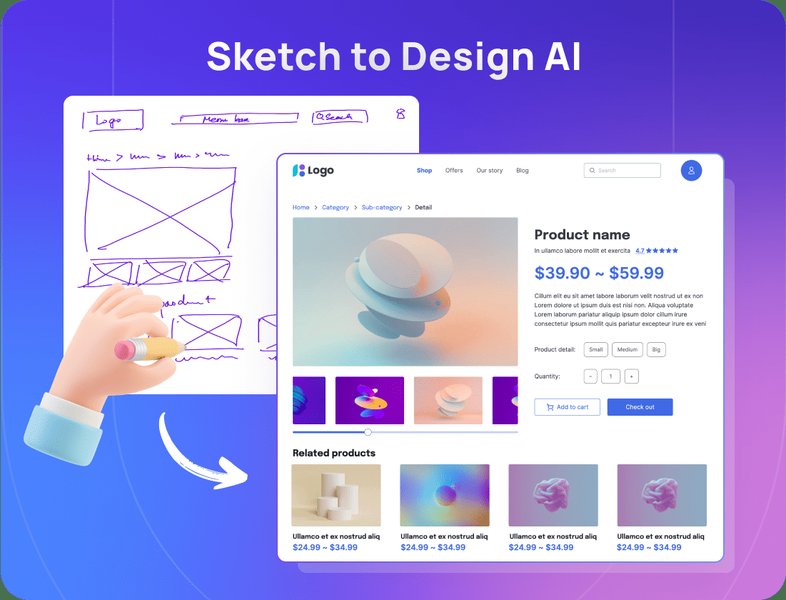
AI design tools can quickly turn sketches into digital wireframes.
AI for Automation
Automation is a key area where AI tools shine. Zapier, for example, can connect various apps and automate repetitive tasks. Other AI automation tools are being used across industries to streamline processes and improve efficiency.
Zapier enables automation workflows between different applications.
AI for Productivity and Organization
Tools like Notion AI and Otter.ai are valuable for productivity. Notion AI assists with writing, brainstorming, and editing within the Notion workspace, while Otter.ai provides transcription services, which can be particularly useful for meetings and lectures.
Considering Use Cases and Features
When determining the "best" AI tool for your needs, it's crucial to consider the specific tasks you want the AI to perform and the features that are most important to you. Factors such as accuracy, speed, ease of use, scalability, and integration with other tools play a significant role in the decision-making process.
For example, a student might prioritize an AI that excels at summarizing research papers and assisting with writing essays, while a marketing professional might look for tools with strong content generation and automation capabilities. Developers will focus on AI assistants that provide accurate code suggestions and debugging support.
The cost is also a significant factor. Many AI tools offer free tiers or trials, allowing users to test their functionality before committing to a paid subscription. Paid plans often unlock more advanced features, higher usage limits, and priority support.
Here is a table summarizing some of the popular AI tools and their primary use cases:
| AI Tool | Primary Use Cases | Key Strengths |
|---|---|---|
| ChatGPT | General conversation, writing, brainstorming, coding assistance | Versatility, strong conversational abilities, broad knowledge |
| Claude | Writing, editing, long context analysis, coding | Excellent writing quality, handling of long documents, transparency |
| Gemini | General tasks, information retrieval | Integration with Google ecosystem |
| Jasper AI | Marketing content generation, blogging, ad copy | Specialized in marketing content |
| Copy.ai | Content creation, marketing copy | Focus on boosting creative content |
| Qodo | Coding assistance, test case generation | Precise code suggestions |
| Visily | UI design generation | AI-powered design creation |
| Uizard | UI design generation from sketches | Transforming hand-drawn ideas into designs |
| Zapier | Task automation, app integration | Connecting and automating workflows |
| Notion AI | Writing assistance, brainstorming, editing within Notion | Integration with Notion workspace |
| Otter.ai | Transcription | Accurate and fast transcription |
Emerging Trends and Tools in 2025
AI Gadgets and Enhanced Capabilities
The year 2025 is also seeing the rise of AI integrated into physical gadgets, aiming to provide more seamless and intuitive interactions with technology. While some are still in early stages, they represent a growing trend of AI moving beyond software into tangible devices.

AI gadgets like the Rabbit R1 are exploring new forms of human-AI interaction.
Furthermore, AI capabilities are continually being enhanced. We are seeing improved accuracy, speed, and scalability in existing tools. The ability of AI to process and analyze larger and more complex datasets is increasing, leading to more sophisticated applications in areas like predictive analytics and research.
Adaptability and customization are also becoming more important, with users seeking AI tools that can be tailored to their unique needs and workflows. This suggests a future where AI is not just a set of predefined tools, but a flexible technology that can be shaped to fit individual and business requirements.
Reviews and Finding the Right Tool
Leveraging User Experiences and Expert Opinions
With the abundance of AI tools available, navigating the options can be challenging. AI tool review websites and platforms play a crucial role in helping users make informed decisions. These platforms often provide unbiased reviews from real users and experts, offering insights into the effectiveness, accuracy, and usability of different tools.
Websites like G2, Gartner Peer Insights, and others compile user reviews and ratings, allowing prospective users to see how tools perform in real-world scenarios. Expert reviews, often found on tech websites and blogs, provide in-depth analysis of features and performance.
When researching potential AI tools, it is beneficial to consult multiple sources to get a balanced perspective. Consider both the stated features of a tool and the experiences of other users to determine if it aligns with your needs and expectations.
Frequently Asked Questions About AI Tools
What are the most popular AI tools in 2025?
Some of the most popular AI tools in 2025 include ChatGPT, Claude, Gemini, Jasper AI, Copy.ai, and a variety of specialized tools for tasks like coding, design, and automation.
How much do AI tools cost?
The pricing of AI tools varies widely. Many offer free versions or trials with limited features. Paid subscriptions can range from a few dollars per month to hundreds of dollars for enterprise-level solutions, depending on the features and usage limits.
Can AI tools really improve productivity?
Yes, AI tools are designed to automate repetitive tasks, assist with content creation, provide quick information access, and streamline workflows, all of which can significantly boost productivity for individuals and businesses.
Are there free AI tools available?
Yes, many powerful AI tools offer free tiers or have free alternatives that provide core functionalities, allowing users to experience the benefits of AI without an initial investment.
How do I choose the best AI tool for my needs?
Identify your specific needs and the tasks you want the AI to perform. Research tools that specialize in those areas, read reviews from other users, and take advantage of free trials or versions to test their capabilities before making a decision.
References
Last updated May 4, 2025