
Navigating the Hybrid Horizon: Selecting Your Ideal Cloud Provider
Unlocking the Potential of Seamless Cloud-On-Premise Integration for Your Business
Key Insights into Hybrid Cloud Provider Selection
- Dominant Players: Amazon Web Services (AWS), Microsoft Azure, and Google Cloud Platform (GCP) are the leading contenders in the hybrid cloud space, each offering unique strengths and comprehensive solutions.
- Flexibility and Control: Hybrid cloud deployments offer the best of both worlds—leveraging public cloud scalability and cost-effectiveness while maintaining control and security over sensitive data on-premises.
- Beyond the Hyperscalers: While the "Big Three" are prominent, specialized providers like IBM Cloud, VMware, HPE, and Oracle Cloud also offer compelling hybrid solutions tailored to specific enterprise needs and existing infrastructures.
In today's dynamic digital landscape, businesses are increasingly gravitating towards hybrid cloud deployments to achieve an optimal balance of flexibility, cost-efficiency, and control. A hybrid cloud environment seamlessly integrates on-premises infrastructure with public cloud services, allowing organizations to strategically place workloads based on performance, security, compliance, and cost considerations. Choosing the right cloud provider for a hybrid deployment is a critical decision that can significantly impact a company's operational efficiency, innovation capabilities, and long-term digital strategy.
This comprehensive guide will delve into the leading hybrid cloud providers, examining their core offerings, strengths, and ideal use cases to help you make an informed decision for your organization's unique requirements.
Understanding the Hybrid Cloud Ecosystem
The Interplay of Public and Private Environments
A hybrid cloud solution combines elements of both public and private cloud environments. The public cloud typically involves third-party providers offering shared computing resources over the internet, characterized by scalability and a pay-as-you-go model. Conversely, a private cloud is dedicated to a single organization, often maintained on-premises, providing enhanced control, security, and compliance. The hybrid approach enables data and applications to move seamlessly between these two environments, optimizing resource utilization and data management.
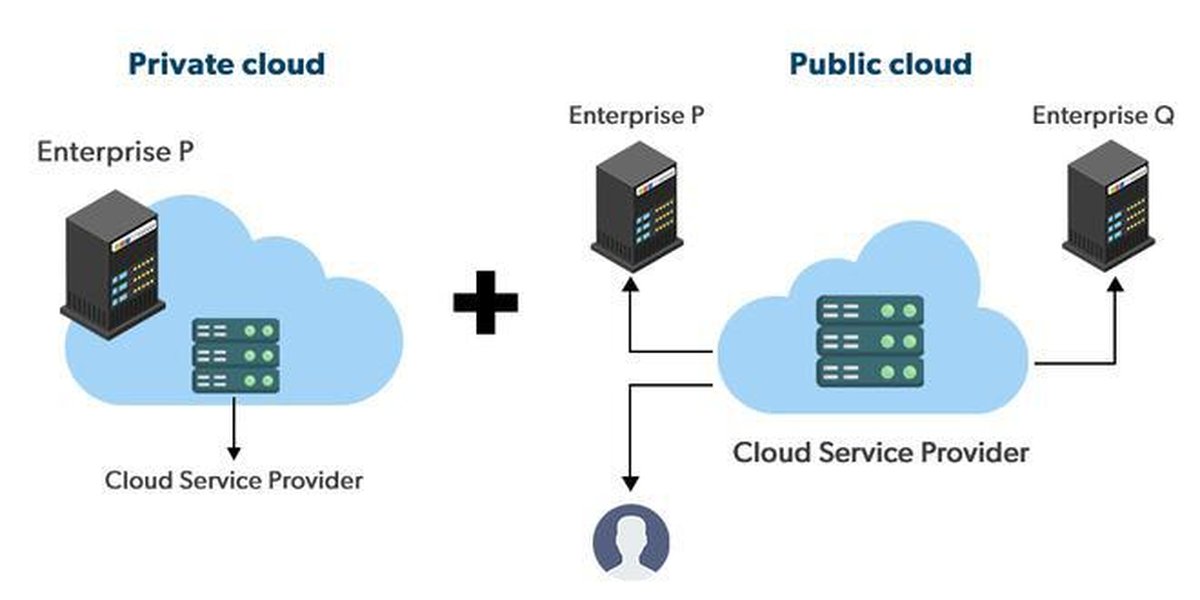
A visual representation of how public and private clouds interoperate in a hybrid cloud setup.
The strategic advantage of a hybrid cloud lies in its ability to manage diverse workloads. Sensitive data and critical applications can reside in the private cloud for stringent control and regulatory compliance, while less sensitive or fluctuating workloads can leverage the public cloud's elasticity and cost benefits. This flexibility also supports robust disaster recovery, business continuity, and the replication of on-premises workloads for backup purposes.
Key Drivers for Hybrid Cloud Adoption
Businesses opt for hybrid cloud for several compelling reasons:
- Flexibility and Scalability: The ability to scale computing resources on-demand to meet fluctuating demands without capital expenditures on physical infrastructure.
- Cost Optimization: Leveraging the public cloud's pay-as-you-go model for burstable workloads, while keeping stable, predictable workloads on-premises.
- Security and Compliance: Maintaining sensitive data in a private environment to meet specific regulatory requirements or internal security policies, while still benefiting from public cloud innovations.
- Disaster Recovery and Business Continuity: Replicating data and workloads across environments to ensure resilience and minimize downtime.
- Legacy System Integration: Bridging existing on-premises infrastructure with modern cloud services, facilitating digital transformation without a complete overhaul.
Top Hybrid Cloud Providers and Their Offerings
The "Big Three" Hyperscalers
Amazon Web Services (AWS), Microsoft Azure, and Google Cloud Platform (GCP) dominate the cloud market and offer extensive hybrid cloud solutions:
Amazon Web Services (AWS) Hybrid Cloud
AWS, the market leader in public cloud, has significantly invested in hybrid offerings. AWS provides solutions that deliver a consistent experience across cloud, on-premises, and edge environments.
- AWS Outposts: Extends AWS infrastructure, services, APIs, and tools to virtually any on-premises data center, providing a truly consistent hybrid experience.
- AWS Wavelength: Embeds AWS compute and storage services within 5G networks, enabling ultra-low-latency applications at the edge.
- AWS Local Zones: Places AWS compute, storage, database, and other select services closer to large population centers and industry hubs.
- AWS Direct Connect: Establishes a dedicated network connection from your premises to AWS, improving bandwidth throughput and providing a more consistent network experience than internet-based connections.
AWS excels in its breadth of services and mature ecosystem, making it suitable for businesses looking to extend their existing AWS investments to on-premises environments.
Microsoft Azure Hybrid Cloud
Microsoft Azure is a strong contender, particularly for organizations with existing Microsoft ecosystem investments. Azure provides robust tools for seamless integration between on-premises infrastructure and the Azure cloud.
- Azure Arc: Extends Azure management to any infrastructure—on-premises, multi-cloud, or edge—allowing consistent management, governance, and security across distributed environments.
- Azure Stack: A portfolio of products (Azure Stack Hub, HCI, Edge) that enable organizations to run Azure services on-premises, ensuring consistency and integration with the Azure public cloud.
- Azure ExpressRoute: Creates private connections to Azure data centers, bypassing the public internet for enhanced security and reliability.
- Azure VPN Gateway: Provides secure, encrypted connectivity between on-premises networks and Azure over the public internet.
Azure's deep integration with Windows Server and .Net frameworks makes it an attractive choice for "lift and shift" migrations of on-premises applications.
Google Cloud Platform (GCP) Hybrid Cloud
GCP, while smaller than AWS and Azure in market share, is rapidly growing and offers compelling hybrid cloud solutions, particularly with its focus on open-source technologies and containerization.
- Anthos: A platform that brings Google Cloud services and management to on-premises environments, other public clouds, and the edge, allowing consistent application deployment and management.
- Google Cloud Dedicated Interconnect: Provides high-bandwidth connections to Google Cloud's network.
- Cloud VPN: Securely connects your on-premises network to your Google Cloud Virtual Private Cloud (VPC) network through an IPsec VPN tunnel.
GCP's strength lies in its advanced analytics, AI/ML capabilities, and strong support for Kubernetes and containerized workloads, making it ideal for organizations focused on modern application development.
Other Leading Hybrid Cloud Solution Providers
Beyond the "Big Three," several other providers offer significant hybrid cloud capabilities:
IBM Cloud
IBM Cloud focuses on enterprise-grade hybrid cloud solutions, often leveraging AI and machine learning to enhance business use cases. IBM Cloud Paks, built on Red Hat OpenShift, enable users to build, deploy, manage, and modernize applications in hybrid environments with a consistent experience.
- Red Hat OpenShift: Provides a consistent and scalable foundation for AI operations and containerized environments across hybrid infrastructures.
- IBM Cloud Satellite: Extends IBM Cloud services to any environment, providing a single management plane.
- IBM Direct Link: Offers high-speed, reliable physical connections between on-premises and IBM Cloud environments.
IBM Cloud is particularly strong for organizations with legacy systems, complex data environments, and a need for modular, AI-powered solutions.
VMware
VMware, a leader in virtualization, offers comprehensive hybrid cloud solutions that leverage its vSphere hypervisor. VMware partners with major public clouds like AWS, IBM Cloud, Oracle, and Microsoft Azure to provide its VMware Cloud services.
- VMware Cloud on AWS: Enables customers to run VMware's software-defined data center (SDDC) stack directly on AWS global infrastructure.
- VMware vSphere: Core virtualization platform that provides a consistent operating environment from on-premises to cloud.
VMware is an excellent choice for businesses already heavily invested in VMware's virtualization technologies, seeking to extend their existing infrastructure to the cloud with minimal changes.
HPE (Hewlett Packard Enterprise) GreenLake
HPE GreenLake offers a portfolio of cloud and as-a-service solutions that bring the cloud experience to wherever data resides—from edge to cloud. It emphasizes a flexible operating environment for multi-generational IT.
- HPE GreenLake Edge-to-Cloud Platform: Provides a unified approach to managing multivendor computing, networking, storage, and application resources in hybrid and multi-cloud IT environments.
- OpsRamp integration: Enhances observability and management capabilities across hybrid and multi-cloud.
HPE GreenLake is suitable for organizations prioritizing an as-a-service model for their hybrid infrastructure, with strong emphasis on on-premises control and integrated management.
Oracle Cloud Infrastructure (OCI)
Oracle offers a complete suite of cloud services, including robust hybrid cloud solutions, known for its strong database capabilities and competitive pricing.
- Oracle Exadata Cloud@Customer: Delivers Exadata as a service within a customer's data center, optimized for Oracle databases.
- Dedicated Region Cloud@Customer: Provides a full Oracle Cloud region in a customer's data center.
OCI is particularly compelling for enterprises with significant Oracle database investments seeking to extend their database workloads to a hybrid environment.
Comparing Hybrid Cloud Provider Capabilities
A Holistic View of Strengths and Specialties
To provide a clearer comparative analysis, the following radar chart illustrates key strengths of the leading hybrid cloud providers based on typical enterprise needs. These are opinionated analyses reflecting general market perceptions and provider focuses.
This radar chart provides a comparative overview of how different hybrid cloud providers generally perform across various key attributes. Higher values indicate stronger performance or focus in that area. It's important to note that actual performance can vary based on specific implementation and business needs.
The chart illustrates that while AWS excels in overall innovation and service breadth, Azure stands out for its deep on-premises integration and legacy system support, often appealing to enterprises with existing Microsoft infrastructures. GCP shows strength in multi-cloud management and cost efficiency due to its open approach. IBM Cloud and VMware are highly capable in supporting legacy systems and providing robust on-premises integration, especially for complex enterprise environments.
Considerations for Your Hybrid Cloud Strategy
Factors Influencing Provider Selection
When selecting the best hybrid cloud provider, consider the following:
- Existing Infrastructure: Evaluate compatibility with your current on-premises hardware, software, and virtualization technologies.
- Workload Requirements: Understand the specific demands of your applications in terms of performance, data residency, latency, and compliance.
- Security and Compliance Needs: Assess the provider's security features, certifications, and ability to meet industry-specific regulations (e.g., HIPAA, GDPR).
- Cost Model: Compare pricing structures, including data transfer costs, storage, compute, and networking, to ensure alignment with your budget.
- Management and Orchestration Tools: Look for unified management consoles, automation capabilities (e.g., Terraform, Ansible), and monitoring solutions that span both environments.
- Vendor Lock-in: Consider the ease of migrating workloads and data to and from the cloud to avoid excessive dependence on a single provider.
- Ecosystem and Partner Network: Evaluate the availability of third-party tools, integrations, and consulting services.
- Support and Expertise: Assess the quality of technical support and the provider's industry-specific expertise.
The Role of Management and Orchestration
Effective hybrid cloud deployment hinges on robust management and orchestration. Tools like Azure Arc, AWS Outposts, and GCP Anthos provide a unified control plane, enabling consistent operations across diverse environments. These platforms help streamline deployment, monitoring, and security, reducing operational complexity.
This video provides insights into hybrid and multi-cloud architectures, offering valuable perspectives on managing these complex environments effectively. Understanding the distinctions and management strategies is crucial for successful deployment.
This video highlights the importance of effective management strategies for hybrid and multi-cloud environments. Given the inherent complexity of integrating disparate systems, robust management and orchestration tools are paramount. Solutions that offer a single pane of glass for monitoring, deploying, and governing resources across both on-premises and public cloud components significantly reduce operational overhead and potential inconsistencies. The discussion in the video underscores that while the concept of hybrid cloud offers immense flexibility, its true value is unlocked through intelligent management that ensures seamless operations, consistent policy enforcement, and optimized resource utilization across the entire hybrid landscape. This reinforces that the chosen provider's management capabilities are as crucial as their underlying infrastructure.
A Snapshot of Key Hybrid Cloud Capabilities
Comparing Feature Sets and Best Fits
The following table provides a concise comparison of the key hybrid cloud capabilities offered by the leading providers, highlighting their unique strengths and ideal applications:
| Provider | Key Hybrid Solution(s) | Strengths for Hybrid | Ideal Use Case |
|---|---|---|---|
| Amazon Web Services (AWS) | Outposts, Wavelength, Local Zones, Direct Connect | Extends AWS services on-premises; broad service portfolio; robust edge computing. | Organizations wanting to extend existing AWS infrastructure; edge computing. |
| Microsoft Azure | Azure Arc, Azure Stack, ExpressRoute | Strong integration with Microsoft ecosystem; unified management; legacy application support. | Enterprises with significant Windows/Microsoft workloads; consistent management across hybrid/multi-cloud. |
| Google Cloud Platform (GCP) | Anthos, Dedicated Interconnect, Cloud VPN | Open-source approach; strong containerization (Kubernetes); AI/ML capabilities. | Modern application development; multi-cloud strategies; AI/ML workloads. |
| IBM Cloud | IBM Cloud Paks (on Red Hat OpenShift), Direct Link, Cloud Satellite | Enterprise-focused; AI/ML enhancements; strong for regulated industries and legacy integration. | Large enterprises with complex legacy systems; AI-driven transformation. |
| VMware | VMware Cloud on AWS/Azure/IBM, vSphere | Leverages existing virtualization investments; consistent operations across private/public. | Organizations heavily invested in VMware on-premises infrastructure. |
| HPE GreenLake | GreenLake Edge-to-Cloud Platform | Consumption-based IT as-a-service; brings cloud experience to on-premises. | Businesses seeking an OpEx model for on-premises IT; edge computing needs. |
| Oracle Cloud Infrastructure (OCI) | Exadata Cloud@Customer, Dedicated Region Cloud@Customer | Optimized for Oracle databases; strong performance and cost efficiency claims. | Enterprises with large Oracle database deployments. |
Frequently Asked Questions (FAQs)
What is the main advantage of a hybrid cloud over a public or private cloud?
Can I use more than one public cloud provider in a hybrid setup?
What are the common challenges in adopting a hybrid cloud?
Is hybrid cloud suitable for small and medium-sized enterprises (SMEs)?
Conclusion
The optimal cloud provider for a hybrid cloud deployment is not a one-size-fits-all answer; it depends significantly on your organization's existing IT landscape, specific workload requirements, security mandates, and long-term strategic goals. While AWS, Azure, and GCP offer comprehensive and mature hybrid solutions, other specialized providers like IBM Cloud, VMware, HPE, and Oracle Cloud also present compelling options, especially if you have significant existing investments in their technologies or particular industry-specific needs. A thorough evaluation of your technical needs, cost constraints, and business priorities, coupled with a deep understanding of each provider's unique offerings, will pave the way for a successful hybrid cloud journey.
Recommended Further Exploration
- How to assess hybrid cloud security and compliance?
- What are the best tools for hybrid cloud management and orchestration?
- Comparing total cost of ownership for hybrid cloud solutions
- Impact of edge computing on hybrid cloud architectures
References
Last updated May 21, 2025