
Unlocking Scripture: Comprehensive Approaches to Bible Memorization and Top App Selections
Delving into effective techniques and modern tools for embedding God's Word in your heart.
Memorizing Scripture is a profound spiritual discipline that offers numerous benefits, from deepening your understanding of God's Word to equipping you for daily challenges and fostering a closer relationship with Christ. It allows you to meditate on passages throughout your day, providing guidance, comfort, and wisdom when you need it most. While the act of memorization itself is valuable, the ultimate goal is to internalize and apply the truths of the Bible to your life, allowing the Holy Spirit to transform you through His Word. This guide explores various effective approaches to Bible memorization and highlights some of the best modern applications designed to support your journey.
Key Insights for Scripture Memorization
- Context is Crucial: Always strive to understand the surrounding verses, chapters, and the broader biblical narrative to grasp the full meaning and correct application of a memorized passage.
- Repetition and Engagement: Consistent, active repetition—through reading aloud, writing, reciting, and even singing—is fundamental to solidifying verses in your memory.
- Leverage Technology Wisely: While ancient believers memorized Scripture without apps, modern tools offer unique features like spaced repetition, audio playback, and gamified learning to enhance the process and keep you motivated.
Effective Approaches to Bible Memorization
Committing Scripture to memory can be approached through various techniques, each suited to different learning styles and goals. A balanced approach often incorporates several of these methods to maximize retention and understanding.
Traditional and Analog Methods
Before the advent of digital tools, believers effectively memorized Scripture through focused, disciplined practices. These methods remain highly effective and can be integrated with app-based approaches.
Repetitive Reading and Recitation
One of the simplest yet most powerful methods is consistent repetition. Reading a verse or passage aloud multiple times helps embed it in your auditory and visual memory. Many recommend reading a passage 10 times and then reciting it aloud from memory 10 times. Gradually, you can recite more verses before referring back to the text, building up to larger sections or even entire chapters.
Writing and Rewriting Scripture
The act of writing out verses by hand engages kinesthetic memory, helping to solidify the words. You can write the verse multiple times, break it down into phrases, or even try writing it from memory after several readings. This method forces you to slow down and pay close attention to each word. Some find it helpful to keep a journal specifically for this purpose, noting observations and applications alongside the written verses.
The "First Letter" Method
This technique, popularized by memory athletes, involves writing down only the first letter of each word in a verse. You then try to recall the entire verse using only these initial letters as prompts. This method can be particularly effective for longer passages, allowing you to build up your recall incrementally. It forces active retrieval, strengthening the memory pathways.
Verse Mapping and Contextual Study
Beyond rote memorization, understanding the context of a verse is paramount. Verse mapping involves delving into the historical context, transliteration, different translations, connotations, and theological framework of a chosen verse. This holistic approach not only aids memorization but also prevents misinterpretation, ensuring you understand God's intended meaning.
Topical and Biographical Studies
Instead of memorizing verses randomly, you can select a specific topic (e.g., peace, forgiveness, prayer) or a biblical character. Use a concordance to find all relevant verses on that topic or about that person. Studying these verses collectively provides a comprehensive understanding of the theme, making the associated verses more memorable due to their thematic connections. This also helps in seeing how Bible truths are illustrated through lives and situations.
Audio Reinforcement
Listening to Scripture being read aloud, especially the verses you are trying to memorize, can be incredibly beneficial. Many Bible apps and audio Bibles allow you to loop specific passages. You can listen while driving, exercising, or even sleeping, leveraging auditory learning to reinforce memorization. Speaking along with recordings can further enhance this method.
This video provides an easy method to break down verses, making memorization less overwhelming.
Structured Study Methods
For those who prefer a more systematic approach, several structured Bible study methods can naturally lead to memorization by promoting deep engagement with the text.
The SOAP Method
SOAP stands for Scripture, Observation, Application, and Prayer. This devotional method encourages active engagement with a passage:
- S - Scripture: Read and write out the chosen verse or passage.
- O - Observation: Note what the passage says. What stands out? What do you learn about God or humanity?
- A - Application: How can you apply this truth to your life today?
- P - Prayer: Write a prayer asking God to help you understand and apply the truth you've learned.
Inductive Bible Study
The inductive method involves observing a passage, interpreting its meaning, and then applying it to your life. This often includes:
- Reading the passage multiple times to grasp the overall message.
- Making a list of everything it says about God (Father, Son, and Holy Spirit).
- Identifying key themes, repeated words, and literary devices.
- Summarizing the chapter or book in your own words.
Optimizing Your Memorization Practice
To make your Bible memorization journey successful and sustainable, consider these practical tips:
Start Small and Build Momentum
Don't try to memorize too much too quickly. Begin with a single verse or a short passage that resonates with you. As you succeed, your confidence will grow, motivating you to tackle longer sections. Consistency over intensity is key.
Choose Meaningful Passages
Select verses or passages that speak to your current life circumstances, spiritual growth goals, or areas where you need guidance. Memorizing Scripture that feels personally relevant will increase your motivation and retention.
Regular Review Schedule
Memorization is not a one-time event; it requires ongoing review. Implement a spaced repetition system where you revisit verses at increasing intervals (e.g., daily for a week, then weekly for a month, then monthly). Many apps automate this process for you.
Community and Accountability
Memorizing Scripture with a small group or accountability partner can be highly motivating. You can encourage each other, share insights, and even quiz one another on memorized passages.
Integration into Daily Routines
Purposefully weave Scripture memorization into your daily life. This could mean reviewing verses during your commute, while doing chores, or as part of your morning devotional time. Consistency makes a significant difference.
Leveraging Technology: The Best Bible Memorization Apps
Modern technology offers a powerful suite of tools to assist with Bible memorization. These apps often incorporate various techniques, including spaced repetition, interactive games, and audio features, to make the process engaging and effective.
This radar chart evaluates popular Bible memorization apps based on key features like spaced repetition, interactive learning, audio playback, translation variety, progress tracking, and user experience. It provides a visual comparison of their strengths.
The Bible Memory App (BibleMemory.com)
Often cited as a top choice, The Bible Memory App offers a comprehensive system for memorizing, organizing, and reviewing verses. It engages multiple cognitive areas (audio, visual, touch) and allows you to choose from over 10 Bible translations, including ESV, KJV, NIV, and NASB. Key features include:
- Typing from memory: Users type out the verses, sometimes by just the first letter of each word to save time.
- Audio recording: Record yourself reading verses and play them back on a loop for hands-free review.
- Customizable review schedules: Set your own pace and receive notifications for review.
- Syncing across devices: Your progress is seamlessly synced between mobile devices and the website.
- Group memorization: Share memory lists with others, making it ideal for Bible studies or families.
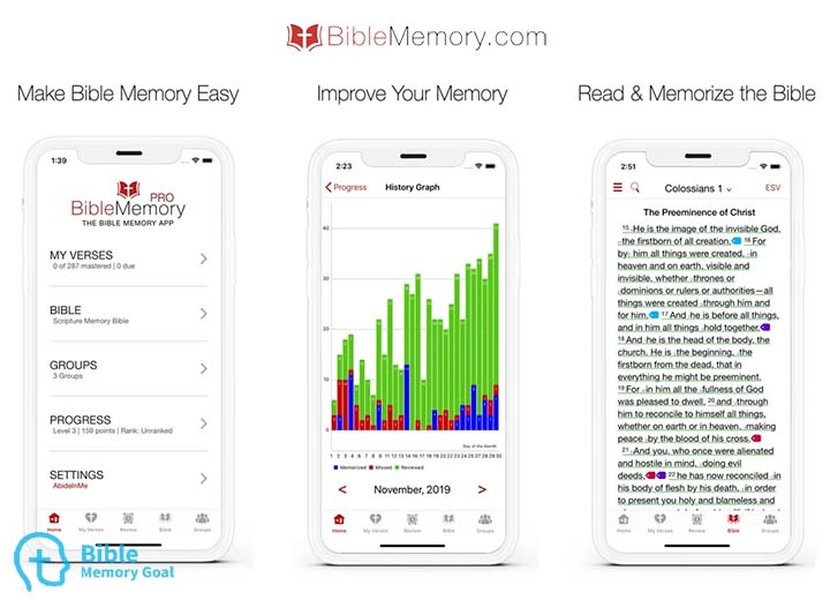
Screenshots illustrating the interactive features of The Bible Memory App.
Remember Me. Bible Memory Joy
With over two million downloads, Remember Me is a highly popular and free Bible memorization app. It supports various Bible translations and offers a fun, faith-building experience through games, audio, and images.
- Multiple input methods: Enter text manually or retrieve verses from a wide range of Bible versions.
- Games and interactive features: Helps make memorization enjoyable and effective.
- Verse collections: Organize your memory verses into collections.
- Progress tracking: Monitor your memorization journey with insightful reports.
- Completely free: No premium features or subscriptions, offering full functionality without cost.
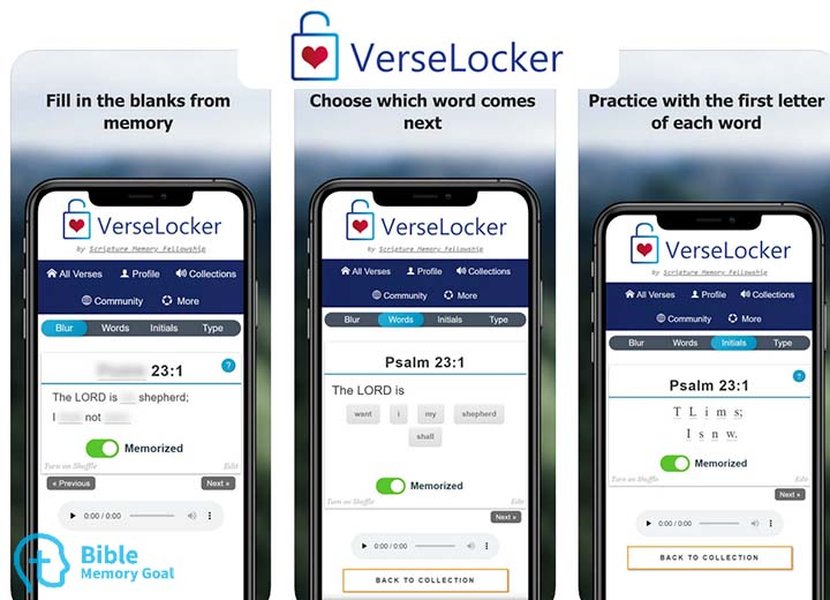
Visuals from the VerseLocker app, highlighting its user-friendly interface.
VerseLocker
VerseLocker is another free app (no premium features or subscriptions) that helps users memorize Bible verses with audio and visual tools. It works with all Bible translations and focuses on practical memorization techniques.
- Audio looping: Listen to verses on repeat.
- Fill-in-the-missing-words: Interactive exercises to test recall.
- Typing from memory: Reinforces memory through active recall.
- Collections and progress tracking: Organize verses and track your learning.
Verses - Bible Memory
Verses offers simple memory games and progress tracking to make Scripture memorization easier and more enjoyable. It has facilitated over 10 million memory games, helping users learn passages perfectly.
- Memory games: Engaging activities to aid memorization.
- Progress tracking: Monitor your memory health over time.
- Type out feature: Helps words stick in memory through active engagement.
Other Notable Apps and Tools
- Anki: While not Bible-specific, Anki is a powerful flashcard system that utilizes spaced repetition, making it highly effective for memorizing anything, including Scripture. The desktop version is free, though the mobile app can be paid.
- Dwell Bible App: Primarily an audio Bible app, Dwell also offers features for listening to Scripture on repeat, which can aid memorization, especially for auditory learners.
- Fighter Verses: Recommended for those who prefer to memorize short, impactful verses, though it may be less intuitive for organizing large quantities.
Choosing Your Best Approach and App
The "best" Bible memorization app and approach ultimately depend on your individual learning style, preferences, and goals. What works for one person may not work for another. It's recommended to experiment with a few methods and apps to find what resonates most with you.
Consider the following when making your choice:
| Factor | Considerations | Why it Matters for Memorization |
|---|---|---|
| Learning Style | Are you a visual, auditory, kinesthetic, or reading/writing learner? | Aligns methods (e.g., audio apps for auditory learners, writing for kinesthetic) to natural strengths. |
| Time Commitment | How much time can you realistically dedicate daily/weekly? | Helps choose methods suitable for short bursts (e.g., app games) or longer, in-depth study (e.g., inductive). |
| Translation Preference | Do you prefer KJV, ESV, NIV, etc.? | Ensures the app supports your preferred Bible version for consistency and familiarity. |
| Technique Preference | Do you prefer typing, listening, flashcards, or writing? | Guides app choice based on integrated features that match your preferred memorization techniques. |
| Cost | Are you looking for free options or willing to pay for premium features? | Determines access to advanced features like customized review schedules, more translations, or specific study tools. |
| Community/Accountability | Do you want to share progress or memorize with a group? | Influences whether to choose an app with social sharing features or to pair app use with an in-person study group. |
Ultimately, the Holy Spirit's enablement and your desire to draw closer to God through His Word are the most crucial elements, regardless of the tools you use. These apps and methods are aids, not substitutes, for a heartfelt pursuit of God's truth.
Frequently Asked Questions
What is the SOAP method of Bible study?
Why is memorizing Scripture important?
Can I memorize the Bible without using apps?
How often should I review memorized verses?
Should I memorize individual verses or longer passages?
Conclusion
Engaging with Scripture through memorization is a transformative practice that can profoundly impact your spiritual life. Whether you prefer traditional methods like repetitive reading and writing, structured study techniques like SOAP or inductive study, or leverage the convenience of modern apps, the goal remains the same: to hide God's Word in your heart. By understanding the context, consistently reviewing, and allowing the Holy Spirit to illuminate the truth, you can effectively internalize Scripture, making it a living and active force in your daily walk with God. Experiment with different approaches and tools to find what best supports your journey of drawing closer to the Lord through His Word.
Recommended Searches
- How to do inductive Bible study effectively
- Benefits of daily Bible reading and meditation
- Bible verses for spiritual growth and encouragement
- How to choose a Bible study method for beginners