
Understanding the Biceps Brachii: A Comprehensive Guide for Massage Therapists
Unlocking the Secrets of the Upper Arm's Most Iconic Muscle
The biceps brachii, often simply referred to as the "biceps," is arguably the most recognizable muscle in the human body. Its prominent position on the anterior aspect of the upper arm makes it a symbol of strength and fitness. However, for a massage therapist, understanding this muscle goes far beyond its visual appeal. The biceps brachii plays a crucial role in the complex movements of the shoulder and elbow joints and can be a significant source of pain and dysfunction if not properly cared for. This report provides a detailed overview of the biceps brachii, covering its anatomy, actions, common issues, and effective techniques for assessment and treatment, all tailored for the massage therapy professional.
Key Insights for Massage Therapists
- Dual-Joint Action: The biceps brachii is a biarticular muscle, meaning it crosses and acts upon both the shoulder and elbow joints, contributing to shoulder flexion, elbow flexion, and forearm supination.
- Common Pain Referral Patterns: Trigger points within the biceps brachii can refer pain to the anterior shoulder and down to the elbow region, often mimicking other conditions like bicipital tendinopathy.
- Integrated Care Approach: Effective treatment involves a combination of techniques, including targeted massage to release tension and address trigger points, alongside stretching and strengthening exercises to restore balance and function.
Anatomical Foundations of the Biceps Brachii
A Detailed Look at its Structure and Heads
The biceps brachii is a large, thick, fusiform muscle located in the anterior compartment of the upper arm. As its name implies, "biceps" (Latin for "two-headed") indicates its two distinct proximal attachments, or heads, which originate from the scapula. These heads merge to form a single muscle belly, creating the characteristic bulge visible when the arm is flexed.
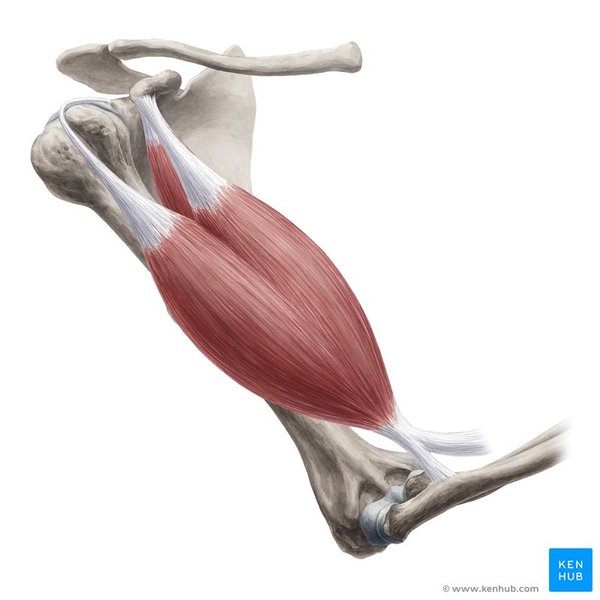
The two heads of the Biceps Brachii muscle, originating from the scapula.
Origin Points: Anchoring the Biceps
- Long Head: Originates from the supraglenoid tubercle of the scapula, a bony projection located just above the glenoid cavity. The tendon of the long head passes through the glenohumeral (shoulder) joint capsule, making it susceptible to conditions like tendinopathy.
- Short Head: Arises from the apex of the coracoid process of the scapula, a curved projection on the anterior side of the scapula.
Insertion Points: Where the Action Ends
Both heads converge to form a single muscle belly, which then tapers into a common distal tendon. This tendon crosses the elbow joint and inserts into the radial tuberosity of the radius bone in the forearm. Additionally, a fibrous membrane known as the bicipital aponeurosis (or lacertus fibrosus) emerges from the distal part of the muscle and inserts into the deep fascia of the forearm.

The precise origin and insertion points of the Biceps Brachii.
Actions and Functional Significance
More Than Just a Show Muscle
The biceps brachii is a versatile muscle, contributing to several key movements of the upper limb. Its biarticular nature allows it to influence both shoulder and elbow mechanics. While often thought of as the primary elbow flexor, it plays a more nuanced role, especially when considering the other muscles in the anterior compartment of the arm.
- Forearm Supination: This is considered its most powerful action, particularly when the elbow is flexed. Supination involves rotating the forearm outwards so that the palm faces upwards.
- Elbow Flexion: The biceps assists in bending the forearm at the elbow joint. While prominent, the brachialis muscle is actually the primary and strongest flexor of the elbow, with the biceps supporting this action, especially when the forearm is supinated.
- Shoulder Flexion: The biceps also assists in flexing the arm at the glenohumeral (shoulder) joint. The long head, in particular, helps to stabilize the humeral head within the shoulder joint.
It's important to note that the biceps brachii works in synergy with other muscles. Its antagonist is the triceps brachii, located in the posterior compartment of the arm, which is responsible for elbow extension.
Innervation and Blood Supply
The Lifelines of the Biceps
Nerve Supply: Musculocutaneous Nerve
The biceps brachii muscle is innervated by the musculocutaneous nerve, which typically arises from spinal nerve roots C5, C6, and C7. This nerve provides the necessary neural input for the muscle to contract effectively. Understanding its innervation is crucial for diagnosing and treating neurological issues that might affect biceps function.
Arterial Supply: Brachial Artery Branches
The blood supply to the biceps brachii primarily comes from the muscular branches of the brachial artery. Adequate blood flow is essential for muscle health, repair, and recovery, especially after strenuous activity or injury.
Palpation: Feeling the Biceps
Locating and Assessing the Muscle
For a massage therapist, effective palpation is fundamental to assessing muscle health and identifying areas of tension or dysfunction. The biceps brachii is relatively easy to palpate due to its superficial location. To locate it:
- Ask the client to gently flex their elbow and supinate their forearm (palm up).
- Place your fingers on the anterior aspect of their upper arm, between the shoulder and the elbow.
- As the client gently resists your pressure or continues to flex, you will feel the muscle belly contract and become prominent.
- You can trace the muscle belly upwards towards the shoulder, feeling for the two heads as they diverge.
- Distally, follow the tendon towards the elbow joint to palpate its insertion into the radial tuberosity.
Pincer palpation can be used to grasp the muscle belly and assess its texture and any areas of tenderness or tightness. Remember to always apply gentle, consistent pressure and communicate with your client to ensure their comfort.
Common Biceps Brachii Issues and Trigger Points
Addressing Pain and Dysfunction
The biceps brachii is susceptible to various conditions, often related to overuse, repetitive motion, or trauma. Massage therapists frequently encounter clients presenting with pain originating from or referred by the biceps.
- Tendinopathy: Inflammation or irritation of the biceps tendons, particularly the long head, is a common overuse injury. This can cause pain in the anterior shoulder and is often seen in athletes performing overhead activities.
- Muscle Strains and Tears: These injuries occur when the muscle-tendon unit is overloaded, leading to anything from minor strains to complete ruptures (e.g., "Popeye deformity" from a ruptured long head tendon).
- Trigger Points: These are hyperirritable spots in a taut band of muscle tissue that can cause localized pain and referred pain to other areas. Trigger points in the biceps brachii commonly refer pain to the anterior shoulder, down the arm, and into the elbow region. This referred pain can sometimes be mistaken for other conditions like medial epicondylitis or bicipital tendinitis.
Therapeutic Approaches for the Biceps Brachii
Massage, Stretching, and Strengthening Strategies
As a massage therapist, your role in addressing biceps brachii issues is multifaceted, involving a combination of hands-on techniques and client education on self-care.
Massage Techniques: Releasing Tension and Promoting Healing
Massage helps to release tension in the biceps muscle, reduce inflammation, improve blood flow, and break down adhesions or scar tissue, thereby stimulating the healing process.
- Stripping the Muscle: Apply gentle, consistent pressure with a tool or your hands along the length of the muscle fibers, moving from origin to insertion (or vice versa). This helps to lengthen and release tight bands.
- Cross-Fiber Friction: Apply short, deep strokes perpendicular to the muscle fibers, especially around tender spots or areas of tendinopathy. This technique can help to realign collagen fibers and improve local circulation.
- Trigger Point Release: Apply sustained pressure to identified trigger points until the tenderness diminishes or dissipates. Incorporating active movement (e.g., gentle elbow flexion and extension while holding pressure) can enhance the release.
When performing massage, always be mindful of the neurovascular bundle (median nerve, musculocutaneous nerve, ulnar nerve, and brachial artery) located medially to the biceps brachii muscle, ensuring it is avoided.
This video demonstrates deep remedial massage techniques for treating biceps dysfunction, which can address shoulder, elbow, and scapula pain.
Stretching the Biceps Brachii: Enhancing Flexibility
Regular stretching helps to maintain muscle length, improve flexibility, and prevent stiffness. Here's a common stretch:
- Wall/Doorway Biceps Stretch: Stand facing a wall or doorway. Extend your arm behind you, placing your palm flat against the wall with your fingers pointing downwards and your arm straight. Gently lean forward or rotate your body away from the arm until you feel a stretch in your biceps and the front of your shoulder. Hold for 20-30 seconds, repeating 2-3 times. Ensure the stretch is gentle and does not cause pain.
Strengthening Exercises: Building Resilience
Balanced strength training is crucial for preventing muscle imbalances and supporting the biceps brachii. While the biceps is heavily involved in daily activities, specific exercises can target it for strengthening:
- Biceps Curls (Dumbbell or Resistance Band): Hold a dumbbell with your palm facing forward (supinated grip). Keeping your elbow close to your side, slowly curl the weight upwards towards your shoulder, squeezing your biceps at the top. Slowly lower the weight back down with control. For resistance bands, stand on the band and hold the handles, performing a similar curling motion. Focus on proper form to avoid overworking other muscles.
Integrating Biceps Care into Practice
Holistic Considerations for Therapists
A comprehensive understanding of the biceps brachii extends beyond its individual anatomy and actions to how it interacts with the entire kinetic chain of the upper limb and shoulder girdle. Massage therapists should consider:
- Postural Assessment: Poor posture can contribute to biceps tension and dysfunction, especially rounded shoulders or forward head posture.
- Adjacent Muscle Assessment: Remember that the biceps works in conjunction with other muscles like the brachialis (the primary elbow flexor), brachioradialis, and coracobrachialis. Assess and treat these muscles as well, as they can also contribute to upper arm and elbow pain. The triceps brachii, as its antagonist, also warrants attention to ensure muscular balance.
- Client Education: Empower clients with knowledge about their body and self-care techniques. Teach them proper stretching, self-massage techniques (e.g., using a massage ball), and the importance of warm-ups and cool-downs.
- Referral: Recognize when a client's condition is beyond the scope of massage therapy and refer them to a medical professional for diagnosis and further treatment. This is particularly important for suspected tendon tears or severe, persistent pain.
Biceps Brachii Performance and Resilience Radar Chart
Visualizing Key Attributes for Therapeutic Focus
This radar chart illustrates various attributes of the biceps brachii muscle, from a therapeutic perspective. It highlights aspects such as its functional importance, susceptibility to injury, responsiveness to treatment, and its role in overall upper limb health. A higher score on a spoke indicates greater significance or characteristic in that area.
Biceps Brachii: Key Anatomical and Clinical Information
A Quick Reference Table for Therapists
This table summarizes essential information about the biceps brachii, providing a concise overview for quick reference during assessment and treatment planning.
| Feature | Description |
|---|---|
| Muscle Type | Skeletal muscle, biarticular, fusiform |
| Location | Anterior compartment of the upper arm, between shoulder and elbow |
| Heads (Origin) | Long Head: Supraglenoid tubercle of scapula Short Head: Coracoid process of scapula |
| Insertion | Radial tuberosity of radius and fascia of forearm (via bicipital aponeurosis) |
| Primary Actions | Powerful forearm supination (especially when elbow flexed) Elbow flexion Assists in shoulder flexion Stabilizes humeral head in shoulder joint |
| Innervation | Musculocutaneous nerve (C5, C6, C7) |
| Blood Supply | Muscular branches of brachial artery |
| Common Pathologies | Tendinopathy (long head), muscle strains/tears, trigger points |
| Referred Pain | Anterior shoulder, down the arm, elbow region |
| Antagonist | Triceps Brachii |
Frequently Asked Questions (FAQ)
What is the primary role of the biceps brachii?
Can biceps pain refer to other areas?
What is the "Popeye deformity"?
Is massage effective for biceps tendinopathy?
Are there other muscles that help with elbow flexion besides the biceps?
Conclusion
The biceps brachii is a fascinating and functionally critical muscle in the human upper limb. For massage therapists, a deep understanding of its anatomy, actions, common pathologies, and effective therapeutic techniques is indispensable. By skillfully applying massage, incorporating stretching, and educating clients on strengthening and self-care, therapists can significantly contribute to the alleviation of pain, restoration of function, and overall well-being of their clients. Recognizing its multi-joint actions and potential for referred pain allows for more precise and effective treatment strategies, making the biceps brachii a rewarding muscle to work with in practice.
Recommended Further Exploration
- Deep dive into brachialis and coracobrachialis muscle anatomy and function.
- Advanced techniques for diagnosing and treating biceps tendinopathy.
- The role of shoulder stability in biceps health and injury prevention.
- Comparative analysis of anterior arm muscle synergies and imbalances.
References
Last updated May 21, 2025