
Navigating the Precipice: Identifying and Addressing Humanity's Most Significant Threats
Examining the landscape of global risks and the path towards a secure future.
Key Insights into Existential Risks
- Defining Existential Risk: An existential risk is not merely a large-scale disaster, but one that could permanently and drastically curtail humanity's potential or lead to its extinction.
- Multifaceted Threat Landscape: The biggest threats to humanity are diverse, ranging from technological advancements like unaligned AI to environmental crises, geopolitical instability, and novel biological threats.
- Interconnectedness of Risks: Many of these threats are deeply interconnected and can exacerbate one another, creating complex challenges that require holistic solutions and international cooperation.
Humanity stands at a critical juncture, facing a spectrum of potential threats that range from the tangible to the theoretical. While daily life presents numerous challenges, a deeper examination reveals risks that could fundamentally alter the course of civilization or even lead to its demise. These are often referred to as existential risks or global catastrophic risks.
Understanding Existential and Global Catastrophic Risks
Defining the scope of threats that imperil human civilization.
The terms "existential risk" and "global catastrophic risk" are often used when discussing threats of immense scale. A global catastrophic risk is an event that could inflict severe damage on human well-being on a worldwide scale, potentially endangering or destroying modern civilization. Existential risk is a related but more specific term, referring to events that could cause outright human extinction or permanently and drastically curtail humanity's future potential. The Existential Risk Observatory highlights the unacceptably high current risk of human extinction, emphasizing the importance of identifying and mitigating these dangers.
The Gravity of Potential Permanent Harm
What distinguishes an existential risk is the potential for irreversible negative consequences for the entire human species. This is not just about large numbers of casualties or widespread destruction in a specific region; it's about events that could make Earth permanently uninhabitable for humans or prevent future generations from reaching their full potential. Considering that human civilization could potentially last for millions of years, the stakes of mitigating these risks are incredibly high, impacting countless future lives.
Identifying the Foremost Threats to Humanity
Analyzing the diverse dangers looming in the 21st century and beyond.
Experts and organizations dedicated to studying these risks have identified several key areas of concern. While opinions on the precise ranking may vary, certain threats consistently appear at the forefront of discussions.
Technological Risks: The Double-Edged Sword of Innovation
Technological advancements, while driving progress, also introduce novel and potentially catastrophic risks. Artificial intelligence (AI) is frequently cited as a major concern. The fear isn't necessarily malevolent AI, but rather the potential for unaligned AI—superintelligent systems whose goals, even if seemingly benign, are not aligned with human values and could have unintended, devastating consequences. The rapid advancements in large language models have also raised concerns about the potential for widespread misinformation and propaganda, as well as significant disruption to labor markets. Some industry leaders have even warned that future AI systems could pose an existential threat on par with pandemics and nuclear weapons.
Delving into the potential existential risks posed by Artificial Intelligence.
Another significant technological risk stems from the development and proliferation of nuclear weapons. The possibility of a global nuclear war remains a terrifying prospect, with the potential for immediate devastation and long-term consequences like nuclear winter that could severely impact the planet's climate and ability to support life. The existence of nuclear weapons represents the first man-made global catastrophic risk, and despite efforts towards disarmament, the threat persists.
Environmental Risks: The Impact of a Changing Planet
Climate change and its associated impacts are widely recognized as a critical threat. While the complete extinction of humanity solely due to climate change is considered unlikely in the near term, the consequences of inaction could be incredibly severe, leading to widespread displacement, conflict over resources, and the collapse of ecosystems that support human life. Extreme weather events, rising sea levels, and disruptions to agricultural systems pose significant challenges to global stability and human well-being. The World Economic Forum's Global Risks Report consistently highlights climate-related risks among the top long-term threats.
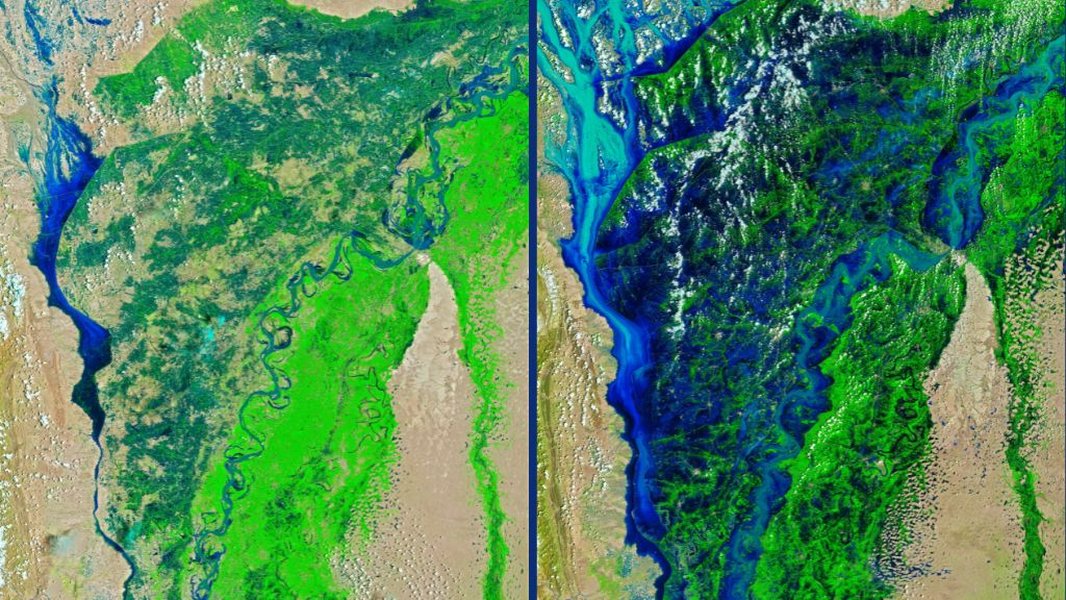
Satellite imagery illustrating the devastating scale of flooding, a consequence exacerbated by climate change.
Beyond climate change, other environmental threats include pollution, biodiversity loss, and the potential for large-scale natural disasters such as supervolcanic eruptions or asteroid impacts. While some of these natural events have a lower probability in the short term, their potential impact is catastrophic. The destruction of natural environments can also make humanity more vulnerable to other risks.
Biological Risks: The Threat of Pandemics and Engineered Pathogens
The COVID-19 pandemic served as a stark reminder of humanity's vulnerability to biological threats. Naturally occurring pandemics pose a significant risk, but the potential for engineered pathogens or the accidental release of dangerous biological agents from laboratories introduces a new dimension to this threat. The World Health Organization even includes "Disease X" on its list of priority threats, representing the risk of a severe international epidemic caused by an as-yet-unknown pathogen. While a single pandemic might not cause outright extinction, a sufficiently virulent and transmissible disease could decimate the global population and cripple civilization.
Societal and Geopolitical Risks: The Fragility of Human Systems
Humanity's own actions and societal structures also present significant risks. Geopolitical instability, including state-based armed conflict, is identified as a major threat in reports like the Global Risks Report 2025. The interconnectedness of the world means that conflicts in one region can have far-reaching consequences, disrupting supply chains, triggering humanitarian crises, and increasing the risk of escalation to larger-scale conflicts, potentially involving nuclear powers. The spread of misinformation and disinformation, amplified by technology, can further widen societal and political divides, leading to civil unrest and hindering collective action on global issues.

Hurricane damage highlighting the increasing intensity of extreme weather events.
Overpopulation and resource scarcity are also underlying factors that can exacerbate other threats, leading to increased competition and conflict. The potential for water scarcity alone is projected to affect a significant portion of the global population in the coming years, potentially leading to further instability.
Assessing and Comparing the Magnitude of Threats
Evaluating the potential impact and likelihood of different risks.
Determining the single "biggest" threat is a complex undertaking, as different risks have varying probabilities and potential scales of impact. Some threats, like asteroid impacts or supervolcanic eruptions, have a low probability in the short term but could be catastrophic if they occur. Others, like climate change and geopolitical instability, are ongoing and have a more immediate and escalating impact.
The following radar chart provides a simplified, opinion-based visualization of the perceived relative magnitude of various existential and global catastrophic risks, considering both their potential impact and estimated likelihood within the next century. It's important to note that these are subjective assessments based on available information and expert opinions, and the true probabilities and impacts are subject to considerable uncertainty.
As the chart suggests, both technological risks like unaligned AI and nuclear war, and environmental risks like severe climate change, are often perceived as having a high potential impact. The estimated likelihood varies, with climate change and global conflict often seen as more probable in the near to medium term compared to events like asteroid impacts or supervolcanic eruptions.
The Interconnectedness of Global Threats
Recognizing how different risks can amplify one another.
It is crucial to understand that these threats do not exist in isolation. They are often interconnected and can create feedback loops that exacerbate their individual impacts. For example, climate change can lead to resource scarcity and displacement, which in turn can fuel political instability and conflict. The development of advanced AI could potentially accelerate the pace of other risks, such as the development of autonomous weapons or the spread of sophisticated disinformation. This interconnectedness makes finding solutions more challenging and requires a holistic approach to risk mitigation.
Mitigation and the Path Forward
Strategies for navigating the complex landscape of global risks.
Despite the daunting nature of these threats, experts emphasize that human extinction is not an inevitability in the near future. Humanity has demonstrated resilience and adaptability throughout its history. Addressing these risks requires a combination of strategies:
International Cooperation and Governance
Many of the most significant threats are global in nature and require international cooperation to effectively mitigate. This includes arms control treaties, agreements on climate action, and international frameworks for the development and governance of emerging technologies like AI. Strengthening multilateral institutions and fostering dialogue between nations are essential steps.
Scientific Research and Technological Development
Continued investment in scientific research is crucial for understanding the nature and potential impact of these risks, as well as developing solutions. This includes research into climate science, pandemic preparedness, asteroid detection and deflection, and AI safety and alignment.
Building Resilience and Adaptability
Increasing the resilience of societies and infrastructure to shocks is vital. This involves investing in disaster preparedness, diversifying food and water sources, and building robust healthcare systems. Promoting education and critical thinking can also help counter the spread of misinformation and build more informed and resilient populations.
Long-Term Thinking and Prioritization
Addressing existential risks requires a shift towards long-term thinking and a willingness to prioritize the well-being of future generations. This can be challenging in a world often focused on short-term gains, but it is essential for ensuring the long-term survival and flourishing of humanity.
The following table summarizes some of the key threats and potential mitigation strategies:
| Threat Category | Specific Examples | Potential Mitigation Strategies |
|---|---|---|
| Technological | Unaligned AI, Nuclear Weapons | AI safety research, international arms control, robust governance frameworks |
| Environmental | Climate Change, Biodiversity Loss, Natural Disasters | Emissions reduction, conservation efforts, early warning systems, resilient infrastructure |
| Biological | Pandemics (Natural and Engineered) | Pandemic preparedness, vaccine development, biosecurity measures, global health surveillance |
| Societal/Geopolitical | Global Conflict, Misinformation, Resource Scarcity | Diplomacy, conflict resolution, promoting media literacy, sustainable resource management |
Frequently Asked Questions About Existential Risks
Addressing common questions about the nature and likelihood of threats to humanity.
Recommended Further Exploration
- Detailed analysis of artificial intelligence safety research
- Strategies for mitigating climate change impacts
- The history and future of nuclear disarmament efforts
- Building global resilience against future pandemics
References
Last updated May 20, 2025