
Unveiling Regular Expressions for Specific Binary Languages
A deep dive into crafting precise patterns for strings composed of {0,1}, tackling substring, subsequence, and complement challenges.
Regular expressions are a powerful tool for defining patterns in strings. When working with a binary alphabet like {0, 1}, they allow us to describe complex languages—sets of strings—with specific properties. Below, we'll explore how to construct regular expressions for three distinct language descriptions, providing both the expression and a clear argument for its correctness.
Essential Insights: Key Takeaways
- Specificity is Key: Crafting regular expressions requires careful consideration of whether a pattern is a contiguous substring or a more flexible subsequence, and whether conditions are inclusive or exclusive.
- Combining Conditions: Multiple criteria, such as a specific ending and a required internal substring, can be addressed by concatenating pattern components that allow for arbitrary intervening characters.
- Complements of Finite Sets: For finite languages, their complement (all strings *not* in the language) is often best expressed by enumerating the allowed strings, especially those of shorter lengths, and then a general pattern for all longer strings.
Decoding Complex String Properties with Regular Expressions
Let's break down each language requirement and construct the appropriate regular expression, justifying each component's role in accurately defining the language.
(a) All strings that end in "010" and contain "000" as a substring
This language requires strings to satisfy two conditions simultaneously: they must terminate with the exact sequence "010", and somewhere within the string, the sequence "000" must appear as a contiguous block of characters (a substring).
The Regular Expression
The regular expression for this language is: (0|1)*000(0|1)*010
Rationale and Construction
This expression is built by ensuring both conditions are met through a sequential structure:
(0|1)*: This initial part matches any sequence of zeros and ones, including an empty sequence. It represents any characters that might appear before the required "000" substring.000: This explicitly matches the required substring "000". Its presence guarantees that the string contains "000".(0|1)*: This second instance of(0|1)*matches any sequence of zeros and ones that might appear after the "000" substring but before the final "010" ending.010: This final part explicitly matches the required ending "010", ensuring the string terminates correctly.
The concatenation of these parts ensures that a string must first allow for any prefix, then contain "000", then allow for any intermediate characters, and finally conclude with "010". For example, the string "1100011010" matches: (11) matches the first (0|1)*, (000) matches 000, (11) matches the second (0|1)*, and (010) matches 010. It's important to note that the "000" substring must appear distinctly before or separate from the "010" ending if they don't naturally overlap to satisfy both (e.g., "00010" works; "000" itself doesn't end in "010").
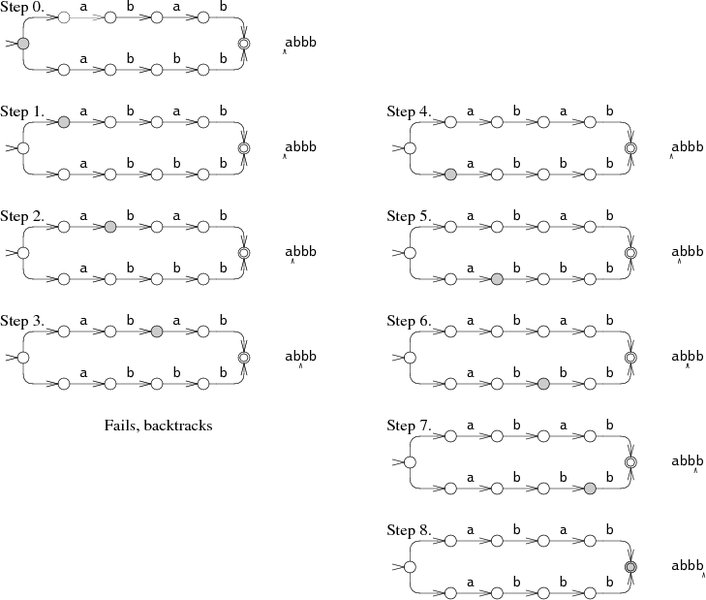
A Non-deterministic Finite Automaton (NFA) illustrates how states and transitions can define patterns, similar to regular expressions.
(b) All strings that do not contain the subsequence "010"
This language includes all binary strings where the characters '0', then '1', then '0' do *not* appear in that order, even if they are not contiguous.
Understanding "Subsequence" vs. "Substring"
A substring requires characters to be adjacent (e.g., "010" in "110101"). A subsequence only requires the characters to appear in the correct order, with any number of other characters (or none) in between (e.g., "010" is a subsequence of "00110" and "010"). The problem specifies "subsequence."
The Regular Expression for No Subsequence "010"
The regular expression for this language is: 1*0*1*
Justification of the Pattern
A string does not contain "010" as a subsequence if and only if it is impossible to find a '0', then later find a '1', and then even later find another '0'. This condition is met by strings that have all their '1's, then all their '0's, then all their '1's again (allowing any of these blocks to be empty).
1*: Matches any number of initial '1's (or none).0*: Matches any number of '0's (or none) following the initial '1's.1*: Matches any number of '1's (or none) following the '0's.
Let's argue why this structure prevents the "010" subsequence:
- If a string is entirely '1's (
1*, with0*being empty), it cannot form "010". - If a string is entirely '0's (
0*, with both1*parts being empty), it cannot form "010". - If a string has '0's and '1's according to
1*0*1*:- To form the subsequence "010", we must pick a '0' (first element). This '0' must come from the middle
0*block. - Next, we must pick a '1' (second element) that appears *after* this '0'. This '1' must come from the final
1*block. - Finally, we must pick another '0' (third element) that appears *after* this '1'. However, in the structure
1*0*1*, there are no '0's after the final1*block begins. All '0's are confined to the middle0*block, which precedes the final1*block.
- To form the subsequence "010", we must pick a '0' (first element). This '0' must come from the middle
Thus, any string matching 1*0*1* cannot contain "010" as a subsequence. Conversely, any string that is *not* of the form 1*0*1* must inherently mix '0's and '1's in a way that will create a "010" subsequence (e.g., "0110", which is not 1*0*1*, contains "010" as 0110 -> pick first 0, then 1, then second 0). Examples of strings in this language: \(\epsilon\) (empty string), "111", "00", "110011", "0111", "1110".
(c) The complement of the language L = {0, 01, 10, 101, 011, 111}
The complement of a language L, denoted \(L^c\), consists of all strings over the given alphabet {0, 1} that are *not* in L. Since L is a finite set of six specific strings, its complement \(L^c\) will contain all other binary strings.
Defining the Complement
\(L^c = \{w \in \{0,1\}^* \mid w \notin L\}\)
We need to find all binary strings except "0", "01", "10", "101", "011", and "111".
The Regular Expression by Enumeration
The regular expression for this complement language is:
\epsilon | 1 | 00 | 11 | 000 | 001 | 010 | 100 | 110 | (0|1)(0|1)(0|1)(0|1)(0|1)*
Breakdown by String Length and Justification
We construct \(L^c\) by considering strings of different lengths:
- Length 0: The empty string, \(\epsilon\). Is \(\epsilon \in L\)? No. So, \(\epsilon \in L^c\). Regex part:
\epsilon(or often implicitly matched if not otherwise specified, but good to be explicit for complements). - Length 1: Possible strings are "0", "1".
- "0" is in L. So, "0" is not in \(L^c\).
- "1" is not in L. So, "1" is in \(L^c\). Regex part:
1.
- Length 2: Possible strings are "00", "01", "10", "11".
- "01" is in L. Not in \(L^c\).
- "10" is in L. Not in \(L^c\).
- "00" is not in L. So, "00" is in \(L^c\).
- "11" is not in L. So, "11" is in \(L^c\). Regex part:
00 | 11.
- Length 3: Possible strings are "000", "001", "010", "011", "100", "101", "110", "111".
- Strings from L: "101", "011", "111". These are not in \(L^c\).
- All other length-3 strings are in \(L^c\): "000", "001", "010", "100", "110". Regex part:
000 | 001 | 010 | 100 | 110.
- Length 4 or more: The language L contains no strings of length 4 or greater. Therefore, *all* binary strings of length 4 or more are in \(L^c\).
- This can be represented as
(0|1)(0|1)(0|1)(0|1)(0|1)*. This means any four characters followed by any sequence of zero or more characters. This covers all strings of length \(\ge 4\).
- This can be represented as
Combining all these parts with the union operator (|) gives the complete regular expression for \(L^c\). Each part precisely describes a set of strings belonging to the complement, and together they cover all possibilities not in L.
Visualizing Language Constraints
A mindmap can help visualize the core requirements for each language problem and how the regular expressions address them.
then All 0s (optional)
then All 1s (optional)"] idB4["Prevents '0' after a '1' that followed an earlier '0'"] idC["(c) Complement of L = {0, 01, 10, 101, 011, 111}"] idC1["Regex: ε | 1 | 00 | 11 | 000 | 001 | 010 | 100 | 110 | (0|1)(0|1)(0|1)(0|1)(0|1)*"] idC2["Constraint: All strings in {0,1}* NOT in the specific finite set L"] idC3["Structure: Enumeration of allowed strings by length"] idC4["Shorter strings listed explicitly;
Longer strings (length ≥4) covered by general pattern"]
This mindmap illustrates that each regular expression is a direct translation of the language's rules into a formal pattern. For problem (a), it's about sequential fulfillment of conditions. For (b), it's about a structural property that inherently avoids the forbidden subsequence. For (c), it's a constructive approach, building the complement piece by piece.
Comparative Analysis of Language Properties
The three language problems present different challenges in terms of how their constraints are expressed. A radar chart can offer a visual comparison of these aspects based on their characteristics.
This chart highlights that Problem (a) involves high positional dependency and specificity. Problem (b) has high exclusion logic due to the "not contain" nature and a surprisingly concise regex once the correct structure for subsequences is known. Problem (c) scores high on specificity and exclusion, with its ease of derivation coming from systematic enumeration, though this leads to a less concise regex.
Tabular Summary of Regular Expressions
Here's a quick reference table summarizing the languages and their corresponding regular expressions:
| Language Description | Regular Expression | Core Idea |
|---|---|---|
| (a) All strings that end in "010" and contain "000" as a substring. | (0|1)*000(0|1)*010 |
Sequential satisfaction: prefix, "000", infix, "010" ending. |
| (b) All strings that do not contain the subsequence "010". | 1*0*1* |
Structural property: all initial 1s, then all 0s, then all final 1s. Prevents "0...1...0" ordering. |
| (c) The complement of the language {0, 01, 10, 101, 011, 111}. | \(\epsilon\) | 1 | 00 | 11 | 000 | 001 | 010 | 100 | 110 | (0|1)(0|1)(0|1)(0|1)(0|1)* |
Enumeration: list all strings not in the finite set, categorized by length. |
This video provides a general tutorial on regular expressions, explaining how they are used to match patterns in text, which is foundational to understanding their application in formal language theory.
Frequently Asked Questions (FAQ)
(0|1)* mean in a regular expression?
Recommended Further Exploration
- How are regular expressions converted to finite automata, and vice versa?
- What are the limitations of regular expressions in describing languages, and what types of languages can they not define?
- Explore advanced regular expression features like lookaheads and lookbehinds for complex pattern matching.
- Investigate the pumping lemma for regular languages and its use in proving a language is not regular.
References
Last updated May 7, 2025