
Unveiling the Crystalline Marvels of Bismuth Vanadate (BiVO4)
A Deep Dive into its Polymorphs, Properties, and Photoelectrocatalytic Promise
Key Insights into BiVO4 Structure
- Polymorphic Diversity: BiVO4 exists in several crystalline forms, with the most significant being monoclinic scheelite, tetragonal scheelite (dreyerite), and orthorhombic (pucherite), each exhibiting distinct structural and electronic properties.
- Monoclinic Scheelite Dominance: The monoclinic scheelite phase (ms-BiVO4) is overwhelmingly preferred for photocatalytic and photoelectrochemical applications due to its optimal band gap (around 2.4-2.5 eV) and superior charge separation efficiency, making it highly effective for visible-light absorption and water splitting.
- Structural-Property Relationship: The precise atomic arrangement, including lattice distortions and the coordination environments of Bismuth (Bi3+) and Vanadium (V5+), directly influences BiVO4's electronic band structure, optical properties, and photocatalytic activity, highlighting the critical role of structural control in its performance.
Bismuth Vanadate (BiVO4) is a fascinating inorganic compound that has garnered significant attention across various scientific and technological domains, particularly in photocatalysis, photoelectrocatalysis, and as a vibrant yellow pigment. Its diverse applications are deeply rooted in its intricate crystal structure and the various polymorphic forms it can adopt. Understanding the structural nuances of BiVO4 is paramount to harnessing its full potential, especially in cutting-edge fields like solar water splitting and environmental remediation.
The Polymorphic Landscape of BiVO4
A Family of Crystal Structures
BiVO4 is known for its rich polymorphism, meaning it can exist in several distinct crystal structures, each with unique atomic arrangements and resulting properties. These polymorphs can occur naturally as minerals or be synthesized in a laboratory under specific conditions. The most commonly recognized phases include:
- Monoclinic Scheelite (Clinobisvanite): This is arguably the most studied and technologically significant polymorph. It crystallizes in the monoclinic C2/c space group (or B2/b in some literature). Its structure is characterized by a layered arrangement containing Bi3+ cations and tetrahedral VO43- anions. The monoclinic scheelite phase is thermodynamically stable at ambient conditions and is highly favored for its superior photoelectrochemical performance, primarily due to its narrow band gap (approximately 2.4-2.5 eV) which allows efficient visible light absorption. This phase exhibits a slight distortion in its crystal structure, which enhances the lone-pair impact of Bi 6s states, contributing to its special optical properties and excellent photocatalytic activities.
- Tetragonal Scheelite (Dreyerite): This polymorph has a tetragonal crystal structure belonging to the I41/amd space group. It can be formed under high-temperature conditions (above 250°C at room pressure) or high-pressure conditions (e.g., 1.6 and 4.3 GPa). While also a scheelite-type structure, its photocatalytic efficiency is generally lower than that of the monoclinic phase, partly due to a wider band gap (around 2.9 eV).
- Orthorhombic (Pucherite): Pucherite is a natural mineral polymorph of BiVO4 with an orthorhombic crystal structure, belonging to the Pnca space group. Its structure involves tetrahedrally coordinated vanadium and eight-fold coordinated bismuth. While it exists naturally, it is less commonly investigated for advanced photocatalytic applications compared to the monoclinic scheelite due to its properties.
- Tetragonal Zircon: Another tetragonal phase exists, often referred to as the tetragonal zircon (t-z) type. This phase is noted for its wide band gap, which typically results in very low photocatalytic performance.
Structural Stability and Transitions
BiVO4 can undergo phase transitions depending on external conditions such as temperature and pressure. For instance, the transition between the monoclinic and tetragonal scheelite phases is ferroelastic, occurring around 528 K (255°C). This transition is suggested to be driven by the lone-pair cation Bi3+, where the Bi-O polyhedron, regular above the transition, becomes significantly distorted below it. The ability to control these phase transitions and stabilize desired polymorphs is crucial for optimizing BiVO4's functional properties.
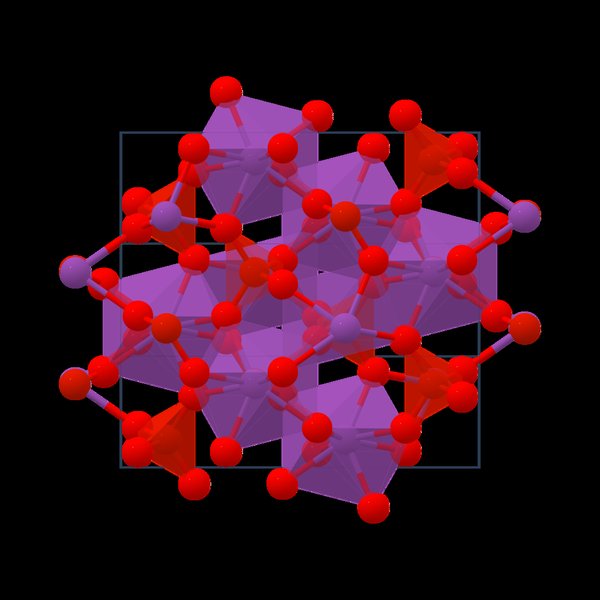
Monoclinic C2/c crystal structure of BiVO4, showcasing the arrangement of Bismuth (purple), Vanadium (grey), and Oxygen (red) atoms.
Atomic Architecture and Electronic Properties
The Interplay of Structure and Functionality
The performance of BiVO4 in applications like photoelectrochemical water splitting is intimately linked to its atomic structure, particularly the coordination environments of Bismuth and Vanadium, and how these influence its electronic band structure. In the monoclinic scheelite phase, V5+ is typically bonded in a tetrahedral geometry to four O2- atoms. Bi3+ is eight-fold coordinated to oxygen atoms, and its lone-pair electrons play a critical role in the material's properties.
Band Structure and Charge Carrier Dynamics
BiVO4 is classified as a direct band gap semiconductor, despite its band extrema being away from the Brillouin zone center. The band gap of monoclinic BiVO4 is approximately 2.4-2.5 eV, enabling it to absorb visible light effectively. The electronic structure reveals that coupling between Bi 6s and O 2p orbitals forces an upward dispersion of the valence band, while coupling between V 3d, O 2p, and Bi 6p orbitals lowers the conduction band minimum. This unique electronic configuration is essential for efficient charge separation and transport, which are critical for photocatalytic activity.
- Valence Band (VB): Primarily formed by O 2p states, with significant contributions from Bi 6s states.
- Conduction Band (CB): Dominated by V 3d states, with contributions from Bi 6p states.
Efficient charge separation is crucial for BiVO4's photoelectrochemical performance. Studies show that spatial separation of photogenerated electrons and holes can occur between different crystal facets, such as the (040) and (200) facets of BiVO4 nanocrystals. The efficiency of this separation is directly dependent on the facet proportion, with theoretical simulations indicating that the matching degree of charge collection length and crystal configuration is a major determining factor.
Lattice Distortion and Doping Effects
Lattice distortion, often induced by doping with elements like molybdenum (Mo), tungsten (W), or zirconium (Zr), can significantly promote carrier separation and enhance the photoelectrochemical water splitting performance of BiVO4 photoanodes. Doping can create n-type conductivity, similar to how Mo and W doping affects the monoclinic scheelite crystal. For example, W-doped BiVO4 has been shown to improve carrier dynamics and photoelectrochemical properties. Oxygen vacancies can also induce lattice strain, further boosting charge separation.
Surface Chemistry and Morphology
Impact on Catalytic Performance
Beyond the bulk crystal structure, the surface chemistry and morphology of BiVO4 nanoparticles and films profoundly influence their performance, particularly in photocatalysis and photoelectrocatalysis. The surface electronic properties and atomic structure of monoclinic BiVO4 are particularly favorable for various catalytic approaches.
- Morphology Control: The morphology of BiVO4 films can vary from square and flake nanoparticles to irregular hexagonal shapes, depending on the deposition substrate (e.g., YSZ (001) vs. YSZ (111)). Controlling the morphology, including aspects like particle size, shape, and exposed facets, is essential for optimizing its physical and chemical properties for specific applications.
- Surface Facet Engineering: Crystal facet engineering is a powerful strategy to modulate charge separation behavior in semiconductor photocatalysts. For BiVO4, precise control over facet proportions, such as the (040)/(200) facets, directly impacts charge separation efficiency.
- Surface Passivation and Cocatalysts: Detrimental surface states can inhibit the performance of BiVO4 photoanodes. Strategies like surface passivation with organic molecules (e.g., 1,3,5-benzenetricarboxylic acid) or the addition of cocatalysts (e.g., single-atomic-Co or iron oxyhydroxide) can improve charge transfer, accelerate interfacial reaction kinetics, and enhance stability.
Applications Driven by Structure
From Pigments to Photoelectrochemical Cells
The diverse structural forms of BiVO4 dictate its suitability for a wide range of applications:
| Polymorph | Crystal Structure | Key Properties | Primary Applications |
|---|---|---|---|
| Monoclinic Scheelite (Clinobisvanite) | Monoclinic (C2/c or B2/b) | Direct band gap (2.4-2.5 eV), excellent visible light absorption, high charge separation efficiency, thermodynamically stable at ambient conditions. | Photoelectrochemical water splitting (photoanodes), photocatalysis, solar energy conversion, pigments (bright yellow with greenish tint). |
| Tetragonal Scheelite (Dreyerite) | Tetragonal (I41/amd) | Wider band gap (approx. 2.9 eV), formed under high pressure/temperature. | Less active for visible-light photocatalysis compared to monoclinic, used in some pigment formulations. |
| Orthorhombic (Pucherite) | Orthorhombic (Pnca) | Naturally occurring mineral, tetrahedrally coordinated V, eight-fold coordinated Bi. | Primarily of mineralogical interest; limited advanced applications compared to synthetic polymorphs. |
| Tetragonal Zircon | Tetragonal | Wide band gap. | Very low photocatalytic performance; primarily academic interest in phase transitions. |
The application of BiVO4 in photoelectrochemical water splitting is a prime example of its structural advantages. Its favorable valence and conduction band positions, combined with its ability to absorb visible light, make it an attractive candidate for converting solar energy into chemical fuels. However, challenges such as poor charge transport, low charge carrier mobility, and high charge recombination rates necessitate sophisticated interface regulation strategies and lattice engineering to achieve high efficiencies and long-term stability.
Visualizing BiVO4's Performance Potential
A Comparative Radar Chart of Polymorphic Strengths
To further illustrate the distinct advantages of the various BiVO4 polymorphs, particularly in the context of advanced energy applications, the following radar chart provides a comparative overview of their perceived strengths based on current research and understanding. This chart highlights why monoclinic scheelite BiVO4 stands out in areas critical for photocatalytic and photoelectrochemical processes.
As illustrated, the monoclinic scheelite phase consistently outperforms other polymorphs across critical metrics for photocatalytic and photoelectrochemical applications, such as visible light absorption and charge separation efficiency. The tetragonal scheelite and orthorhombic phases, while important for fundamental understanding, generally show lower performance in these areas, often due to their wider band gaps or less favorable electronic structures.
Understanding Crystal Structures
A Foundation in Materials Science
For a deeper understanding of how crystal structures are characterized and refined, especially for complex materials like BiVO4, techniques such as X-ray diffraction (XRD) and Rietveld refinement are indispensable. These methods allow researchers to determine lattice parameters, space groups, and atomic positions with high precision. The following video provides a practical insight into refining crystal structures, which is directly applicable to studies on BiVO4:
This video demonstrates the Rietveld refinement technique, which is crucial for determining the precise crystal structure of materials like BiVO4 from X-ray diffraction data.
Rietveld refinement is a powerful tool used to analyze powder diffraction data, allowing for the determination of various structural parameters, including lattice constants, atomic positions, and crystallite size. This technique is vital for confirming the phase purity and structural modifications in doped BiVO4, providing insights into how dopants are incorporated into the crystal lattice and affect its properties.
Frequently Asked Questions about BiVO4 Structure
What is BiVO4 and why is its structure important?
What are the main polymorphic forms of BiVO4?
Which BiVO4 polymorph is best for photocatalysis and why?
How do doping and lattice distortion affect BiVO4's structure and performance?
Can BiVO4 undergo phase transitions?
Conclusion: The Structural Foundation of BiVO4's Versatility
The structural characteristics of Bismuth Vanadate are at the heart of its widespread utility, particularly in the realm of sustainable energy and environmental applications. Its polymorphic nature, with the monoclinic scheelite phase standing out for its optimized electronic and optical properties, provides a versatile platform for scientific exploration and technological innovation. The intricate interplay between atomic arrangement, lattice distortions, and surface chemistry profoundly dictates BiVO4's efficiency in processes like visible light absorption, charge separation, and water oxidation. Continued research into structural engineering, precise control over synthesis parameters, and novel doping strategies will undoubtedly unlock further advancements, positioning BiVO4 as a cornerstone material for addressing global challenges in energy and catalysis.
Recommended Further Queries
- Explore the detailed mechanism of photoelectrochemical water splitting using Bismuth Vanadate.
- Investigate advanced doping strategies employed to boost the efficiency of BiVO4.
- Delve into the impact of surface facet engineering on BiVO4 nanocrystals.
- Understand various synthesis methods and how they control BiVO4 morphology.