
Unlocking Bitcoin and Blockchain: Your Journey from Curious Beginner to Informed Expert
A step-by-step guide to understanding the revolutionary technologies of Bitcoin and its underlying blockchain.
Welcome! If you're looking to understand Bitcoin (BTC) and the intricate workings of blockchain technology, you've come to the right place. This guide is designed to take you from the foundational concepts to more advanced topics, building your knowledge progressively. Our goal is to equip you with the understanding needed to embark on your journey toward becoming an expert in this fascinating field.
Key Highlights to Get You Started
- Bitcoin is a decentralized digital currency, meaning it operates without a central authority like a bank, enabling peer-to-peer transactions globally.
- Blockchain is the foundational technology for Bitcoin, acting as a secure, transparent, and immutable distributed ledger that records all transactions in blocks.
- Understanding mining, cryptography, and consensus mechanisms is crucial to grasping how the Bitcoin network remains secure and functional.
Chapter 1: The Absolute Basics – Untangling Bitcoin and Blockchain
Let's start with the fundamental building blocks, using simple terms and analogies to make these concepts approachable.
What is Bitcoin (BTC)? The Digital Cash Revolution
Bitcoin, often abbreviated as BTC, is a form of digital money. It was introduced in 2008 by an anonymous individual or group known as Satoshi Nakamoto, with its network launching in 2009. Unlike traditional currencies issued by governments (like the US Dollar or the Euro), Bitcoin is decentralized. This means it's not controlled by any single bank, government, or company. Instead, it operates on a peer-to-peer network, allowing users to send and receive value directly with one another across the globe, quickly and with potentially lower fees, without needing intermediaries.
Think of Bitcoin as "digital cash" that exists only in the digital realm. Its value fluctuates based on supply, demand, and market sentiment, much like stocks or commodities.
What is Blockchain? The Trust Machine Behind Bitcoin
Blockchain is the groundbreaking technology that makes Bitcoin possible. At its heart, a blockchain is a distributed, digital ledger—essentially a record book. Imagine a Google Doc or a shared spreadsheet that is duplicated and spread across thousands of computers (called "nodes") worldwide.
This ledger is composed of a continuously growing list of records, called "blocks," which are linked together securely using cryptography. Each block contains a batch of transactions. Because this ledger is distributed and cryptographically secured, it's incredibly difficult to tamper with. Once a transaction is recorded on the blockchain, it cannot be altered or deleted, making it an immutable and transparent record-keeping system.
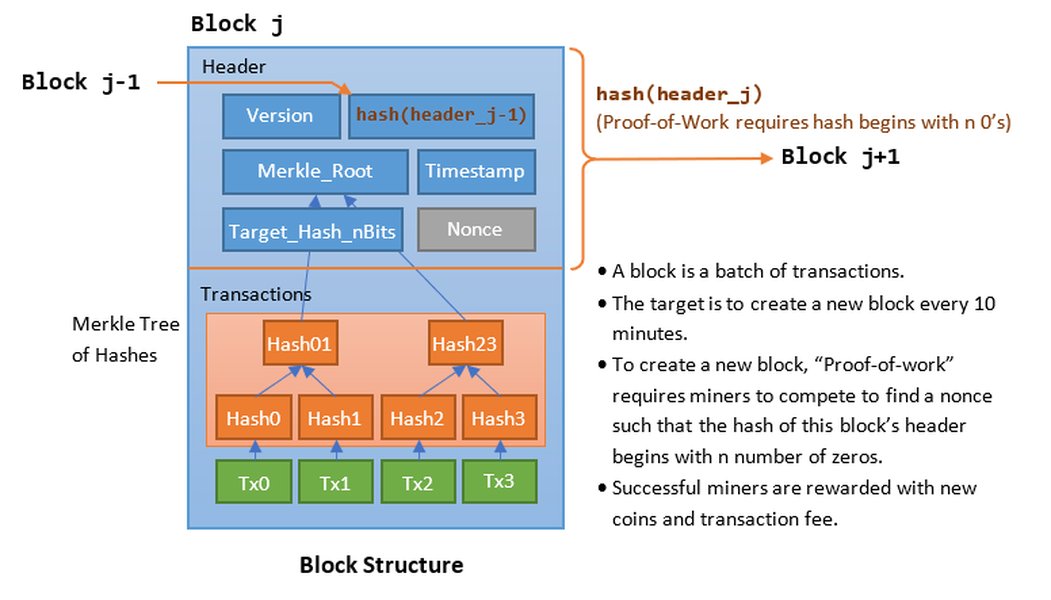
Visual representation of how blocks are linked in a chain using cryptographic hashes.
Chapter 2: Peeking Under the Hood – How Blockchain Works
Now that you have a basic idea, let's delve deeper into the mechanics of blockchain technology.
The Anatomy of a Block: Building the Chain
Each "block" in the blockchain contains three main components:
- Data: For Bitcoin, this data primarily consists of a list of verified transactions (e.g., sender, receiver, amount of BTC transferred).
- A Hash: This is like a unique digital fingerprint for the block. It's a string of characters generated from the block's content. If any data within the block changes, the hash changes.
- The Hash of the Previous Block: This is crucial. By including the previous block's hash, each block is cryptographically linked to the one before it, forming a "chain." This linkage is what makes the blockchain secure.
The Genesis Block: Where It All Begins
The very first block in any blockchain is called the "Genesis Block." It's unique because it doesn't have a preceding block to link to. For Bitcoin, its Genesis Block was created by Satoshi Nakamoto in January 2009.
Immutability and Transparency: A Ledger You Can Trust
Immutability means that once data is recorded on the blockchain, it cannot be practically changed or deleted. If someone tried to alter a transaction in an old block, that block's hash would change. Since the next block contains the original hash of the (now-altered) block, this discrepancy would break the chain, and the network would immediately recognize the tampering attempt.
Transparency means that (for public blockchains like Bitcoin's) anyone can view the transactions recorded on the ledger. While real-world identities are not directly linked to Bitcoin addresses (providing pseudonymity), the flow of transactions is open for public scrutiny using tools called block explorers.
Decentralization: Power to the People (Nodes)
As mentioned, the blockchain ledger isn't stored in one central place. Instead, identical copies are maintained by numerous computers (nodes) participating in the network. This decentralization ensures that:
- There's no single point of failure. If one node goes offline, the network continues to operate.
- It's resistant to censorship. No single entity can unilaterally decide to block or reverse transactions.
- It enhances security, as a malicious actor would need to control a majority of the network's computing power (a "51% attack") to compromise it, which is extremely difficult and expensive for large networks like Bitcoin.
Chapter 3: Making Bitcoin Move – Transactions Explained
Understanding how Bitcoin transactions occur is key to understanding its practical use.
Your Digital Keys: Bitcoin Wallets
To send or receive Bitcoin, you need a Bitcoin wallet. A wallet is a digital tool (software, hardware, or even paper) that stores your Bitcoin and interacts with the Bitcoin network. Crucially, it manages your cryptographic keys:
- Public Key: This is derived from your private key and is used to generate Bitcoin addresses. A Bitcoin address is like your bank account number or email address; you share it with others to receive Bitcoin. You can have many public addresses linked to a single wallet.
- Private Key: This is a secret, complex string of characters that grants access to your Bitcoins. It's used to "sign" (authorize) transactions you send. Your private key must be kept absolutely secret; anyone who knows it can control your Bitcoin.
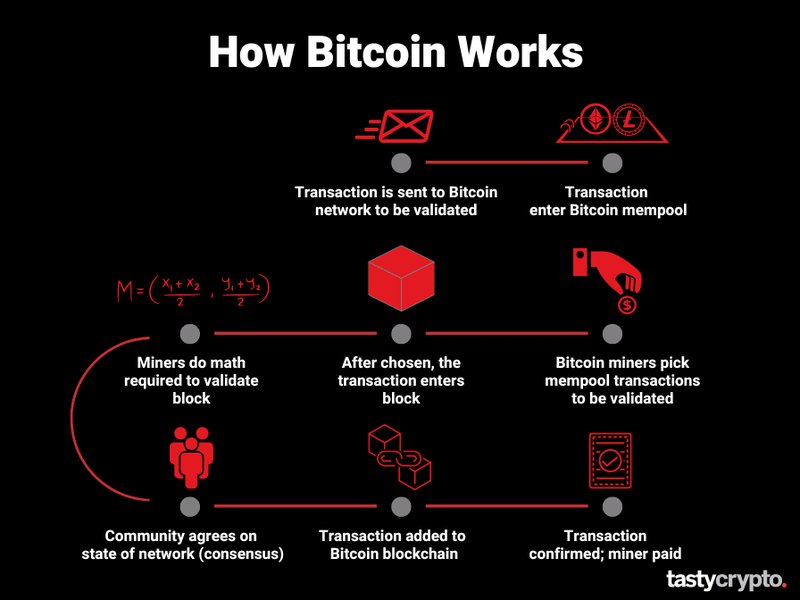
An overview of how Bitcoin transactions are initiated, verified, and added to the blockchain.
The Journey of a Bitcoin Transaction
When you want to send Bitcoin, the process generally follows these steps:
- Initiation: You use your Bitcoin wallet to specify the recipient's Bitcoin address and the amount of BTC you want to send.
- Signing: Your wallet software uses your private key to digitally "sign" the transaction. This signature proves that you own the Bitcoin being sent and authorize the transfer, without revealing your private key.
- Broadcasting: The signed transaction is broadcast to the Bitcoin network, reaching various nodes.
- Verification & Mining: Special nodes called "miners" pick up pending transactions. They verify their legitimacy (e.g., checking if the sender has enough funds and if the signature is valid). Valid transactions are then bundled into a new block.
- Confirmation: Once a miner successfully adds this new block to the blockchain, the transactions within it are considered "confirmed." More confirmations (i.e., more blocks added after your transaction's block) increase the transaction's security and finality. Typically, 6 confirmations are considered very secure.
Chapter 4: The Engine Room – Mining and Achieving Consensus
Mining is a critical process in the Bitcoin network, responsible for both creating new Bitcoins and securing the blockchain.
What is Bitcoin Mining? Securing the Network and Creating Coins
Bitcoin mining is the process by which new Bitcoin transactions are verified and added to the blockchain as new blocks. It is also the mechanism through which new Bitcoins are introduced into circulation. Miners are individuals or entities who dedicate computing power to this task.
Proof of Work (PoW): The Great Digital Puzzle
Bitcoin uses a consensus mechanism called Proof of Work (PoW). To add a new block to the blockchain, miners must solve a complex cryptographic puzzle. This involves:
- Taking a collection of unconfirmed (but verified) transactions.
- Adding a random piece of data called a "nonce."
- Repeatedly hashing this data until they find a hash that meets specific criteria set by the network (e.g., it must start with a certain number of zeros).
This process is essentially a computational race. It requires significant processing power and, consequently, consumes a substantial amount of electricity. The "work" is the computational effort expended to find the correct nonce. The "proof" is the resulting hash that meets the criteria, which is easy for other nodes to verify.
Rewards and Incentives: Why Miners Mine
Miners are incentivized to perform this work for two reasons:
- Block Reward: The first miner to successfully solve the puzzle and add a new block to the blockchain receives a reward in the form of newly minted Bitcoins. This is how new BTC enters the system. Initially, this reward was 50 BTC per block.
- Transaction Fees: Miners also collect transaction fees voluntarily included by users who initiate transactions. Higher fees can incentivize miners to prioritize including a transaction in a block.
The block reward is subject to a "halving" event approximately every four years (or every 210,000 blocks). The most recent halving occurred in 2024, reducing the block reward to 3.125 BTC. This gradual reduction in new supply is designed to control inflation and mimics the scarcity of precious metals like gold. Bitcoin has a finite supply capped at 21 million coins, expected to be fully mined around the year 2140.
Mining Difficulty: Keeping the Rhythm
The Bitcoin network automatically adjusts the difficulty of the cryptographic puzzle approximately every 2016 blocks (roughly every two weeks). The goal is to maintain an average block creation time of around 10 minutes. If blocks are being found too quickly (more computing power joins the network), the difficulty increases. If they are found too slowly, it decreases.
Comparing Bitcoin and Blockchain: Key Distinctions
While interconnected, Bitcoin and blockchain are not the same. This table highlights their main differences and relationships:
| Feature | Bitcoin (BTC) | Blockchain |
|---|---|---|
| Definition | A decentralized digital currency. | A distributed ledger technology. |
| Primary Purpose | To serve as a peer-to-peer electronic cash system; a store of value. | To provide a secure, transparent, and immutable way to record transactions or data. |
| Nature | An application or use case of blockchain technology. | The underlying infrastructure or platform. |
| Token/Coin | BTC is the native token used for transactions and rewards. | Does not inherently have its own coin unless designed for a specific cryptocurrency (like Bitcoin's blockchain). |
| Scope | Primarily financial transactions. | Can be used for various applications beyond finance (e.g., supply chain, voting, healthcare). |
| Creator | Satoshi Nakamoto (pseudonym). | Conceptualized as part of Bitcoin's design by Satoshi Nakamoto; now developed for many other uses. |
Chapter 5: Visualizing the Ecosystem – Key Components at a Glance
To help you connect these concepts, here’s a mindmap illustrating the core components of Bitcoin and blockchain technology.
Connecting the Dots: A Bitcoin and Blockchain Mindmap
This mindmap provides a high-level overview of how different aspects of Bitcoin and blockchain interrelate, from fundamental definitions to operational mechanics and security features.
This visual map should help solidify your understanding of how these complex pieces fit together to form a cohesive system.
Chapter 6: The Pillars of Trust – Security in the Bitcoin Ecosystem
The security of Bitcoin and its blockchain relies on several interconnected principles.
Cryptography: The Language of Security
Cryptography is fundamental to Bitcoin's security:
- Hashing: As discussed, cryptographic hash functions (like SHA-256 used by Bitcoin) create unique fingerprints for blocks and link them securely. They also play a role in generating Bitcoin addresses.
- Digital Signatures: Using public-key cryptography, digital signatures ensure that only the owner of the private key can authorize transactions from their wallet. This verifies authenticity and integrity.
Consensus Mechanisms: Agreeing on the Truth
A consensus mechanism is a protocol that allows all participants in a distributed network to agree on the current state of the ledger. For Bitcoin, Proof of Work is the chosen mechanism. It ensures that all nodes agree on which transactions are valid and which blocks should be added to the chain, preventing issues like "double-spending" (spending the same Bitcoin twice).
Comparing Consensus: A Look at Different Approaches
While Bitcoin uses Proof of Work, other blockchains utilize different consensus mechanisms. Each has its own trade-offs in terms of security, scalability, energy efficiency, and decentralization. The radar chart below offers a comparative overview of some common mechanisms based on general perceptions and design goals.
This chart visually represents the perceived strengths and weaknesses of different consensus mechanisms. For example, PoW is often lauded for its high security and decentralization but criticized for low energy efficiency. PoS aims to improve energy efficiency and scalability, potentially at some cost to decentralization or security complexity.
Chapter 7: Beyond Currency – The Expanding Universe of Blockchain
While Bitcoin was the first major application, blockchain technology's potential extends far beyond digital currencies.
Smart Contracts: Self-Executing Agreements
Smart contracts are self-executing contracts with the terms of the agreement directly written into code. They run on a blockchain, meaning they are stored on a decentralized network and execute automatically when predefined conditions are met. Ethereum is the most well-known platform for smart contracts. These can automate processes, reduce the need for intermediaries, and enhance transparency in agreements ranging from financial derivatives to insurance claims.
Transforming Industries: Diverse Blockchain Use Cases
Blockchain technology is being explored and implemented in various sectors:
- Supply Chain Management: Tracking goods from origin to consumer, enhancing transparency, and reducing fraud.
- Healthcare: Securely managing patient records, streamlining insurance claims, and tracking pharmaceuticals.
- Voting Systems: Creating more transparent and tamper-proof election processes.
- Identity Verification: Enabling secure and user-controlled digital identities.
- Intellectual Property: Protecting and managing copyrights and patents.
- Web3: Forming a foundational layer for the next iteration of the internet, emphasizing decentralization, user ownership of data, and token-based economies.
Chapter 8: Level Up Your Expertise – Advanced Concepts to Master
As you delve deeper, certain technical concepts become crucial for a comprehensive understanding.
Deeper Dives into Bitcoin's Technology
- Merkle Trees: Bitcoin blocks use Merkle trees to efficiently summarize and verify all transactions within a block. This allows for quick verification of transaction inclusion without needing to download the entire block.
- Bitcoin Script: A simple, stack-based programming language used in Bitcoin transactions. It allows for basic programmable logic, defining how Bitcoins can be spent (e.g., requiring multiple signatures for a transaction).
Network Dynamics: Forks and Upgrades
Blockchains can undergo changes or "forks."
- Soft Forks: Backward-compatible upgrades to the protocol.
- Hard Forks: Non-backward-compatible changes that can lead to a permanent split in the blockchain, potentially creating a new cryptocurrency (e.g., Bitcoin Cash, which forked from Bitcoin).
Understanding forks is key to understanding network evolution and governance debates within cryptocurrency communities.
The Scalability Challenge: Striving for Efficiency
One of the major challenges for Bitcoin (and many other blockchains) is scalability—the ability to handle a large number of transactions per second. Bitcoin's current capacity is around 3-7 transactions per second, far less than traditional payment systems like Visa.
Solutions are being developed and implemented, such as:
- Layer-2 Solutions: Protocols built "on top" of the main blockchain. The Lightning Network is a prominent example for Bitcoin, enabling faster and cheaper off-chain transactions that are later settled on the main blockchain.
Chapter 9: Navigating the Landscape – Challenges and Considerations
Despite its innovations, Bitcoin and blockchain technology face several challenges.
The Double-Edged Sword: Price Volatility
Bitcoin's price is notoriously volatile, experiencing significant swings in short periods. This makes it a risky investment for some and can hinder its adoption as a day-to-day currency.
The Energy Debate: Environmental Impact of Mining
The Proof of Work mining process, especially for Bitcoin, consumes a vast amount of electricity, leading to environmental concerns. The debate continues on the sustainability of PoW and the potential for more energy-efficient consensus mechanisms or greener mining practices.
The Evolving Regulatory Scene
Governments and regulatory bodies worldwide are still developing frameworks for cryptocurrencies and blockchain technology. Regulatory uncertainty can impact adoption, investment, and innovation in the space. As of 2025, developments like the approval of Bitcoin ETFs in some jurisdictions have increased mainstream exposure but also brought more regulatory scrutiny.
Chapter 10: Your Path to Mastery – Practical Steps Forward
Becoming an expert is a journey of continuous learning and practical application.
Hands-On Learning and Continuous Study
- Get a Wallet: Set up a Bitcoin wallet (start with a reputable software wallet) and experiment with very small amounts to understand how transactions work.
- Use Block Explorers: Websites like Blockchain.com or Blockchair allow you to view real-time Bitcoin transactions and blocks. This provides a practical view of the blockchain in action.
- Read the Bitcoin Whitepaper: Satoshi Nakamoto's original paper, "Bitcoin: A Peer-to-Peer Electronic Cash System," is a foundational document.
- Follow Reputable Sources: Stay updated with news, research, and educational content from trusted industry publications, academic institutions, and development communities.
- Engage with Communities: Participate in forums, online groups, or local meetups to learn from others and discuss developments.
- Consider Technical Learning: If interested, explore coding tutorials related to blockchain development (e.g., Solidity for Ethereum smart contracts, or even simple blockchain prototypes in Python).
Chapter 11: Understanding Bitcoin and Blockchain Visually
Sometimes, a visual explanation can make complex topics much clearer. The following video provides an excellent breakdown of how Bitcoin fundamentally works.
"But how does bitcoin actually work?" by 3Blue1Brown
This video elegantly explains the cryptographic principles behind Bitcoin, including hash functions, digital signatures, and the concept of the distributed ledger. It's highly recommended for grasping the mathematical and conceptual underpinnings that make Bitcoin secure and functional, without getting overly technical initially, yet providing depth for those keen to learn more.
Frequently Asked Questions (FAQ)
Is Bitcoin anonymous?
Can the blockchain be hacked?
What's the difference between Bitcoin and other cryptocurrencies (altcoins)?
Why is Bitcoin valuable?
How are new Bitcoins created?
Conclusion: Your Expert Journey Begins Now
Understanding Bitcoin and blockchain is like learning a new language—it takes time, patience, and consistent effort. You've now covered the essential vocabulary and grammar, from the basic definitions of Bitcoin as a decentralized currency and blockchain as its underlying ledger, through the mechanics of transactions, mining, and security, to advanced concepts and broader applications.
The world of digital assets and distributed ledger technology is dynamic and constantly evolving. By building on this foundational knowledge, engaging with practical applications, and staying curious, you are well on your way to navigating this exciting field with confidence and insight. Your journey to expertise has truly begun.
Recommended Further Exploration
To continue deepening your understanding, consider exploring these related queries:
- What are the differences between Proof of Work and Proof of Stake consensus mechanisms?
- How do smart contracts on Ethereum work in detail?
- What is the Lightning Network and how does it improve Bitcoin scalability?
- Explore the history and evolution of cryptographic hash functions.
References
 aws.amazon.com
Last updated May 21, 2025